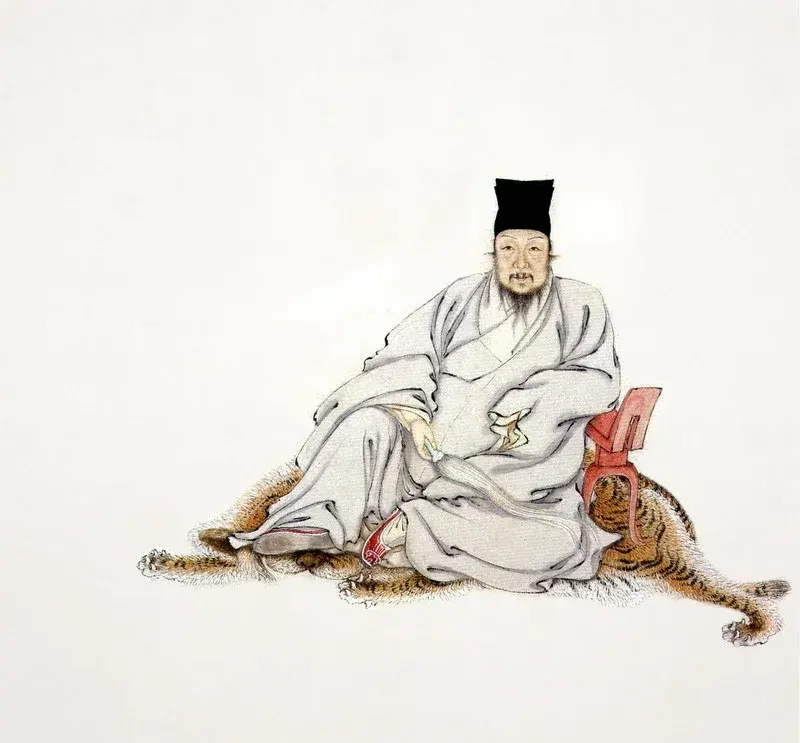
Biography
Auspicious Birth and Studies in Yunjian
On July 12, 1608, Chen Zilong was born in Huating County, Songjiang Prefecture, South Zhili. His father, Chen Suowen, was a 1589 jinshi who rose to Right Vice Minister of Works and was celebrated for his profound classical erudition. According to tradition, on the night of Chen Zilong's birth, his mother dreamed of a golden dragon coiling on the bedchamber wall with dazzling brilliance, prompting his father to name him "Zilong" (Son of the Dragon).
Chen Zilong showed remarkable intellectual prowess from an early age, possessing an extraordinary photographic memory. Nurtured by an upright family environment, he composed antithetical couplets at age seven and read the classical canons and dynastic histories by age ten. Because he was somewhat frail in boyhood, his father engaged prominent scholars to tutor him in ancient prose while having him practice horsemanship and swordsmanship, hoping he would excel in both civil and military arts.
During the Tianqi reign, the eunuch Wei Zhongxian dominated the imperial court, launching brutal persecutions against Donglin scholars. Witnessing factional tyranny and imperial decline in the Jiangnan region, Chen Zilong harbored deep sorrow and resolved to rescue the dynasty. In 1624, he formed close friendships with talented youths in the prefecture including Xia Yunyi, Xu Fuyuan, Peng Shichao, Zhou Libin, and Song Zhengbi. Meeting frequently at ancient temples outside Songjiang, they examined historical causes of dynastic decay and vigorously debated state affairs, laying the core foundation for a formidable political and literary circle.
In 1628, the Jiangxi scholar Ai Nanying traveled south to Suzhou. Hearing this, the spirited young Chen Zilong intercepted Ai Nanying's boat at Suzhou's walls, engaging in rigorous debates on classical prose methods and statecraft over several days. Chen Zilong's expansive grasp of national strategic challenges and effortless eloquence deeply impressed Ai Nanying, winning Chen instant literary renown across Jiangnan.
Leading the Ji She and Advocating Practical Statecraft
In 1629, Chen Zilong joined Xia Yunyi, Du Linzheng, Zhou Libin, Xu Fuyuan, and Peng Bin to formally establish the Ji She (Incipience Society) in Songjiang. The name was drawn from the Book of Changes passage regarding understanding incipience and seizing the initiative, signifying a commitment to anticipate national crises and employ practical learning for the common welfare. The six founders were honored across Jiangnan as the "Six Gentlemen of the Ji She."
Unlike many late Ming literary groups obsessed with rigid eight-legged examination essays or dissipated entertainment in Nanjing pleasure quarters, Chen Zilong sought to purge frivolous and superficial tendencies. At the time, degenerate currents of Wang Yangming's School of Mind dominated Jiangnan, with scholars indulging in abstract discourse on innate moral knowledge while completely ignorant of practical administration, military logistics, and penal law. Chen Zilong denounced this detachment, loudly calling on scholars to leave their studies and confront urgent dynastic perils.
He took the lead in championing practical statecraft within the society, urging members to master astronomy, hydraulics, salt and iron administration, fiscal taxation, border fortifications, and military tactics alongside classical prose. He frequently gathered colleagues to analyze the Later Jin threat in Liaodong and peasant insurgencies in Shaanxi, drafting actionable policy essays.
In 1632, Chen Zilong and fellow society members published the Jishe Renshen Wenxuan, setting a new model for examination prose centered on realistic governance. In the spring of 1633, he participated in the grand Tiger Hill gathering in Suzhou, formalizing an alliance with Zhang Pu's Fu She (Restoration Society) and becoming one of the most prominent leaders of progressive literati organizations in southern China.
Examination Setbacks and Monumental Compilations
Despite his brilliant intellect and widespread fame, Chen Zilong encountered repeated disappointments on the imperial examination path. In 1630, he passed the provincial examinations in Nanjing to become a juren. However, in subsequent metropolitan examinations in Beijing, he suffered consecutive setbacks.
In the spring of 1631, Chen Zilong went to Beijing for the metropolitan examination, studying the Book of Songs with Peng Bin, Yang Tinglin, and Wan Shouqi. His examination essay directly criticized contemporary abuses, leading Senior Grand Secretary Wen Tiren to reject it. Although Chief Examiner Zhou Yanru praised Chen Zilong's writing highly upon re-examining discarded papers, court factionalism barred his advancement. In 1634, he sat for the examination again, but Wen Tiren's relentless hostility toward Fu She and Ji She scholars resulted in another failure.
These successive setbacks did not diminish Chen Zilong's determination; rather, they redirected his energy toward the systematic investigation of real-world administrative challenges. In 1635, he lived and wrote at Nanyuan in Songjiang alongside Xu Fuyuan and Zhou Libin. In 1637, Chen Zilong sat for his third metropolitan examination. The palace reader was the righteous minister Huang Daozhou, who recognized his exceptional talents and granted him the jinshi degree.
While awaiting official posting in the capital, news arrived that his mother had passed away. Devoted to filial duty, Chen Zilong resigned immediately to observe three years of mourning in Songjiang. Residing quietly at Guangfulin, he used this period to finance and direct the compilation of the monumental 504-volume Huangming Jingshi Wenbian in collaboration with Xu Fuyuan and Song Zhengbi. Simultaneously, he edited and printed Xu Guangqi's unfinished 60-volume agricultural treatise, Nongzheng Quanshu, preserving foundational administrative records for posterity.
Service in Shaoxing and Bandit Pacification
In May 1640, having completed the mourning period, Chen Zilong returned to court. In recognition of his broad abilities and grasp of military and penal law, he was assigned as Judicial Police Magistrate of Shaoxing Prefecture, Zhejiang. This office was responsible for criminal jurisdiction, trials, and tax auditing, widely regarded as one of the most demanding local administrative posts.
Upon arrival, Chen Zilong eliminated extortion and corrupt collusion among local clerks. He personally presided over trials, reviewing archives and conducting on-site investigations into long-standing unsolved grievances. Within a few months, he exonerated dozens of wrongful convictions and punished abusive local magnates, prompting commoners to revere him as "Clear Sky Chen" (Chen Qingtian).
At the time, mountainous regions of Xiaoshan and Zhuji suffered from banditry exacerbated by excessive taxation. Bandits entrenched at Zijingling exploited rugged topography to rob merchants and residents, resisting previous officials. Assigned to direct pacification, Chen Zilong avoided clumsy mass mobilization. Instead, he scouted forward terrain, adopted a strategy of pacifying misguided commoners while executing bandit chiefs, and led selected local volunteers in a nighttime ambush that captured the chief and dismantled the stronghold.
In the spring of 1641, while inspecting famine conditions along Zhuji's rivers, Chen Zilong opened granaries for relief sales and cracked down on predatory price gouging. In 1643, when the Dongyang scholar Xu Du gathered tens of thousands in revolt over corrupt exactions, Chen Zilong rode alone into Xu Du's rebel camp, persuading them to surrender peacefully and sparing the prefecture from devastation. When Regional Inspector Zuo Guangxian reneged on the agreement and executed Xu Du, Chen Zilong was deeply grieved by bureaucratic treachery.
Nanjing Appointment and Frank Remonstrance
In January 1644, rewarded for pacifying eastern Zhejiang, Chen Zilong was promoted to Secretary in the Ministry of Personnel in Nanjing. In March, Li Zicheng's forces captured Beijing, and the Chongzhen Emperor committed suicide on Jingshan, extinguishing the Ming central court. In May, the Prince of Fu, Zhu Yousong, was enthroned in Nanjing, establishing the Hongguang regime. Recommended by Huang Daozhou, Chen Zilong was appointed Supervising Secretary of the Office of Scrutiny for War to inspect defense works around Nanjing.
Confronting this crumbling situation, Chen Zilong recognized the fatal peril of factional strife and regional complacency. He submitted multiple forward-looking memorials urging that stabilizing public morale was prerequisite to territorial recovery. He proposed sending ministers to organize the Huai-Yang defense zone, coordinating the Four Northern Garrisons into mutually supportive positions, strengthening riverine fleets, and disciplining military ranks against civilian harassment.
However, the Hongguang court was dominated by Ma Shiying and Ruan Dacheng, who persecuted political opponents while neglecting military readiness. Chen Zilong spoke out fearlessly at court, exposing the arrogance of garrison commanders and the vulnerability of Yangtze defenses. Feared and marginalized by powerful courtiers, Chen Zilong realized the political collapse was irreversible, resigned in despair, and retired to Guangfulin in Songjiang in the spring of 1645.
Lake Tai Resistance and Maritime Coordination
In May 1645, Qing forces under Prince Dodo overwhelmed the northern garrisons, crossed the Yangtze, and seized Nanjing. Following the imposition of the strict hair-cutting edict, anti-Qing resistance erupted across Jiangnan. When Songjiang commanders Wu Zhikui and Huang Fei took up arms, Chen Zilong left retirement to rally resistance alongside Xia Yunyi and Xu Fuyuan.
Chen Zilong liquidated his family property to fund military supplies, recruiting thousands of volunteers, Lake Tai fishermen, and river sailors under the commander Shen Tingyang. However, these civilian volunteer armies lacked formal combat training, heavy artillery, and coordinated command. Qing cavalry rapidly surrounded Songjiang; the city fell in July, Huang Fei was captured, and Xia Yunyi drowned himself in martyrdom. Concealed by loyal friends among Lake Tai reed marshes, Chen Zilong narrowly escaped.
Refusing to abandon the struggle, Chen Zilong maintained ties with surviving guerrilla units on Lake Tai islands. He dispatched emissaries across the sea to Zhoushan to establish contact with the Prince of Lu, Zhu Yihai, and the coastal fleet of Zhang Mingzhen. The Prince of Lu appointed Chen Zilong Minister of War with authority over military affairs and grain transport across seven provinces. Adopting the pseudonym "Daoist of Dazun," Chen Zilong moved secretly between Lake Tai, Jiaxing, and Songjiang, coordinating intelligence for a synchronized land-sea offensive to liberate Jiangnan.
Martyrdom in the Waves of Suzhou
In early 1647, the Qing brigade commander in Songjiang, Wu Shengzhao, resentful of mistreatment by Manchu commanders and observing Ming naval resurgence off Zhejiang, sent intermediaries to Chen Zilong offering to mutiny with his ten thousand troops and return allegiance to the Ming.
Delighted by this opportunity, Chen Zilong drafted an anti-Qing declaration, dispatched messengers with royal decrees to coordinate Zhoushan naval forces entering the Yangtze, and scheduled a coordinated offensive against Suzhou and Songjiang for mid-April. However, adverse winds delayed the coastal fleet, and Wu Shengzhao's subordinate officers mutinied, exposing the conspiracy to the Qing governor-general. Qing troops arrested Wu Shengzhao and uncovered Chen Zilong's drafted proclamations and handwritten letters in a hidden chamber.
Alarmed, Qing authorities dispatched five hundred elite soldiers to seal waterways and comb the countryside. In early May, tipped off by an informant, Qing troops encircled Chen Zilong's hideout at Mengjiangwei in Wuxian, capturing him.
Recognizing Chen Zilong's immense reputation, the Qing commander Ba Shan and turncoat Chen Jin attempted to entice him with high office and wealth. Chen Zilong stood tall and unyielding. When Chen Jin asked what office he held in the Ming, Chen Zilong proclaimed: "I was a jinshi of the Chongzhen reign and a Supervising Secretary of the Hongguang court!" When pressed to shave his hair and submit, he furiously rebuked the turncoats for betraying their ancestors, refusing food and drink.
Realizing conciliation was futile, Qing commanders ordered Chen Zilong transported by prison boat to Nanjing for execution. On June 15, 1647, as the boat passed under Kuatang Bridge in Suzhou, Chen Zilong caught his captors off guard, shouted "Chen Zilong, loyal minister of the Great Ming, dies here!" and leaped into the swirling rapids. By the time soldiers hauled him ashore, he had achieved martyrdom at forty. His disciples and comrades risked their lives to recover his body, burying him secretly at the southern foot of Mount She in Songjiang.
Major Achievements
Compiling the Huangming Jingshi Wenbian
In late Ming intellectual history, Chen Zilong's most enduring cultural contribution was directing the compilation of the monumental 504-volume Huangming Jingshi Wenbian (with an additional four supplementary volumes).
Between 1638 and 1639, while observing mourning at home, Chen Zilong was distressed by the superficiality of scholar-officials and the deteriorating state of the empire. Convinced that reforming empty academic habits required comprehensive, actionable literature on governance and defense, he used personal funds to purchase rare books, partnering with Xu Fuyuan, Song Zhengbi, and others to scour Jiangnan private libraries. Together, they gathered memorials, policy discourses, and essays authored by 438 prominent ministers and scholars spanning nearly three centuries from the Hongwu to the Chongzhen eras.
This massive editorial undertaking took two years of rigorous collation and critical selection. The anthology focused strictly on practical affairs including national economy, border defense, garrison agriculture, water conservancy, Grand Canal grain transport, and frontier administration, deliberately excluding celebratory essays, travelogues, and social verses. Authors featured included foundational statesmen such as Liu Ji, Qiu Jun, Wang Yangming, Hai Rui, and Zhang Juzheng. Chen Zilong appended concise analytical commentaries evaluating the strengths and weaknesses of each policy, turning the work into an indispensable manual of statecraft for contemporary officials and an irreplaceable primary source for later historians of the Ming dynasty.
Editing and Publishing the Nongzheng Quanshu
Beyond the Huangming Jingshi Wenbian, Chen Zilong's foremost contribution to the history of Chinese science and technology was his independent editing, organizing, and publication of Xu Guangqi's monumental agricultural compendium, Nongzheng Quanshu.
The pioneering late Ming scientist Xu Guangqi had devoted his life to agronomy and water conservancy, accumulating vast manuscripts that remained incomplete and scattered upon his death. In 1639, motivated by the conviction that agriculture was the foundation of national wealth and power, Chen Zilong took upon himself the task of collating Xu's surviving papers. Building a temporary workshop at Nanyuan in Songjiang, he tracked down scattered draft notes, diagrams, and treatises across the region.
Chen Zilong dedicated months to sorting, editing, and systematically organizing the chaotic manuscripts into twelve comprehensive categories across sixty volumes: fundamental principles of agriculture, field systems, agricultural operations, water conservancy, farm implements, arboriculture, sericulture, extended sericulture, crop planting, animal husbandry, agricultural manufacturing, and famine relief administration. Preserving Xu Guangqi's scientific spirit while integrating his own field observations, Chen Zilong financed the woodblock carving himself, ensuring that this crowning achievement of traditional Chinese agronomy was preserved intact for future generations.
Reviving Late Ming Poetics as Leader of the Yunjian School
In Chinese literary history across the Ming-Qing transition, Chen Zilong was universally acknowledged as an eminent literary master and poetic leader. He founded and led the renowned Yunjian School (encompassing both poetry and lyric poetry), orchestrating a dynamic literary revival during the twilight years of the Ming dynasty.
In shi poetry, Chen Zilong opposed the trivializing and esoteric currents of the Gongan and Jingling schools. He advocated that poetry should inherit the vigorous spirit of High Tang masters such as Du Fu, Gao Shi, and Cen Shen while drawing upon the robust cadence of Han and Wei folk ballads. His poetic themes ranged from somber reflections on national survival in his Qiuxi Zagan to lengthy realist narratives depicting peasant suffering amidst war. Characterized by profound resonance, tragic gravity, and deep patriotic devotion, his verse earned him the reputation as the "rearguard champion of Ming poetry."
In ci lyric poetry, his impact was even more transformative. While ci composition had languished throughout much of the Ming, Chen Zilong's genius revitalized the genre. Drawing from southern Song masters such as Xin Qiji, Jiang Kui, and Zhou Bangyan, he infused personal and national tragedies into nuanced lyric forms, restoring intellectual depth to the medium. Wang Shizhen praised him as an unparalleled master of both poetry and lyric, while Zhu Yizun hailed him as the foremost lyric poet of the entire three centuries of the Ming dynasty, profoundly influencing early Qing masters like Chen Weisong.
Leading the Ji She and Transforming Literati Culture
Amidst the fierce partisan societies and intellectual ferment of the late Ming, the Ji She founded by Chen Zilong and Xia Yunyi held distinctive significance in political and intellectual history.
Formed in the early Chongzhen period with Songjiang as its epicenter, the Ji She drew exceptional scholars from Suzhou, Changzhou, Zhenjiang, Jiaxing, and Huzhou. Compared to the sprawling Fu She, the Ji She emphasized intellectual rigor, ideological purity, and practical relevance. Serving as both ideological mentor and operational architect, Chen Zilong insisted that young literati reject factional maneuvering between remaining Donglin and eunuch factions, directing their intellectual energy toward practical classical scholarship and field surveys of social conditions.
Through regular scholarly gatherings, policy debates, and publication of selected essays, the Ji She established an efficient network and intellectual platform. Under Chen Zilong's guidance, numerous southern scholars abandoned empty metaphysical speculation, turning toward empirical research and practical statecraft. When the dynasty collapsed, members of the Ji She almost universally chose martyrdom over collaboration: Xia Yunyi drowned himself, Xu Fuyuan crossed the sea in continued resistance, and Zhou Libin died in reclusion, making their collective integrity an enduring monument of intellectual moral fortitude.
Formulating Defense Doctrines and Combined Arms Tactics
Chen Zilong was not only an activist in anti-Qing resistance but also an insightful military theorist who left strategic treatises. Confronting the agile cavalry forces of the Later Jin in Liaodong alongside domestic peasant rebellions, he authored the Anwei Ce, Bingyuan Zouyi, and numerous defense memorials.
In tactical doctrine, Chen Zilong recognized that Ming infantry could not match northern cavalry in open field engagements. He vigorously championed a combined tactical system integrating combat carts and firearms. He designed defensive formations coordinating infantry and carts with layered deployments of muskets and cannons, urging ordnance bureaus to manufacture advanced Western cannons, Frankish guns, and rocket projectiles to suppress enemy charges with dense long-range firepower.
In maritime strategy and logistics, Chen Zilong presciently formulated an overarching doctrine of using the sea as a defensive moat and coordinating land-maritime operations. He advocated fortifying naval garrisons at Chongming, Zhoushan, and Dengzhou, utilizing southern coastal shipping routes for grain transport to circumvent land corridors severed by warfare. His military theories were applied directly by maritime resistance forces under the Prince of Lu and contributed significant insights to late Ming defense technology and strategic thought.
Coordinating Armed Resistance Across Land and Sea
As a Confucian scholar, Chen Zilong demonstrated extraordinary military courage and steely resolve during the national catastrophe, serving as the strategic coordinator of popular anti-Qing resistance in Jiangnan.
In the dark and dangerous period following the fall of Nanjing, Chen Zilong refused to shave his hair or accept inducements from collaborator officials. Operating within the labyrinth of Lake Tai's waterways and reeds, he unified scattered Ming soldiers, fishermen, and civilian volunteers. Braving Qing patrols, he traveled across Lake Tai by night in small fishing boats to organize logistical supplies and weapon distribution.
Beyond coordinating inland guerrilla forces and Wu Shengzhao's garrison in Songjiang, Chen Zilong's immense political prestige positioned him as the supreme liaison between inland resistance and coastal naval forces in eastern Zhejiang. He dispatched trusted agents through naval blockades to maintain secret communication with Zhang Mingzhen and the Prince of Lu at Zhoushan. This grand strategy of coordinated dual-front operations demonstrated his expansive military vision. Although the enterprise was betrayed by mutineers, his courageous efforts ignited an enduring flame of resistance across Jiangnan.