Birth in Sichuan
Born into a prosperous landed family in Shehong, Zizhou; showed chivalric and gallant inclinations in youth.
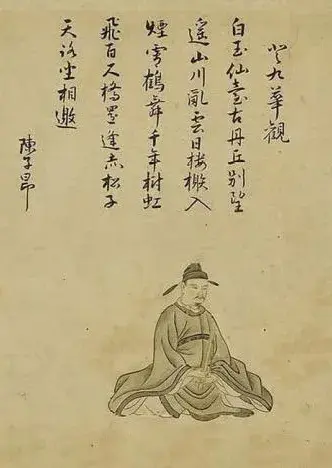
陈子昂
Chen Zi'ang (陈子昂, 659–700), courtesy name Boyu, was an illustrious poet, essayist, and statesman of the Tang Dynasty, recognized as the premier pioneer and architect of the High Tang poetic renaissance. Born into a wealthy clan in Shehong, Zizhou, Chen was a chivalric youth who experienced a dramatic awakening at eighteen, turning to rigorous classical and philosophical studies. Passing the imperial jinshi examination in 684,…
Chen Zi'ang (陈子昂, 659–700), courtesy name Boyu, was an illustrious poet, essayist, and statesman of the Tang Dynasty, recognized as the premier pioneer and architect of the High Tang poetic renaissance. Born into a wealthy clan in Shehong, Zizhou, Chen was a chivalric youth who experienced a dramatic awakening at eighteen, turning to rigorous classical and philosophical studies. Passing the imperial jinshi examination in 684, he attracted the attention of Empress Wu Zetian through his candid political memorials, serving successively as Proofreader of the Imperial Library, Administrative Assistant in the Right Guard Armor Bureau, and Right Reminder. Throughout his political career, Chen submitted outspoken memorials addressing frontier strategy, penal moderation, and civil welfare. In 696, he accompanied Prince of Jian'an Wu Youyi on a punitive expedition against the Khitans; demoted to a military clerk for pressing offensive strategies, he climbed the ancient terrace of Jizhou to compose his immortal masterpiece Song on Ascending Youzhou Terrace. In literature, Chen vehemently attacked the decadent, ornate styles inherited from the Qi and Liang dynasties, championing the Jian'an Literary Style and moral allegory. His bold innovation liberated Tang verse from formalist superficiality, paving the way for the poetic summits of Li Bai and Du Fu. After retiring to nurse his elderly father, he was maliciously framed and imprisoned by the corrupt magistrate Duan Jian, perishing tragically in prison at forty-two.
Born into a prosperous landed family in Shehong, Zizhou; showed chivalric and gallant inclinations in youth.
Injured someone in a sword dispute, prompting a profound moral epiphany to abandon arms and devote himself to classical learning at Mount Jinhua.
Traveled to the western capital Chang'an to study at the Directorate of Education, composing numerous travel verses.
Passed the jinshi examination; submitted memorials on imperial funeral rites and administrative reform, gaining Wu Zetian's patronage as Proofreader of the Imperial Library.
Joined Qiao Zhizhi's military staff against rebellious steppe confederations, advancing to Tongcheng and Zhangye before submitting key western border policies.
Following filial mourning, was summoned to court as Right Reminder, earning public esteem for fearless remonstrance as \"Reminder Chen.\"
Joined Wu Youyi's northern expedition against Khitan insurgent forces under Li Jinzhong as staff military advisor.
Demoted for urging bold military initiatives; ascended the terrace at Jizhou to compose Song on Ascending Youzhou Terrace and Reflections on Ancient Jizhou.
Memorialized the court for permission to retire to Shehong to tend to his elderly father, constructing a mountain retreat and drafting Later Historical Records.
Following his father's death, was extorted and framed by the predatory local magistrate Duan Jian, dying in prison at age forty-two.
Chen Zi'ang was born in 659 during the Xianqing era of Emperor Gaozong at the foot of Mount Wudong in Shehong County, Zizhou. The Chen clan was an affluent local lineage whose wealth had accumulated over generations. His father, Chen Yuanjing, was widely respected for his generosity and charity toward fellow villagers. In his early years, Chen Zi'ang possessed an adventurous and unconstrained temperament, displaying reckless bravery, riding swift steeds, and practicing swordsmanship while consorting with local youths, aspiring to military conquest without interest in Confucian textual exegesis.
In 676 (Yifeng 1), at the age of eighteen, Chen Zi'ang wounded an opponent during a violent street brawl. The bloodshed and the imminent danger of criminal prosecution shocked him into the realization that individual brute force could never achieve statecraft. Resolving to reform his conduct, he cut ties with his former companions and retreated into a Daoist hermitage on Mount Jinhua in Shehong. Immersing himself in classical annals, historical treatises, and ancient literature, he studied relentlessly day and night. Within a few years, he harmonized the essential doctrines of Confucianism and Taoism, acquiring a peerless scholarly reputation throughout Sichuan.
In 679 (Tiaolu 1), driven by ambitions of public service, Chen Zi'ang journeyed across the Qinling Mountains to the imperial capital Chang'an, enrolling in the Directorate of Education (Guozijian). During his studies, he befriended eminent scholars and composed notable travel poems such as Bidding Farewell to a Friend on a Spring Night, Crossing Jingmen and Looking Toward Chu, and Reflections at Mount Xian. His verses discarded florid phonological constraints in favor of solemn vigor. In 681, he submitted his prose and poetry to Grand Councilor Xue Yuanchao, who lauded his soaring talent and predicted his future greatness.
In 682 (Yongchun 1), Chen competed in the metropolitan examinations but failed due to his refusal to pander to prevailing ornamental tastes. Accepting the outcome with composure, he returned to western Sichuan to seek spiritual solace in mountain landscapes. Near Mount Wudong, he engaged in deep philosophical discussions with the eminent monk Master Hui and explored longevity traditions, composing Ascending Jinhua Belvedere on a Spring Day and the opening poem of his celebrated Occasional Inspirations (Ganyu) cycle.
In autumn 683 (Hongdao 1), Chen traveled eastward to Luoyang. In 684 (Guangzhai 1), he passed the jinshi examination with distinction. At this juncture, Emperor Gaozong had passed away in Luoyang and Empress Dowager Wu Zetian held the reins of power as regent. Amid debates over transporting the imperial coffin to Chang'an, Chen foresaw that moving the cortege across famished Guanzhong would exhaust state coffers. He promptly submitted Memorial on Admonishing against Moving the Imperial Coffin to the Capital and Memorial on Admonishing Administrative Governance, urging burial in Luoyang and moral rectitude. Wu Zetian was deeply impressed, summoning him to the Secretariat and appointing him Proofreader of the Imperial Library.
In the eleventh month of 685 (Chuigong 1), Empress Wu Zetian granted Chen a private audience at the Secretariat, presenting him with imperial brush and paper to elicit proposals on state governance. Chen immediately submitted Three Memorials on Crucial Affairs of the State and Military, offering trenchant analyses on imperial emissaries, local prefects, and the economic burden on commoners, advocating strict oversight and agricultural relief.
In spring 686 (Chuigong 2), when nomadic tribes rebelled on the northern frontier, Chen joined the expeditionary force led by Qiao Zhizhi and General Liu Jingdong. Marching across northern desert sands to Tongcheng, Juyan Lake, and the Zhangye River, Chen observed firsthand the grueling sacrifices of frontier garrisons, composing realistic frontier verses such as Lines Written at Juyan Ancient Fortress for Qiao Zhizhi and Elegy for the Old Man of the Frontier. Upon returning to the capital, he presented Three Memorials on the Security of Western Frontier Commanderies, urging defensive vigilance, diplomatic accommodation of non-Han tribes, and restraint against unprovoked military expansion.
In winter 687 (Chuigong 3), Wu Zetian contemplated carving a military roadway through Mount Shu to attack the Qiang tribes of Yazhou. Knowing the arduous terrain of Sichuan, Chen submitted Memorial on Admonishing against the Campaign against Yazhou Qiang, demonstrating that distant conquests would destabilize the southwest. In 688, observing the reign of terror unleashed by cruel clerks like Zhou Xing and Lai Junchen against imperial princes and ministers, Chen risked his life to submit Memorial on Admonishing against the Excessive Use of Punishments, advocating legal justice and judicial clemency. In 689, he was transferred to Administrative Assistant in the Right Guard Armor Bureau.
In 690 (Zaichu 1), Wu Zetian formally proclaimed the Wu Zhou Dynasty. Chen submitted Four Hymns on the Heavenly Mandate of Great Zhou, subtly framing praise as an appeal to implement benevolent Confucian governance. In 691, he vacated his post to return to Sichuan following the death of his stepmother, spending his mourning period tending to his aging father and composing poetry in rustic seclusion.
In 693 (Changshou 2), having completed his mourning, Chen returned to court and was promoted to Right Reminder. In this remonstrance office, Chen fearlessly rebuked imperial missteps and denounced official corruption, earning public acclaim as \"Reminder Chen.\" However, the late Wu Zhou court was rife with factional intrigue. In 694 (Yanzai 1), Chen was falsely implicated in a treason conspiracy by political enemies and thrown into prison. He endured severe abuse with unbroken dignity until public outcry led to his exoneration in 695 (Tianci Wansui 1), whereupon he was restored as Right Reminder.
In the fifth month of 696 (Wansui Tongtian 1), Khitan chieftains Li Jinzhong and Sun Wanrong rebelled against oppressive Chinese commandants, seizing Yingzhou and invading Hebei. Wu Zetian appointed her nephew, Prince of Jian'an Wu Youyi, as Supreme Commander of the Qingbian Army, attaching Chen Zi'ang to his staff as military counselor.
In the third month of 697 (Shengong 1), the vanguard under Wang Xiaojie was ambushed and annihilated at Yuyang. The entire campaign army fell into panic. The inexperienced and timid Wu Youyi was paralyzed with indecision. Chen Zi'ang stepped forward with strategic proposals, pointing out that the Khitan invaders suffered severe supply shortages and urging an immediate counteroffensive with mobile cavalry to sever their rear communications. Chen passionately volunteered to lead ten thousand elite shock troops to spearhead the breakthrough.
However, the arrogant and suspicious commander took offense at Chen's blunt remonstrance, summarily stripping him of military counseling duties and demoting him to a minor military clerk. Seeing his patriotic devotion rejected by an incompetent commander, Chen was consumed by anguish amid the smoke and ruins of the northern frontier. Walking alone near the ancient city of Ji in Youzhou, Chen ascended the solitary heights of the Jizhou watchtower.
Gazing upon the boundless northern plains, he recalled how King Zhao of Yan had built the Golden Terrace to honor worthy men such as Guo Wei and Yue Yi. Contrasting that ancient era of enlightened statecraft with his contemporary reality of marginalized worthies and sycophantic courtiers, Chen was overwhelmed by existential sorrow. Standing between infinite time and boundless space, he uttered his timeless lament: Song on Ascending Youzhou Terrace and composed Reflections on Ancient Jizhou. In the seventh month of 697, following the Khitan collapse, Chen returned to Luoyang, continuing as Right Reminder.
The deep disillusionment from the northern expedition and the venomous atmosphere of the court convinced Chen that imperial politics was irredeemable. In 698 (Shengli 1), after submitting Three Memorials on the Stability of Sichuan, he petitioned to resign on the grounds of his father's advanced age. Wu Zetian granted him permission to retire with state stipends.
Returning to Shehong, Chen constructed a thatched hermitage at Western Mountain, gathering medicinal herbs and tending to his father. During his retirement, he began compiling Later Historical Records, an ambitious chronological critique of governance from Emperor Wu of Han to the Tang. In the seventh month of 699, his father Chen Yuanjing passed away. Consumed by grief, Chen observed strict mourning beside the tomb, his health deteriorating under extreme emotional strain.
The local magistrate of Shehong, Duan Jian, was an unprincipled and extortionate functionary who sought personal enrichment by exploiting the wealthy Chen estate. Knowing that Chen was without court protectors, Duan fabricated accusations to extort the family. The Chen household surrendered a staggering sum of two hundred thousand strings of cash to secure his release; yet, fearing that Chen might someday regain imperial favor and retaliate, Duan continued to harass him, repeatedly dragging the bedridden poet to the county tribunal for brutal interrogations. In 700 (Jiushi 1), the literary master Chen Zi'ang died under torture in the county dungeon at the age of forty-two, provoking universal grief throughout the realm.
During the early Tang Dynasty, the literary arena was dominated by ornamental Six Dynasties styles and the courtly Shangguan style, which emphasized symmetrical parallelism and delicate phraseology at the expense of substantive content. While the Four Eminent Writers of the Early Tang expanded poetic subject matter, they failed to sever ties with Southern Dynasties formalist artifice. Chen Zi'ang boldly raised the standard of poetic revolution.
In his celebrated manifesto Preface to the Slender Bamboo, Chen delivered a blistering critique of post-Han decadence: \"For five hundred years the literary Dao has suffered decline; the Jian'an Literary Style has found no successors through Jin and Song... Regarding poems of the Qi and Liang, their colors and embellishments compete in excess, while genuine allegory and moral aspiration are entirely extinguished.\" Chen explicitly separated vigorous Jian'an poetry from ornate Southern Dynasties verse, elevating ancient moral allegory and heroic vitality into the governing canons of Tang poetry, serving as the ideological compass guiding Tang literature toward the golden High Tang era.
Chen Zi'ang's poetry matched his visionary theory. His cycle of thirty-eight poems entitled Occasional Inspirations (Ganyu) drew upon Ruan Ji's Expressing My Feelings, employing subtle allegories to rebuke despotic misrule, lament the suffering of commoners under ceaseless warfare, and reflect on cosmic transience. These poems eradicated superficial courtly ornamentation through solemn cadence and unadorned vigor.
His Song on Ascending Youzhou Terrace remains one of the supreme philosophical lyrics in world literature. Standing atop the ancient battlements of Youzhou, Chen crystallized his personal despair within the infinite expanse of cosmic time and terrestrial space: \"Ahead, I see not the ancients; behind, I see not those to come. Pondering the endlessness of heaven and earth, alone in anguish, my tears descend!\" Free of floral embellishments, the poem's twenty-two characters evoke universal existential resonance, standing as an enduring spiritual monument of Chinese literary civilization.
Beyond his literary genius, Chen Zi'ang was a statesman of penetrating foresight and deep humanitarian commitment. Amid the perilous terror of Wu Zetian's secret police, he repeatedly submitted trenchant memorials on state affairs, including Memorial on Admonishing against the Excessive Use of Punishments and Three Memorials on the Security of Western Frontier Commanderies.
In these memorials, Chen consistently defended the welfare of ordinary people, condemning corrupt officials who preyed upon the populace and opposing extravagant imperial tours. On border security, he opposed reckless aggressive expansions that drained agrarian foundations, advocating administrative moderation and localized pacification. His political writings remain shining testaments to civic courage and Confucian public morality.
FIGURES ASSOCIATED WITH THIS DYNASTY