Birth in Changzhou
Born in Benniu Town, Wujin County; raised by her maternal aunt's husband after her mother died.
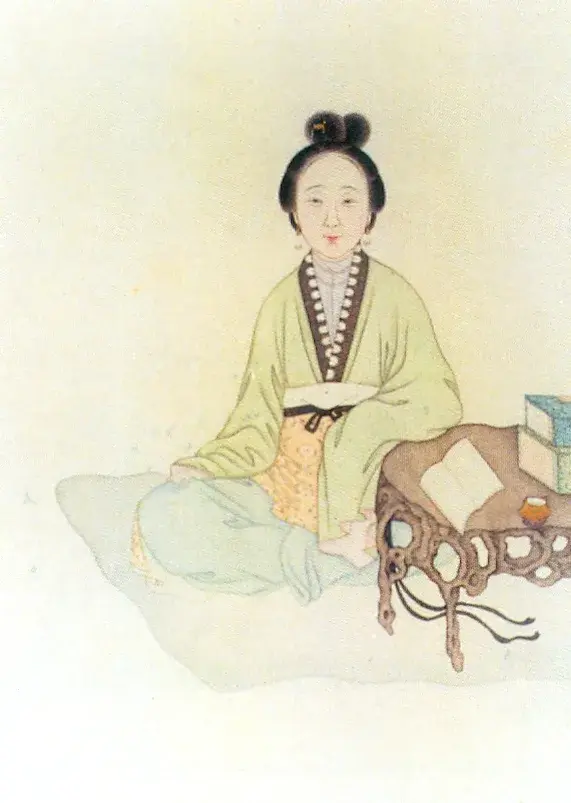
陈圆圆
Chen Yuanyuan (陈圆圆, 1624–1681), originally surnamed Xing and named Yuan with the courtesy name Wanfen, was a native of Wujin County, Changzhou Prefecture (modern Changzhou, Jiangsu Province). She was one of the most famous Kunqu opera courtesan-performers of the late Ming and early Qing dynasties, celebrated in popular tradition as one of the Eight Beauties of Qinhuai. Orphaned of her mother at an early age, she was raised in…
Chen Yuanyuan (陈圆圆, 1624–1681), originally surnamed Xing and named Yuan with the courtesy name Wanfen, was a native of Wujin County, Changzhou Prefecture (modern Changzhou, Jiangsu Province). She was one of the most famous Kunqu opera courtesan-performers of the late Ming and early Qing dynasties, celebrated in popular tradition as one of the Eight Beauties of Qinhuai. Orphaned of her mother at an early age, she was raised in the home of her aunt's husband, surnamed Chen, from whom she adopted her surname. Endowed with beauty, musical genius, and literary grace, she mastered the female roles (dan) of Suzhou Kunqu theatre, earning renown as an artist of matchless beauty and voice. Amid the cataclysmic collapse of the Ming dynasty, Tian Hongyu, father of Emperor Chongzhen's favorite consort, traveled south to recruit beauties and abducted Chen Yuanyuan to Beijing. Seeking military protection as peasant uprisings spread, Tian presented Chen to Wu Sangui, the supreme commander of the border armies at Shanhai Pass. When Li Zicheng's Shun army captured Beijing in 1644, his general Liu Zongmin seized Chen Yuanyuan. Enraged by the abduction of his beloved consort, Wu Sangui famously abandoned his planned surrender to Li Zicheng, defected to the Manchu Regent Prince Dorgon, and opened Shanhai Pass to Qing armies. This event, immortalized by poet Wu Weiye as "flying into a towering rage all for a fair-faced maiden," transformed the geopolitical fate of seventeenth-century China. Following Li Zicheng's defeat, Wu Sangui was reunited with Chen Yuanyuan, and she accompanied him during his long military campaigns throughout Shaanxi, Sichuan, and Yunnan. When Wu Sangui established his court as the Prince of Pacifying the West in Kunming, Chen Yuanyuan chose to avoid inner palace disputes. Foreshadowing dynastic peril, she retired from court luxury to take Buddhist vows as a nun, adopting the religious name Jijing. She survived the turbulent collapse of the Revolt of the Three Feudatories, passing away peacefully in 1681 at the age of fifty-eight.
Born in Benniu Town, Wujin County; raised by her maternal aunt's husband after her mother died.
Attained supreme celebrity as a Kunqu performer in Suzhou, performing in The Western Chamber.
Forcibly taken to the imperial capital by Imperial Guard Commander Tian Hongyu.
Bestowed by Tian Hongyu upon General Wu Sangui as his consort during a lavish banquet.
Abducted by Shun general Liu Zongmin; Wu Sangui defected to the Qing to recapture her.
Reunited with Wu Sangui on the front lines and accompanied his armies across northern and western China.
Resided in the Anfu Garden palace within Kunming upon Wu Sangui's installation as Prince of Pacifying the West.
Took monastic vows as a Buddhist nun at Sanshan Convent, adopting the dharma name Jijing.
Wu Sangui rebelled against the Qing; Chen retreated into monastic isolation and meditation.
Passed away peacefully in seclusion at age 58 as imperial forces pacified southwestern China.
Chen Yuanyuan was born Xing Yuan in 1624 in Benniu Town, Wujin County. Following her mother's early death, her impoverished father was unable to sustain the household, placing her under the guardianship of her uncle-in-law, Chen. Taking his surname, she was known affectionately as Chen Yuanyuan. Growing up in the cultural heartland of the Yangtze River delta, she exhibited exceptional artistic intuition and intellectual poise from early youth.
During the late Chongzhen era, urban Jiangnan experienced a flourishing of theatrical culture centered around Suzhou. To relieve family destitution, Chen Yuanyuan entered a theatrical troupe in Suzhou, specializing in Kunqu opera. Her vocal timber was praised as flawless, while her dramatic portrayals of female heroines—such as Hongniang in The Western Chamber and Mu Suhui in The West Pavilion—captivated literati and nobles alike. Ming scholar Zou Shu celebrated her refined carriage and luminous presence. Prominent scholar Mao Pijiang fell deeply in love with her during his travels in Suzhou, and the two pledged marriage, though the growing national chaos soon disrupted their union.
By the early 1640s, Ming China was crumbling under simultaneous peasant rebellions in the interior and Manchu invasions along the northern frontiers. In 1642, following the death of Emperor Chongzhen's favorite consort, Lady Tian, her father Tian Hongyu lost his court influence. Desperate to restore his imperial favor, Tian led a retinue to Jiangnan under the pretext of an imperial consort selection, forcibly abducting Chen Yuanyuan to Beijing. Finding the emperor overwhelmed by military crises, Tian retained her as the premier performer in his private residence.
Recognizing that survival in the capital required military backing, Tian Hongyu sought to ingratiate himself with Wu Sangui, commander of the elite frontier forces at Shanhai Pass. Tian hosted a lavish banquet in Wu's honor, ordering Chen Yuanyuan to perform. Enamored by her beauty and grace, Wu Sangui requested her hand, and Tian eagerly presented her as a concubine to cement their alliance. With urgent military commands summoning him back to the frontier, Wu Sangui departed Shanhai Pass, leaving Chen Yuanyuan in his Beijing residence.
In April 1644, peasant forces under Li Zicheng breached Beijing, prompting the Chongzhen Emperor to commit suicide on Jingshan Hill. Amid widespread looting in the capital, Li's senior general Liu Zongmin arrested former Ming nobles, plundered the Wu estate, seized Chen Yuanyuan, and tortured Wu's father Wu Xiang for treasure.
Wu Sangui was initially marching toward Beijing prepared to negotiate surrender to Li Zicheng. However, upon receiving intelligence that his father had been imprisoned and his beloved consort abducted by Liu Zongmin, Wu flew into a legendary rage, reportedly crying out: "If I cannot even protect a woman, how can I face the realm?" He immediately severed negotiations, executed Li Zicheng's envoys, recaptured Shanhai Pass, and sent urgent letters pledging allegiance to Regent Prince Dorgon of the Qing Empire. Opening the gates of Shanhai Pass, Wu and Qing forces routed Li Zicheng's army at the Battle of Shanhai Pass, altering the dynastic course of Chinese history.
Before evacuating Beijing in defeat, Shun forces executed thirty-eight members of the Wu family, but Chen Yuanyuan was rescued during the chaotic retreat by Wu's trusted cavalry guards. Reunited with Wu Sangui in his military encampment, the two embraced in tears.
Over the subsequent fifteen years, Chen Yuanyuan accompanied Wu Sangui as his foremost consort through grueling military campaigns across Shaanxi, Sichuan, and Guizhou. In 1659, following the complete subjugation of the Southern Ming, Wu Sangui was created Prince of Pacifying the West and granted vice-regal authority over Yunnan. In Kunming, Wu constructed the magnificent Anfu Garden beside Cuihu Lake exclusively for Chen Yuanyuan, channeling mountain springs into expansive lotus ponds to create a luxurious sanctuary.
Despite her position of favor, Chen Yuanyuan remained clear-eyed regarding the fragility of princely fortune. Within the palace, Wu Sangui's principal wife, Lady Zhang, was notoriously jealous and aggressive. Externally, Wu Sangui's monopolization of power in the southwest placed him on an inevitable collision course with the young Kangxi Emperor in Beijing.
Wisely declining to compete for status or court wealth, Chen Yuanyuan requested permission to retire from court life. Around 1665, she formally took Buddhist vows as a nun, adopting the religious name Jijing. She moved into the secluded Sanshan Convent at the base of Mount Wuhua, setting aside her silks for rough monastic robes, practicing daily chanting, and copying scriptures. When Wu Sangui rebelled in 1673, plunging the empire into the Revolt of the Three Feudatories, Chen Yuanyuan repeatedly advised him against bloodshed to no avail.
Historical sources and modern archaeological discoveries in Guizhou confirm that prior to the fall of Kunming in 1681, she was secretly escorted by General Ma Bao to Majiazhai in Cengong County, Guizhou. Living under an assumed identity as a pious Buddhist recluse, she passed away quietly in 1681 at the age of fifty-eight.
Chen Yuanyuan's personal experience at the fall of Beijing acted as a catalytic fuse during the Ming-Qing transition. In the spring of 1644, the allegiance of Wu Sangui's border army held the decisive balance of power in East Asia.
Her abduction by Liu Zongmin transformed Wu Sangui's strategic calculations, converting a hesitant border commander into an implacable foe of the Shun regime. Poet Wu Weiye immortalized this pivotal moment in his famous epic Song of Yuanyuan, reflecting how private passions intertwined with geopolitical transformations to open the gates of China to Qing rule.
As a central figure of late Ming Jiangnan culture, Chen Yuanyuan achieved lasting distinction in the history of traditional Chinese performing arts. Trained in the artistic center of Suzhou, she mastered the classical Kunqu musical system.
Her acting was celebrated for emotional authenticity and technical subtlety, transcending the rigid theatrical conventions of the era. Contemporary literati including Wen Zhenheng and Mao Pijiang left detailed accounts praising her stage presence, confirming her status as one of the preeminent female dramatic artists of the seventeenth century.
Throughout Chinese dynastic history, courtesans and concubines who became embroiled in high-stakes political struggles frequently met tragic, violent fates. In contrast, Chen Yuanyuan demonstrated extraordinary restraint and political foresight.
Recognizing the domestic peril posed by Lady Zhang and the geopolitical danger of Wu Sangui's unchecked ambition, she voluntarily withdrew from court luxury to embrace monastic simplicity. This disciplined disengagement preserved her personal safety amidst ruthless palace intrigues and earned the enduring respect of subsequent generations of scholars.
For centuries, the ultimate fate of Chen Yuanyuan remained shrouded in mystery, generating rival local legends in Yunnan and Jiangsu. In the 1980s, historians and epigraphers conducted field investigations in Majiazhai, Cengong County, Guizhou, locating a secretive settlement of Wu Sangui's descendants.
Scholars deciphered an encrypted seventeenth-century tombstone dedicated to "The Late Ancestress Nie of the Wu Family from Suzhou." The inscription utilized homophonic and symbolic wordplay to conceal Chen Yuanyuan's identity, verifying that she had been successfully escorted to Guizhou by General Ma Bao and lived out her natural life. This discovery provided concrete material evidence resolving one of the most romanticized enigmas of seventeenth-century Chinese history.
FIGURES ASSOCIATED WITH THIS DYNASTY