Birth into Eminent Lineage
Born on January 3 in Baocun, Yixing, named after the classical Book of Songs verse "Lofty is Mount Song."
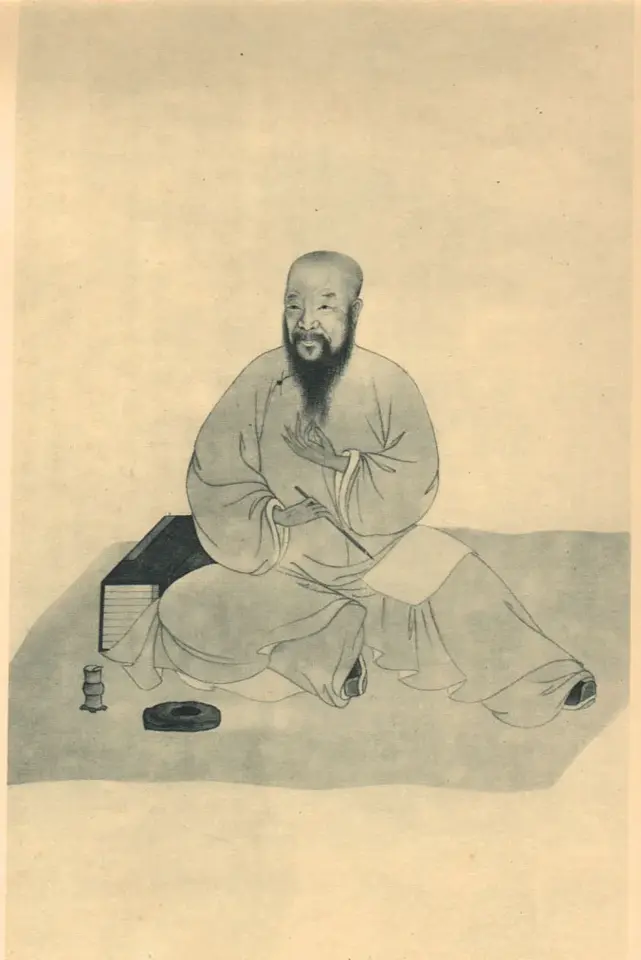
陈维崧
Chen Weisong (陈维崧, January 3, 1626 – June 12, 1682), courtesy name Qi'nian (其年), art name Jialing (迦陵), was a native of Yixing County, Changzhou Prefecture, Jiangsu Province (modern Yixing, Jiangsu Province). Chen was an extraordinary lyric poet, master of parallel prose, and historian during the Ming-Qing transition, celebrated as the founder and leader of the influential Yangxian Ci School, paired with Zhu Yizun and Nalan…
Chen Weisong (陈维崧, January 3, 1626 – June 12, 1682), courtesy name Qi'nian (其年), art name Jialing (迦陵), was a native of Yixing County, Changzhou Prefecture, Jiangsu Province (modern Yixing, Jiangsu Province). Chen was an extraordinary lyric poet, master of parallel prose, and historian during the Ming-Qing transition, celebrated as the founder and leader of the influential Yangxian Ci School, paired with Zhu Yizun and Nalan Xingde as the Three Great Lyricists of the Qing Dynasty, and lauded alongside Wu Zhaoqian and Peng Shidu as one of the Three Phoenixes of the Jiangzuo Region. He hailed from an illustrious Donglin gentry family; his grandfather Chen Yuting rose to Left Censor-in-Chief under the Ming, and his father Chen Zhenhui was renowned as one of the Four Scions of the Late Ming. Endowed with precocious genius, Chen received early tutelage from Ming loyalist patriots Chen Zilong and Li Wen, achieving regional literary renown. Following the fall of the Ming Dynasty in 1644, his family fell into poverty. Experiencing chronic setbacks in civil service examinations, he spent decades wandering as an itinerant guest and scholar. He resided with Hou Fangyu's family in Shangqiu and spent eight years at Mao Xiang's Shuihui Garden in Rugao, pouring his historical grief and observations of civilian hardships into verse. In 1679, Emperor Kangxi instituted the special Erudite Literatus examination; Chen competed as a commoner, passed in the highest grade, and was appointed Examiner of the Hanlin Academy to compile the History of Ming. Chen possessed formidable literary energy. In lyric poetry, he swept away the delicate, ornamental tendencies of late-Ming versification, resuscitating the vigorous heroic traditions of Su Shi and Xin Qiji, producing an astonishing output of 1,629 ci poems across 416 tune matrices, surpassing all historical predecessors in volume and diversity. His parallel prose was hailed as majestic, oceanic, and the finest since the Kaiyuan and Tianbao eras of the Tang Dynasty. Passing away in 1682 at his Beijing lodgings, he left behind Collected Works of the Lake and Sea Tower and Jialing Ci.
Born on January 3 in Baocun, Yixing, named after the classical Book of Songs verse "Lofty is Mount Song."
His father Chen Zhenhui engaged celebrated master Chen Zilong to tutor young Chen at Baocun for several months.
Composed Song of Zhaojun, earning praise from Li Wen; met Fang Yizhi, Mao Xiang, and Hou Fangyu in Nanjing.
The Ming Dynasty collapsed; his family estate was ravaged, forcing him into rustic seclusion with his father.
Accompanying his younger brother Chen Zongshi who married into Hou Fangyu's family, Chen resided in Shangqiu, Henan.
Attended the grand Tiger Hill gathering in Suzhou; composed Shangsi Poem, earning praise from Wu Weiye as one of the Three Phoenixes.
Joined his father's friend Mao Xiang in Rugao, studying and writing at the Shuihui Garden for eight consecutive years.
Passed Emperor Kangxi's special examination, receiving appointment as Hanlin Examiner and entering the Ming History Bureau.
Passed away from respiratory exhaustion on June 12 at his lodgings outside Xuanwumen at the age of fifty-eight.
Chen Weisong was born into an illustrious scholar-official family in Baocun, Yixing, Jiangsu. His great-grandfather Chen Yide had attained the Ming jinshi degree; his grandfather Chen Yuting served as Left Censor-in-Chief in the Northern Censorate during the Chongzhen reign, standing as a pillar of the Donglin faction; his father Chen Zhenhui possessed nationwide fame for moral courage, standing alongside Hou Fangyu, Fang Yizhi, and Mao Xiang as the Four Scions of the Late Ming. His given name, Weisong, was drawn from the Book of Songs hymn "Lofty is Mount Song, its peaks reach to the heavens," expressing dynastic and familial expectations.
Endowed with exceptional intellect, young Chen was composing verse at age five. In 1630, his father invited Chen Zilong, leader of the Yunjian poetic school, to Baocun to tutor the boy. Chen Zilong's emphasis on ancient Han and Wei models exerted a profound lifelong influence on Chen Weisong. In the seventh month of 1631, when his grandfather Chen Yuting was summoned to Beijing as Left Censor-in-Chief, Chen Weisong and his father escorted him as far as Yangzhou. By 1632, seven-year-old Chen had read the Records of the Grand Historian and the Book of Han, mastering ancient governance. In 1633, he accompanied family elders to Nanjing to attend his grandfather. In 1638, Fushe leader Wu Yingji visited Yixing and tutored Chen alongside companions Xu Tengjiao, Wu Dilai, and Ren Yuanxiang, praising his talent to regional scholars.
In 1639, thirteen-year-old Chen composed Song of Zhaojun. Literary master Li Wen read the composition with admiration and immediately wrote to Chen Zilong to praise the boy's genius. That autumn, Chen accompanied his father to Nanjing for the provincial exams, residing at Song Zhisheng's Outian Villa, where he was introduced to Fang Yizhi, Mao Xiang, and Hou Fangyu, who recognized him as a future pillar of the literary world. Chen then formally enrolled under Chen Zilong to master classical poetic meters.
In 1644, the Ming Dynasty fell, followed by the collapse of the Southern Ming regimes. The Chen family estates in Yixing were devastated. In 1656, his father Chen Zhenhui died while upholding unyielding loyalist principles. Although Chen attained government student status under the early Qing, repeated failures in civil service examinations combined with the political suspicion surrounding former Ming elites plunged him into poverty, compelling him to earn a living as an itinerant secretary.
In 1646, Chen's younger brother Chen Zongshi married the daughter of Hou Fangyu and moved to Shangqiu, Henan, where Chen Weisong joined them, witnessing the bleak post-war destruction of the Central Plains. On the third day of the third month in 1653, the Shenjiao and Tongsheng societies convened a gathering of nearly one thousand scholars at Tiger Hill in Suzhou. Literary leader Wu Weiye presided over the gathering. Chen and Peng Shidu composed Shangsi Poem extemporaneously, capturing the assembly with their eloquence. Moved by their mastery, Wu hailed Chen Weisong, Peng Shidu, and Wu Zhaoqian as the Three Phoenixes of Jiangzuo.
In late 1658, facing destitution, Chen travelled to Rugao to seek refuge with his father's dear friend Mao Xiang. Mao welcomed him warmly, lodging him in the Shencui Chamber of his Shuihui Garden. Chen remained there for eight years. Having repeatedly failed regional examinations, he abandoned civil examination aspirations. In the garden, he formed an intimate bond with the young singer Yunlang (Ziyun), dedicating dozens of famous lyric poems to him. During this period, he compiled the biographical collection Furen Ji and edited Jin Ciyuan, producing the major portion of his masterpiece verse in Shuihui Garden.
During the early Kangxi reign, Chen travelled through Yangzhou, Taizhou, Huai'an, and Beijing, forming friendships with Gong Dingzi, Wang Shizhen, Jiang Chenying, and Shao Changheng, and forging an intimate poetic partnership with Zhu Yizun. In Beijing, Chen and Zhu collaborated on poetic criticism and jointly published the Zhu-Chen Village Lyrics, creating an enduring landmark in Qing poetic history.
In 1678, Emperor Kangxi ordered the convocation of the special Erudite Literatus examination to recruit Han intellectuals. High officials competed to nominate Chen. Despite his loyalist sentiments, three decades of impoverishment led him to accept the imperial summons in 1679. In the third month, Emperor Kangxi examined the candidates at the Hall of Preserving Harmony. Chen composed with effortless brilliance, placing fourteenth in the first grade and receiving appointment as Examiner of the Hanlin Academy.
Chen was assigned to the Ming History Bureau to compile the biographies for the official History of Ming. Drawing upon his intimate knowledge of late-Ming archival records, Donglin documents, and Fushe histories, he wrote with strict factual objectivity, rectifying erroneous court records and preserving the heroic deeds of late-Ming loyalists. Living in a dilapidated house outside Xuanwumen, he laboured over manuscripts day and night, suffering from chronic coughing and exhaustion. Senior colleagues such as Wang Shizhen, Peng Sunyv, and Wang Wan frequently visited his humble quarters, marveling at his inexhaustible literary power.
On June 12, 1682, Chen succumbed to chronic respiratory illness at his Xuanwumen lodgings at the age of fifty-eight. He died in utter poverty, leaving behind barely enough for burial. Grand Academician Feng Pu and friend Song Deyi contributed personal funds to manage his funeral ceremonies, while Xu Qianxue supervised the adoption of Chen's nephew Chen Lvduan as legal heir to escort his coffin back to his ancestral home in Yixing for burial.
Following the mid-Ming Dynasty, classical lyric poetry languished in delicate ornamentation and superficial imitation of Song masters. During the Shunzhi and Kangxi reigns, Chen emerged as a literary titan, reviving the masculine heroic traditions of Su Shi and Xin Qiji and establishing the Yangxian Ci School.
Chen insisted that lyric poetry must embody immense grandeur and unyielding structural bone, expanding the thematic range of the genre to encompass dynastic collapse, peasant suffering, and the horrors of warfare. His famous poem To the Melody of Hexinlang: Song of the Trackers depicted the suffering of one hundred thousand commoners conscripted to haul warships; Song of the South: Random Chants of Jiangnan exposed exorbitant taxes that forced peasants to sleep in ox carts under autumn rains; To the Melody of Dielianhua: Sixth Month Verses illustrated the exhaustion of farmers carrying goods to market; and lyrics to Dianjiangchun, Zuiluopo, and Yeyougong expressed deep historical melancholy. Through these works, the Yangxian School rivaled the Zhexi School, defining the golden revival of Qing lyric poetry.
Chen achieved unparalleled quantitative and qualitative mastery in Chinese lyric poetry. His younger brother Chen Zongshi recorded in his preface to Jialing Ci that Chen wrote continuously in his later years, sometimes composing dozens of poems in a single day. Over his lifetime, Chen authored 1,629 ci poems across 416 tune matrices, representing the largest individual output and greatest variety of metrical tunes in the entire history of Chinese literature.
His long compositions rolled like thunderous ocean waves, while his shorter quatrains matched the delicate grace of early masters. Poetic critic Chen Tingzhuo praised his immense scope, noting that his prolific mastery was unmatched throughout ancient and modern times, unifying the distinct strengths of Su Shi, Xin Qiji, Zhou Bangyan, and Jiang Kui within a single hand.
Beyond his lyric poetry, Chen was the preeminent leader in resurrecting Han, Wei, and Six Dynasties parallel prose during the early Qing. While parallel prose had degenerated into sterile acoustic symmetry, Chen revitalized the form with panoramic narrative momentum, profound classical learning, and rhythmic power.
Ji Yun recorded in Siku Quanshu Zongmu Tiyao that Chen's prose possessed vigorous talent and complete natural bone; Wang Wan observed that his parallel prose was unmatched across the millennium since the Kaiyuan and Tianbao eras of the Tang; and Mao Xianshu lauded his prose for leaping with the vigor of dragons and tigers. His fifty-four-volume Collected Works of the Lake and Sea Tower stands as a monumental textbook for the study of Chinese parallel prose.
As the descendant of prominent Donglin loyalists, Chen brought an intense sense of historical responsibility to his service in the Ming History Bureau. Thoroughly versed in the political factions of the late Ming, he insisted on factual impartiality, rectifying misleading official archives and recording the authentic struggles of patriotic scholars.
Writing through chronic illness, Chen produced dozens of biographical volumes for the History of Ming, distinguished by incisive prose and lucid structure. His biographical drafts provided foundational primary sources for the final authorized History of Ming, embodying his enduring intellectual tribute to his fallen ancestral realm.
FIGURES ASSOCIATED WITH THIS DYNASTY