Born in Xu County
Born into an impoverished commoner family in Xu County, Yingchuan, displaying early maturity and justice.
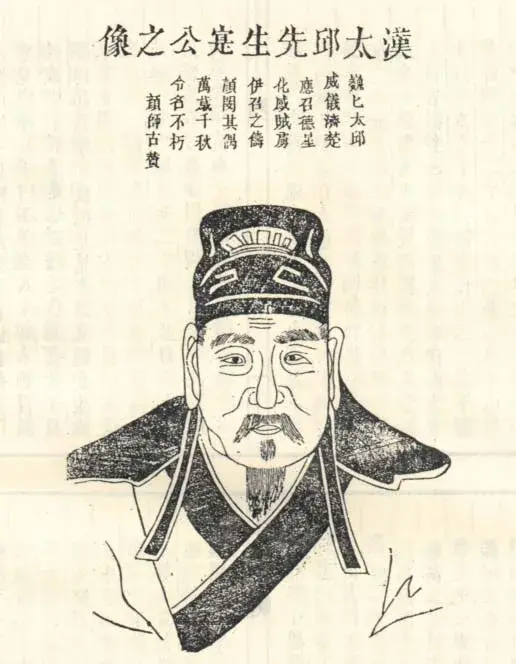
陈寔
Chen Shi (陈寔, 104–187 CE), courtesy name Zhonggong, was a native of Xu County, Yingchuan Commandery (present-day Gucheng Village, Changge City, Henan Province). He was an illustrious scholar-official, political thinker, and preeminent spiritual leader of the Confucian literati in the middle to late Eastern Han dynasty, celebrated as the founding patriarch of the distinguished Yingchuan Chen clan. Having served as Magistrate…
Chen Shi (陈寔, 104–187 CE), courtesy name Zhonggong, was a native of Xu County, Yingchuan Commandery (present-day Gucheng Village, Changge City, Henan Province). He was an illustrious scholar-official, political thinker, and preeminent spiritual leader of the Confucian literati in the middle to late Eastern Han dynasty, celebrated as the founding patriarch of the distinguished Yingchuan Chen clan. Having served as Magistrate of Taiqiu in Pei Kingdom with exceptional moral governance, he was universally honored by subsequent generations as "Chen Taiqiu." Following his death, scholars across the realm bestowed upon him the posthumous title of "Master Wenfan," a distinction sustained through imperial titles across subsequent dynasties. Originating from humble origins, Chen Shi possessed earnest diligence, profound rectitude, and genuine humility from his youth. Beginning his public career as a county clerk, commandery postal inspector, and officer of merit, he gained renown for selfless impartiality and willingness to bear blame to protect others. Later appointed Magistrate of Wenxi and subsequently Magistrate of Taiqiu, Chen Shi implemented governance founded on moral suasion, resolving legal disputes through ethical instruction and caring for the impoverished. His compassionate conversion of an impoverished burglar crouching upon his roofbeams gave rise to the immortal idiom "Gentleman on the Rafters." In 166 CE, when the First Disaster of the Partisan Prohibitions erupted, Chen Shi declared, "If I do not enter prison, the people will have none to rely upon," voluntarily surrendering himself to incarceration in Luoyang to shield his reformist peers. In his declining years, Chen Shi retired to his ancestral homeland, mediating community disputes and nurturing rustic virtues, fostering a regional ethos where people said: "We would rather endure judicial punishment than face Master Chen's reproach." In 187 CE (the 4th year of the Zhongping era), Chen Shi passed away peacefully at home at the age of eighty-four. General-in-Chief He Jin sent imperial condolence envoys, while over thirty thousand scholars and dignitaries, including Xun Shuang and Kong Rong, assembled for his funeral, with more than a thousand donning mourning hemp. Chen Shi's pure moral character and boundless benevolence remain timeless exemplars of Confucian moral governance and noble personhood.
Born into an impoverished commoner family in Xu County, Yingchuan, displaying early maturity and justice.
Served as a county menial; the gate warden recognized his potential, and the magistrate funded his Imperial Academy studies.
Appointed Postal Inspector and Officer of Merit of Yingchuan, shielding superiors from blame and earning renown as a worthy elder.
Recruited by Minister of Works Huang Qiong; served as Magistrate of Wenxi, resigning to observe mourning for his father.
Appointed Magistrate of Taiqiu, governing through moral instruction and originating the "Gentleman on the Rafters" idiom.
First Partisan Disaster broke out; Chen Shi surrendered voluntarily to Luoyang prison to protect peers, pardoned the following year.
Second Partisan Disaster spread; lived in quiet rural retirement, arbitrating local disputes with absolute fairness.
Passed away at home at age eighty-four; thirty thousand attended his funeral, honoring him as Master Wenfan.
Chen Shi, courtesy name Zhonggong, was born into an impoverished commoner household in Xu County, Yingchuan Commandery (modern Gucheng Village, Changge City, Henan Province). During the Eastern Han, aristocratic lineages increasingly dominated social advancement, making it exceptionally arduous for destitute commoners to attain classical education. Despite poverty, Chen Shi maintained lofty aspirations, demonstrating quiet dignity and composed rectitude. Even in childhood play, he arbitrated disputes among peers with scrupulous fairness, winning the respect of neighborhood youths.
Upon reaching adulthood, Chen Shi was hired as a menial clerk at the county yamen, performing heavy labor such as gatekeeping, sweeping, and courier tasks. The warden of the western gate, an experienced veteran observer of human nature, noticed that Chen Shi spent every moment of leisure reading classical texts, carrying himself with innate dignity. The warden remarked in admiration: "Chen Zhonggong possesses extraordinary talent; how can he be confined to menial servitude!" The warden exempted him from drudgery, supplied him with clothes and rations, and funded his enrollment in the local academy.
Shortly thereafter, the Magistrate of Fu'an passing through Xu County noticed Chen Shi's literary refinement and deep grasp of canonical hermeneutics. He appointed Chen Shi to his secretarial staff and sponsored his journey to Luoyang to study at the Imperial Academy. At the Academy, Chen Shi associated with the empire's foremost scholars while maintaining rigorous personal austerity, even undertaking manual grain-pounding labor for fellow students without boasting. Scholars of all ranks admired his encyclopedic learning and unpretentious demeanor, spreading his fame throughout the capital.
Returning home after his studies, Chen Shi was recruited by the Administrator of Yingchuan to serve as Commandery Postal Inspector and Officer of Merit, overseeing inspections and personnel appointments. At that time, consort lineages and court eunuchs persistently dispatched private letters demanding official favors and appointments. The Administrator was an unbending official who wished to prosecute every requester. Chen Shi possessed greater strategic prudence: recognizing that head-on confrontation would bring disaster upon the commandery, he privately intercepted the letters and appointed candidates according to their actual abilities. Whenever public censure arose, Chen Shi accepted personal blame rather than implicate the Administrator. Initially suspecting Chen Shi of sycophancy, the Administrator wept in shame and admiration upon discovering the truth.
In 151 CE (the 1st year of the Yuanjia era), Minister of Works Huang Qiong recruited Chen Shi into his ministry, subsequently assigning him as Magistrate of Wenxi in Hedong Commandery. Arriving at his post, Chen Shi reformed local customs. Soon afterward, his father passed away, prompting Chen Shi to surrender his seals of office to observe filial mourning in a thatched hut beside his father's tomb for three full years.
Following his mourning period, the imperial court appointed Chen Shi as Magistrate of Taiqiu in Pei Kingdom. Taiqiu was a strategic crossroads characterized by litigious customs and martial traditions. Rejecting the harsh punitive traditions of legalist officials, Chen Shi implemented governance rooted entirely in Confucian moral suasion. He presided over open court biweekly, eschewing torture to address litigants with compassionate reason. When neighbors disputed land boundaries, Chen Shi appealed to familial ethics until both parties wept in shame and ceded the disputed property. Governing Taiqiu through courtesy and benevolence, he sheltered widows and orphans; within a few years, corruption ceased, litigation vanished, and Taiqiu became an empire-wide model of virtuous rule.
During Chen Shi's tenure at Taiqiu, an extraordinary incident gave birth to the timeless Chinese idiom "Gentleman on the Rafters." During a severe summer drought, harvests failed and famine gripped the region. Late one evening, an impoverished burglar slipped into Chen Shi's home. Hearing movement in the inner chambers, the intruder climbed onto the roof beams to conceal himself.
Reading by candlelight, Chen Shi noticed the shadow lurking above. Remaining serene, he did not summon household servants to apprehend the intruder. Instead, he straightened his robes, summoned his children and grandchildren into the central hall, and addressed them with solemn warmth: "Human beings in this world must never fail to cultivate self-discipline! Those who are wicked were not necessarily evil by nature; driven by deprivation and corrupting customs, their habits solidify until they sink into crime. Look above: the gentleman on our roof beams is precisely such a person!"
Hearing these words, the burglar was stricken with remorse and terror. He jumped down from the rafters, dropped to his knees, and wept bitterly, begging for forgiveness. Chen Shi gently assisted him to his feet, inquired into his domestic destitution, and consoled him: "Looking upon your countenance, you are no hardened felon. If you preserve a good heart and exercise restraint, you can surely earn an honest livelihood. In this year of famine, even upright folk struggle; why abandon yourself to theft?"
Chen Shi directed his family to bring forth two bolts of fine silk, presenting them to the thief to relieve his immediate distress. Overwhelmed with gratitude, the man vowed to reform, returning to his village to become a hardworking farmer. This story spread throughout the commandery. Criminals were shamed into repentance, and theft ceased entirely across Taiqiu. The phrase "Gentleman on the Rafters" entered classical literature as an enduring symbol of transformative compassion, moral education, and human dignity.
In 166 CE (the 9th year of the Yanxi era), the First Disaster of the Partisan Prohibitions erupted. Palace eunuchs falsely accused upright literati of seditious factionalism, leading Emperor Huan to order the arrest of over two hundred prominent scholars, including Li Ying, Du Mi, and Chen Xiang. Having already retired from his post in Taiqiu, Chen Shi was not listed on the initial arrest warrants.
However, Chen Shi felt that Li Ying and his peers had sacrificed themselves for the state, leaving the literati community under existential siege. He sighed: "Li Yuanli and his colleagues are the finest talents under heaven. In this hour of peril, if I do not enter prison with them, upon whom can the scholars rely!" Chen Shi arranged his robes and journeyed voluntarily to Luoyang, surrendering himself to the Northern Whangmen Prison.
Within the dungeons, Chen Shi shared hardships with his peers. His towering moral stature inspired such awe that eunuch interrogators dared not subject him to torture. In 167 CE, Emperor Huan proclaimed an amnesty under pressure from Dou Wu, and Chen Shi was released. When the Second Disaster erupted in 169 CE, Chen Shi secluded himself in the mountains of Yingchuan, avoiding entanglement with consort cliques while quietly sheltering numerous fugitive scholars.
In his final decades, Chen Shi's moral authority was supreme. Whenever villagers in Yingchuan had disputes, they bypassed local magistrates to present their grievances before Master Chen's gate. His arbitrations were so just that losing parties left thoroughly convinced of their errors. Commoners coined the saying: "We would rather endure judicial punishment than face Master Chen's reproach!"
In 187 CE (the 4th year of the Zhongping era), Chen Shi passed away peacefully at his home in Xu County at the age of eighty-four. General-in-Chief He Jin sent imperial envoys to offer condolences. On the day of his funeral, more than thirty thousand scholars, officials, and disciples from across the empire traveled to Yingchuan, with over a thousand eminent figures, including Minister of Works Xun Shuang and scholar Kong Rong, wearing mourning hemp. Local scholar He Yong authored his funeral elegy, and the literati conferred upon him the posthumous title of "Master Wenfan" (signifying literary virtue as moral exemplar). The Yingchuan Chen clan he founded flourished across the Six Dynasties: his sons Chen Ji and Chen Chen were renowned as "Twin Dragons," his grandson Chen Qun served as Cao Wei Minister of Works and created the Nine-Rank System, and his great-grandson Chen Tai served as Secretariat Prefect, establishing the lineage as one of the preeminent noble houses in Chinese history.
Serving as Magistrate of Taiqiu, Chen Shi governed through transformative compassion. Confronting an impoverished burglar upon his rafters, he instructed his family that "bad men are not born wicked, but corrupted by habit," presenting the thief with silk to encourage self-renewal. This event created the immortal idiom "Gentleman on the Rafters," establishing an archetype of Confucian moral education that values reform over penal retribution.
When the First Partisan Disaster struck in 166 CE, Chen Shi, though unindicted, declared that "without my imprisonment, the people will have none to rely upon" and surrendered himself to the Northern Whangmen Prison. His willingness to share martyrdom with Li Ying inspired the persecuted literati and checked the savagery of eunuch interrogators, exemplifying the highest Confucian virtue of selfless moral responsibility.
In his rural retirement, Chen Shi served as the moral arbiter of regional society. Resolving disputes with scrupulous fairness, he inspired the popular consensus: "We would rather endure judicial punishment than face Master Chen's reproach." He demonstrated how Confucian ethical authority could transform grassroots society, establishing the moral autonomy of scholar-gentlemen over bureaucratic coercion.
Chen Shi established a strict domestic tradition of filial rectitude and incorruptible service. His sons Chen Ji and Chen Chen were renowned as the "Twin Dragons," his grandson Chen Qun founded the Nine-Rank System, and his descendants occupied senior ministerial posts throughout the Wei, Jin, and Southern Dynasties. The Yingchuan Chen clan endured for centuries as one of the most distinguished aristocratic houses in Chinese history.
FIGURES ASSOCIATED WITH THIS DYNASTY