Birth in Yining
Born on October 23 in Zhuduanli, Yining State, Jiangxi; evacuated by his mother amid Taiping warfare.
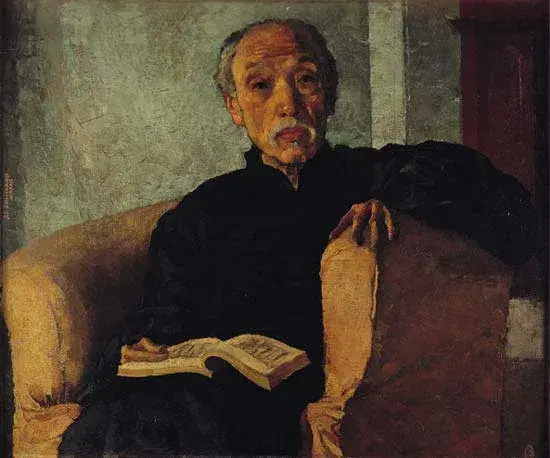
陈三立
Chen Sanli (陈三立, October 23, 1853 – September 14, 1937), courtesy name Boyan (伯严), art name Sanyuan (散原), was a native of Yining State (modern Xiushui County, Jiujiang City, Jiangxi Province). He was the eldest son of the reformist Governor Chen Baozhen, and father of the eminent cultural historian Chen Yinke and artist Chen Hengke. Chen Sanli was an illustrious patriotic poet, philosopher, and social activist of late…
Chen Sanli (陈三立, October 23, 1853 – September 14, 1937), courtesy name Boyan (伯严), art name Sanyuan (散原), was a native of Yining State (modern Xiushui County, Jiujiang City, Jiangxi Province). He was the eldest son of the reformist Governor Chen Baozhen, and father of the eminent cultural historian Chen Yinke and artist Chen Hengke. Chen Sanli was an illustrious patriotic poet, philosopher, and social activist of late imperial and early modern China, revered as the acknowledged master and flagbearer of the Tongguang Style poetic movement, one of the Four Scions of the 1898 Reform alongside Tan Sitong, Ding Huikang, and Wu Baochu, and widely celebrated by modern scholars as the last great traditional poet of China. Born into an eminent scholarly lineage, Chen attained the imperial jinshi degree in 1889, receiving appointment as Secretary in the Ministry of Personnel before swiftly resigning to attend his father. Following the disastrous Treaty of Shimonoseki after the First Sino-Japanese War, he sent an impassioned telegram to Governor-General Zhang Zhidong demanding the execution of Li Hongzhang to appease national fury. Assisting his father in governing Hunan, Chen served as the intellectual architect of the Hunan Reforms, founding the School of Current Affairs, the Southern Study Society, and the Xiang Journal, while recruiting luminaries such as Liang Qichao and Huang Zunxian to transform Hunan into the vibrant vanguard of national constitutional reform. After the 1898 Coup, he was cashiered by Empress Dowager Cixi and barred from officialdom for life. Retiring to Nanjing where he built the Sanyuan Retreat, Chen lived as a loyalist recluse while passionately promoting modern civic education and national industry. He funded the pioneering Siyi Elementary School, advocated the construction of the Nanxun Railway, and directed the modern revision of the Mount Lu Gazetteer. In 1937, following the Marco Polo Bridge Incident and the Japanese occupation of Beiping, the eighty-five-year-old poet resolutely resisted enemy overtures, driving Japanese agents from his gate and choosing martyrdom through a voluntary hunger strike, refusing food and medicine for five days until his passing, leaving behind an immortal legacy of moral heroism.
Born on October 23 in Zhuduanli, Yining State, Jiangxi; evacuated by his mother amid Taiping warfare.
Passed the Jiangxi provincial examination; rewarded for submitting his exam paper in classical ancient prose.
Attained the metropolitan jinshi degree and received appointment as Secretary of the Ministry of Personnel, soon resigning to assist his father.
Telegraphed Zhang Zhidong demanding the execution of Li Hongzhang following the national humiliation of the Treaty of Shimonoseki.
Assisted his father in launching the Hunan Reforms, founding the School of Current Affairs and Southern Study Society.
Dismissed from all imperial offices and stripped of civil rank following the 1898 Coup, returning to Jiangxi to live in seclusion.
Following his father's sudden death, moved to Nanjing to establish the Sanyuan Retreat, dedicating himself to poetry.
Offered his private residence and financial backing to establish Siyi Elementary School, pioneering modern curricula.
Co-founded the Jiangxi Railway Company to promote the indigenous construction of the Nanxun Railway.
Initiated the comprehensive scientific revision of the Mount Lu Gazetteer, establishing modern local historiographical methods.
Publicly denounced Zheng Xiaoxu for serving the puppet Manchukuo regime, excising Zheng's preface from his poetry collection.
Refused food and medicine following the Japanese occupation of Beiping, passing away on September 14 at age eighty-five.
Chen Sanli was born into an illustrious lineage in Zhuduanli, Yining State (modern Xiushui County, Jiangxi Province). On the day of his birth, October 23, 1853, Taiping forces were locked in ferocious combat with imperial troops across northern Jiangxi. His mother, Lady Huang, carried the newborn infant on her back, fleeing across rugged mountain trails into neighboring counties to escape pillaging armies. Raised in an atmosphere of rigorous scholarly instruction, Chen displayed brilliant erudition from early youth, immersing himself in ancient pre-Qin prose and Han-Wei poetry while rejecting rigid feudal formalities.
In 1873, Chen accompanied his father Chen Baozhen to Changsha, residing at the Xianyuan estate, and sat for the prefectural examination in Nanchang. In the same year, he married Lady Luo, daughter of Prefect Luo Hengkui. During the early Guangxu reign, he studied under tutor Liao Shuheng at Xianyuan. Appalled by the stultifying conventions of examination eight-legged essays, Chen abandoned standard examination templates, devoting his intellect to classical ancient prose and historical philosophy.
In 1882, Chen sat for the Jiangxi provincial examination. Rejecting examination conventions, he composed his essays in vigorous, unfettered pre-Qin prose, presenting trenchant analyses of contemporary national crises. Chief examiner Chen Baochen marveled at his unconventional brilliance, overcoming administrative opposition to grant him the provincial juren degree. After passing the metropolitan preliminary in 1886, he returned to Changsha to co-found the Bihu Poetry Society with Wang Kaiyun. In 1889, Chen competed in the metropolitan palace examination, winning the jinshi degree and receiving an imperial assignment as Secretary in the Ministry of Personnel.
Shortly after assuming his post in the Ministry of Personnel, Chen grew disillusioned with the pervasive factionalism of Beijing court politics. He resigned his office to accompany his father to administrative postings in Henan and Hubei. In Hubei, Governor-General Zhang Zhidong deeply respected his literary acumen, inviting him to evaluate student examination essays at the prestigious Lianghu Academy; during this period, Chen accompanied fellow poet Yi Shunding on extensive journeys across Mount Lu, winning literary renown across the Yangtze valley. In 1895, following the catastrophic defeat in the First Sino-Japanese War, Li Hongzhang signed the humiliating Treaty of Shimonoseki, surrendering Taiwan and paying two hundred million taels. Overcome with anguish, Chen immediately dispatched an urgent telegram to Zhang Zhidong, demanding that Li Hongzhang be executed to appease the Chinese people.
In 1895, Chen Baozhen was appointed Governor of Hunan. Chen Sanli served as his father's chief strategist and executive director during the Hunan Reforms. Under the stewardship of father and son, Hunan pioneered sweeping administrative modernizations. Chen Sanli organized the School of Current Affairs, engaging Liang Qichao as Chief Chinese Instructor and Li Weige as Western Instructor, training young patriots including Cai E; he established the Southern Study Society, along with the Xiangxue Journal and Xiang Journal, advocating civil enlightenment and local administrative self-governance.
Chen enlisted progressive reformist thinkers including Tan Sitong, Huang Zunxian, and Tang Caichang, establishing the Hunan Constabulary Bureau, opening regional mineral extraction, and constructing modern highways, converting landlocked Hunan into the most enlightened provincial administration in China. His literary and political collaboration with Tan Sitong, Ding Huikang, and Wu Baochu earned them national acclaim as the Four Scions of the 1898 Reform.
In autumn 1898, Empress Dowager Cixi staged the 1898 Coup, imprisoning Emperor Guangxu and executing Tan Sitong and the Six Gentlemen of the Reform. The Chen family was severely victimized: Chen Baozhen was dismissed from the governorship and permanently barred from office, while Chen Sanli was stripped of his ministerial title on charges of recruiting subversive radicals, receiving a lifetime ban from government service. Heartbroken, he escorted his father back to Jiangxi to live in secluded retirement at the West Mountain Blue Cottage.
In the summer of 1900, as the allied forces entered Beijing during the Boxer Calamity, Chen Baozhen died abruptly at the Blue Cottage, rumored to have been forced to commit suicide by secret imperial decree from Cixi. Devastated by the tragic loss of his father and the collapse of dynastic reform, Chen abandoned all lingering political ambitions. In late 1900, he relocated his family to Nanjing, purchasing land along the Qingxi Creek to construct a spacious residence of ten bays named Sanyuan Retreat, styling himself Sanyuan Laoren.
Adopting the persona of a loyalist recluse, Chen spent his days reading history and composing verse, expressing his historical grief through the celebrated line: "Leaning on the balustrade amid a gust of storm clouds, I have come to stand as an idle bystander to the Divine Land." Yet, while renouncing officialdom, he channeled his energy into social welfare and modern education. In 1903, he vacated rooms in his private estate to establish a modern family academy and generously funded scholar Liu Yizheng to establish Siyi Elementary School in Nanjing.
Siyi Elementary School revolutionized early modern Chinese education. Chen hired foreign instructors to teach English, mathematics, physics, and chemistry. Furthermore, he abolished eight-legged essays, eliminated customary prostrations before Confucian tablets, and banned rote memorization and corporal punishment. In 1905, Chen joined Jiangxi scholar Li Youfen to found the Jiangxi Railway Company, mobilizing private domestic capital to construct the Nanxun Railway, resisting foreign attempts to control regional transport.
In 1906, a catastrophic drought struck Yining State, prompting starving villagers from Tonggu to travel to Yifeng to purchase grain. Wealthy merchants framed them as bandits, orchestrating an ambush that slaughtered fifty-seven refugees. When corrupt magistrates suppressed the massacre, surviving villagers travelled to Nanjing to implore Chen's aid. Outraged by the injustice, Chen drafted an appeal directly to the Ministry of Justice, securing imperial investigators who punished the culprits and vindicated the victims. During the final years of the Qing, Yuan Shikai offered him ministerial appointments, and early Republican governors repeatedly invited him into cabinet office, but Chen steadfastly declined every overture.
Following the establishment of the Republic of China, Chen lived in Shanghai, Hangzhou, and Mount Lu. In 1930, recognizing that historical gazetteers of Mount Lu were filled with errors, Chen initiated a complete scientific revision, engaging fellow Jiangxi scholar Wu Zongci as editor-in-chief. Chen insisted on incorporating modern scientific standards into traditional gazetteer compilation, enlisting geologist Li Siguang to author the geological chapters and botanist Hu Xiansu to compile regional botanical surveys, establishing the landmark principle: "retain the ancient where ancient, adopt the modern where modern."
During the 1932 Shanghai Incident, when Japanese forces assaulted Zhabei, Chen was recuperating on Mount Lu. Anxious for national defense, he subscribed to daily airmailed newspapers from Shanghai, grieving over foreign aggression to the point of shouting "kill the Japanese invaders" in his sleep. In 1933, when his old poetic friend Zheng Xiaoxu betrayed China to serve as Prime Minister of the Japanese puppet state of Manchukuo, Chen publicly denounced Zheng as a national traitor, excised Zheng's preface from all reissued copies of his poetry collections, and severed relations forever.
In 1934, Chen relocated to Beiping. In July 1937, the Marco Polo Bridge Incident erupted. Friends urged the eighty-five-year-old master to flee south, but Chen sat upright and refused: "I shall never flee!" When defeatists suggested Chinese capitulation, he rebuked them fiercely: "Are the Chinese dogs and pigs? Shall we bow our heads and allow ourselves to be slaughtered?"
Following the fall of Beiping in late July, Japanese occupation authorities sought to exploit Chen's enormous cultural prestige by coercing him into accepting puppet offices, sending daily agents to cajole him. Chen barred his gates; when Japanese spies refused to depart, Chen shouted to his servants to seize brooms and beat the intruders out of his courtyard. Thwarted, Japanese forces placed his residence under surveillance.
Witnessing the devastation of China, Chen's chronic respiratory illness worsened severely. Determined to maintain his moral integrity, he refused all medication and ceased taking food and water on September 9. When family members knelt beside his bed with tears to offer medicine, he kept his lips tightly sealed, waving them away. Following a five-day hunger strike, Chen passed away on September 14, 1937, at the age of eighty-five. Prevented by wartime chaos from immediate burial, his coffin was temporarily kept at Changchun Temple in Beiping until 1948, when he was laid to rest at Mount Paifang in Hangzhou.
During the profound national crisis following the First Sino-Japanese War, Chen assisted his father Chen Baozhen in directing the Hunan Reforms with extraordinary statesmanship. Breaking through conservative resistance, he established the School of Current Affairs and Southern Study Society, inviting Liang Qichao and Huang Zunxian to lecture in Changsha, transforming Hunan into the intellectual center of the constitutional movement.
Chen organized the provincial constabulary, promoted modern arms manufacturing, exploited regional mines, and launched the Xiang Journal, creating the earliest comprehensive program for political reform, modern education, and local self-governance in late imperial China. Operating as an unofficial chancellor, Chen stood shoulder to shoulder with Tan Sitong, pioneering the institutional transformation of modern China.
Chen was the paramount master of Chinese classical poetry during the late Qing and early Republican eras. He founded and championed the celebrated Tongguang Style, absorbing the vigorous poetic traditions of Du Fu, Han Yu, Huang Tingjian, and Chen Shidao to articulate the monumental historical upheavals of his age.
His poetic style was celebrated for profound acoustic vigor, dense textual architecture, and deep emotional resonance, liberating traditional verse from superficial imitation. Authoring the Collected Works of Sanyuan Retreat across multiple supplements, Chen was lauded by Liang Qichao as unmatched by any poet since the Tang and Song dynasties, universally recognized as the last supreme master of the Chinese classical poetic canon.
Following the defeat of the 1898 Reform, Chen channeled his patriotism into civic education and indigenous industrial sovereignty. His founding and sponsorship of Siyi Elementary School in Nanjing shattered traditional feudal rote learning, introducing modern sciences, physical education, and foreign languages to Chinese elementary schooling.
In economic affairs, Chen co-founded the Jiangxi Railway Company, mobilizing private domestic capital to build the Nanxun Railway to resist foreign encroachment upon the Yangtze transport corridors. Through these efforts, he demonstrated how traditional scholar-gentry could lead grassroots modern industrialization and educational reform.
In his final years, Chen demonstrated the pure moral fortitude of traditional Chinese scholar-officials. From demanding armed resistance after the Treaty of Shimonoseki to severing ties with collaborationist traitors, he maintained unyielding patriotic conviction.
Confronting Japanese coercion in occupied Beiping, he drove enemy agents from his residence and chose martyrdom through a voluntary hunger strike at age eighty-five. Chen's ultimate sacrifice dispelled the humiliation of enemy occupation, standing as an enduring symbol of national defiance that inspired the Chinese people throughout the War of Resistance.
FIGURES ASSOCIATED WITH THIS DYNASTY