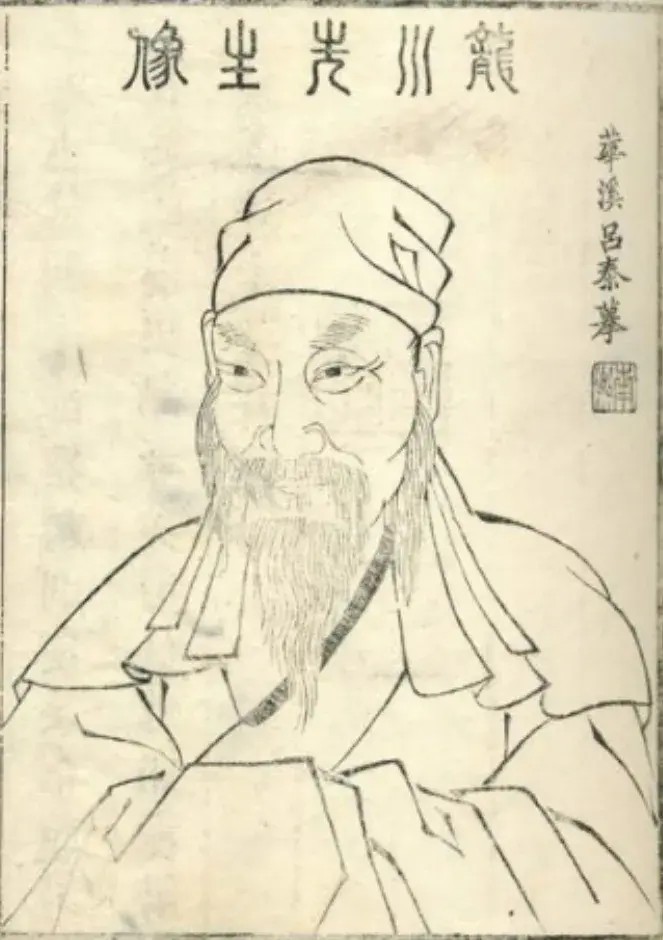
Biography
Family Lineage and Early Diligence
Chen Liang was a distant descendant of the famous Eastern Han scholar Chen Shi of Yingchuan. Following the upheaval of the Yongjia era in the Western Jin dynasty, the Chen clan migrated southward to Changcheng in Jiangnan (modern Changxing, Zhejiang), where their line eventually produced Emperor Wu of Chen (Chen Baixian). Chen Liang belonged to the Qianhuang branch of the six major Chen lineages in Yongkang. During the fall of Northern Song in 1126, his great-grandfather Chen Zhiyuan served as a military officer under Liu Yanqing and was killed in battle while defending Kaifeng against the Jurchen forces. Following this martyrdom, his grandfather Chen Yi repeatedly failed the civil examinations and relocated the family to Longkushan in Yongkang, where family fortunes declined into poverty. His father Chen Ciyin maintained a modest living through farming and commerce. Chen Liang was born on October 16, 1143, and was initially named Runeng by his grandfather.
At his birth, he was said to possess piercingly bright eyes. In his youth, he studied in the private academy of local gentry He Zigang, who was astounded by his intellect and predicted he would achieve greatness. Chen Liang was gifted with an astonishing memory, mastering classical canons and dynastic histories by age sixteen. He displayed an extraordinary passion for military treatises, studying Sun Tzu and Wu Qi night and day while analyzing strategic terrain and troop formations. His fiery discussions on historical rises and falls consistently amazed local scholars with their vast scope and sharp insight.
Mentorship under Zhou Kui and Renaming
In 1160, before reaching twenty, Chen Liang composed insightful military essays examining Emperor Guangwu of Han's victories against overwhelming odds, advocating the integration of defensive fortifications and mobile counter-offensives. In 1163, Emperor Xiaozong ascended the throne with aspirations of reclaiming the north, appointing eminent statesman Zhou Kui as Vice Minister of War and Imperial Lecturer, before elevating him to Vice Grand Councilor. Introduced to young Chen Liang, Zhou Kui was astonished by his visionary statecraft, treating him as a generational compatriot.
Zhou Kui formally renamed him Liang ('Radiant Brightness') and conferred the courtesy name Tongfu, exhorting him to emulate the great strategist Zhuge Liang in restoring the dynastic house. During this period, Chen Liang read voraciously and befriended patriotic scholars across the south. In 1165, scholar He Ke arranged for Chen Liang to marry the daughter of his elder brother He Hui. Soon afterward, his father Chen Ciyin was wrongfully imprisoned in a local dispute. Chen Liang petitioned tirelessly across multiple prefectures until his father was exonerated, demonstrating profound filial piety and indomitable determination.
Treatises on Dynastic Resurgence and Strategic Vision
In 1168, Chen Liang attained first rank in the local prefectural examinations. In 1169, at age twenty-seven, he observed with bitter indignation the complacent indulgence and military inertia that settled over the Southern Song court following the Longxing Peace Accord. Seeking to rouse the monarch from appeasement, he composed his monumental political critique, Five Treatises on Dynastic Resurgence (Zhongxing Wulun), and submitted it to Emperor Xiaozong. The treatises were systematically divided into five strategic themes: Strategic Operations, Eradicating Empty Ritualism, Personnel Selection, Identifying Traitors, and Restoring Social Order.
In these treatises, Chen Liang articulated a revolutionary geopolitical perspective: 'The natural barrier of the Yangtze River is insufficient to preserve the south on its own; throughout history, those who wished to preserve Jiangnan had to recover the Central Plains.' He earnestly advised Emperor Xiaozong to discard the vacuous literary affectations of the bureaucracy, overhaul military appointments, dismiss decrepit ministers wedded to appeasement, develop mobile strike cavalry units, and transfer the dynastic military capital from Lin'an northward to Jiankang (modern Nanjing) to build strategic depth. Although his proposals resonated among patriotic literati, entrenched councilors dismissed them as radical and dangerous. Undaunted by official indifference, Chen Liang returned to his ancestral home at Longkushan, where he taught disciples and compiled his seminal historical critique, Treatise on Weighing Antiquity (Zhuogu Lun) and Chronicles of the Three Kingdoms.
In the Five Treatises on Dynastic Resurgence, Chen Liang systematically articulated his strategic doctrine. On Strategic Operations established Nanjing as the indispensable strategic hub for controlling the Huai River and recovering the Central Plains; On Eradicating Empty Ritualism condemned excessive bureaucratic formalities that sapped the martial vigor of scholar-officials; On Personnel Selection advocated bypassing hereditary privileges to recruit military talents from grassroots society; On Identifying Traitors exposed the deceitful nature of court appeasers who sacrificed dynastic honor for private gain; and On Restoring Social Order synthesized historical precedents to demonstrate that periods of extreme turmoil necessitate decisive mobilization.
Remonstrance in Lin'an and the First Imprisonment
In 1178, Emperor Xiaozong issued an open imperial decree soliciting candid administrative counsel. The thirty-six-year-old Chen Liang packed his travel chests and proceeded directly to the imperial capital of Lin'an. Over successive weeks, he submitted the renowned First, Second, and Third Memorials to Emperor Xiaozong. Exhibiting extraordinary moral audacity, Chen Liang denounced the dynastic policy of appeasement since the Shaoxing Accord as institutional suicide, warned that the empire was resting atop a simmering volcano, and excoriated imperial ministers for enriching themselves under the cover of diplomatic humiliation.
Chen Liang delineated three imperative measures for dynastic resurgence: first, the sovereign should undertake an imperial tour of inspection to Jiankang, stationing the royal armies along the Huai River to signal an irreversible determination to recover lost territory; second, aristocratic hereditary privileges must be curtailed to elevate grassroots talents skilled in statecraft and warfare; third, state finances and military logistics must be thoroughly overhauled by enriching commoners and reducing peasant burdens. The memorials struck a raw nerve among the appeasement faction headed by Grand Councilor Wang Huai and maternal imperial relatives. During his formal examination at the Department of State Affairs, Chen Liang presented his arguments with uncompromising vehemence. Enraged councilors suppressed his petitions. When Chen Liang submitted another fiery memorial denouncing ministerial corruption, court enemies arrested him on charges of treasonous defamation, throwing him into the dreaded Censorate prison. Thanks to vigorous interventions by Zhou Kui's former associates and sympathetic court officials, Emperor Xiaozong, recognizing Chen Liang's fierce patriotic loyalty, intervened to grant his release.
Throughout his three memorials in 1178, Chen Liang expounded concrete tactical dispositions along the Song-Jin frontier. In his First Memorial, he argued that passive tributary appeasement was tantamount to slow suicide; in his Second Memorial, he detailed the interdependence of the upper Jing-Xiang waterways and the Huai River corridor, recommending coordination with loyalist resistance bands across the northern mountains; in his Third Memorial, he fiercely castigated court councilors for suppressing candid discourse, asserting that failure to attack guaranteed dynastic collapse while offensive warfare offered the only viable path to survival.
Intellectual Synthesis and the Great Debate with Zhu Xi
Upon returning home, Chen Liang founded an academic academy in Yongkang, formally inaugurating the Yongkang School of practical statecraft. He forcefully championed a utilitarian philosophy of governance (Shigong), repudiating the trend of orthodox Neo-Confucians who detached moral virtues from real-world consequences and erected an artificial divide between the Heavenly Principle and human utility. In 1182, while Zhu Xi was inspecting the tea and salt administration across eastern Zhejiang, Chen Liang traveled to Taizhou to confer with him. The two philosophical giants engaged in intense personal debates over several days, subsequently continuing their dialogue through a celebrated series of lengthy letters in what became immortalized as the 'Debate on Kingship, Hegemony, Righteousness, and Utility.'
Chen Liang argued that founding monarchs like Emperor Gaozu of Han and Emperor Taizong of Tang, while perhaps lacking the abstract moral perfection demanded by Confucians, achieved immense real-world merit by pacifying chaos, providing stability, and sustaining millions of lives across centuries. He boldly coined the maxim: 'When merit reaches its fulfillment, true virtue is already embodied therein.' He insisted that righteousness must demonstrate tangible socio-political efficacy, proclaiming that military readiness and dynastic defense represented the highest ethical responsibilities of their age. This sustained intellectual duel dealt a decisive blow to the sterile metaphysical dogmatism of contemporary thinkers and cemented the prestige of eastern Zhejiang pragmatic thought in Chinese intellectual history.
In the debate on kingship and utility, Chen Liang mounted an uncompromising critique of Zhu Xi's dismissal of Han and Tang achievements. While Zhu Xi derided Emperor Gaozu of Han and Emperor Taizong of Tang as selfish despots who governed through expediency, Chen Liang contended that relieving commoners from oppressive Qin statutes and establishing the peace of the Zhenguan era were genuine embodiments of Confucian benevolence. He emphasized that moral righteousness cannot remain an empty metaphysical construct, arguing that genuine virtue is demonstrated through tangible prosperity and human flourishing.
Vicissitudes of Incarceration and the Second Imprisonment
Throughout his life, Chen Liang's unbending temperament generated bitter resentment among corrupt local officials and political rivals. In 1184, a violent feud resulting in death erupted in Yongkang; local gentry seized the opportunity to frame Chen Liang as the mastermind behind the conflict, fabricating charges of poisoning, administrative interference, and bribery. He was arrested, bound in chains, and subjected to severe interrogations in prison for over one hundred days.
During his incarceration, guards subjected him to brutal interrogation under instructions from hostile elites, yet Chen Liang remained serene and steadfast in his cell. His close friend Xin Qiji, then serving as Judicial Intendant of Western Liangzhe, was outraged by the false charges. Xin Qiji mobilized court allies including He Dan and Luo Dian to submit memorials attesting to Chen Liang's innocence. Emperor Xiaozong ordered a comprehensive retrial that exposed the conspiracy, resulting in Chen Liang's full exoneration. Although his family assets were depleted by the legal ordeal, his patriotic resolve remained unshaken, and he subsequently restored two hundred mou of ancestral farm holdings.
The Goose Lake Gathering and Heroic Poetic Alliance
In the summer of 1188, Chen Liang purchased a residence in Jingkou and traveled directly to Jiankang to examine defensive installations and survey military terrain along the Yangtze. That autumn, he submitted his third major memorial to the court, the Wushen Memorial, urging Emperor Xiaozong to assign the Crown Prince to supervise frontline forces at Jiankang to fortify military morale. However, with Xiaozong in his declining years and power firmly held by Wang Huai's appeasement cabal, his recommendations were again shelved.
In the winter of that year, Chen Liang made an arduous journey across the mountains to Shangrao in Jiangxi to visit his lifelong comrade-in-arms, the dismissed general and poet Xin Qiji. At Xin Qiji's retreat near Goose Lake, the two foremost patriots of the Southern Song spent ten days together in profound seclusion. Over endless cups of wine, they analyzed defensive frontiers, mapped prospective counter-offensives across the Central Plains, and composed immortal verses. Upon Chen Liang's departure, Xin Qiji presented him with the celebrated ci poem set to the tune Hexinlang, to which Chen Liang replied with matching rhymes. Lines such as 'A man's heart remains as firm as iron until death; watch him try his hand at mending the torn firmament' became an enduring literary symbol of heroic devotion and selfless camaraderie.
During the Goose Lake Gathering, Chen Liang and Xin Qiji conducted comprehensive operational simulations for northern recovery. Leveraging Xin Qiji's firsthand familiarity with northern terrain and Jin cavalry formations alongside Chen Liang's mastery of ancient military treatises, they mapped strategic transport corridors between the Yellow and Huai rivers, planning coordinated drives toward Kaifeng and Luoyang. Concluding a sacred compact, Xin Qiji pledged to drill frontier troops from his military command, while Chen Liang vowed to advocate statecraft reforms at court.
Calamity and the Third Imprisonment
Chen Liang's rising national fame and uncompromising critiques of appeasement continually attracted malice from local rivals and conservative courtiers. In 1191, a fellow scholar died suddenly following a community banquet in Yongkang; jealous rivals immediately bribed relatives to falsely accuse Chen Liang of administering poison in the wine. Local magistrate officials arrested Chen Liang and transferred him under armed escort to the Court of Judicial Review in Lin'an.
This marked the third major imprisonment of Chen Liang's tumultuous life. Prison interrogators subjected him to severe beatings, inflicting catastrophic physical injuries that brought him near death. Imperial Academy students and upright scholar-officials vehemently petitioned the throne on his behalf. Emperor Guangzong personally reviewed the trial records and identified glaring inconsistencies in the prosecution's claims. In 1192, Guangzong issued an imperial decree ordering Chen Liang's immediate exoneration and penalizing the malicious accusers. Though severely crippled by torture, Chen Liang emerged from prison with his patriotic spirit burning as brightly as ever.
Zhuangyuan Triumph in the Imperial Palace Examination
In 1193, past the age of fifty, Chen Liang sat for the imperial metropolitan examinations, advancing to the palace examination. Facing Emperor Guangzong's inquiries on imperial governance, Chen Liang cast aside traditional platitudes and presented his brilliant ten-thousand-word treatise, the Palace Examination Memorial. In this masterwork, he passionately diagnosed dynastic vulnerabilities, proclaimed that dynastic institutions must adapt boldly to historical transformations, and urged an immediate purge of corrupt bureaucratic apathy.
Chen Liang's paper boldly analyzed administrative deficiencies, asserting that ancestral models were designed to address the challenges of their own time and that present rulers must innovate fearlessly. He urged Emperor Guangzong to revitalize the bureaucracy, eliminate empty literary affectations, and mobilize national strength for northern recovery. Deeply moved by Chen Liang's vision and eloquence, Emperor Guangzong personally ranked his paper first in the empire, crowning Chen Liang as the Zhuangyuan and appointing him Signatory Official of the Jiankang Administrative Staff. The triumph of a lifelong grassroots scholar caused a national sensation among literati.
In his Palace Examination Memorial, Chen Liang outlined a sweeping governance program. Addressing the dynastic malaise that had festered since the southern relocation, he urged Emperor Guangzong to lead administrative revitalization by remitting onerous agrarian taxes across Jiangnan, purging corrupt officials, and reforming palace armies to promote proven field warriors. His ten-thousand-word treatise was hailed by examiners as the finest examination paper of the Southern Song dynasty.
Premature Demise and Enduring Legacy
Winning the Zhuangyuan title and receiving an appointment to Jiankang brought Chen Liang to the threshold of realizing his lifelong strategic dream. However, the physical tortures and privations of three separate incarcerations had irreparably ruined his health. In the spring of 1194, while journeying from Yongkang toward Jiankang to assume his official post, he was struck by a severe illness at his ancestral estate in Qianhuang Village.
Even as his vitality waned upon his sickbed, Chen Liang continued to dictate military defense strategies and administrative proposals to his attendants. On the twenty-eighth day of the intercalary fifth month of 1194, the great patriotic thinker passed away at the age of fifty-two. The news of his death triggered profound mourning across the nation. Xin Qiji wept tears of blood upon hearing the news, penning his famous elegy praising Chen Liang as an incomparable genius whose brush poured thousands of words. During the Jiaxi era of Emperor Lizong, the imperial court posthumously promoted him to Grand Master for Thorough Counsel and granted him the illustrious posthumous name Wenyi ('Cultured and Resolute').
Major Achievements
Founding the Yongkang School of Practical Statecraft
Chen Liang's foremost contribution to Chinese philosophy was the establishment of the Yongkang School, a pivotal branch of the eastern Zhejiang pragmatic tradition. In direct opposition to the ascetic dogmatism of contemporary Neo-Confucians who preached 'preserving heavenly principle and eradicating human desire,' Chen Liang raised the banner of material realism. He demonstrated that moral principles are inherent within concrete socio-historical realities, formulating a pragmatic Confucian paradigm focused on public welfare and state efficacy that directly inspired later giants like Huang Zongxi and Wang Fuzhi.
The Historic Philosophical Debate on Kingship and Utility
The intellectual debate between Chen Liang and Zhu Xi over kingship, hegemony, righteousness, and utility represents a watershed moment in Chinese intellectual history.
In the debate on kingship and utility, Chen Liang mounted an uncompromising critique of Zhu Xi's dismissal of Han and Tang achievements. While Zhu Xi derided Emperor Gaozu of Han and Emperor Taizong of Tang as selfish despots who governed through expediency, Chen Liang contended that relieving commoners from oppressive Qin statutes and establishing the peace of the Zhenguan era were genuine embodiments of Confucian benevolence. He emphasized that moral righteousness cannot remain an empty metaphysical construct, arguing that genuine virtue is demonstrated through tangible prosperity and human flourishing. Drawing on extensive historical research, Chen Liang thoroughly dismantled Zhu Xi's dogma that idealized ancient mythical rulers while dismissing the Han and Tang dynasties as morally debased. Chen Liang demonstrated that ethical legitimacy must be grounded in material security and civil flourishing, breaking the stifling moral absolutism of Song scholars and laying the groundwork for modern historical realism.
Three Monumental Memorials on Dynastic Resurgence
Chen Liang risked his life on three separate occasions to deliver comprehensive strategic memorials to Emperor Xiaozong, exemplifying the highest standard of intellectual civic duty. Spanning from his early Five Treatises on Dynastic Resurgence to the First Memorial to Emperor Xiaozong and the Wushen Memorial, he articulated a complete geopolitical doctrine for the recovery of northern territories, emphasizing the strategic centrality of Nanjing and demonstrating peerless military foresight.
Military Strategic Theories on Offensive Maneuvers
In military theory, Chen Liang composed twenty analytical essays in his Zhuogu Lun, significantly advancing traditional Chinese strategy and tactics. He maintained that military operations must reject rigid dogmas, stressing the complementary nature of orthodox formations and unorthodox maneuvers. Addressing the Song-Jin conflict, he formulated the principle of striking vital strategic vulnerabilities, advocating the creation of mobile cavalry forces rather than relying exclusively on passive river defense.
Preeminent Master of Heroic Ci Poetry
In Chinese literary annals, Chen Liang stands alongside Xin Qiji as one of the towering masters of the Heroic (Haofang) school of Song poetry. His poetic compositions are celebrated for their majestic vigor, fierce emotional sincerity, and heroic grief over national decline. The poetic dialogues exchanged with Xin Qiji at Goose Lake swept away the decadent sentimentality of the Graceful and Restrained school, elevating Chinese ci poetry to unprecedented heights of ideological depth and civic consciousness.
Triumphant Zhuangyuan in the Imperial Palace Examination
In 1193, after enduring the agony of three wrongful incarcerations, Chen Liang secured first place in the imperial palace examinations. His Palace Examination Memorial refused all conventional sycophancy, boldly challenging the emperor to undertake sweeping administrative reforms. His triumphant performance shattered the conventional prejudice favoring servile court essays, creating one of the most celebrated legends in the history of the imperial examination system.
Unyielding Moral Fortitude in the Face of Tyranny
Subjected to three wrongful arrests, gruesome physical tortures, and relentless political persecution by appeasement cabals, Chen Liang never compromised his principles or surrendered his patriotic integrity. His unwavering fortitude in the face of brutal adversity established an enduring moral paradigm for Chinese intellectuals, demonstrating that truth and civic dedication must be upheld regardless of personal cost.