Birth in Yuezhong
Chen Hongshou is born into a prominent family in Zhuji County, Shaoxing Prefecture, Zhejiang, given the childhood name Lianzi and courtesy name Zhanghou.
陈洪绶
Chen Hongshou (陈洪绶, 1599–1652), courtesy name Zhanghou (章侯) and art name Laolian (老莲), was a paramount master painter, printmaker, calligrapher, and literary figure during the transition from the Ming to Qing dynasties. Born into a distinguished family in Zhuji, Shaoxing Prefecture, Zhejiang, he demonstrated prodigious pictorial genius from early childhood, later studying under the Neo-Confucian master Liu Zongzhou and…
Chen Hongshou (陈洪绶, 1599–1652), courtesy name Zhanghou (章侯) and art name Laolian (老莲), was a paramount master painter, printmaker, calligrapher, and literary figure during the transition from the Ming to Qing dynasties. Born into a distinguished family in Zhuji, Shaoxing Prefecture, Zhejiang, he demonstrated prodigious pictorial genius from early childhood, later studying under the Neo-Confucian master Liu Zongzhou and receiving artistic guidance from Wu School masters Lan Ying and Sun Di. Synthesizing the ancient brushwork of Gu Kaizhi and Li Gonglin, Chen creatively transformed traditional curvilinear drapery lines into sharp, angular iron-wire contours, establishing a groundbreaking aesthetic paradigm characterized by monumental archaism, eccentric gravitas, and exquisite decorative tension. Along with northern master Cui Zizhong, he was hailed across China as one of the twin giants of figure painting, celebrated as "Chen of the South and Cui of the North." During the Chongzhen reign, he was summoned to the imperial palace to copy portraits of ancestral emperors, gaining rare access to the imperial painting collection. Following the catastrophic fall of the Ming Dynasty in 1644, he steadfastly refused to serve the Qing court or southern collaborationist regimes, taking monastic tonsure at Yunmen Monastery and later eking out a living as an independent urban painter. His monumental woodblock print designs, including Shuihu Yezi, Bogu Yezi, and illustrations for The Nine Songs and Romance of the Western Chamber, elevated Chinese book illustration to its absolute historical pinnacle. Renowned also for his angular calligraphic "Laolian style" and his poignant poetry collection Baolun Tang Ji, Chen Hongshou is recognized by global art historians as one of the seventeenth century's most brilliantly original, modern, and uncompromising masters.
Chen Hongshou is born into a prominent family in Zhuji County, Shaoxing Prefecture, Zhejiang, given the childhood name Lianzi and courtesy name Zhanghou.
At age four, while attending private tutorial school in Xiaoshan, he paints a monumental mural of Guan Yu on a freshly whitewashed wall, astonishing local elites.
His father Chen Yuchao dies prematurely at age thirty-five, prompting young Chen Hongshou to immerse himself in classic painting treatises and historical records.
He travels to West Lake with his elder brother Chen Hongxu, studying painting under Hangzhou masters Lan Ying and Sun Di, who marvel at his divine talent.
He marries Lady Lai, eldest daughter of Provincial Administration Commissioner Lai Sixing in Xiaoshan, receiving rigorous scholarly instruction from his father-in-law.
Following his mother's death, Chen cedes his entire multi-thousand-acre ancestral estate to his grasping brother and departs to study Neo-Confucianism under Liu Zongzhou.
He studies Qu Yuan's poetry with Lai Fengji and paints the celebrated Illustrations to the Nine Songs and Qu Yuan Chanting, establishing his artistic fame across Jiangnan.
He enrolls as a student in Zhuji County Academy; offended by an arrogant education inspector demanding paintings, he retires to mountain monasteries.
Grieving the premature death of his first wife, he travels north to the capital Beijing for several months, composing hundreds of melancholic poems before returning south.
He stays in Beijing and forms deep, lifelong friendships with reformist scholar-officials Huang Daozhou and Ni Yuanlu.
He enters the Directorate of Education as an imperial student, associating with Zhou Lianggong and Jin Bao in patriotic literary societies.
Emperor Chongzhen summons him to serve as Secretariat Drafter to copy imperial portraits; disenchanted with court factionalism, he resigns his post and departs the capital.
Beijing falls to peasant rebels and Emperor Chongzhen commits suicide; hearing the tragic news at Qingteng Study in Shaoxing, Chen weeps bitterly and wanders the streets in grief.
Qing forces capture Nanjing; his revered mentor Liu Zongzhou starves himself to death and his close friend Qi Biaojia drowns himself in martyrdom; Chen spurns all offers of office.
Qing forces seize Shaoxing; abducted by enemy commanders demanding battle paintings, Chen defies their blades; he flees to Yunmen Monastery and shaves his head as a monk.
Returning to secular life to support his family, he moves to a humble Shaoxing lane, supporting himself strictly by selling paintings as a loyalist recluse.
In collaboration with master Huizhou woodblock carver Huang Jianzhong, he completes the legendary forty-eight-leaf print series Bogu Yezi.
On June 23, he falls critically ill in Shaoxing; serenely sitting upright on a hemp rope bed chanting the Buddha's name, he passes away at the age of fifty-five.
Chen Hongshou was born in the twelfth month of the twenty-sixth year of the Wanli reign (early 1599) in Changfu Township, Fengqiao, Zhuji County, Shaoxing Prefecture, Zhejiang. His lineage had supplied high-ranking state officials for generations, though his father Chen Yuchao saw the family fortunes gradually decline. Legend recounts that on the eve of his birth, an itinerant Buddhist monk visited the family, offering a green lotus seed and predicting the birth of a boy possessing pure spiritual grace. His father subsequently named him Lianzi (Lotus Seed), registering his formal name as Hongshou, courtesy name Zhanghou, and later taking the art name Laolian (Old Lotus).
Chen demonstrated an astonishing visual memory and drawing aptitude in earliest childhood. At age four, while studying at his prospective in-laws' private school in Xiaoshan, his tutor temporarily left the academy after sternly ordering the servant to guard the pristine, newly plastered white walls. The inquisitive child cleverly lured the attendant away, assembled tables and chairs into an improvised scaffold, climbed up with large brushes soaked in heavy ink, and vigorously drew upon the plain wall.
Within moments, a nine-foot-tall depiction of Lord Guan Yu brandishing the Green Dragon Crescent Blade materialized upon the wall. The martial saint was rendered with a flowing beard, piercing eyes, and towering physical grandeur. When the household head returned and witnessed the majestic image, he fell to his knees in awe, believing the holy general had manifested in person, and consecrated the chamber as a shrine to Lord Guan. The tale of "Child Prodigy Chen Lianzi" quickly spread throughout eastern Zhejiang.
In 1606, when Chen was only nine, his father Chen Yuchao passed away at the age of thirty-five. The bereavement plunged the family into hardship, instilling in the young boy a contemplative, introspective temperament. Inheriting his father's vast collection of historical treatises, art anthologies, and master paintings, Chen spent his mourning period copying classical compositions, internalizing the structural secrets of brushwork. His enlightened mother Lady Wang encouraged her sons to persevere in the scholar-gentry tradition, cementing Chen's lifelong dedication to the arts.
In 1607, the ten-year-old Chen Hongshou studied alongside his elder brother Chen Hongxu at Qianxia Pavilion in their She Garden estate. Reading ancient texts by day, Chen filled every scrap of spare paper with vibrant flower-and-bird sketches. Recognizing his extraordinary gifts, his elder brother accompanied him to Hangzhou to study beside the scenic West Lake under prominent masters Lan Ying and Sun Di of the Wulin Painting School. Lan Ying, then the foremost painting leader in Hangzhou, was awestruck by the sheer archaic power and structural density of Chen's figure sketches.
Lan Ying frankly confessed to his peers: "If this young master completes his artistic development, even Wu Daozi and Zhao Mengfu must bow before him. How could we dare lay another brush upon the canvas!" Acknowledging that he could never rival Chen's figure painting genius, Lan Ying resolved never to paint human figures again, proclaiming Chen's brushwork to be divinely endowed rather than humanly acquired. During his stay in Hangzhou, Chen systematically studied stone steles and calligraphy rubbing scrolls across ancient Buddhist monasteries and Confucian academies.
Visiting the Hangzhou Prefectural Academy, Chen encountered the famed stone engraving of Confucius and His Seventy-Two Disciples attributed to Song master Li Gonglin. Entranced by its linear refinement, Chen shut himself indoors for ten days to produce a meticulous tracing copy. When onlookers showered praise on its photographic accuracy, Chen felt unsatisfied, realizing that mere servile imitation offered no artistic independence. He returned to the stone carvings, studied them closely for several days, and produced a second copy after another ten days of seclusion.
In this second version, Chen deliberately altered the forms, transforming round curvilinear drapery lines into sharp, angular iron contours and exaggerating the cranial and facial proportions of the ancient sages into archaic, imposing figures. While conventional viewers complained that the copy no longer resembled the original stone relief, Chen clapped his hands with joy, declaring: "Capturing the inner spirit while departing from physical semblance—here my personal style is born!" By 1611, at age fourteen, his paintings offered in the markets of Hangzhou were eagerly purchased by connoisseurs and wealthy merchants, making his name famous throughout Jiangnan.
In 1613, Chen's grandfather Chen Xingxue died at age sixty-eight. In 1614, honoring a longstanding childhood betrothal, Chen married Lady Lai, eldest daughter of Xiaoshan scholar and Provincial Administration Commissioner Lai Sixing. Lai Sixing was an eminent Southeast Neo-Confucian scholar who held Chen in deep esteem, imparting rigorous textual and historical training. In early 1615, Chen's mother Lady Wang passed away at forty-one.
Losing three primary parental figures within three years shook Chen to his core. His elder brother Chen Hongxu, panicked over the division of ancestral wealth, schemed to monopolize the entire family inheritance. Disdaining legal squabbles over worldly goods, the proud Chen Hongshou generously surrendered all his hereditary farmland and manor houses to his brother without keeping a single copper coin, departing with empty hands to dwell in Shaoxing.
In the autumn of 1615, Chen painted The Infinite Longevity Scroll at Guanghuai Pavilion in Shaoxing to express his sorrow over life's vicissitudes. Through scholarly introductions, he formally entered the academy of Liu Zongzhou, the preeminent Neo-Confucian philosopher of eastern Zhejiang. Liu's doctrine of "watchfulness over oneself when alone" (shendu) emphasized uncompromising personal integrity and moral responsibility. Studying at Jishan Academy, Chen internalized this ethical rigor, fortifying the steadfast, incorruptible scholar-gentry spirit that defined his lifelong defiance against corruption and foreign conquest.
During the harsh winter of 1616, nineteen-year-old Chen lodged at Songshi Dwelling in Xiaoshan, studying Qu Yuan's Nine Songs with his brother-in-law Lai Fengji. In heavy snowfall, the two scholars chanted the eccentric poetry of Mid-Tang poet Li He, accompanied by plaintive zither melodies. Moved to tears by patriotic melancholy, Chen stayed up through two consecutive nights, creating eleven monumental illustrations for The Nine Songs and concluding with the seminal portrait Qu Yuan Chanting.
In Qu Yuan Chanting, the exiled Chu statesman is depicted with an emaciated physique, wearing a tall ceremonial cap and bearing a long sword, wandering beside barren autumnal waters. Utilizing wiry, angular iron-wire linework reminiscent of bent iron and tempered steel, Chen vividly captured Qu Yuan's tragic grief, sorrow for his homeland, and scorn for sycophants. This composition became the definitive visual icon of Qu Yuan in Chinese art history. That same year, Chen created the forty-leaf Shuihu Yezi (Water Margin Leaf Prints) for his friend Xu Yechi.
In this print series, Chen portrayed forty heroic outlaws from Mount Liang. Departing entirely from conventional static woodcuts, he captured each hero's vital essence through dramatic dynamic gestures and bold linear distortions: Song Jiang's solemn restraint, Lin Chong's brooding intensity, Wu Song's fearsome authority, and Lu Zhishen's unbridled vigor were rendered with acute psychological insight. Cut by master Huizhou artisans, this series captivated literary circles and established the aesthetic blueprint for depicting Water Margin characters across subsequent centuries.
In 1618, Chen passed the prefectural examinations to become a government student in Zhuji. When an arrogant education inspector toured the region and repeatedly dispatched bailiffs to demand paintings from Chen, the proud youth shuttered his gates and posted a scathing refusal. Threatened with administrative retaliation, Chen discarded his student status like discarded soil and retreated into mountain monasteries. In 1619, he secluded himself at Mount Fahua Temple in Hangzhou, spending months meditating on the Avatamsaka Sutra.
While in secluded contemplation, Chen indulged in wine and spontaneously executed ink bamboo sketches using dry brushes and scorched ink. When Jiading scholar Li Liufang examined the work, he inscribed it enthusiastically as "Intoxicated ink of the young Vimalakirti, a divine masterpiece." Later acquired in Shaanxi, connoisseur Zhang Daomin prized it so dearly that he traded a prized white warhorse from the Western frontier to secure the scroll. In 1620, Chen painted the revered Icon of Cundi Bodhisattva (now in the Metropolitan Museum of Art) for his friend Chen Zhimo.
In the spring of 1620, Chen visited the Yue Fei Temple by West Lake. The famous courtesan Dong Feixian hosted an elaborate banquet in his honor, requesting a painting of lotus blossoms, which Chen swiftly executed while heavily intoxicated, inscribing it with a lyric quatrain. Chen was a famously romantic and eccentric personality who reveled in wine and musical entertainment. As Qing scholar Zhu Yizun noted in Jingzhiju Shihua: "Zhanghou was proud and aloof, deeply fond of wine and female companions. When powerful officials offered great wealth for his art, he turned his back in contempt; yet when fine wine and courtesans were present, he arrived uninvited, painting all night long and willingly giving works even to common servants."
Chen's legendary eccentricities were celebrated across Jiangnan society. A wealthy local landlord, having been repeatedly ejected after offering enormous sums for a central hanging scroll, hatched a shrewd scheme. He hired beautiful courtesans from West Lake, chartered a luxurious banquet barge stocked with exquisite delicacies, and arranged for their vessel to cross paths with Chen's pleasure boat. Hearing enchanting melodies and catching the aroma of aged wine, Chen joined the festivities unprompted. As wine flowed, the courtesans rolled out pristine paper, and Chen joyfully painted several monumental scrolls until dawn, never disputing the arrangement once sober.
In 1621 and 1627, Chen sat for the provincial examinations in Hangzhou, but his blunt policy essays criticizing imperial corruption offended conventional examiners, resulting in consecutive failures. In the spring of 1623, his first wife Lady Lai died of illness, leaving him heartbroken. To overcome his grief, Chen made his first northern journey to Beijing, residing between Tianjin and the capital for several months in poverty and sickness, writing hundreds of melancholic poems before returning south. In 1624, he remarried, taking as his second wife the daughter of Han, Vice Commander of Hangzhou Guard.
Upon his return, Chen forged intimate intellectual bonds with prominent literary figures, including Zhang Dai, Zhou Lianggong, Qi Biaojia, and Meng Chengshun. Zhang Dai fondly chronicled their gatherings in Tao'an Mengyi. In the autumn of 1634, Zhang Dai, Chen Hongshou, Zeng Jing, and Zhao Chunqing boarded the grand pleasure boat "Unmoored Boat" to view the autumn maple foliage along West Lake. Beneath crisp autumn skies, Chen stood at the prow painting an ancient Buddhist deity for Zhao Chunqing, singing rustic Yue folk ballads at the top of his voice while Zhang Dai accompanied him on the seven-stringed zither, creating an immortal portrait of late Ming bohemian elegance.
Between 1628 and 1630, his second son Zhizhen and third son Chuzhen were born. Chen constructed Zuihua Pavilion and excavated dual pools at his She Garden home, but financial pressures forced him to travel continuously between Hangzhou and Shaoxing. In the autumn of 1630, Chen failed the provincial examination for the third time. Brooding in a Hangzhou inn, his brother bought wine and rented a boat to console him. Reclining on his couch, Chen composed prefaces and drew Portrait of Cui Yingying for Li Tingmo's edition of The Western Chamber, mesmerizing onlookers with his ethereal, dancing linework.
During this period in Hangzhou, Chen also developed a fruitful creative partnership with master Huizhou woodblock carver Xiang Nanzhou. Hangzhou was then a bustling commercial publishing hub where competing printing houses vied to publish popular plays and novels. Chen and Xiang spent days beside the hearth debating the nuances of wood carving translation. Xiang's chisel technique was solemn and archaically robust, faithfully translating Chen's tensile iron-wire lines onto dense pear and date wood blocks, propelling early prints like Shuihu Yezi and The Nine Songs into rapid circulation and driving Huizhou printmaking to its zenith.
In the autumn of 1632, Chen traveled north to Beijing for a second time, developing close associations with Hanlin Academician Ni Yuanlu and Supervising Censor Huang Daozhou. Ni Yuanlu held Chen's painting and character in the highest esteem; the two scholars spent nights drinking wine, composing verse, and debating imperial defense strategies. When Chen departed south in the spring of 1633, he presented Ni with Banana Palms and Rocks accompanied by five lyric poems, to which Ni composed matching verses in return.
In early 1640, Chen traveled along the Grand Canal to Beijing for the third time. In 1642, his elder brother Chen Hongxu died at age fifty. With financial assistance from fellow disciples, Chen enrolled in the Imperial Academy as an imperial scholar, achieving top marks in academic evaluations. By then, Li Zicheng's peasant armies swept through Central China and Manchu cavalry pressed against the Shanhaiguan Pass. Though residing in the city markets, Chen formed patriotic poetry circles with Zhou Lianggong and Jin Bao, sending urgent defense proposals to his mentor Liu Zongzhou.
In the spring of 1643, Emperor Chongzhen, hearing of Chen's preeminent renown, summoned him to the imperial palace to serve as Secretariat Drafter, commissioning him to copy ancestral imperial portraits in the inner palace. Chen gained unprecedented access to the imperial collections in Wuying Hall and the Grand Secretariat archives, studying masterworks by Gu Kaizhi, Yan Liben, and Li Gonglin. Connoisseurs across China paired him with northern master Cui Zizhong, dubbing them "Chen of the South and Cui of the North." When Chongzhen offered him a permanent court artist post, Chen, perceiving the dynasty's inevitable doom, pleaded illness and resigned, departing the capital forever.
In the third month of 1644, Li Zicheng's forces took Beijing, and Emperor Chongzhen hanged himself on Coal Hill, marking the collapse of the Ming Dynasty. When the devastating news reached eastern Zhejiang, Chen was lodging at the Qingteng Study, former residence of Ming literary and artistic giant Xu Wei. Stricken with despair, Chen wept aloud toward heaven and refused food for days. Tearing his robes and loosening his hair, he ran barefoot through the streets of Shaoxing wailing uncontrollably, prompting passersby to deem him mad. At Qingteng Study, he wrote in agonizing verses: "The heavens collapse, the earth sinks, and officials surrender; the old recluse's mournful wails stain his clothes with blood!"
In the fifth month of 1645, Qing Prince Dodo's armies seized Nanjing. In the sixth month, Chen's revered teacher Liu Zongzhou starved himself to death over twenty days beside the Shanhe river, while his close friend Qi Biaojia drowned himself in the pond of his Yushan villa to defend his moral honor. Shattered by their deaths, Chen rushed to mourn, collapsing repeatedly over their remains. In Shaoxing, Prince of Lu Zhu Yihai established a provisional regency, offering Chen the post of Hanlin Academician, while Emperor Longwu in Fujian appointed him Censor. Recognizing the internal rot and futile factionalism of the Southern Ming courts, Chen resolutely declined all official titles.
Ma Shiying, the notorious Grand Secretary of the fallen Hongguang court, fled to Zhejiang laden with treasure. Coveting Chen's artistic fame, Ma brought silk and pearls to Qingteng Study, knocking on the door to request a portrait of himself enjoying life. Chen locked the gate and shouted insults from within: "Treacherous sycophants like Ma and Ruan ruined the state and drove the late emperor to his death! I am a blameless loyalist of the Great Ming; how could I ever wield a brush as a lackey for traitors!" He then ordered his servants to dump dirty wash-water over Ma's head, sending the discredited minister fleeing in disgrace to the applause of the local gentry.
In the fifth month of 1646, Qing Prince Bolo led eight-banner cavalry across the Qiantang River, shattering Ming defensive lines and capturing Shaoxing. Qing troops entered Fengqiao in Zhuji, ransacking gentry residences for art. A fierce Qing commander, aware of Chen's reputation, dispatched armed troops to seize him and drag him into the central military tent. Slamming a gleaming scimitar onto the table, the general barked orders for Chen to immediately paint an epic battle victory scroll for the Qing commanders.
Chen stood tall without a trace of fear, eyes blazing, and laughed coldly: "The brush embodies the vital soul of a Ming scholar. Your blade is sharp, and my head may be severed, but my brush shall never yield!" He stretched his neck forward, welcoming the executioner's strike. Awed by Chen's unyielding courage, the general sighed deeply, sheathed his blade, and respectfully escorted the loyalist master out of the camp. However, as the Qing court enforced the draconian queue hairstyle decree, Chen fled in the sixth month with his young son to Yunmen Monastery on Mount Qinwang beside the Ruoye Stream, taking Buddhist monastic tonsure under an aged monk.
He assumed the Buddhist name Huichi (Repenting Too Late) and adopted aliases such as Huiseng (Repentant Monk), Yunmenseng (Monk of Cloud Gate), and Laochi (Old Tardy), expressing profound anguish over the fall of his dynasty. Beneath the solitary monastery lamp, he collated his lifetime of poetry with the help of his fourth son Chen Ruzhen, titling the collection Baolun Tang Ji (Collected Works of the Hall of Cherished Ribbons) to memorialize the Ming dynasty. In 1647, though still wearing monastic robes, the economic plight of his large family compelled him to return to secular life, settling in a dilapidated Shaoxing lane to earn a precarious livelihood strictly as an independent painter.
During his final five years (1647–1652), surrounded by the tumult of dynastic change, Chen Hongshou experienced a phenomenal explosion of creative brilliance. Living in a humble dwelling in Shaoxing, he severed all connections with Qing officialdom. When local Qing authorities attempted to entice him with heavy bribes, he cursed and slammed the door, or deliberately painted grotesque Zhong Kui figures and twisted rocks to mock them. Yet when impoverished commoners, loyalist survivors, wandering actors, or courtesans sought his brush, he painted with joy all day without demanding a coin.
In his final years, Chen produced towering masterworks of Chinese art, including sixteen woodblock illustrations for The Romance of the Western Chamber, forty-eight prints for Bogu Yezi, Yang Shen with Flowers in His Hair, Sixteen Views of Hermitic Life, and Yang Shen Intoxicated. In Yang Shen with Flowers in His Hair, he depicted the exiled Ming genius Yang Shen wandering a remote post road with massive peonies in his hair, a thinly veiled self-portrait projecting his own inconsolable patriotic mourning.
Decades of heavy drinking combined with chronic sorrow devastated Chen's health, worsening his pulmonary ailment. On June 23, 1652 (the eighteenth day of the fifth month of the ninth year of Shunzhi), Chen fell critically ill in his Shaoxing lodgings at age fifty-five. Declining all medicines, he summoned his sons and disciples, urging them never to seek Qing examination degrees. He bathed, dressed in formal robes, sat calmly cross-legged on a hemp rope bed chanting the Buddha's name, and passed away with a serene smile. He was laid to rest at Mount Changfu in Zhuji, bringing to a close the life of a peerless master.
Chen Hongshou occupies an epochal position in Chinese art history, universally acclaimed as the greatest master of figure painting in the three centuries of the Ming dynasty. From the mid-Ming onward, the Wu School and Dong Qichang's Songjiang School directed literati painting almost exclusively toward delicate, airy landscapes, causing figure painting to atrophy following the deaths of Qiu Ying and Tang Yin. Chen burst onto the scene with iconoclastic genius, smashing the academic dogmas of proportion and photographic realism to establish an entirely original aesthetic of "archaic grotesquerie" (gaogu qihai).
Drawing deep inspiration from pre-Tang and Tang masters, Chen combined round and square brushwork, creatively replacing the flowing curvilinear lines of Song master Li Gonglin with stiff, angular, broken-reed contours and trembling iron-wire brushstrokes. His depictions of ancient scholars, immortals, court ladies, and commoners feature elongated, towering torsos, deliberately distorted proportions, angular facial structures, and dense layered drapery folds that radiate profound spiritual aloofness. Modern international art historians celebrate him as one of the earliest seventeenth-century global masters to possess an entirely independent, highly individualized modern style.
In coloring and tonality, Chen synthesized Tang and Song mineral pigments with literati ink wash, formulating an intensely expressive palette of muted ochre, cool mineral green, azurite, and cinnabar. His compositions exhibit a rhythmic, musical cadence, contrasting dense linear networks with vast spatial voids. By exaggerating the scale of his figures' heads and bodies, he endowed them with surreal monumentality and profound historical gravity, rescuing traditional figure painting from decorative trivia and elevating it to a sublime medium of moral reflection and philosophical metaphor.
In his celebrated masterworks Ancient Pine and Cypress and Four Pleasures of Nan Shenglu, Chen's figurative technique reached transcendent maturity. In Four Pleasures of Nan Shenglu, painted for his close friend Meng Chengshun (courtesy name Shenglu), he visualized the four idyllic pleasures of reclusion: Tao Yuanming resting upon a drunken rock, Wang Xizhi admiring geese, Bai Juyi enjoying leisurely ease, and Sima Guang rejoicing in solitary simplicity. The figures possess gaunt, dignified expressions with billowing garments delineated by sinuous, steel-hard contours. Rich in spatial voids and structural balance, the scroll seamlessly fuses pre-Tang spiritual nobility with Song and Yuan literati spontaneity, widely acknowledged as an unmatched masterpiece in the history of Chinese portraiture.
Beyond his renown as a master of hanging scrolls and handscrolls, Chen was the definitive pioneer who elevated Chinese woodcut book illustration to its historical aesthetic pinnacle. Amid the late Ming boom in commercial printing and vernacular literature, Chen consciously allied with the premier Huizhou woodcut carvers Xiang Nanzhou and Huang Jianzhong, producing immortal woodblock classics including The Nine Songs, Shuihu Yezi, Bogu Yezi, and the Zhang Shenzhi edition of The Romance of the Western Chamber.
In Shuihu Yezi, Chen utilized spare, incisive white-line contours to capture forty heroes of Mount Liang. Seizing the defining psychological moment of each figure, he broke free from the stiff conventions of commercial block prints, creating dynamic archetypes that served as the standard model for Water Margin illustrations for centuries. In his Western Chamber prints, masterpieces such as Yingying Praying to the Moon, Interrogating the Maid, and Celebrating the Examination Triumph display sophisticated architectural framing and psychological nuance, elevating book illustrations from mere textual accessories to autonomous, highly prized works of visual art.
In the forty-eight prints of Bogu Yezi, completed a year before his death, Chen's artistic vision merged seamlessly with the transcendent carving skill of Huang Jianzhong. In this series, figure proportions are further compressed into stocky, archaic forms full of naive charm, while lines flow with weathered, calligraphic spontaneity. Devoid of late Ming commercial superficiality, the series exudes the rugged monumentality of archaic stone inscriptions, hailed by generations of connoisseurs as the supreme crowning achievement in the history of classical Chinese book illustration.
His illustrations for Yuan Yang Zhong Jiao Hong Ji (The Mandarin Duck Tomb: The Story of Jiaohong) represent another rare treasure of Chinese woodblock printing. In this theatrical narrative, Chen captured the subtle, private yearnings of young lovers against garden pavilions, strange taihu rocks, and banana fronds, conjuring an intensely lyrical, poignant atmosphere. His crisp linear transitions broke through the flat, unidirectional storytelling of traditional prints, introducing dynamic perspective and rhythmic chiaroscuro that established a flawless harmony between narrative illustration and pure fine art.
Chen achieved remarkable breakthroughs in Buddhist, Daoist, and historical literati portraiture, pioneering expressive formal innovations that anticipate modernism. Having embraced Buddhist philosophy in his youth, immersed himself in the Avatamsaka Sutra in middle age, and received tonsure as a monk in his later years, Chen invested his religious imagery with solemn liturgical dignity and profound metaphysical contemplation. In his iconic work Nothing Left to Say (Wufa Keshuo Tu), he portrayed an ascetic arhat with deep-set eyes, an aquiline nose, and looped earrings seated upon a craggy rock with a gnarled wooden staff, lips parted as he expounds Zen mysteries to a kneeling disciple.
While inheriting the eccentric, grotesque arhat traditions of Five Dynasties master Guanxiu, Chen stripped away their ferocious demonic wildness, replacing it with an austere, aloof nobility that mirrored the idealized literati recluse. In historical narrative handscrolls like Worthy Sages of Jin, Sixteen Views of Hermitic Life, and Tao Yuanming Returning Home, Chen portrayed recluses like Tao Yuanming and the Seven Sages of the Bamboo Grove playing zithers, straining wine, washing inkstones, and gathering medicinal herbs, using historical allegory to protest the Qing conquest and express unyielding cultural pride.
These figures consistently feature monumental torsos, slender fingers, square, flattened facial structures, and long, piercing brows with eyes gazing dispassionately upon the mortal world. Through this intensely subjective, expressionistic approach, Chen transformed painting from objective representation into a poignant visual manifesto of personal emotion and collective cultural memory, exerting an enduring influence upon modern figure painting.
Beneath the immense fame of his figure paintings, Chen Hongshou's flower-and-bird and landscape paintings established equally formidable traditions. His flower-and-bird works synthesized Northern Song academic meticulous realism (gongbi) with Yuan and Ming spontaneous ink wash (xieyi), forging a highly decorative and expressive vocabulary. He frequently depicted ancient Taihu garden rocks, gnarl-trunked trees, severed peony branches, and water narcissi, rendered with archaic brushwork and rich, subdued mineral pigments. Lan Ying praised his colors as "possessing archaic secrets unrevealed by earlier masters, standing first across Jiangnan."
In spontaneous ink-wash flower painting, celebrated works like Lotus and Mandarin Ducks and his miscellaneous painting albums demonstrate bravura ink washes, uninhibited brushwork, and the miraculous interplay of dry flying-white streaks and concentrated dark ink. When painting lotuses, Chen delineated curling leaves like weathered iron sheets and veined stems like coiled steel wires, contrasting pristine red blossoms against towering craggy rocks and gentle aquatic birds in an exquisite dynamic equilibrium between masculine strength and delicate lyricism.
His landscapes construct towering precipices, fragmented ravines, strange rocks, and soaring waterfalls, using rugged, angular short lines with minimal surface texturing (cun) to evoke solemn, atmospheric expanses. This seamless fusion of decorative geometric structures with poetic literati sentiment widened the expressive horizons of Chinese painting, directly inspiring later masters such as Bada Shanren, Shitao, the Eight Eccentrics of Yangzhou, Ren Bonian, and Qi Baishi.
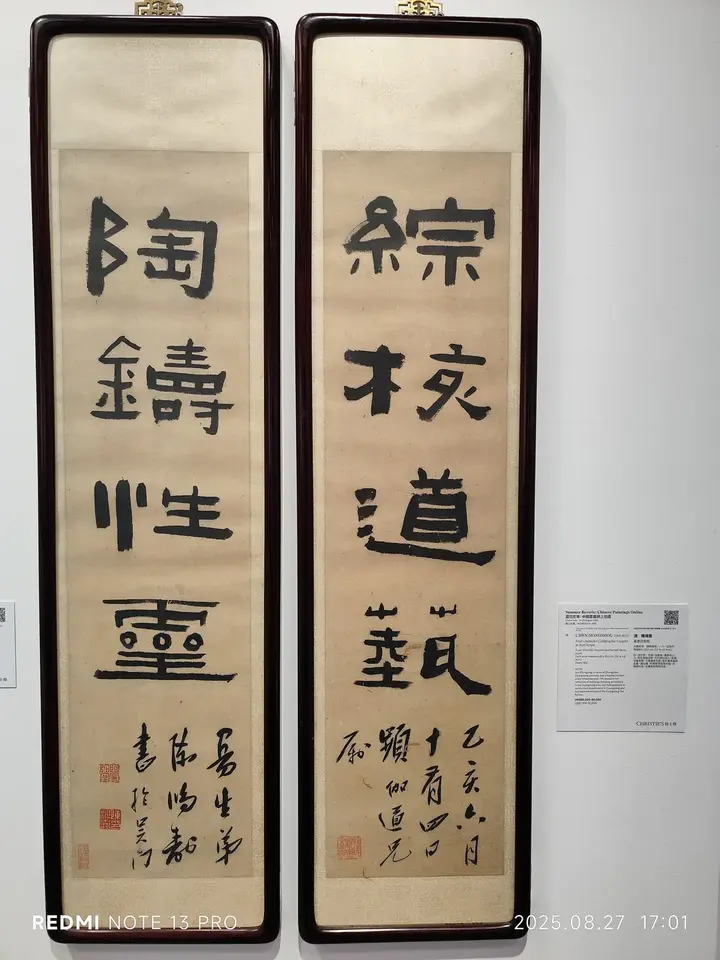
Chen's calligraphic artistry stood out distinctly amid late Ming calligraphic trends, functioning in perfect organic harmony with his painting style. He strictly observed centered-tip brushwork (zhongfeng), mastering the traditional secret of a vertical palm and level wrist. In his early years, he studied the taut, lean angularity of Ouyang Tong's Daoyin Stele; in middle age, he absorbed the wild cursive freedom of Huai Su, while assimilating the structural strength of Chu Suiliang, Mi Fu, and Yan Zhenqing, ultimately forging his singular "Laolian style."
His calligraphy features elongated vertical structures, taut, slender strokes, flat short horizontals, and exposed sharp needle-like vertical terminals, displaying intense geometric structure and modern design sensibility. His poetic inscriptions on paintings, predominantly executed in running-cursive script, are archaic, dynamic, and rhythmically integrated with his eccentric pictorial compositions. Qing scholar Bao Shichen ranked his calligraphy in the supreme "untrammeled class" (yipin shang), praising his style as "an authentic Chu melody that never deviates from elegance."
Chen's upright, centered running script drew inspiration from Tang dynasty sutra copyists, matching the sharp, angular iron-wire lines of his paintings. In his inscriptions, he masterfully deployed vertical columns of script across empty picture spaces, integrating text as an indispensable element of the visual architecture. In modern times, the legendary connoisseur and painter Zhang Daqian famously forged ancient masters with undetectable perfection, but admitted that he could never forge the inscriptions of Jin Nong and Chen Hongshou due to their unmatchable archaic bone structure and sublime linear refinement.
Chen Hongshou possessed profound literary talents and historical consciousness. His poetic style was rugged, desolate, and archaic, consciously emulating Qu Yuan's Elegies of Chu, Han and Wei ballads, and the jagged verse of Late Tang poets Li He and Wen Tingyun, entirely devoid of late Ming triviality. His early poetry displayed buoyant lyricism celebrating youthful ambition and the scenic splendor of Jiangnan; in his later years, shattered by examination failures and the loss of relatives, his voice darkened into tragic resonance.
Following the cataclysm of 1644, his poetry became the anguished cry of an unyielding Ming loyalist. The ten-volume Baolun Tang Ji, compiled during his lifetime by his fourth son Chen Ruzhen, contains hundreds of rhapsodies, regular verses, lyrics, prefaces, and art inscriptions. It meticulously documents Chen's mental journey from peacetime elegance through national collapse, monastic retreat, and poverty-stricken commercial painting, serving as an irreplaceable historical witness to the intellectual trauma of Jiangnan elites during the Ming-Qing transition.
Throughout Baolun Tang Ji, Chen relentlessly castigated officials who surrendered to the conquerors, while offering heartbreaking elegies for his martyred teacher Liu Zongzhou and friend Qi Biaojia. Qing scholar Zhu Yizun praised his verse as "standing solitary and aloof, like an ancient cypress in autumn winds whose music carries far." Modern literary historians recognize Chen as a pillar of late Ming patriotic loyalist poetry, whose moral heroism and artistic genius continue to shine through the ages.
FIGURES ASSOCIATED WITH THIS DYNASTY