Birth in Suzhou
Born into a prominent aristocratic clan in Changzhou County; his grandfather Chen Qiong was a high minister and connoisseur.
陈道复
Chen Daofu (陈道复, 1483–1544), originally named Chen Chun (陈淳), went by his courtesy name Daofu and later styled himself Fufu, with the art names Baiyang and Baiyang Shanren, a native of Changzhou County, Suzhou Prefecture (modern-day Suzhou, Jiangsu Province), was a preeminent painter, calligrapher, and poet of the middle Ming Dynasty. In the history of Chinese art, he is paired with Xu Wei (Qingteng) as the twin peaks of…
Chen Daofu (陈道复, 1483–1544), originally named Chen Chun (陈淳), went by his courtesy name Daofu and later styled himself Fufu, with the art names Baiyang and Baiyang Shanren, a native of Changzhou County, Suzhou Prefecture (modern-day Suzhou, Jiangsu Province), was a preeminent painter, calligrapher, and poet of the middle Ming Dynasty. In the history of Chinese art, he is paired with Xu Wei (Qingteng) as the twin peaks of expressive ink painting, known as "Qingteng and Baiyang," celebrated as the founding father of large-scale freehand ink flower-and-bird painting (daxieyi). Born into an eminent scholar-gentry lineage in Suzhou, his grandfather Chen Qiong served as Minister of Personnel in Nanjing and maintained an intimate bond with Shen Zhou, patriarch of the Wu School of painting; his father Chen Yao was a close friend of master painter Wen Zhengming. At age sixteen, Chen Daofu entered Wen Zhengming's studio to study Confucian classics, poetics, calligraphy, and painting. He became a county student at twenty-six and enrolled as a tribute student in the National University in Nanjing at thirty-six through his grandfather's military merit. Upon completing his studies at forty, Chen permanently renounced bureaucratic ambitions, adopting the art name Baiyang Shanren and retreating to rural seclusion in Dayao Village and beneath Mount Lingyan, living an untrammeled life immersed in art and nature. Chen Daofu achieved groundbreaking revolutions in painting and calligraphy. Initially absorbing the refined techniques of Shen Zhou and Wen Zhengming, he broke free from academic orthodoxies in his middle years by integrating cursive script brushwork into painting, creating an expressive, spontaneous style characterized by pale ink washes and dynamic asymmetrical balance. This innovation propelled Chinese flower-and-bird painting from Song-Yuan decorative precision into the expressive realm of the literati mind. In landscape painting, he synthesized the misty techniques of Mi Youren and Gao Kegong to create his signature "Jiangnan Misty Cloud Mountains." In calligraphy, his wild cursive script pioneered late Ming romantic expressionism. Championing the aesthetic principle that "the viewer should seek my truth beyond mere pigments," his art profoundly shaped later giants including Xu Wei, Bada Shanren, Shitao, the Yangzhou Eccentrics, Wu Changshuo, and Qi Baishi.
Born into a prominent aristocratic clan in Changzhou County; his grandfather Chen Qiong was a high minister and connoisseur.
At age sixteen, entered Wen Zhengming's academy to study classics, poetry, calligraphy, and landscape painting.
Passed county examinations to become a licentiate (shengyuan) in Changzhou County.
Enrolled in the National University in Nanjing at age thirty-six by virtue of his grandfather's meritorious service.
Completed studies at forty, renounced imperial examinations, and retired to Dayao Village, styling himself Baiyang Shanren.
Liberated himself from academic strictures, integrating wild cursive brushwork into freehand flower painting to establish a distinctive personal style.
Traveled between Dayao Village and his mountain hermitage on Mount Lingyan, painting while drinking with friends.
Completed his monumental landscape scroll Misty Mountains (Yanhua Shan Tu) during his final summer; passed away peacefully in winter at age sixty-two.
Chen Daofu was born in 1483 (the 19th year of the Chenghua reign) in Changzhou County, Suzhou Prefecture. The Changzhou Chen family was one of the most culturally distinguished aristocratic houses in Ming Suzhou. His grandfather Chen Qiong served as Minister of Personnel in Nanjing and Vice Censor-in-Chief in Guangdong, possessing immense collections of ancient calligraphy and Song-Yuan paintings, and maintained a lifelong friendship with Shen Zhou, founder of the Wu School of painting. His father Chen Yao was an accomplished Neo-Confucian scholar and calligrapher who enjoyed an intimate fraternal relationship with master artist Wen Zhengming. Surrounded by rare masterpieces—such as Mi Youren's Cloudy Mountains—young Chen Daofu breathed the refined air of classical connoisseurship from his infancy.
In 1498, at age sixteen, Chen Daofu was placed by his father under the direct mentorship of Wen Zhengming. Wen Zhengming held high expectations for his gifted pupil, guiding him through Confucian canonical commentaries, poetry, ancient prose, and the delicate landscape techniques of the Southern School. Endowed with brilliant painterly intuition, Chen Daofu absorbed Shen Zhou's rugged vigor and Wen Zhengming's refined lyricism, quickly earning recognition as the foremost student in Wen's studio. In 1508, at age twenty-six, he obtained his county licentiate degree.
In 1518 (the 13th year of the Zhengde reign), the imperial court rewarded the late Chen Qiong's suppression of coastal pirates by granting hereditary entrance into the Imperial Academy. Thirty-six-year-old Chen Daofu took up the appointment, entering the National University in Nanjing. Living in the ancient southern capital, he studied historical collections, broadened his social contacts among Jiangnan literati, and befriended prominent Chan masters and Daoist scholars.
However, the political climate of the late Zhengde and early Jiajing reigns was darkened by eunuch corruption and partisan feuds. Naturally solitary, freedom-loving, and disdainful of sycophancy, Chen Daofu grew weary of bureaucratic rivalries. In 1522, upon completing his studies at age forty, he made the firm resolve never to pursue bureaucratic office. Furthermore, following the deaths of his grandfather and father, the family fortune waned. Unperturbed by declining wealth, Chen relocated his household from downtown Suzhou to Dayao Village in the countryside, building a rustic retreat named "Baiyang Hermitage" beneath Mount Lingyan. Adopting the moniker "Baiyang Shanren" ("The White Sun Recluse"), he dedicated his life to poetry, wine, and painting amid the hills and lakes of Wu.
Free from courtly obligations, Chen Daofu's artistic genius flourished. He observed that the Wu School following Wen Zhengming was becoming increasingly formulaic, bound by rigid decorative brushwork that suffocated natural vitality. Determined to forge a new path, Chen initiated a bold artistic transformation between the ages of forty and fifty.
He integrated the explosive, dynamic energy of wild cursive calligraphy into ink painting, discarding mechanical line drawing. When painting folding branches, seasonal flowers, and garden rocks, he loaded soft-hair brushes with diluted ink and saturated water, executing petals and leaves with asymmetrical, spontaneous diagonal strokes. Ink tones spread organically across absorbent paper, balancing wetness and dryness. His compositions appeared casual and effortless, yet radiated intense structural vitality and spiritual freedom, establishing the revolutionary daxieyi (expressive freehand) approach in Chinese flower-and-bird painting.
When Wen Zhengming beheld his disciple's radical stylistic departure, he did not rebuke him, but smiled and remarked warmly to friends: "I was merely Daofu's civil examination tutor; in calligraphy and painting he has found his own celestial path, and is no longer my disciple!" This generous acknowledgment validated Chen Daofu's stature as an independent master who had transcended his master's lineage.
In his twilight years, Chen lived a life of serene detachment. He loved wine, frequently floating on Lake Tai with literati companions, executing spontaneous scrolls while pleasantly intoxicated. Connoisseurs, scholars, and local magistrates vied to acquire his ink bamboo and floral paintings, yet Chen remained indifferent to commercial gain, happily gifting masterpieces to humble village acquaintances.
In the spring of 1544, residing in his mountain studio, he painted with boundless inspiration. That summer, sensing the approach of his final days, he gathered his artistic powers to paint the monumental landscape scroll Misty Mountains (Yanhua Shan Tu), applying splash-ink washes inspired by Mi-style cloud mountains. The scroll displayed breathtaking vigor, devoid of any sign of physical decay. In winter of that same year, Chen Daofu passed away peacefully at Baiyang Hermitage at age sixty-two, and was buried beneath Mount Dengwei in Suzhou.
Chen Daofu's supreme achievement in art history was establishing the expressive freehand (daxieyi) flower-and-bird painting tradition. Prior to Chen, Chinese flower-and-bird painting was dominated by Song fine-brush realism or early Ming small-scale decorative outlines (xiaoxieyi).
Chen boldly dismantled rigid physical verisimilitude, declaring that "the viewer should seek my truth beyond mere pigments." He pioneered the method of using diluted, dripping ink washes applied with tilted brushes (danmo qihao), allowing water, ink, and absorbent paper to merge spontaneously. His loose, asymmetrical branches of mallow, lotus, narcissus, and red pear captured the living spirit of the flora with profound philosophical economy. Later, literary giant Xu Wei (Qingteng) adopted and intensified his expressive approach, establishing the historic "Qingteng and Baiyang" lineage. Master painters across subsequent centuries—including Bada Shanren, Shitao, the Eight Eccentrics of Yangzhou, Wu Changshuo, and Qi Baishi—venerated Chen Daofu as the founding ancestor of large-scale freehand ink painting.
In landscape painting, Chen Daofu executed equally revolutionary innovations. Discarding the meticulous, linear texture strokes of later Wu School followers, he revived the Northern Song splash-ink techniques of Mi Fu and Mi Youren, fusing them with Yuan master Gao Kegong's cloud-mountain compositions.
Chen captured the humid atmosphere and drizzling rain of Jiangnan by dragging wide, ink-laden brushes horizontally across the paper, creating ethereal contrasts between evaporating mist and forested mountain peaks. Masterpieces such as Misty Mountains (Yanhua Shan Tu) and Cloud Mountains after Mi demonstrated an untrammeled mastery of wash techniques, expanding the poetic boundaries of Chinese landscape art.
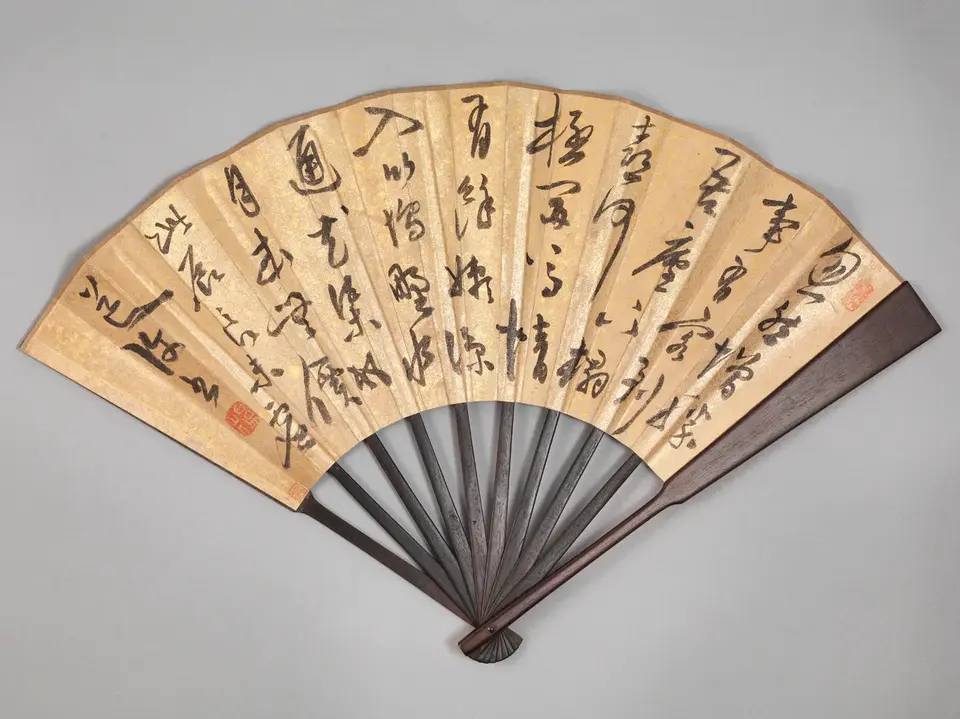
Beyond painting, Chen Daofu was an extraordinary calligrapher who led late Ming calligraphy away from decorous balance toward dynamic romantic expression. Mastering the wild cursive scripts of Tang masters Zhang Xu and Huaisu while incorporating ancient seal script resonance, his cursive lines featured dramatic variations in pressure and rhythmic speed.
Crucially, Chen Daofu became the first artist to systematically channel cursive calligraphic rhythm directly into the compositional lines of ink painting, achieving authentic artistic synthesis. Renowned calligraphy historian Huang Dun observed that Chen Daofu's bold cursive style was a vital 16th-century precursor to the romantic expressionism of late Ming masters such as Zhang Ruitu, Huang Daozhou, Wang Duo, and Ni Yuanlu.
FIGURES ASSOCIATED WITH THIS DYNASTY