Founding of Ci'en
Crown Prince Li Zhi petitioned Emperor Taizong to construct Da Ci'en Monastery in filial tribute to his mother, Empress Wende.
皇家
In the socio-political, geographic, and religious landscape of the Tang Dynasty, the term "Royal Court" (Huangjia) designates the paramount apparatus of dynastic sponsorship centered upon the Tang emperors, empresses, and imperial scions. Establishing their imperial capital at Chang'an, the Li-Tang royal house integrated imperial ideology, Confucian filial ethics, and Mahayana Buddhist devotion, inaugurating an expansive…
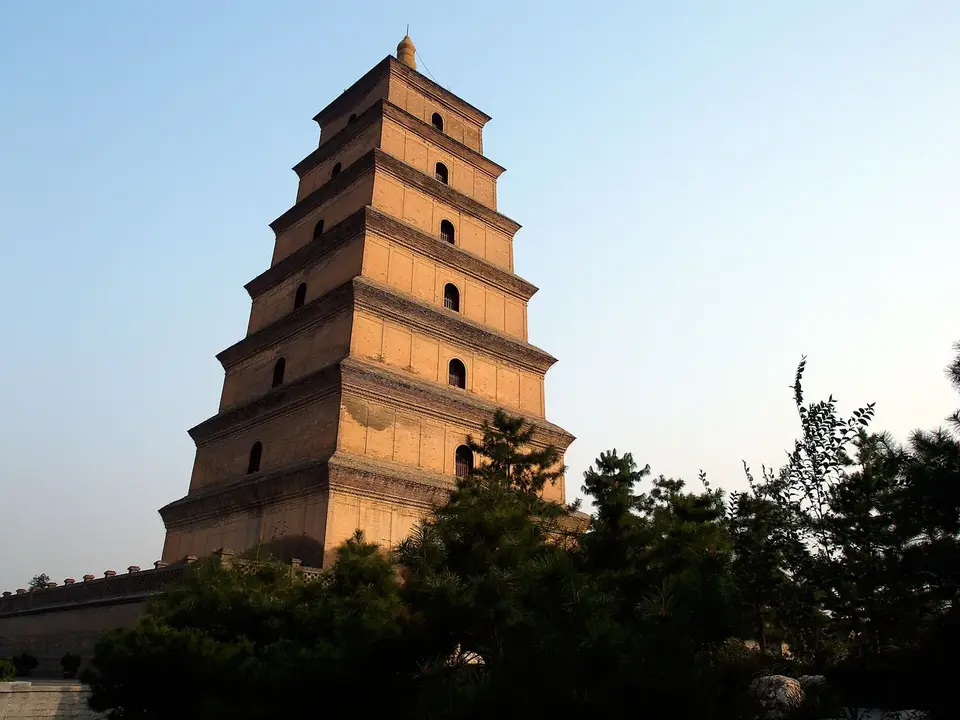
In the socio-political, geographic, and religious landscape of the Tang Dynasty, the term "Royal Court" (Huangjia) designates the paramount apparatus of dynastic sponsorship centered upon the Tang emperors, empresses, and imperial scions. Establishing their imperial capital at Chang'an, the Li-Tang royal house integrated imperial ideology, Confucian filial ethics, and Mahayana Buddhist devotion, inaugurating an expansive system of state-sponsored monastic construction and cultural patronage characteristic of the High Tang era. The consummate material embodiment of this royal patronage and centralized cultural statecraft is the Giant Wild Goose Pagoda (Dayan Ta), situated within the imperial Da Ci'en Monastery in the Jingchang Ward of Chang'an. From 648 (Zhenguan 22), when Crown Prince Li Zhi (later Emperor Gaozong) commissioned Da Ci'en Monastery in memory of his late mother Empress Wende, to 652 (Yonghui 3), when Emperor Gaozong subsidized Tripitaka Master Xuanzang to construct the brick pagoda, through to the Chang'an era (701–704), when Empress Wu Zetian mobilized imperial funds to reconstruct the monument into a majestic seven-story pavilion-style brick pagoda, the imperial house served as the ultimate benefactor, architect, and patron of this UNESCO World Heritage monument. With both Emperors Taizong and Gaozong authoring imperial prefaces engraved in stone by premier calligrapher Chu Suiliang at the southern portal, the Giant Wild Goose Pagoda became an enduring cultural monument uniting sovereign authority, canonical translation, and the civil examination tradition of "Inscribing Names on the Wild Goose Pagoda" (Yanta Timing).
Crown Prince Li Zhi petitioned Emperor Taizong to construct Da Ci'en Monastery in filial tribute to his mother, Empress Wende.
Emperor Taizong composed the Preface to the Sacred Teaching, accompanied by Li Zhi's record, establishing state patronage for Buddhist translation.
Xuanzang petitioned the throne to build a tower to house Sanskrit scriptures and relics; Emperor Gaozong subsidized a five-story brick pagoda.
Emperor Gaozong ordered Chancellor Chu Suiliang to transcribe the two imperial prefaces onto limestone steles mounted at the southern portals.
Emperor Gaozong visited the monastery, personally composing the Monastery Stele Record and conferring the official name "Da Ci'en Monastery."
Empress Wu Zetian and imperial nobles financed the total reconstruction of the pagoda into a seven-story pavilion-style brick structure.
Jinshi graduate Zhang Ju inscribed his name upon the pagoda wall, establishing the national tradition of examination inscriptions.
Poets Du Fu, Gao Shi, Cen Shen, Xue Ju, and Chu Guangxi ascended the pagoda, composing landmark masterpieces of High Tang literature.
In 648 (Zhenguan 22), Crown Prince Li Zhi was consumed by filial grief for his late mother, Empress Wende (Empress Zhangsun), who had passed away early in his youth. Desiring to express boundless gratitude for her maternal nurture, Li Zhi obtained the authorization of Emperor Taizong to construct an imperial monastery on the grounds of the abandoned Wulou Monastery in the picturesque Jingchang Ward in southern Chang'an. Mobilizing the artisans of the Ministry of Works, the imperial court erected Da Ci'en Monastery, comprising thirteen vast courtyards and nearly two thousand palatial halls.
The completion of Da Ci'en Monastery stood as the supreme moral monument of Tang dynastic filial governance and state-sponsored religious integration. Both Taizong and Gaozong understood that the Buddhist doctrine of universal compassion and filial retribution served as an indispensable instrument for reinforcing societal stability in a vast empire. The imperial house provided state stipends to support monastic ordinations, commanding Master Xuanzang to transfer his imperial translation bureau from Hongfu Monastery to Da Ci'en, elevating the complex into the foremost imperial monastery in East Asia.
In 656 (Xianqing 1), having ascended the throne, Emperor Gaozong visited Da Ci'en Monastery accompanied by civil and military ministers. He personally brushed the calligraphic inscription for the Da Ci'en Monastery Stele Record, eloquently articulating the harmonious synthesis of Confucian filial statecraft and Buddhist virtue. This imperial protection firmly established Da Ci'en Monastery as the foundational patriarchal seat of the East Asian Faxiang-Yogacara school of Buddhism.
Imperial backing for Xuanzang's scholarly translation enterprise culminated in monumental imperial literary compositions. In 648, Emperor Taizong composed the celebrated Preface to the Sacred Teaching of the Great Tang Tripitaka (Da Tang Sanzang Shengjiao Xu), followed by Crown Prince Li Zhi's Record of the Preface to the Sacred Teaching. These twin imperial documents integrated the martial glory of the Tang Empire with the profound metaphysical insights of Buddhist philosophy, dispelling centuries of scholarly prejudice against foreign Buddhist teachings and integrating the tradition into state orthodoxy.
In the spring of 652 (Yonghui 3), Xuanzang, deeply concerned that the fragile palm-leaf Sanskrit manuscripts and Buddha relics brought back from India might be lost to decay or metropolitan fires, formally submitted an architectural petition requesting permission to erect a stone stupa at Da Ci'en Monastery. Xuanzang initially proposed an Indian-style stone stupa standing thirty zhang in height. Reviewing the blueprints, Emperor Gaozong, seeking to spare Xuanzang arduous toil and mindful of the enormous quarrying costs, decreed that the Ministry of Works should allocate imperial funds to construct a five-story brick-faced pagoda in the western courtyard.
According to the Biography of the Tripitaka Master of Da Ci'en Monastery, the name "Wild Goose Pagoda" derived from ancient Buddhist lore in Magadha, India, where Hinayana monks were once warned away from consuming meat by a wild goose sacrificing its life, prompting them to embrace Mahayana compassion and erect a reliquary tower. The imperial court's sponsorship of this pagoda symbolized the flourishing of Mahayana Buddhism in Chinese soil.
The construction took two years to complete. Within its chambers, Xuanzang reverently enshrined holy relics and authentic Sanskrit manuscripts. In 653, Emperor Gaozong ordered Chancellor Chu Suiliang, the premier calligrapher of the empire, to brush the two imperial prefaces in his quintessential regular script. The inscriptions were carved into two great limestone slabs and embedded within niches flanking the southern portal of the pagoda, creating a masterpiece uniting imperial prose, Buddhist translation, and calligraphic art.
Following its reconstruction into a seven-story pavilion during the reign of Empress Wu Zetian, the interior chambers of the Giant Wild Goose Pagoda were endowed with sacred relics and art objects reflecting imperial devotion. The ground-floor entrance hall housed not only Chu Suiliang's calligraphic stele inscriptions of the imperial prefaces, but also exquisite limestone carvings illustrating Xuanzang's pilgrimage and translation activities along the Silk Road.
The second-story chamber enshrined a gilded bronze seated statue of Sakyamuni Buddha, while the third story housed a dedicated hardwood altar preserving sacred Buddha relics alongside a bronze architectural model of the pagoda. The fourth-story chamber permanently enshrined two authentic Sanskrit palm-leaf manuscripts measuring 40 centimeters in length and 7 centimeters in width, serving as physical relics of intercultural transmission.
The fifth and sixth stories displayed thousand-Buddha jade sculptures, stone reliefs, and carved wooden tablets bearing the five-character ancient-style poems composed by Du Fu, Cen Shen, Gao Shi, Xue Ju, and Chu Guangxi in 752. Reaching the seventh story, visitors could look out across the grid of Chang'an toward Mount Zhongnan, experiencing a spiritual panorama that united Buddhist transcendence with imperial grandeur.
Imperial maintenance and enhancement of the Giant Wild Goose Pagoda reached a glorious turning point during the reign of Empress Wu Zetian. In the Chang'an era (701–704), after fifty years of weathering, the original five-story brick-and-earth structure suffered from structural decay and creeping vegetation. Displaying visionary imperial ambition, Empress Wu allocated treasury funds and rallied imperial princes, princesses, and noble houses to donate lavish donations for a complete architectural reconstruction.
Abandoning the Indian-style brick-faced earthen-core construction, the imperial master builders embraced indigenous Chinese pavilion aesthetics and multi-story engineering. Utilizing water-milled blue bricks and fine lime mortar, they reconstructed the Giant Wild Goose Pagoda into a monumental seven-story, square-plan pavilion-style brick pagoda soaring over sixty meters in height. Each floor was fitted with arched arched doorways and internal wooden staircases allowing visitors to ascend and view the capital. Its gracefully tiered eaves, refined brackets, and imposing silhouette established the iconic physical form that has endured to this day.
This royal reconstruction not only represented a technological triumph of medieval Chinese brick masonry, but also elevated the monument from a private scripture vault into a sublime imperial civic landmark visible across the Chang'an skyline. Adorning the stone lintels and doorframes of the ground floor portals, imperial master artisans engraved exquisite line-carvings of heavenly beings and Buddhist tableaux, traditionally attributed to court masters Yan Liben and Wu Daozi.
Under imperial patronage, Da Ci'en Monastery evolved from an exclusive royal sanctuary into the cultural and social heart of metropolitan Chang'an. During the Jinglong era of Emperor Zhongzong, the court established the Academy for the Cultivation of Literature (Xiuwen Guan), recruiting the empire's finest literary masters to accompany imperial progresses and compose poetic responses.
Every autumn on the Double Ninth Festival, the emperor proceeded in his imperial carriage to Da Ci'en Monastery, ascending the Giant Wild Goose Pagoda to gaze upon Mount Zhongnan and the bustling avenues of Chang'an. The monarch banqueted ministers upon the pagoda tiers, commanding scholar-officials to compose verses. These imperial-scholastic poetic exchanges were compiled into forty volumes of Ci'en Ascending Poems, creating a celebrated court tradition. In late autumn of 752 (Tianbao 11), poetic giant Du Fu joined contemporaries Cen Shen, Gao Shi, Xue Ju, and Chu Guangxi in ascending the pagoda, where Du Fu composed his immortal lines: "Its lofty spire straddles the vault of heaven, fierce winds blow without respite."
Following the An Lushan Rebellion, though Da Ci'en Monastery suffered recurring destruction during late Tang wars, the Giant Wild Goose Pagoda was repeatedly restored by provincial authorities. During the Five Dynasties period under Later Tang, regional governors financed major structural restorations; successive repairs followed during the Song, Yuan, and Ming dynasties.
In 1604 (Wanli 32), confronting surface weathering of the original Tang masonry, Shaanxi Governor Zhao Kehuai encased the entire exterior of the pagoda in a sturdy shell of Ming-dynasty bricks, creating the composite structural profile seen today—a Ming brick facade protecting the internal seven-story Tang core. Subsequent repairs under Kangxi and Tongzhi in the Qing Dynasty maintained the tower's internal stairways and eave brackets.
Following the founding of the People's Republic of China, the Giant Wild Goose Pagoda was designated among the First Batch of Major Historical and Cultural Sites Protected at the National Level. Comprehensive conservation programs addressed structural leaning and stabilized groundwater levels. In 2014, at the 38th session of the World Heritage Committee, the pagoda was inscribed on the UNESCO World Heritage List as a prominent site along the "Silk Roads: the Routes Network of Chang'an-Tianshan Corridor," cementing its eternal status as a global cultural treasure.
During the Lantern Festival, the Double Ninth Festival, and auspicious seasonal days, the imperial court frequently opened the monastic orchards to the populace, allowing scholars, commoners, and foreign merchants to mingle freely in celebration of imperial peace and prosperity. When the monastery's celebrated peonies bloomed in spring, citizens from across the capital crowded its pathways in a colorful metropolitan festival.
In 707 (Jinglong 1), Jinshi graduate Zhang Ju visited Da Ci'en Monastery with fellow officials and spontaneously inscribed his name and ancestral home upon the southern walls of the pagoda. Rather than punishing this act, the Tang royal court welcomed the gesture, institutionalizing it as a national rite of honor for successful civil examination candidates.
Following the promulgation of examination results each spring, the imperial court sponsored lavish banquets in the Royal Apricot Garden. Adorned in imperial red silk and mounted on caparisoned horses, newly graduated Jinshi proceeded in solemn cavalcade to Da Ci'en Monastery to inscribe their names upon the Giant Wild Goose Pagoda. If a graduate subsequently rose to become chancellor, his name was re-inked in vermilion red. At age twenty-seven, celebrated poet Bai Juyi composed his famous lines: "Beneath the Ci'en Pagoda where names are inscribed, among the seventeen, I was the youngest." Through this symbolic ritual, the imperial house permanently fused scholarly honor and bureaucratic legitimacy with the ancient brick monument.
By constructing Da Ci'en Monastery and the Giant Wild Goose Pagoda, the Tang imperial house pioneered a novel institutional model in medieval Chinese history, uniting royal filial ancestral devotion with state-sponsored translation academia. Da Ci'en Monastery functioned both as an imperial shrine honoring Empress Wende and as the supreme governmental translation academy, supported directly by the imperial exchequer.
The court assembled the empire's preeminent scholastic monks, official editors, and court calligraphers within the monastery, appointing high-ranking imperial ministers as official superintendents. This imperial bureau system emancipated Buddhist translation from reliance on precarious private donations, transforming the transmission of Buddhist culture into a formal instrument of Tang statecraft and facilitating the emergence of the Faxiang-Yogacara school.
Emperor Taizong's Preface to the Sacred Teaching and Emperor Gaozong's Record of the Preface to the Sacred Teaching represent the highest official imperial endorsement of Buddhist thought in Chinese intellectual history. These imperial texts harmonized the Confucian principles of righteous governance with Buddhist metaphysical philosophy, achieving an unprecedented synthesis within the centralized ideology of the Tang Empire.
Commissioning premier calligrapher Chu Suiliang to transcribe the texts onto steles flanking the pagoda portals created an enduring monument uniting imperial prose, supreme calligraphy, and sacred doctrine. These inscriptions became quintessential models for generations of literati, serving as unassailable historical documents celebrating the High Tang civil order.
The comprehensive reconstruction directed by Empress Wu Zetian during the Chang'an era marked a technological leap in ancient Chinese masonry engineering. Following imperial blueprints, master architects discarded the primitive earthen-core method, utilizing water-milled blue bricks to construct a hollow-core, seven-story pavilion structure featuring internal ascending stairs and arched viewing windows.
Reaching a height of 64.5 meters upon a 25.5-meter square base, the pagoda possessed extraordinary seismic resilience, withstanding multiple devastating earthquakes in the Guanzhong basin across thirteen centuries. This seven-story pavilion design thoroughly Sinified the Indian Buddhist stupa, creating an indigenous architectural paradigm that profoundly influenced pagoda design throughout medieval East Asia.
The imperial court's generous patronage of civil scholars found its most sublime ceremonial expression at the Giant Wild Goose Pagoda. By designating the pagoda as the official site for Jinshi graduates to inscribe their names, the throne transformed this Buddhist complex into the ultimate shrine of literati achievement.
From the Jinglong era through the fall of the Tang, countless literary giants, including Bai Juyi, Liu Yuxi, and Han Yu, recorded their names upon the pagoda walls. The tradition of "Inscribing Names on the Wild Goose Pagoda" became an enduring symbol of imperial meritocracy and scholarly prestige. Through this rite, the Tang royal court bound the aspirations of the empire's educated elite to the imperial state, cementing the pagoda as the supreme cultural totem of the Tang golden age.
The ancient Sanskrit palm-leaf manuscripts preserved in the Giant Wild Goose Pagoda were produced from the leaves of the palmyra palm (Borassus flabellifer), subjected to boiling, pressing, herbal curing, and trimming. In ancient India, before the widespread adoption of paper, sacred Buddhist texts were incised onto palm leaves using iron styluses and rubbed with lampblack oil. During his seventeen-year pilgrimage traversing over 110 kingdoms, Master Xuanzang studied under Venerable Silabhadra at Nalanda, eventually bringing back 657 Mahayana sutras, treatises, and vinaya texts in this palm-leaf format.
The Tang royal court allocated vast imperial revenues to erect the Giant Wild Goose Pagoda specifically to safeguard these fragile cultural treasures against fire and decay. This imperial patronage not only preserved countless ancient Sanskrit texts that subsequently disappeared in India due to political upheaval, but also transformed Chang'an into the greatest international center for translation and philological research in medieval Eurasia.
As an imperial sanctuary of supreme sanctity, the Giant Wild Goose Pagoda housed over six hundred Sanskrit palm-leaf manuscripts and authentic Buddha relics brought by Xuanzang along the Silk Road. Within its fourth-story chamber, two precious palm-leaf manuscripts measuring 40 centimeters in length remain preserved to this day, representing priceless artifacts of intercultural transmission.
Modern archaeological assessments suggest that beneath the pagoda foundation, an imperial underground reliquary crypt (digong), akin to that discovered at Famen Monastery, likely conceals magnificent Tang royal offerings and sacred implements. By gathering world-class scriptures, relics, and artistic engravings within the pagoda, the imperial court transformed Chang'an into the central spiritual hub of the Eurasian Silk Road.
FIGURES ASSOCIATED WITH THIS DYNASTY