Taiyuan Uprising
Escaped Chang'an to join Li Yuan at Jinyang; appointed Chief of Staff and Cavalry Commander.
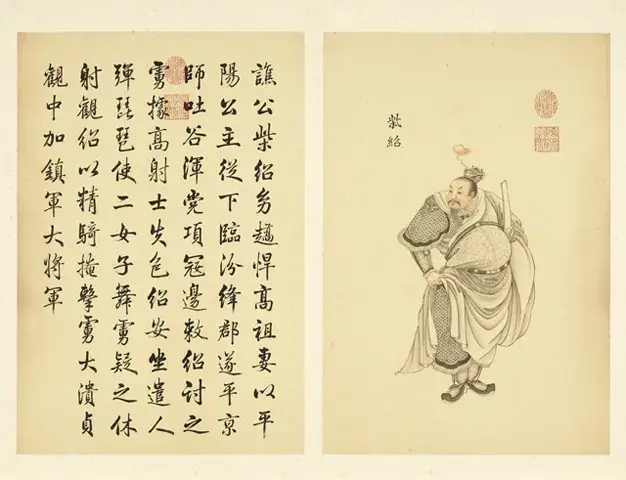
柴绍
Chai Shao (柴绍, ?–638), courtesy name Sichang, was an illustrious founding general of the Tang dynasty and one of the Twenty-Four Meritorious Officials of the Lingyan Pavilion. Born into a prominent Guanlong military aristocracy in Linfen, Jinzhou, he was the son of Sui governor Chai Shen. Renowned from youth for his courage, chivalrous character, and consummate skill in mounted archery, Chai Shao entered imperial service…
Chai Shao (柴绍, ?–638), courtesy name Sichang, was an illustrious founding general of the Tang dynasty and one of the Twenty-Four Meritorious Officials of the Lingyan Pavilion. Born into a prominent Guanlong military aristocracy in Linfen, Jinzhou, he was the son of Sui governor Chai Shen. Renowned from youth for his courage, chivalrous character, and consummate skill in mounted archery, Chai Shao entered imperial service as an imperial bodyguard to Sui Crown Prince Yang Zhao. Recognizing his exceptional martial talent and noble pedigree, Li Yuan (the future Tang Emperor Gaozu) gave him his third daughter (later celebrated as Princess Pingyang) in marriage. In 617 (Daye 13), when Li Yuan launched the Taiyuan uprising against the Sui dynasty, Chai Shao slipped out of Chang'an to join the rebellion, serving as Chief of Staff of the Right Army and Cavalry Commander. He played a decisive role in slaying Sui general Song Laosheng at Huoyi and was among the first to scale the walls of Chang'an. Following the establishment of the Tang dynasty, Chai Shao served as a premier cavalry commander under Li Shimin, participating in the pacification of Xue Ju, Song Jingang, Wang Shichong, and Dou Jiande. In 623, facing an overwhelming Tuyuhun invasion at Minzhou, Chai Shao famously deployed female pipa dancers to distract the barbarians before launching a devastating flank attack, an episode celebrated as "Subduing Barbarians through Song." In 628 (Zhenguan 2), he commanded the final campaign that destroyed Liang Shidu in Shuofang, extinguishing the last Sui-era rival warlord. Honored as Duke of Qiao, Chai Shao died in 638, receiving the posthumous name Xiang and enshrinement in the imperial ancestral temple.
Escaped Chang'an to join Li Yuan at Jinyang; appointed Chief of Staff and Cavalry Commander.
Slew Song Laosheng at Huoyi and was the first to scale the ramparts of Sui capital Chang'an.
Appointed Zuo Yiwui Da Jiangjun; ennobled as Duke of Linfen upon the dynastic founding.
Cut enemy supply lines in the campaign against Xue Renguo, securing imperial dominance in Longxi.
Spearheaded the pursuit of Song Jingang through Qianshugu, fighting eight battles in a single day.
Commanded elite heavy cavalry against Dou Jiande and Wang Shichong, advanced to Duke of Huo.
Employed pipa dancers to distract Tuyuhun archers before executing a lethal cavalry encirclement.
Besieged Shuofang amidst heavy snow, crushing Turkic relief armies and unifying northern China.
Re-ennobled as Duke of Qiao, granted the senior military rank of Zhenjun Da Jiangjun.
Died of illness; personally visited by Emperor Taizong, buried with imperial honors, and enshrined in the Tai Miao.
Chai Shao descended from an illustrious lineage of Guanlong military aristocrats. His grandfather Chai Lie served Northern Zhou as a Senior General and Governor of Anzhou, ennobled as Duke of Guanjun. His father, Chai Shen, was a high-ranking Sui palace guard commander and Governor of Julu. Endowed with natural agility and martial daring, Chai Shao was renowned throughout the capital for his horsemanship and archery. He commenced his career during the Daye era as an imperial Qianniu Beishen bodyguard to Crown Prince Yang Zhao.
Li Yuan, then garrison commander of Taiyuan, sought to cultivate ties with rising military leaders across northern China. Impressed by Chai Shao's chivalrous bearing and impeccable noble descent, Li Yuan arranged for his marriage to his third daughter. This union bound Chai Shao intimately to the core leadership of the House of Li.
In the summer of 617 (Daye 13), Li Yuan initiated preparations for the Taiyuan uprising. Chai Shao was residing in the Sui capital of Chang'an when secret couriers arrived from Jinyang urging his immediate return. Fearing that traveling with his wife would arouse official suspicion, Chai Shao hesitated. Princess Pingyang resolved his dilemma with heroic clarity, declaring: "You must go at once! As a woman, I can easily conceal myself and take care of matters here." Chai Shao broke through imperial checkpoints on horseback, while Princess Pingyang dispersed her family wealth in Huxian to raise a formidable insurgent army known as the Army of the Lady (Niangzi Jun).
While traveling through Qianshugu, Chai Shao encountered Li Yuan's sons Li Jiancheng and Li Yuanji, who were considering abandoning their journey to become woodland bandits out of fear of Sui pursuit. Chai Shao vigorously admonished them, pointing out that banditry offered certain doom while the righteous banners of Taiyuan promised imperial dominion. Persuaded by his counsel, the brothers joined Chai Shao and galloped night and day to Jinyang.
Li Yuan rejoiced at their arrival, appointing Chai Shao Chief of Staff of the Right Army and Supreme Commander of Cavalry. In the autumn of 617, Li Yuan marched south toward Guanzhong. At the battle of Huoyi, the veteran Sui general Song Laosheng drew up his elite formations outside the walls. Chai Shao and Li Shimin led an aggressive cavalry envelopment, cutting off Song Laosheng's retreat and slaying him on the field.
Advancing to the Yellow River, Chai Shao led the forward cavalry across the waters, defeating the Sui commander Sang Xianhe at Changdao. In September, the rebel armies invested Chang'an. Chai Shao fought in the front ranks, scaling the ramparts under a hail of stones and opening the city gates to admit the army. Following the formal founding of the Tang dynasty in 618 (Wude 1), Chai Shao was appointed Zuo Yiwei Da Jiangjun and ennobled as Duke of Linfen.
Between 618 and 621, Chai Shao served as Li Shimin's most dependable cavalry commander during the brutal wars of national unification. At the Battle of Qianshuiyuan against Xue Ju and his son Xue Renguo, Chai Shao outflanked the rebel battle line, cutting off their lines of supply and precipitating Xue Renguo's surrender.
In 619, when Liu Wuzhou's general Song Jingang occupied Taiyuan, Chai Shao accompanied Li Shimin to Babili. In April 620, during the relentless pursuit through Qianshugu, Chai Shao spearheaded eight successive cavalry assaults in a single day, driving the enemy over two hundred li and annihilating Song Jingang's army.
During the climactic double campaign of 621 against Wang Shichong at Luoyang and Dou Jiande at Hulao Pass, Chai Shao repeatedly commanded the elite Xuanjia heavy cavalry. In the decisive engagement at Hulao, Chai Shao pierced Dou Jiande's flank, fracturing his defensive squares and capturing thousands of prisoners. For his exceptional services in destroying two rival empires simultaneously, Chai Shao was advanced to Duke of Huo.
In April 623 (Wude 6), the nomadic Tuyuhun launched a major invasion of Minzhou. Leading a relief army, Chai Shao found his vanguard trapped in a narrow valley with hostile archers occupying the surrounding heights. Amidst falling arrows and panicking troops, Chai Shao coolly ordered two camp musicians to play the pipa and dance in full view of the enemy. Captivated by the unexpected performance, the nomadic warriors ceased firing and crowded forward to watch. Exploiting their distraction, Chai Shao launched a concealed cavalry force around the rear, inflicting a crushing defeat that left five hundred enemy dead, including a prominent nomadic prince.
In 628 (Zhenguan 2), the sole surviving Sui-era warlord, Liang Shidu, remained entrenched in Shuofang under the protection of the Eastern Turks. Emperor Taizong commissioned Chai Shao as Supreme Commander to eradicate the rebel bastion. Marching through blinding blizzards, Chai Shao ambushed and destroyed a massive Turkic relief army beneath the city walls. Despairing of rescue, Liang Shidu was assassinated by his cousin Liang Luoren, who surrendered the fortress. Chai Shao's victory completed the territorial unification of northern China.
Chai Shao was elevated to Duke of Qiao and Zhenjun Da Jiangjun. In 638 (Zhenguan 12), worn down by decades of relentless campaigning, Chai Shao fell gravely ill. Emperor Taizong personally visited his bedchamber to comfort him. Upon his death, Taizong suspended court business in mourning, posthumously conferred the rank of Grand Area Commander of Jingzhou, awarded the posthumous name Xiang, and ordered his enshrinement in the Tai Miao. In 643, his portrait was placed fourteenth on the roster of the Lingyan Pavilion.
Chai Shao was celebrated in Chinese military annals for his mastery of psychological deception and unconventional tactics. His famous stratagem at Minzhou in 623, in which he used musical performance to disarm and distract a numerically superior nomadic army before delivering a lethal flanking blow, remains one of the most famous examples of psychological warfare in imperial military history.
From the inception of the Taiyuan uprising through the destruction of Song Laosheng, Song Jingang, and Dou Jiande, Chai Shao served as a primary cavalry hammer for the Tang dynasty. His final campaign against Liang Shidu in 628 extinguished the last bastion of domestic resistance to Tang rule, securing the northern frontier and laying the strategic foundation for the golden age of Zhenguan.
FIGURES ASSOCIATED WITH THIS DYNASTY