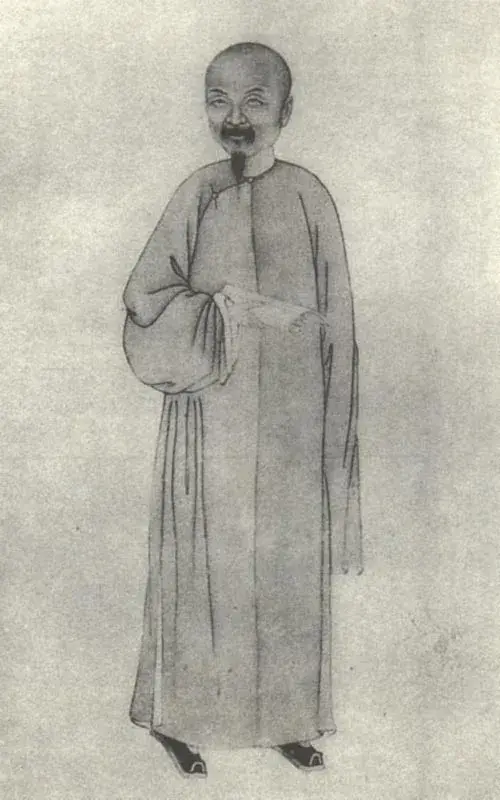
Biography
Illustrious Ancestry and Child Prodigy
Cha Shenxing was born on June 5, 1650, in Yuanhua Town, Haining County, Hangzhou Prefecture, Zhejiang Province. The Cha lineage of Haining was a preeminent gentry house renowned for producing generations of high-ranking scholar-officials throughout the Ming and Qing dynasties. However, in the turbulence surrounding the dynastic transition, Cha's branch suffered acute financial hardship. Endowed with precocious intellect, Cha composed verse at five, and by six his compositions exhibited refined rhythm and antithetical balance.
At the age of ten, Cha authored the treatise On Marquis Wu, evaluating Zhuge Liang's administration of Shu Han. Senior county scholar Fan Xiang praised the essay, establishing Cha's metropolitan reputation as a child prodigy. In 1667, at seventeen, Cha traveled to Yuyao to study the Confucian classics and the Book of Changes under Huang Zongxi, the paramount thinker of the Eastern Zhejiang School. Huang's emphasis on empirical statecraft provided the rigorous foundation for Cha's lifelong intellectual endeavors.
At eighteen, visiting Hangzhou, Cha composed the widely celebrated couplet: 'Extraordinary worldly affairs reside in hearsay; the finest friendships blossom at first sight.' Ming loyalist scholar Lu Jiashu admired his genius and arranged for his daughter to marry Cha. In 1669, Cha traveled to Mount Wu to study belles-lettres under Ningbo scholar Ye Boyin. In 1671, at twenty, Cha passed the prefectural examinations, becoming a licensed government student.
His early years in Haining solidified his profound classical learning and instilled deep appreciation for clan resilience amidst dynastic disruption. Alongside his father-in-law and senior literati, he explored Neo-Confucian metaphysics while mastering historical treatises. In East Zhejiang literati circles, his moral integrity and luminous intellect earned widespread admiration among contemporaries.
Parental Bereavement and Southwestern Campaigns
In 1671, aspiring toward official candidacy, Cha sat for the provincial civil service examination. Before the session concluded, urgent letters arrived reporting his mother's critical illness. Cha hastened home to attend her bedside, but she passed away the following year. Within several years, his father also died. Bereaved of both parents within seven years, his impoverished household plunged into destitute despair.
Imperial statutes strictly prohibited examination candidacy during required three-year mourning periods. As the eldest son responsible for impoverished younger siblings, Cha set aside examination preparation to seek external employment. In the summer of 1679, Cha accompanied his cousin Cha Rong to Jingzhou, entering the military secretariat of Guizhou Governor Yang Yongjian. With the campaign against Wu Sangui's rebellion in full swing, Cha marched with government armies into the rugged mountainous terrain of Guizhou and Yunnan.
Amidst garrison warfare and civilian dislocation on the southwestern frontier, the twenty-nine-year-old scholar underwent a profound philosophical transformation. He gathered and burned all his youthful romantic poetry, vowing thereafter that his verse would strictly mirror actual landscapes and civilian tribulations. In 1682, bidding farewell to Governor Yang, Cha traveled from Guiyang through Hunan to Changsha, compiling his documentary verses into Collection of the Swift Return, which achieved wide acclaim among military officers and frontier gentry.
During his southwestern campaigning, Cha witnessed military logistics, pass fortifications, and indigenous chieftain cultures. Journeying through miasmal ravines by day and composing realistic field journals by night, the trials of the remote borderlands purged away ornate salon conventions, endowing his poetic oeuvre with somber gravitas and genuine compassion for the downtrodden.
Metropolitan Scholarship and Tutoring in Mingzhu's Residence
In 1683, Cha resided in Hangzhou, reuniting with his mentor Huang Zongxi and touring West Lake. That winter, sponsored by his paternal grand-uncle Cha Peiji, Cha resolved to travel to Beijing to seek metropolitan advancement. In the summer of 1684, Cha arrived in Beijing, enrolling as an imperial student at the National Guozijian Academy.
In Beijing, Cha paid respects to Wang Shizhen, Vice Minister of Punishments and undisputed arbiter of the poetry world, who warmly welcomed him. Cha integrated into premier literati circles, gathering with Zhu Yizun, Tang Youzeng, Hui Zhouli, Wu Wen, Jiang Chenying, Wei Kun, and Zhang Yunzhang at Changchun Temple and Mohe Hermitage. When his cousin Zhu Yizun moved to the Ancient Wisteria Studio outside Xuanwumen, Cha became a regular attendee at nocturnal poetry gatherings, establishing a formidable metropolitan reputation.
In the winter of 1686, Grand Secretary Nalan Mingzhu, recognizing Cha's eminence, hired him as preceptor for his youngest son, Nalan Kuixu. Mingzhu exercised immense court influence, but Cha maintained scholarly dignity within the grand residence. Under Cha's dedicated guidance, Kuixu excelled in classical studies, cementing an enduring teacher-student bond that withstood later political upheavals. In 1687, Mingzhu constructed his Haidian villa, inviting Cha to survey the site and compose dedicatory verses.
During his years teaching inside the prime minister's estate, Cha scrupulously maintained personal austerity, never exploiting grandee influence for private benefit. He directed Kuixu through dynastic histories and canonical ethics while participating in high-minded literary salons across the capital, winning deep veneration from the grand secretary's entire family.
The Theatrical Inquisition of 1689 and Adopting the Name Shenxing
In early 1689, Cha requested leave to return to Haining to care for his dying father-in-law, Lu Jiashu. After managing the funeral ceremonies, Cha returned to Beijing in the autumn. However, an unforeseen political storm was gathering across the capital. In August, following the demise of Empress Xiaoyiren, the imperial court had entered a mandatory twenty-seven-day period of national mourning.
Dramatist Hong Sheng's newly authored opera The Palace of Eternal Life was attracting wide acclaim in metropolitan literati circles. Imperial Diarist Zhao Zhixin and Cha Shenxing accepted an invitation to attend an evening performance and banquet in Hong Sheng's private courtyard. Supervising Censor Huang Liuhong, harboring factional grievances, submitted memorials impeaching Zhao Zhixin and his companions for indulging in theatrical festivities during imperial mourning. The Kangxi Emperor dismissed Zhao Zhixin and all attending officials, banishing Hong Sheng from Beijing.
Cha Shenxing, as an attending guest, suffered harsh retribution. Charged with gross irreverence during national mourning, he was stripped of his Imperial Academy studentship and expelled to his hometown. This devastating setback prompted sleepless self-examination. Concluding that literati carelessness invited disaster, he discarded his original clan name Silian, adopting the name Shenxing (meaning 'circumspect action') and the courtesy name Huiyu (meaning 'regretting error'), using them as a permanent moral safeguard.
This theatrical inquisition shattered Cha's early bureaucratic prospects but proved a vital crucible for moral maturation. In the quiet solitude of his hometown, he channeled introspection into deep textual philology. Embracing his new name, he cultivated prudent restraint, forging an enduring inner stoicism that enabled him to navigate subsequent court perils with equanimity.
Journeying through Jiangnan and Authoring Record of Mount Lu
In February 1690, Cha departed Beijing. Retired Minister of Punishments Xu Yuanwen invited Cha and scholar Jiang Chenying to accompany him south by canal barge. That autumn, Cha worked as an editor at the Jushe Academy in Wuxian, Jiangsu. Crossing Lake Dongting, he encountered poet Zhang Yunzhang; their collaborative verses were carved into woodblocks as Anthology of Harmonies at Jushe.
In the spring of 1692, Cha's close friend Zhu Yan was appointed Prefect of Jiujiang in Jiangxi. Recognizing Cha's talent, Zhu invited him into his administrative secretariat. Journeying through Tongcheng and Anqing, Cha visited the ancestral shrine of Ming martyr Zuo Guangdou and visited the hermitage of Ming loyalist Qian Chengzhi, receiving a copy of Cangshan Ji.
Arriving in Jiujiang, Prefect Zhu provided provisions and escorts for Cha to explore Mount Lu. Over ten days, Cha ascended Five Old Men Peak, Hanpo Pass, Sandie Spring, and the White Deer Grotto Academy, recording geological formations, ancient forest groves, and cliffside inscriptions in his classic travelogue Record of Mount Lu. Synthesizing precise geographical observation with lyrical contemplation, the work established an early Qing benchmark in landscape prose.
Exploring Mount Lu's misty crags, Cha studied Song stone inscriptions and classical academy precepts. In Jiujiang, he assisted Prefect Zhu in tax assessments and educational reforms, earning praise for upright efficiency. When he departed in autumn, local scholars escorted his boat to the river gates, celebrating his prose mastery and personal virtue.
Juren Success at Forty-Four and Itinerant Poetic Friendships
In the spring of 1693, Cha met his younger brother Cha Silian in Anhui, and they traveled together to Beijing. Grand Secretary Mingzhu greeted Cha warmly at Ziyi Garden, while student Nalan Kuixu composed verses welcoming his preceptor. In the autumn of 1693, sitting for the Shuntian provincial examinations at age forty-four, Cha passed the examinations in twentieth place, with close friend Jiang Chenying ranking nineteenth, sparking metropolitan celebration.
In the spring of 1694, Cha failed the metropolitan jinshi examinations. He escorted retired Vice Minister of Rites Xu Zhuo south, writing the verse collection White Duckweed Collection. Over the ensuing years, Cha served across Jiangnan secretariats. In 1697, when his eldest son Cha Kejian passed the metropolitan jinshi examination, Cha erected Deshou Tower on his ancestral estate, composing verses encouraging his son's official career.
In the summer of 1698, Cha joined Zhu Yizun on a journey through Fujian. Traveling down the Qiantang River through the Seven-Mile Gorge to Mount Wuyi, the two early Qing literary giants spent months composing paired verses along the Nine Bends River and the Min River basin. These arduous travels elevated Cha's poetic maturity, winning him renown across southern literati networks.
Throughout decades of itinerant travel, every gorge of Zhejiang, coastal headland of Fujian, and historical landmark of Nanjing was immortalized in his verse. Collaborating with Zhu Yizun on river voyages, they appraised ancient masters and refined poetic meters, freeing Cha's compositions from cloistered academicism and imbuing them with majestic vitality.
Family Bereavement and the Dezhou Imperial Audience
Between 1699 and 1701, Cha suffered devastating family bereavement. Within three short years, his granddaughter, second daughter, daughter-in-law, and mother-in-law died in rapid succession. Stricken with sorrow, Cha suffered hair loss and dental decay. In 1700, he failed the metropolitan examinations once more, afterward lodging at the official yamen of his son Cha Kejian in Shulu County, Zhili.
In October 1702, returning from his southern inspection tour, the Kangxi Emperor docked the imperial barge at Dezhou, Shandong. Seeking assessments of Jiangnan scholars, the emperor consulted Grand Secretary Zhang Yushu, who vigorously recommended Cha. Zhili Governor Li Guangdi confirmed Cha's classical erudition and moral rectitude. Delighted by these reports, Emperor Kangxi dispatched couriers to summon Cha from Zhili to the Dezhou traveling palace.
On October 20, Cha arrived and underwent a direct imperial audience. Questioned regarding classical commentaries and historical governance, Cha responded with erudition and poise. Emperor Kangxi bestowed upon him imperial calligraphy of Neo-Confucian master Cheng Yi's Visual Precepts. On October 28, summoned to the capital, Cha underwent examination inside the Forbidden City's South Study, composing essays on statecraft. Deeply impressed by his lucidity, Emperor Kangxi issued an edict: 'Cha Shenxing and Wang Hao are hereby commanded to attend duties in the South Study alongside Cha Sheng.'
Rising from an unranked provincial candidate directly into the intimate South Study advisory council was a rare imperial favor in Qing annals. Serving on daily shifts alongside Cha Sheng and Wang Hao, Cha drafted imperial verses and edited historical collections. Maintaining austere integrity from dawn to dusk, his classical erudition cemented Emperor Kangxi's lasting trust.
Late Jinshi Success and Imperial Favor as Court Compiler
In January 1703, at age fifty-four, Cha formally entered duty in the South Study, receiving an imperial gift of a precious green stone inkstone. In March, he passed the metropolitan examination. In the palace examination, his elegant statecraft papers earned him second place in the second class of jinshi candidates. He was appointed Bachelor of the Hanlin Academy, and in November of that year, Emperor Kangxi promoted him to Compiler of the Hanlin Academy while retaining his South Study post.
In the South Study, Cha conducted himself with circumspect professionalism, avoiding political intrigue. Whenever Emperor Kangxi traveled to the Mountain Resort at Rehe or the Mulan hunting grounds, he included Cha in his entourage. Traversing frontier grasslands, Cha composed verses on borderlands scenery that consistently won first place in imperial competitions. In 1705, the emperor inscribed a hall plaque reading 'Jingyetang' (Hall of Respectful Diligence) in recognition of his service.
Cha served as a core editor for major imperial publications. In 1709, he entered the Wuying Palace Editorial Office to oversee the encyclopedic compilation Peiwen Yunfu. When Cha requested leave in 1706 to bury his grandparents, Emperor Kangxi ordered that his stipend continue, bestowing two hundred taels of silver, while the Crown Prince gifted two fine mules. Serving ten years in the inner court, Cha was universally recognized as the foremost Confucian courtier of the era.
As Emperor Kangxi's trusted court poet, Cha produced majestic borderland verses during northern expeditions. Passing Gubeikou and witnessing banner cavalry maneuvers across the steppes, his early delicate Jiangnan cadence expanded into heroic northern vigor. His rapid impromptu compositions pleased court grandees, cementing his standing as a master courtier-poet.
Retirement to Haining and Compiling the Su Shi Commentary
In the winter of 1711, prolonged desk work caused severe rheumatism in Cha's left arm, which spread to his right shoulder by spring. Emperor Kangxi granted him exemption from inner court night shifts, transferring him to general Hanlin duties. In the autumn of 1713, past sixty years of age, Cha submitted earnest memorials requesting complete retirement to his ancestral home.
Emperor Kangxi granted his request, allowing him to retire with his Compiler rank. At his departure, Nalan Kuixu offered a gift of one thousand taels of silver to help build a retreat cottage. Cha declined, accepting only one hundred taels for travel expenses: 'Returning to farming, coarse cloth and porridge suffice; I dare not accept such wealth.' Returning to Yuanhua in Haining, Cha constructed Chubai Hermitage and Dehua Hall, closing his doors to focus on editing classical works.
During fourteen years of peaceful retirement, Cha dedicated himself to textual scholarship. He directed the compilation of the 170-volume Jiangxi Provincial Gazetteer and completed his definitive forty-two-volume Supplementary Commentary on Su Dongpo's Chronological Poetry. Consulting rare Song, Yuan, and Ming editions, he chronologically arranged 2,700 poems by Su Shi, resolving historical dates, geographical routes, and obscure Song vernacularisms. In 1719, his 50-volume Collected Poems of Jingyetang was printed to empire-wide acclaim.
Inside Chubai Hermitage, surrounded by bamboo groves and rare imprints, visiting scholars considered an audience with Master Chubai a supreme honor. Cha guided younger students with patience, entirely devoid of bureaucratic arrogance. Rising at dawn with spectacles to collate ancient manuscripts, his scholarly output reached its zenith during these serene retirement years.
The Inquisition of Cha Siting and Final Imperial Exoneration
In 1726, a catastrophic political tempest engulfed the Qing court. Cha's younger brother, Cha Siting, Vice Minister of Rites, served as Chief Examiner in Jiangxi and was arrested for examination questions alleged to mock the dynasty, while being implicated in factional alignments surrounding Longkodo. Siting committed suicide by poison in prison, but imperial retribution threatened his entire clan.
The Yongzheng Emperor ordered the arrest of the entire Cha lineage on charges of family negligence. Bedridden with illness at age seventy-eight, Cha Shenxing was chained in iron collars and transported north in a caged cart alongside his sons and nephews to face trial in Beijing. Metropolitan literati mourned what appeared to be the inevitable execution of the aged poet. In the Board of Punishments prison, Minister Li Tingyi provided discreet protection.
Crucially, Emperor Yongzheng ordered the Board of Punishments to seize and submit Cha's complete literary oeuvre and memorials for direct imperial scrutiny. Reviewing Cha's verses from the Kangxi era, the emperor was touched by the poet's sincere devotion. The emperor remarked to court ministers: 'Cha's loyalty and devotion are pure; he never forgot imperial benevolence for a single meal!' Emperor Yongzheng issued an imperial edict dismissing all charges, releasing Cha and his youngest son Cha Kenian with travel funds.
Released in May 1727, Cha was devastated by clan casualties. Traveling south during the summer heat, he suffered heat exhaustion. Reaching Yuanhua in July, the illness developed into severe dysentery. On October 14, 1727, this giant of the early Qing poetic world passed away peacefully at age seventy-eight, laid to rest at Luohantang in Jiaxing. Serving through the Kangxi and Yongzheng reigns with unbroken moral integrity, his literary masterpieces and ethical stature endure as an immortal model for Chinese literati.
Major Achievements
Collected Poems of Jingyetang and the Song-Style Synthesis
Cha composed over ten thousand poems during his lifetime, selecting over four thousand for his monumental fifty-volume Collected Poems of Jingyetang and a six-volume sequel. His principal contribution to Qing literary history was shattering the rigid imitation of High Tang verse and pedantic archaism, synthesizing Song clarity with Du Fu's moral depth, establishing himself as the preeminent master of the early Qing Song-style poetic revival.
Cha advocated that poetry should transcend artificial boundaries between Tang and Song styles, insisting that natural sentiment and authentic observation constituted the essence of poetry. His language flowed effortlessly like mountain springs. Critic Shen Deqian remarked that his talent was 'like a ten-thousand-bushel fountain gushing forth into masterpieces.' Ji Yun concluded in Annotated Catalog of the Siku Quanshu: 'Wang Shizhen excelled in spiritual tone, Zhu Yizun in erudition, Zhao Zhixin in prosody, and Cha Shenxing in surging talent and authentic realism. Among all six, Cha reigns as the paramount giant.'
The chronological arrangement of Collected Poems of Jingyetang charts his stylistic evolution: from the somber austerity of southwestern campaigns, to the majestic elegance of court duty, to the sweeping grandeur of northern steppe expeditions, and culminating in the tranquil simplicity of late retirement. Later scholars Weng Fanggang and Ruan Yuan praised his verses as the supreme standard of southeastern poetics.
Cha invested his deepest artistic energies in five-character and seven-character regulated verse. His five-character regulated verses possessed Du Fu's moral weight, while his seven-character quatrains captured the sparkling wit of Yang Wanli and Lu You. By introducing conversational naturalism, he revitalized classical poetics during the High Qing era.
Frontier Geography and Documentary Verse of Popular Suffering
The enduring vitality of Cha's verse lies in its unvarnished realism and profound humanitarian concern. Having spent over two decades as an impoverished secretarial traveler across the southwest frontier during the suppression of Wu Sangui, his verse possessed geographical breadth and social acuity inaccessible to armchair Jiangnan literati.
In his collections Diannan Ji, Shudao Ji, and the travel sections of Jingyetang Shiji, Cha employed documentary plain-sketch techniques to portray the customs of Miao and Yao frontier peoples and the rugged mountain passes of Yunnan. He faithfully documented multiethnic civilian life amidst wartime dislocation, establishing a new documentary aesthetic for frontier verse.
In masterpieces including Lament of Bitter Rain, Blocked by Snow, and Seizing Cart Drivers, Cha exposed the crushing weight of corvée labor and extortionate levies on impoverished peasants. Literary historians celebrate these sorrowful verses as an indispensable 'verse history' documenting popular distress beneath the prosperous facade of the Kangxi reign, exhibiting extraordinary empathy among scholar-officials.
The Philological Monument of Commentary on Su Dongpo's Poetry
In classical philology and literary commentary, Cha made groundbreaking contributions through his forty-two-volume Supplementary Commentary on Su Dongpo's Chronological Poetry, universally recognized as the crowning achievement of Qing Su Shi scholarship.
Although Su Shi's verse had attracted numerous Song and Yuan commentators, Su's extensive bureaucratic travels and use of Song colloquialisms had caused previous editions to be rife with chronological errors and far-fetched explanations. Applying rigorous evidential philology, Cha consulted rare local gazetteers, stone inscriptions, and Song literati anthologies to establish an authoritative chronological sequence for over 2,700 poems.
Cha verified the historical circumstances, political contexts, and linguistic sources for each poem, correcting hundreds of long-standing errors in previous commentaries. For over two centuries, the work has served as the definitive guide to Su Shi's poetry, embodying the highest methodological standards of the Qing evidential research school.
Lyric Mastery and the Refined Elegance of Kedao Ci
Beyond his shi poetry and philology, Cha achieved high distinction in the ci lyric genre, publishing the two-volume collection Kedao Ci. Modeling his lyrics upon Song masters Zhou Bangyan, Jiang Kui, and Zhang Yan, Cha cultivated ethereal clarity and structural refinement.
His lyrics avoided salon trivialities, drawing inspiration from water-town landscapes, traveler melancholy, and philosophical musings upon dynastic changes. His musical cadences and clear diction revealed an elevated scholar's detachment in the face of temporal vicissitudes.
Late Qing lyric authority Tan Xian observed in Qiezhong Ci: 'Master Chubai's lyrics possess supreme moral elegance and harmonious cadence, embedding allegorical depth without strain, capturing Jiang Kui's ethereal clarity without his cold severity.' Cha's refined lyrics founded an influential subgenre in early Qing poetry, guiding lyricism toward classical poise.
The Dehua Hall Library and Classical Philological Inquiries
Cha was an eminent bibliophile and Confucian classical scholar. His retreats, Dehua Hall and Chubai Hermitage in Yuanhua, housed tens of thousands of rare Song and Yuan imprints, Ming manuscripts, and collected works. Rather than merely accumulating books, Cha personally collated each volume in vermilion and black ink, recording textual variants in colophons later published as Dehua Hall Bibliographical Colophons.
In Confucian classical scholarship, Cha authored Notes on the Book of Changes and Doubts on the Spring and Autumn Annals. Combining Han evidential philology with Song moral statecraft, he rejected speculative fabrications, insisting that canonical study must elucidate core moral rectitude and civic duty.
Cha made distinguished contributions to local gazetteer compilation, directing the 170-volume Jiangxi Provincial Gazetteer, the 8-volume Mount Lu Gazetteer, and the 3-volume Ehu Academy Gazetteer. His rigorous editorial standards and exhaustive citations set a noble precedent for Qing geographical scholars.
Poetic Theory and the Aesthetics of Realistic Plain-Sketching
Through treatises including Twelve Critical Reviews of Cha Chubai's Poetry, Cha exercised major theoretical leadership during early Qing poetic debates. He opposed the dogmatic archaism of Ming predecessors who demanded slavish imitation of Qin-Han prose and High Tang verse, maintaining that poetry must express authentic human nature and depict genuine reality.
Aesthetically, Cha elevated the plain-sketch (baimiao) technique to new heights in Chinese classical poetry. He insisted that poetic language should cast aside ornate pedantry to achieve profound emotional resonance through simple, unadorned expression, ensuring verses read with the natural grace of everyday speech.
Cha's insistence upon naturalism and emotional sincerity shaped contemporaries including Wang Shizhen and Zhu Yizun, serving as the foundational antecedent for Yuan Mei's eighteenth-century School of Native Sensibility (Xingling Pai), occupying an indelible pivotal position in China's transition toward modern realistic poetry.