Birth in Haining
Born on the 10th day of the 9th month in Yuanhua, Haining; originally named Jiyou; his mother Madame Shen tutored him in phonetics and poetry.
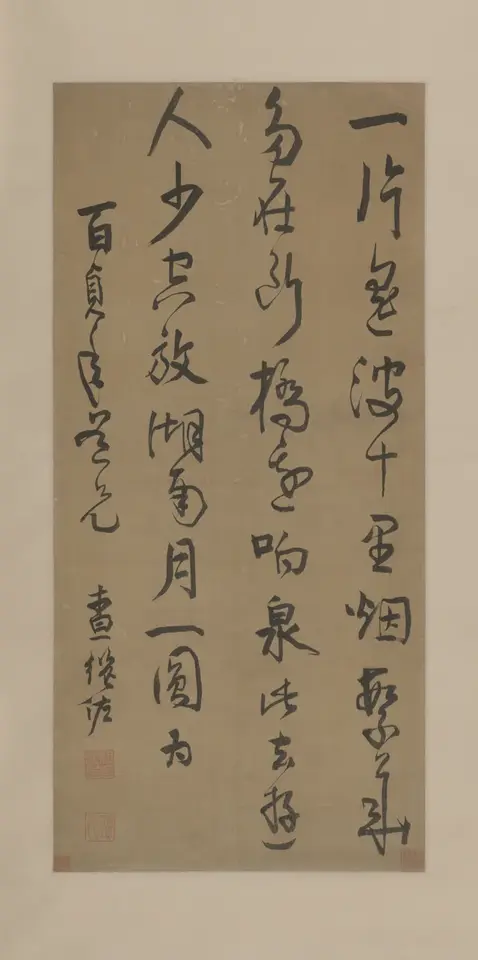
查继佐
Zha Jizuo (查继佐, October 6, 1601 – March 28, 1676), originally named Jiyou (renamed Jizuo due to a clerk's error during examination registration), and later changing his name to Zha Sheng (or the pseudonym Zuo Yin) after the fall of the Ming, courtesy names Sanxiu, Yihuang, and Busheng, art names Yuzhai and Jingxiu, and in his sunset years Dongshan Diaoshi and Feirenshi, was a native of Yuanhua, Haining County, Hangzhou…
Zha Jizuo (查继佐, October 6, 1601 – March 28, 1676), originally named Jiyou (renamed Jizuo due to a clerk's error during examination registration), and later changing his name to Zha Sheng (or the pseudonym Zuo Yin) after the fall of the Ming, courtesy names Sanxiu, Yihuang, and Busheng, art names Yuzhai and Jingxiu, and in his sunset years Dongshan Diaoshi and Feirenshi, was a native of Yuanhua, Haining County, Hangzhou Prefecture, Zhejiang. Known respectfully as Master Dongshan and Master Puyuan, he was an eminent historian, essayist, dramatist, and loyalist scholar of the Ming-Qing transition, celebrated alongside Zhang Dai, Tan Qian, and Wan Sitong as one of the "Four Great Historians of Eastern Zhejiang." Born into an esteemed scholar-gentry lineage in Haining, Zha Jizuo obtained the juren degree in 1633. Following the fall of Beijing and the southern advance of Qing armies in 1644–1645, he committed himself to the anti-Qing resistance, crossing the Qiantang River to join the Shaoxing court of Zhu Yihai, Regent Prince of Lu. He served as Secretary and later Director in the Bureau of Operations of the Ministry of War as well as Army Inspector, actively organizing defense lines along the Qiantang River, defeating Qing vanguards at Mount Zhe, and coordinating with loyalist forces in Lake Tai while accompanying Censor Huang Zongxi's naval detachment at Mount Tan. Following the collapse of the Shaoxing front in 1646, Zha went into underground cultural resistance, altering his surname to "Zha" with an added radical signifying self-admonished guilt, and established the Jingxiu Hall academy in Hangzhou, attracting disciples from across the empire. In 1661–1663, when the catastrophic Zhuang Tinglong History of Ming Treason Case erupted, Zha was implicated because his name had been fraudulently inserted into the editorial list without his consent. Fortunately, because he had prudently filed a preventive deposition with the provincial education commissioner two years prior, imperial inquisitors acquitted him and his household, after which he retired to East Mountain in Haining to cultivate his garden, Puyuan. As a historian, Zha Jizuo was exceptionally prolific, composing over sixty works spanning more than eight thousand pages. His magnum opus was Zuiweilu (Record of My Guilt Alone, originally titled Mingshu), a 102-fascicle biographical history of the Ming Dynasty compiled over nearly three decades from interviews with thousands of eyewitnesses and secret archives. The work is renowned for its fearless coverage of the Jingnan Campaign, peasant rebellions under Li Zicheng, and the southern loyalist courts of Hongguang, Longwu, and the Prince of Lu. He also authored Lu Chunqiu (Annals of the Prince of Lu), Guoshou Lu (Records of Longevity for the State), and Dongshan Guoyu. In performing arts, he mastered Kunqu opera and composed notable chuanqi dramas, leaving an indelible imprint on early Qing historiography and literary culture.
Born on the 10th day of the 9th month in Yuanhua, Haining; originally named Jiyou; his mother Madame Shen tutored him in phonetics and poetry.
Boarded at a distant village academy, cooking his own meals and gaining broad literary fame by age fifteen.
Following the decline of family fortunes, began tutoring in prominent households while pursuing scholarship.
Passed the Zhejiang provincial examination as a juren; subsequently studied and lectured beneath Mount Nanping by West Lake.
Beijing fell to rebel forces, the Chongzhen Emperor committed suicide, and Qing armies entered the central plains.
Following the fall of Nanjing, crossed the Qiantang River to join the Shaoxing court of Regent Prince of Lu as Secretary of War and Army Inspector.
Commanded troops defeating Qing vanguards at Mount Zhe; joined Huang Zongxi's detachment at Mount Tan; went into hiding after the river defenses fell.
Renamed himself Zha Sheng and adopted a modified surname, initiating the compilation of Zuiweilu.
Established Jingxiu Hall at Tieyeling in Hangzhou, lecturing to scholars from across the empire while gathering Ming historical sources.
Discovered that his name had been fraudulently listed as editor in Zhuang Tinglong's History of Ming; immediately submitted a formal legal deposition to the education commissioner.
The Zhuang treason trial erupted, executing hundreds; Zha was imprisoned in Hangzhou but fully exonerated when his earlier official deposition was verified.
Adopting the moniker Feirenshi, retired to Mount Dongshan in Haining, building the Puyuan garden to teach and write.
Completed his 102-fascicle biographical history Zuiweilu after nearly thirty years of work, concealing the manuscript behind walls.
Died on the 14th day of the 2nd month at Puyuan at age seventy-six; his disciple Shen Qi authored his chronological biography.
Zha Jizuo was born on the 10th day of the 9th month in the 29th year of the Wanli reign (October 6, 1601) in Yuanhua, Haining County, Hangzhou Prefecture, Zhejiang Province. The Haining Zha clan was an illustrious gentry lineage that produced distinguished scholars since the Song and Yuan eras. Originally named Jiyou, a clerk mistakenly recorded his name as Jizuo during a county examination, and he retained the name thereafter. His mother, Madame Shen, daughter of scholar Shen Zongwu, was accomplished in Chinese phonology and poetry. Under her guidance, Zha read the Four Books at age five and composed verse at seven.
His early education was characterized by extreme austerity. At age eleven, while walking miles to a village school, he carried two rice-flour buns for lunch; absorbed in reciting classical texts aloud along the ridges of rice fields, he frequently dropped his food without noticing. At twelve, he boarded at a distant school where he gathered firewood and cooked his own meals. By age fifteen, his literary compositions were celebrated across western Zhejiang.
At age twenty, family fortunes declined, compelling Zha Jizuo to support his household as a private tutor. Because of his vast learning and pedagogical skill, wealthy gentry families vied to engage him. Combining teaching with study, he earned his juren degree in the 1633 Zhejiang provincial examinations at age thirty-two. Rather than seeking metropolitan office in a faction-ridden capital, he resided beneath Mount Nanping beside West Lake, studying dynastic history and associating with prominent figures of the Fushe literary movement.
In April 1644, Li Zicheng captured Beijing and the Chongzhen Emperor died by suicide. The following year, Qing forces under Prince Dodo captured Nanjing, bringing down the Hongguang court. In July 1645, the Qing regency imposed the queue edict, igniting mass resistance across Jiangnan.
Learning that Zhu Yihai, Prince of Lu, had established a regency at Shaoxing, Zha Jizuo crossed the Qiantang River to offer his services. The Prince of Lu appointed him Secretary in the Bureau of Operations of the Ministry of War, directing troops under Zheng Yixing, and soon elevated him to Director and Investigating Censor-Inspector. During the year of the Shaoxing regency, Zha actively organized defense fortifications along the Qiantang River. When Qing vanguards approached Mount Zhe in southwestern Haining, Zha directed loyalist forces in a surprise counterattack, inflicting heavy casualties and capturing substantial materiel.
Planning a general counter-offensive, Zha dispatched secret agents behind enemy lines to gather intelligence and established clandestine communications with anti-Qing partisan units around Lake Tai. Later, he joined Censor Huang Zongxi's "Shizhong" loyalist brigade, sailing along the coast to garrison Mount Tan at the mouth of Xiangshan Bay. However, the Shaoxing regime was crippled by internal rivalries and bitter friction with the Longwu court in Fujian. In July 1646, Qing general Bolo exploited low tides to force a crossing of the Qiantang River. Shaoxing fell, and the Prince of Lu fled to Zhoushan Island. Facing catastrophic defeat, Zha Jizuo disguised himself as a woodcutter and slipped back to his hometown in Haining, turning his energies to underground historical preservation.
Following the fall of the loyalist front, Zha Jizuo took an oath never to serve the Qing. To express his remorse as a survivor of a fallen state, he renamed himself Zha Sheng ("Zha the Remorseful"), took the courtesy name Busheng, and added a punitive radical to his surname character. Convinced that while the state had perished its true history must not be obliterated, he resolved to compile an independent, authentic history of the Ming Dynasty.
In 1650, Zha began lecturing at Juejue Hall by West Lake, and in 1652 relocated to Tieyeling in Hangzhou, establishing Jingxiu Hall. Attracted by his moral integrity and deep classical scholarship, students from across the empire traveled to study under him. Concurrently, Zha worked tirelessly on his historical manuscripts.
He gathered palace gazettes, imperial archives, memorials of ministers, and clandestine private accounts. For the late Ming period, he drew upon Huang Zunsu's Shilüe and his comrade Huang Zongxi's Xu Shilüe. For the 1644 dynastic fall and the southern loyalist courts, he relied on personal eyewitness records and conducted extensive field interviews, traveling over ten thousand leagues to interview thousands of retired loyalists. Over nearly thirty years, rewriting his drafts dozens of times, he produced the monumental 102-fascicle biographical history Zuiweilu (Record of My Guilt Alone).
During the late Shunzhi reign, the Jiangnan literary world was engulfed by the Zhuang Tinglong History of Ming Treason Case. Zhuang Tinglong, a wealthy blind merchant from Nanxun in Huzhou, purchased an unpublished Ming history manuscript written by former Grand Secretary Zhu Guozhen, hired local scholars to append the late Ming and Southern Ming eras, and published the work as Mingshi Jilüe. The book used Ming reign names, directly identified the early Qing founders as Ming subjects, and referred to Qing troops as invaders. To enhance its commercial appeal, Zhuang fraudulently printed Zha Jizuo's name at the head of the editorial review list without his knowledge.
In autumn 1661, poet Lu Qi learned of the publication and rushed to alert Zha Jizuo. Instantly discerning that the illicit text would invite treason charges, Zha refused all gift copies and money from the Zhuang family. He immediately drafted a formal petition in parallel prose, submitting it to Provincial Education Commissioner Hu Shangheng. In this official document, Zha explicitly disavowed any involvement and warned that the text contained treasonous expressions, ensuring that his disclaimer was officially registered in government archives.
In 1663, dismissed official Wu Zhirong reported the book to Regent Oboi after an extortion attempt failed. Oboi launched an inquisitorial purge: Zhuang Tinglong's corpse was exhumed and burned, his clan exterminated, and hundreds of printers, booksellers, and literati executed. Zha Jizuo, Lu Qi, and Fan Xiang were arrested and hauled before the provincial surveillance commission in Hangzhou.
During the tribunal, judges examined old education commission archives and discovered Zha's original 1661 deposition, confirming that he had reported the illicit text years prior to Wu Zhirong's denunciation. Imperial commissioners ruled that Zha and his companions were innocent, ordering their release and awarding them confiscated furniture from the Zhuang estate as reward for timely reporting. Contemporary diarist Fei Gong'an noted that Zha collected several boatloads of household goods from Cigan Temple. Zha's foresight and legal acumen preserved his family of over three hundred souls from execution.
Later popular folklore, popularized in Pu Songling's Strange Tales from a Chinese Studio (The Mighty General) and Niu Xiu's Gusheng, claimed that Zha had once fed a beggar named Wu Liuqi in a snowy pavilion, and that Wu, having risen to provincial commander, interceded with Oboi to save Zha. However, in his chronological biography compiled by disciple Shen Qi, Zha explicitly refuted this tale, noting that his survival was owed entirely to the official paper trail created by his timely legal deposition.
Having survived the lethal treason purge, Zha Jizuo retreated further from public life. Changing his name to Zuo Yin and adopting the moniker Feirenshi ("A Non-Person"), he settled on Mount Dongshan in Haining, constructing a retreat called Puyuan and styling himself "The Angler of East Mountain."
In his final years, he declined all Qing administrative invitations, focusing entirely on refining his scholarship. He finalized Zuiweilu, concealing the manuscript inside his library walls, and completed companion historical works including the eight-fascicle Lu Chunqiu, the four-fascicle Guoshou Lu, and Dongshan Guoyu.
Furthermore, Zha organized a private family Kunqu theatrical troupe, tutoring performers in melodic phrasing and staging, and authoring renowned dramas such as Xu Xixiang (Sequel to the Western Chamber) and San Bao'en (Three Acts of Gratitude). On March 28, 1676 (14th day of the 2nd month, 15th year of the Kangxi reign), Zha Jizuo passed away peacefully at Puyuan at age seventy-six, leaving behind an immortal monument of loyalist historiography.
Zha Jizuo's crowning historical contribution was the compilation of Zuiweilu (Record of My Guilt Alone), a 102-fascicle biographical history of the Ming Dynasty produced under the threat of imperial censorship. Disdaining the sanitization practiced by official Qing compilations, Zha committed himself to recording historical truth without fear of consequences.
The work comprises twenty-two annals, thirty-two monographs, and thirty-six collective biographies (subdivided into 102 fascicles). Each section opens with an introductory overview and concludes with an evaluative appraisal of dynastic fortunes. In his biographies, Zha established unprecedented categories: the Huangjie Zhuan (Biographies of Abandoned Integrity) documented officials who surrendered during the Jingnan usurpation, while the Boni Zhuan (Biographies of the Persecuted and Hidden) memorialized martyrs loyal to the Jianwen Emperor. In his late Ming sections, he provided objective analyses of Li Zicheng and Zhang Xianzhong's rebel agrarian policies while preserving comprehensive records of the anti-Qing resistance under the Southern Ming courts. Scholars such as Zhang Zongxiang and Meng Sen praised Zuiweilu for surpassing Tan Qian's Guoque and Zhang Dai's Shikui Shu in rich, unvarnished detail.
In addition to Zuiweilu, Zha Jizuo authored a specialized corpus of historical works focusing on the loyalist campaigns in southeastern China. His eight-fascicle Lu Chunqiu (Annals of the Prince of Lu) utilized the annals-and-detail format of Zhu Xi's Tongjian Gangmu to chronicle Zhu Yihai's regency from 1644 through the defense of Shaoxing, Zhoushan, and Kinmen.
His four-fascicle Guoshou Lu (Records of Longevity for the State) documented the lives of military officers and civilian martyrs who perished fighting Qing forces across Zhejiang, categorized by county. In Dongshan Guoyu, he adapted classical spring-and-autumn discourse formats to analyze factional disputes that undermined southern loyalist regimes. This interconnected body of scholarship established the methodological foundations of the Eastern Zhejiang historical school.
Zha Jizuo's conduct during the Zhuang Tinglong History of Ming Case demonstrated extraordinary crisis management. Recognizing that the illicit publication crossed dangerous political thresholds, he refused association and proactively filed a formal disclaimer with provincial education authorities.
When the purge claimed hundreds of lives in 1663, his verified archival deposition served as undeniable proof of innocence, securing his release and sparing his clan from annihilation. His ability to navigate lethal political turbulence through legal documentation provided a model of prudent self-preservation during times of severe ideological repression.
Beyond his historical achievements, Zha Jizuo was a recognized master of Kunqu opera and theatrical theory. He established a private family troupe at Puyuan, training performers in singing and choreography.
His original dramas—including the chuanqi plays San Bao'en (Three Acts of Gratitude) and Feifeixiang, along with the zaju plays Xu Xixiang (Sequel to the Western Chamber) and Mingfeng Du—combined classical elegance with incisive reflections on dynastic turmoil. His dramatic compositions enriched early Qing theatrical arts and reflected the cultural versatility of late Ming literati.
FIGURES ASSOCIATED WITH THIS DYNASTY