Birth on the Steppe
Born on the banks of the Onon River, the second son of Genghis Khan and his principal wife Börte.
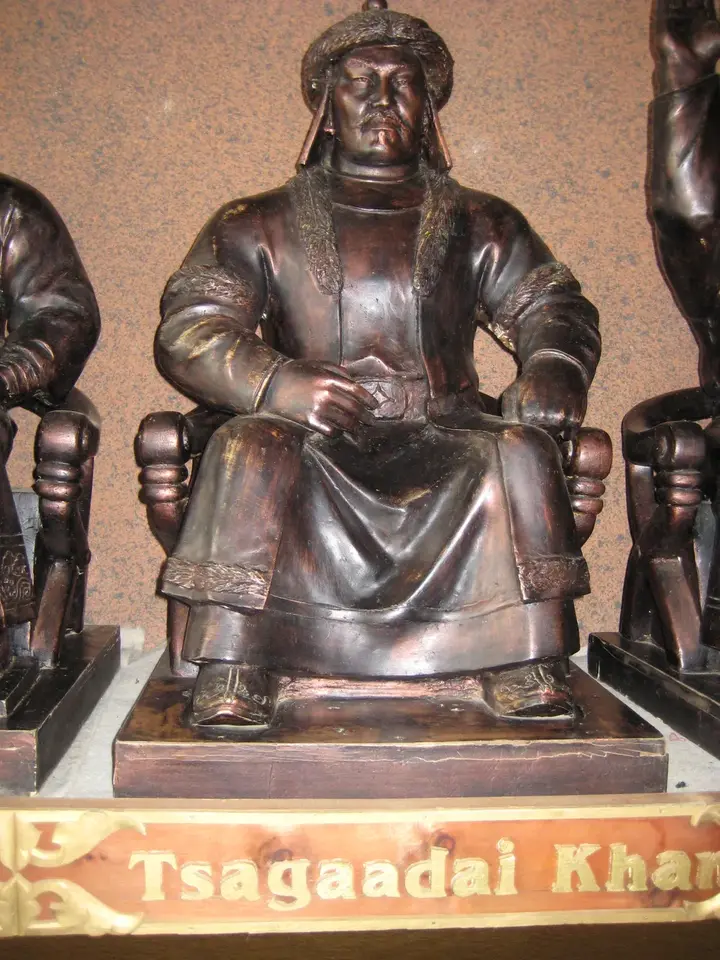
孛儿只斤·察合台
Borjigin Chagatai (孛儿只斤·察合台, 1183–1241) was an imperial prince, prominent military commander, and founder of the Chagatai Khanate within the Mongol Empire. He was the second son of Genghis Khan (Temüjin) and his principal empress Börte, and the elder brother of Ögedei Khan. In 1266 (the third year of Zhiyuan), he was posthumously honored by his nephew Kublai Khan with the temple name Shengzong and the posthumous title Emperor…
Borjigin Chagatai (孛儿只斤·察合台, 1183–1241) was an imperial prince, prominent military commander, and founder of the Chagatai Khanate within the Mongol Empire. He was the second son of Genghis Khan (Temüjin) and his principal empress Börte, and the elder brother of Ögedei Khan. In 1266 (the third year of Zhiyuan), he was posthumously honored by his nephew Kublai Khan with the temple name Shengzong and the posthumous title Emperor Zhongwu. Austere, unyielding, and an expert strategist, Chagatai campaigned alongside his father from early youth. Following the foundation of the Mongol Empire in 1206, he was granted an appanage of eight thousand households. During the conquest of the Jurchen Jin dynasty, Chagatai repeatedly commanded the right wing of the Mongol army alongside his brothers Jochi and Ögedei, capturing key fortresses including Yunnei, Dongsheng, and Shuozhou, sweeping across twenty prefectures on both sides of the Taihang Mountains, and encircling the Jin capital of Zhongdu. During the Western Campaign against Khwarazm, Chagatai directed the five-month siege of Otrar, capturing Inalchuq, and commanded the siege of Gurganj (Urgench). Following the victory, Genghis Khan distributed the empire's western territories, assigning the former domains of Western Liao (stretching from the Amu Darya east to the Altai Mountains) to Chagatai. Establishing his headquarters at Almaliq, Chagatai laid the enduring foundations of the Chagatai Khanate. Within the imperial hierarchy, Chagatai held immense authority as the supreme guardian and arbiter of the Great Yasa, enforcing strict legal compliance across the realm. When the succession was decided during Genghis Khan's lifetime, Chagatai prioritized imperial unity by championing his younger brother Ögedei, subsequently consolidating Ögedei's authority at the 1229 quriltai. Ögedei held his elder brother in profound reverence, dispatching couriers to Almaliq to consult him on all major military campaigns and civil policies. In Central Asia, Chagatai patronized Uighur and Muslim administrators, establishing equitable taxation and securing the overland Silk Road trade routes. He passed away at his Almaliq encampment in 1241 at the age of fifty-eight.
Born on the banks of the Onon River, the second son of Genghis Khan and his principal wife Börte.
Following the founding of the Mongol Empire, granted eight thousand nomadic households and elite guard contingents.
Commanded the right wing army with Jochi and Ögedei, capturing Yunnei, Dongsheng, Wuzhou, and Shuozhou.
Pierced the Zijing Pass to seize over twenty prefectures across Shanxi and Hebei, encircling the Jin capital of Zhongdu.
Marched westward against the Khwarazmian Empire, leading the siege of Otrar for five months alongside Jochi.
Breached the citadel of Otrar, captured Governor Inalchuq, and advanced across the Syr Darya to capture Banakat.
Commanded the final assault on Gurganj, diverting the Amu Darya to flood the fortifications and securing the capital.
Enfeoffed with the former lands of the Qara Khitai; established his imperial tent headquarters at Almaliq.
Led the princes at the quriltai to perform solemn obeisance to Ögedei Khan, consolidating imperial authority.
Attended the Karakorum quriltai, endorsing the Great Western Campaign and dispatching his grandson to join Batu Khan.
Passed away at his encampment in Almaliq, Central Asia, at fifty-eight; posthumously honored as Emperor Zhongwu.
Chagatai was born in 1183 along the Onon River in the northern Mongolian plateau, as the second son of Temüjin (later Genghis Khan) and his primary consort Börte of the Khongirad clan. Growing up amid relentless tribal warfare across the steppes, Chagatai mastered horsemanship and mounted archery from early boyhood, developing a stern, resolute, and demanding character.
In 1206, when Genghis Khan unified the nomadic tribes and proclaimed the Mongol Empire at the headwaters of the Onon River, he organized the populace into thousands and distributed fiefs. Chagatai was granted an appanage of eight thousand nomadic households, along with elite guard contingents drawn from the Ba'arin, Jalayir, and Barlas clans. Recognizing Chagatai's unyielding respect for nomadic customary law and strict discipline, Genghis Khan appointed him supreme supervisor of the Great Yasa, tasking him with overseeing judicial punishments and ensuring absolute compliance across all imperial armies.
During the initial expansion of the Mongol Empire, Chagatai served as a foremost field commander. In 1211, Genghis Khan launched his major invasion of the Jurchen Jin dynasty. Chagatai, together with his elder brother Jochi and younger brother Ögedei, was entrusted with command of the imperial right wing. After piercing Jin defenses at Yehuling, the right wing swept through the Datong basin, capturing vital frontier garrisons including Yunnei, Dongsheng, Wuzhou, and Shuozhou.
In the autumn of 1213, the Mongol armies advanced into the North China plain in three columns. Chagatai and Ögedei once again led the right wing through the Zijing Pass, sweeping along the eastern and western flanks of the Taihang Mountains and subduing over twenty prefectures across Shanxi and Hebei. By the spring of 1214, Chagatai's column converged outside the Jin central capital of Zhongdu (modern Beijing), joining the center column to encircle the city and forcing Emperor Xuanzong of Jin to present tribute and sue for peace.
In 1219, in response to the slaughter of a peaceful Mongol caravan by Inalchuq, the governor of Otrar, Genghis Khan initiated his western expedition against the Khwarazmian Empire with two hundred thousand warriors. Chagatai and Ögedei were designated vanguard commanders to besiege Otrar.
The garrison mounted a desperate defense, but Chagatai enforced ironclad siege lines, maintaining day-and-night assaults with catapults and battering rams for five months. In the spring of 1220, the outer walls fell, and Chagatai directed intense urban fighting, capturing Inalchuq alive and executing him by pouring molten silver into his eyes and ears in retribution for his treachery. Chagatai then crossed the Syr Darya, rapidly taking the fortress of Banakat and subjugating the surrounding region.
In 1221, Genghis Khan ordered Jochi, Chagatai, and Ögedei to converge upon Gurganj (Urgench), the opulent northern capital of Khwarazm. Strategic disagreements initially paralyzed the siege: Jochi, anticipating that Gurganj would become part of his domain, sought to negotiate its surrender to prevent its destruction, whereas Chagatai demanded total bombardment. The resulting division stalled the siege for six months.
Informed of the dispute, Genghis Khan transferred supreme command of the siege to Ögedei. Chagatai submitted immediately to his brother's authority, coordinating a joint assault. The brothers engineered canals diverting the waters of the Amu Darya to undermine the city walls, unleashing Greek fire and siege engines. Following seven days of brutal house-to-house combat, Gurganj was captured, extinguishing the last major bastion of Khwarazmian resistance.
Prior to the western expedition, Chagatai played a pivotal role in resolving the imperial succession. When Genghis Khan convened his sons to name his heir, Chagatai openly challenged Jochi's legitimacy due to their mother's brief captivity among the Merkits. After Genghis Khan intervened to quell the quarrel, Chagatai demonstrated statesmanlike maturity: he proposed that neither he nor Jochi should assume the throne, urging instead that their even-tempered, generous brother Ögedei be designated crown prince. This compromise was accepted by Jochi and the assembly, averting an early dynastic schism.
Following the triumphant return of the armies in 1225, Genghis Khan divided the empire among his sons. Chagatai was granted the extensive territories of the former Western Liao (Qara Khitai), encompassing the lands between the Altai Mountains and the Amu Darya, bounded by Lake Balkhash to the north and the Pamir Mountains to the south. Establishing his grand encampment at Almaliq in the Ili River valley, Chagatai founded the Chagatai Khanate.
When Genghis Khan died in 1227 and Tolui acted as regent, Chagatai remained the senior living prince. At the quriltai held along the Keluren River in 1229, Chagatai firmly honored his oath. He silenced hesitation among dissenting princes, personally leading Ögedei to the throne alongside Tolui and performing the full nine-fold prostrations of vassalage. His public submission ensured an uncontested transition of power.
Throughout his reign, Ögedei treated Chagatai with immense deference, addressing him as "Aqa" (Elder Brother). Imperial decrees, administrative reforms in China, and major campaigns were routinely submitted to Chagatai's camp at Almaliq for prior review and consent.
Within his khanate, Chagatai utilized Uighur and Muslim administrators, notably Mahmud Yalavach, to reorganize urban administration, stabilize currencies, and protect trans-Eurasian trade routes across the Silk Road. Chagatai passed away at his Almaliq headquarters in 1241 at the age of fifty-eight. In 1266, Kublai Khan posthumously honored him as Emperor Zhongwu with the temple name Shengzong.
Chagatai's foremost historical legacy was the creation of the Chagatai Khanate, which anchored Central Asian geopolitical and cultural developments for centuries.
Governing the vast steppe-oasis interface from Almaliq, Chagatai integrated nomadic military structures with the urban Islamic and agrarian traditions of Transoxiana and the Tarim Basin.
He stationed Mongol cavalry in the alpine pastures of the Semirechye and Tian Shan while appointing skilled administrators like Mahmud Yalavach to manage regional commerce, census registration, and tax collection in prosperous urban centers such as Bukhara and Samarkand. This administrative framework bridged East Asian and Persian cultural spheres, fostering the unique Turkic-Mongol cultural synthesis that later gave rise to the Timurid Renaissance and shaped modern Central Asian identities.
Within the administrative history of the Mongol Empire, Chagatai was revered as the supreme embodiment and enforcer of Genghis Khan's legal code, the Great Yasa.
Known for his uncompromising adherence to statutory precedent, Chagatai was tasked with supervising the judges (yarghuchis) and investigating legal infractions among imperial princes and tribal chieftains alike.
He enforced prohibitions against polluting flowing rivers, established severe penalties for theft and banditry along trade routes, and protected diplomatic envoys. Chagatai's relentless enforcement of the Yasa restrained factional overreach by nomadic aristocrats during the empire's expansion, maintaining internal discipline across vast conquered territories.
Chagatai rendered an invaluable service to the continuity of the Mongol Empire by resolving the imperial succession crisis and securing the elevation of Ögedei Khan.
Following the death of Genghis Khan, the empire faced centrifugal tensions between the supporters of Tolui and Ögedei. As the senior surviving son of Börte, Chagatai possessed immense traditional authority.
At the 1229 quriltai, Chagatai insisted on strict obedience to their father's testament. By publicly kneeling before Ögedei and offering the imperial cup, Chagatai compelled all imperial princes and commanders to swear fealty to the new Great Khan. His decisive leadership averted an early civil war and preserved the unity of the imperial administration.
During the first western expedition, Chagatai proved himself an exceptional commander of complex, protracted siege warfare, demonstrating the Mongol army's mastery of technical siege engineering.
At the siege of Otrar, he directed counter-battery bombardment and sapping operations over five months, maintaining unyielding discipline in harsh terrain to neutralize a heavily fortified garrison.
At Gurganj, Chagatai overcame initial operational paralysis by coordinating engineering projects that diverted the Amu Darya, destabilizing the city's mudbrick defensive works. His command demonstrated that the Mongol military had evolved from a steppe cavalry raiding force into an adaptable army capable of taking the most formidable fortified metropolises in Eurasia.
FIGURES ASSOCIATED WITH THIS DYNASTY