Birth in Puyang
Born into a scholarly family in Putian, Fujian, demonstrating passion for portraiture from childhood.
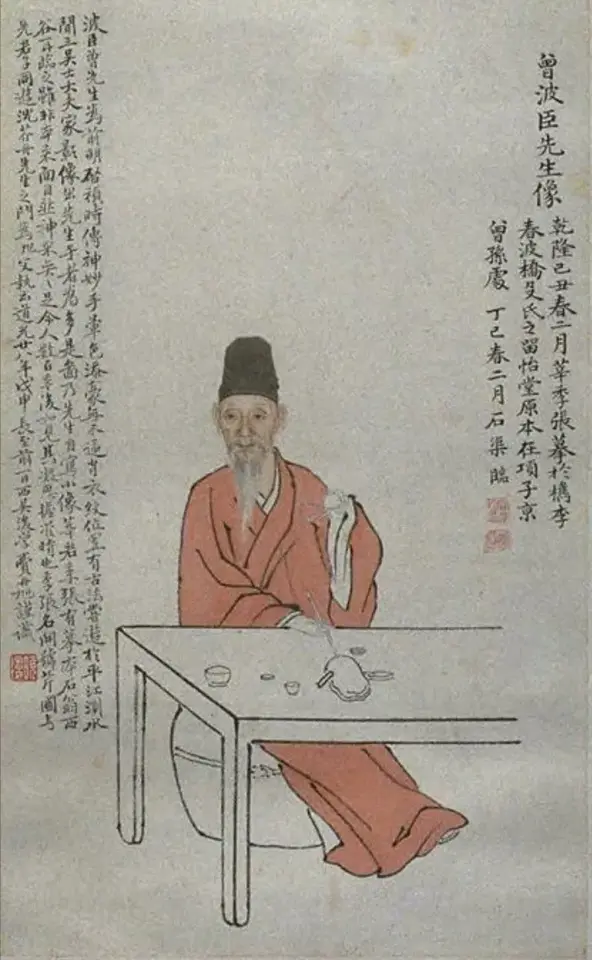
曾鲸
Zeng Jing (1564–1647), courtesy name Bochen, was a native of Putian, Xinghua Prefecture, Fujian. He was a monumental portrait painting master of the late Ming and early Qing dynasties, and the founding father of the renowned Bochen School in traditional Chinese portraiture history. Throughout his long life, Zeng Jing resided in Jiangnan cultural metropolises including Jiangning (modern Nanjing), Hangzhou, Wuzhen, and Yuyao,…
Zeng Jing (1564–1647), courtesy name Bochen, was a native of Putian, Xinghua Prefecture, Fujian. He was a monumental portrait painting master of the late Ming and early Qing dynasties, and the founding father of the renowned Bochen School in traditional Chinese portraiture history. Throughout his long life, Zeng Jing resided in Jiangnan cultural metropolises including Jiangning (modern Nanjing), Hangzhou, Wuzhen, and Yuyao, gaining empire-wide renown for realistic portraiture. Together with painter Wu Bin, calligrapher Hong Kuan, and seal engraver Huang Sheng, he was celebrated as one of the "Four Incomparables of Putian." Prior to his emergence, traditional Chinese portraiture relied predominantly on line drawings or flat color washes, lacking volumetric depth and lighting modeling. Building on Song and Yuan ink-bone outline techniques, Zeng Jing ingeniously incorporated Western chiaroscuro and relief-shading methods introduced by Jesuit missionaries such as Matteo Ricci. He developed a revolutionary layered shading technique (aotu yunran), applying dozens of ultra-thin ochre and ink washes until facial planes, musculature, flesh tones, and inner psychological spirit emerged with striking verisimilitude, giving rise to the Bochen School. Prominent late-Ming luminaries—such as Dong Qichang, Chen Jiru, Huang Daozhou, Wang Shimin, and Zhang Qingzi—eagerly commissioned him to execute their likenesses. Celebrated extant masterpieces include Portrait of Ge Zhenfu, Portrait of Wang Shimin, and Portrait of Zhang Qingzi, preserved today in the Palace Museum and other major institutions.
Born into a scholarly family in Putian, Fujian, demonstrating passion for portraiture from childhood.
Traveled through Fujian and Zhejiang studying figure painting, absorbing Song-Yuan traditions and folk artisans' strengths.
Established a studio along the Qinhuai River in Nanjing, achieving fame among metropolitan scholar-officials.
Synthesized Western lighting and multi-layered wash techniques; the mature Bochen style attracted devoted pupils.
Traveled across Jiangnan prefectures, painting lifelike portraits for cultural leaders like Dong Qichang, Huang Daozhou, and Wang Shimin.
Moved with his grandson Zeng Yi to Zhusu Garden in Wuzhen, Zhejiang, teaching students as the Bochen School spread nationwide.
Passed away peacefully at the advanced age of eighty-four; disciples and fellow painters arranged his burial.
Zeng Jing was born in 1564 in Putian County, Fujian. Since the Song dynasty, Putian had enjoyed flourishing cultural learning alongside strong traditions of Daoist, Buddhist, and portrait mural craftsmanship. Endowed with keen artistic perception and a tranquil disposition, Zeng Jing loved drawing from childhood. In his early years, he interacted with local portraitists and temple mural artisans, absorbing fundamentals of line contouring and mineral coloration. In his youth, he achieved equal fame alongside local worthies Wu Bin, Hong Kuan, and Huang Sheng, acclaimed by fellow literati as the "Four Incomparables of Putian."
Dissatisfied with repetitive, formulaic artisan conventions, Zeng Jing resolved to journey across major cultural hubs. Packing his brushes, he traveled along the Min River basin, the coastal shores of eastern Zhejiang, and Lake Tai. Throughout his travels, he inspected classical scrolls in private collections, deeply analyzing the subtle expressive nuances of Song master Li Gonglin, Yuan master Zhao Mengfu, and early Ming literati portraitists. In the mid-Wanli reign, Zeng Jing arrived in Nanjing, the cultural capital of the Ming realm, establishing a studio along the Qinhuai River to practice as a professional portrait artist.
In Nanjing during the Wanli era, Western Jesuit missionaries led by Matteo Ricci brought European oil paintings of the Virgin Mary and copperplate engravings, sparking profound fascination among Jiangnan scholars and artists. Possessing an open-minded aesthetic outlook, Zeng Jing immediately perceived the transformative power of Western chiaroscuro in conveying the three-dimensional skeletal architecture and lighting variations of the human visage.
Rather than crudely imitating thick Western oil impasto, however, Zeng Jing grounded his technique in Chinese brushwork, fusing Western relief principles with traditional Chinese ink washes. In painting a portrait, he first delineated facial contours with delicate, flowing lines of pale ink. Then, analyzing skeletal bone structure and illumination direction, he built up facial features through dozens of washes using pale ochre and translucent ink. Applying anywhere from several to tens of layered washes, he coaxed forth convex cheekbones, facial planes, and skin textures, achieving sculptural solidity while preserving the poetic calligraphic grace of Chinese literati painting. This revolutionary synthesis transformed the trajectory of traditional Chinese portraiture.
From the late Wanli through the Chongzhen reigns, Zeng Jing's portraiture enjoyed empire-wide acclaim. Jiangnan aristocrats, leaders of the Donglin and Fushe literary societies, and prominent artists considered it a supreme honor to sit for a Zeng Jing portrait. Cultural titan Dong Qichang, essayist Chen Jiru, loyalist martyr Huang Daozhou, orthodox painting leader Wang Shimin, physician Zhang Qingzi, and Fushe leader Hou Dongceng all invited Zeng Jing into their private estates to paint their likenesses.
When painting Huang Daozhou, Zeng Jing captured his unyielding, righteous moral fervor; when depicting Wang Shimin, he vividly conveyed his aristocratic elegance and scholarly composure. Leading contemporary landscape painters, such as Chen Hongshou and Xiang Shengmo, eagerly collaborated by painting pine trees, mossy boulders, and cascading streams around Zeng Jing's figure compositions. Ming essayist Zhang Dai marveled in Dream Recollections of Tao'an: "Zeng Bochen captures a likeness as though drawing reflections directly from a mirror; through subtle wash, dynamic spirit and facial hairs emerge vividly, such that one could stand before the scroll in long conversation without discerning reality from art!"
In his advanced years, Zeng Jing relocated with his grandson Zeng Yi to Zhusu Garden in Wuzhen, Zhejiang, traveling occasionally between West Lake in Hangzhou and Nanjing. Gentle, unpretentious, and free of sectarian jealousy, Zeng Jing shared his painterly methods unstintingly with visiting youths. Late-Ming scholar Ruan Dacheng composed verses depicting his tranquil lifestyle: "After laying down the brush and color wash, leaning upon the stool he rests at ease. Temple chimes chime in autumn rain, leaning on a cane to watch evening hills."
Under Zeng Jing's direct mentorship, exceptional disciples like Xie Bin, Shen Shao, Liu Xiangsheng, Zhang Yushu, and Gu Zonghan matured into prominent portraitists. Carrying forward his layered relief-shading method, they disseminated the technique across Jiangsu, Zhejiang, Fujian, and Jiangxi, ultimately influencing Qing court ateliers and establishing an influential portrait movement. Because Zeng Jing's courtesy name was Bochen, subsequent art historians named this movement the Bochen School, honoring Zeng Jing as its foundational patriarch.
In the early Shunzhi reign, eighty-year-old Zeng Jing, though experiencing failing eyesight, accepted an invitation from senior monks at Niushoushan Temple in Nanjing to execute portraits of eighty-one successive Buddhist patriarchs, finding joy in brushwork until his last days. In 1647, Zeng Jing passed away peacefully in Jiangnan at the age of eighty-four.
Zeng Jing's greatest historical contribution was demolishing the long-standing bias that relegated portraiture to a humble artisan trade, elevating portrait art to equal status with literati landscape painting and inaugurating the Bochen School that dominated the late Ming and early Qing dynasties.
The Bochen School established an unshakeable following among late-Ming literati and reshaped figure painting aesthetics in the Qing court and popular studios. During the Yongzheng and Qianlong reigns, imperial painters and urban studios alike adopted Bochen methods as standard practice. The emergence of the Bochen School marked the historic modernization of Chinese figure painting stimulated by cross-cultural exchanges between China and the West.
Zeng Jing's ink-bone wash method (moben hongran fa) marked a leap forward in traditional fine-brush portraiture. Jiang Shaoshu documented his method in History of Silent Poetry (Wusheng Shishi): "Portraying dozens of sitters, he captured the distinctive character of each. In portraiture, he first dotted the eyes with pale ink to fix the inner spirit, scrutinized bone structure, and then applied light mineral pigment in layered washes, from several to tens of passes, setting off yin and yang until the living spirit emerged naturally."
In practice, Zeng Jing's art progressed through three phases: early classical monochrome line drawing, mid-career exploration of Western lighting and ink-bone structures, and late-career synthesis where volumetric relief harmonized seamlessly with literati spirit. In executing likenesses, Zeng Jing prioritized complete mental attunement, forgetting the separation between painter and sitter. Observing subtle facial expressions, he captured the underlying moral temperament and interior life of his subjects, rendering them so lifelike that viewers felt they were conversing face-to-face with the sitter.
Zeng Jing's extant masterworks are preserved in premier national museums. His celebrated Portrait of Ge Zhenfu (Palace Museum, Beijing) depicts late-Ming poet Ge Yilong with tranquil naturalness, the facial features washed with subtle ochre tones to achieve volumetric verisimilitude; Portrait of Wang Shimin captures the youthful artist seated serenely on a rush cushion, radiating aristocratic elegance; Portrait of Zhao Mengfu employs antique lines conveying ancestral dignity; Portrait of Zhang Qingzi (Zhejiang Provincial Museum) pairs luminous facial features with flowing calligraphic drapery lines.
These masterpieces possess immense artistic value and serve as priceless visual documents for historical research into late-Ming intellectual society.
Jiang Shaoshu wrote in History of Silent Poetry (Wusheng Shishi, Volume 4): "Zeng Jing, courtesy name Bochen, native of Putian. In portraiture he engaged in profound inquiry, uncovering secrets unrevealed for centuries. Capturing likenesses like reflections caught in a mirror, he concentrated spirit within the eyes, cleansing all crude flaws of common artisan daubs. Prominent officials across the realm competed to summon him. In Jiangnan portraiture, Bochen must be ranked foremost."
Late-Ming essayist Zhang Dai observed in Dream Recollections of Tao'an: "In Chinese portraiture, the Song had Li Gonglin and the Ming had Zeng Bochen. In Bochen's portraits, applying mineral azurite and malachite with subtle brushwork, his figures are dynamically lifelike; he was truly a national master of an era."
Early Qing scholar and connoisseur Zhou Lianggong remarked in Reading Paintings (Duhua Lu): "Bochen's painting methods attained divine perfection. Since Bochen emerged, all portraitists throughout the empire have modeled themselves upon him; down to the present day, celebrated painters of Fujian and Zhejiang all belong to his school."
FIGURES ASSOCIATED WITH THIS DYNASTY