Born in Dzungaria
Born in the Ili River valley, the eldest son of Sengge Khan of the Dzungar Khanate.
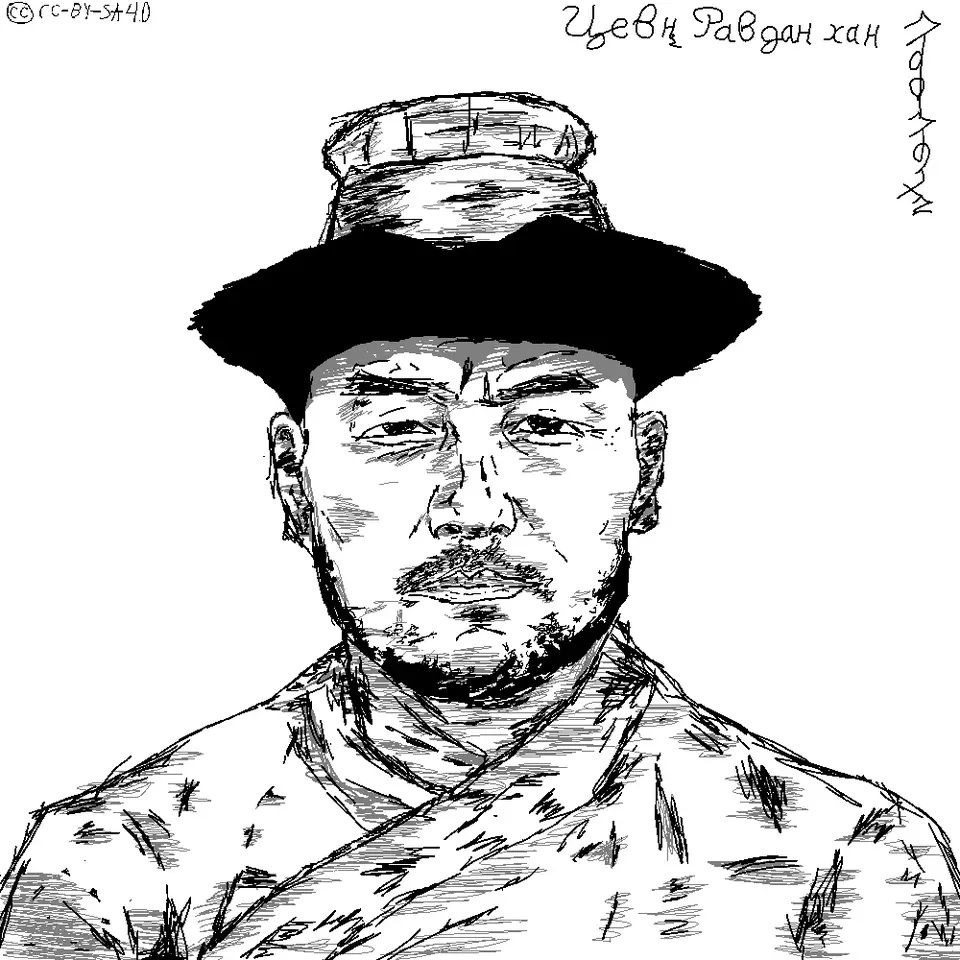
策妄阿拉布坦
Tsewang Rabtan (策妄阿拉布坦, 1665 – 1727) was a prominent leader and Khong Tayiji of the Dzungar Khanate, belonging to the Choros clan of the Oirat Mongols, and the eldest son of Khan Sengge. Following his father's murder in 1670, Tsewang Rabtan initially submitted to his uncle Galdan Boshugtu Khan. In 1688, facing deadly persecution from Galdan, he broke through with seven loyal retainers to establish an independent base in the…
Tsewang Rabtan (策妄阿拉布坦, 1665 – 1727) was a prominent leader and Khong Tayiji of the Dzungar Khanate, belonging to the Choros clan of the Oirat Mongols, and the eldest son of Khan Sengge. Following his father's murder in 1670, Tsewang Rabtan initially submitted to his uncle Galdan Boshugtu Khan. In 1688, facing deadly persecution from Galdan, he broke through with seven loyal retainers to establish an independent base in the Bortal Valley. In 1690, while Galdan invaded Khalkha Mongolia, Tsewang Rabtan seized the Dzungar homeland in Ili, severing Galdan's western retreat. In strategic alliance with the Kangxi Emperor, Tsewang Rabtan contributed to Galdan's ultimate downfall in 1697, subsequently assuming the title of Khong Tayiji over a unified Dzungaria. During his reign, Tsewang Rabtan repelled Russian encroachment, promoted irrigated agriculture, mined gold and copper deposits, utilized European captives to establish modern cannon foundries, and founded schools in the Clear Script (Todo Bichig), driving the khanate to its socioeconomic zenith. However, geopolitical rivalry over Central Asian trade corridors and Tibet led to conflict with the Qing Empire. In 1717, he dispatched General Tsering Dondup on an epic trans-Kunlun expedition that captured Lhasa and killed Lhabzang Khan of the Khoshut. In 1720, the Kangxi Emperor dispatched imperial armies under Prince Yunti that expelled the Dzungars from Tibet. Tsewang Rabtan died in 1727 at sixty-three, succeeded by his son Galdan Tsering.
Born in the Ili River valley, the eldest son of Sengge Khan of the Dzungar Khanate.
Following Sengge's assassination, Galdan returned from Tibet to take the khanate; Tsewang Rabtan submitted to his uncle.
Persecuted by Galdan after his younger brother's murder, he escaped with seven loyal retainers to establish a base in Bortal.
Seized the Dzungar capital along the Ili River while Galdan was east fighting Qing forces at Ulan Butung, cutting Galdan's escape route.
Galdan died in despair after the Battle of Jao Modo; Tsewang Rabtan captured Galdan's remnants and was confirmed Khong Tayiji.
Dispatched formal tribute embassies to Beijing, confirmed as supreme ruler over the Dzungars by the Kangxi Emperor.
Clashed with Qing border outposts over the control of Hami and Turpan trade arteries, reigniting the Qing-Dzungar war.
Dispatched Tsering Dondup with six thousand cavalry across the Kunlun Mountains, capturing Lhasa and executing Lhabzang Khan.
The Kangxi Emperor dispatched two expeditionary armies that routed Dzungar garrisons and installed the Seventh Dalai Lama in Lhasa.
Passed away in the Ili River valley at the age of sixty-three; his son Galdan Tsering inherited the khanate.
Tsewang Rabtan was born in 1665 in the Ili River valley of the Dzungar Basin, the eldest son of Sengge, supreme Khan of the Dzungars. In 1670, Sengge was assassinated in a palace coup orchestrated by rival half-brothers. Sengge's brother Galdan returned from Buddhist monastic studies in Lhasa, rallied Khoshut support, and executed the conspirators to claim the Dzungar throne. The young Tsewang Rabtan served faithfully under his uncle's banners.
However, as Tsewang Rabtan demonstrated charismatic leadership, Galdan grew suspicious. In 1688, Galdan executed Tsewang Rabtan's younger brother Sonom Rabtan and forcibly appropriated Tsewang Rabtan's betrothed bride. Recognizing an imminent death threat, Tsewang Rabtan executed a daring midnight escape with seven trusted retainers, riding westward into the Bortal River valley. There, he rallied dissident clans, forged weapons, and established an autonomous military redoubt.
In 1690, Galdan launched an all-out invasion of Khalkha Mongolia, clashing with the Kangxi Emperor's main army at Ulan Butung. Taking advantage of the vacuum, Tsewang Rabtan led a lightning cavalry assault into the Ili valley, annihilating Galdan's home garrison and taking control of the Dzungar core territories. This operation trapped Galdan in Kobdo without a rear base, establishing a de facto strategic pincer with the Qing Empire.
In 1696, the Qing army crushed Galdan's forces at the Battle of Jao Modo. In the spring of 1697, Galdan committed suicide in Kobdo. Tsewang Rabtan captured Galdan's remaining family and baggage trains, dispatching envoys to Beijing to deliver Galdan's daughter and pledge formal submission. The Kangxi Emperor confirmed Tsewang Rabtan as Khong Tayiji, acknowledging his sovereignty over the Dzungar territories.
Tsewang Rabtan proved an exceptional administrator. Moving beyond traditional nomadism, he relocated thousands of Uyghur farming households from southern oases to the Ili River valley, digging extensive canal irrigation networks to make Ili self-sufficient in grain. He employed European prisoners of war, notably Swedish artillery officer Johan Gustaf Renat, to build modern cannon foundries and small-arms manufactories in Ili. He developed gold mines in the Altai Mountains and copper works in Ili, while establishing schools to promote the Clear Script (Todo Bichig) and print Buddhist and administrative texts, elevating the Dzungar Khanate to the height of its power.
Despite tributary ties with Beijing, Tsewang Rabtan sought paramount authority over all Mongol tribes. In 1715, clashes over the oasis hubs of Hami and Turpan ignited full-scale war with the Qing.
In 1717, Tsewang Rabtan launched a breathtaking military campaign to secure religious supremacy in Tibet. He dispatched his cousin Tsering Dondup with six thousand veteran Dzungar cavalry. Embarking on one of the most astonishing marches in military history, the cavalry traversed the Taklamakan Desert during winter, scaled the permanently frozen Kunlun Mountains at altitudes exceeding 15,000 feet, and swept down through the Changtang plateau into Lhasa.
The Dzungar forces stormed Lhasa, killed Lhabzang Khan of the Khoshut, deposed his puppet Dalai Lama, and occupied central Tibet. This surprise conquest shattered Qing influence over the Tibetan plateau, threatening Qing control over the southern Mongols.
The occupation of Lhasa provoked a massive imperial counter-offensive. In 1720, the Kangxi Emperor commissioned his fourteenth son, Prince Yunti, as General-in-Chief to lead two coordinated armies into Tibet from Sichuan and Qinghai. Welcomed by Tibetan monks and nobles, Qing forces routed Dzungar detachments and installed Kelzang Gyatso as the Seventh Dalai Lama in the Potala Palace. The broken Dzungar survivors fled in disarray back to Dzungaria.
Following this catastrophic defeat, Tsewang Rabtan consolidated his remaining forces in the western Ili valley, establishing fortified lines against advancing Qing frontier outposts in Turpan.
In 1727, Tsewang Rabtan passed away in Ili at the age of sixty-three. His son Galdan Tsering succeeded as Khong Tayiji, sustaining the Qing-Dzungar conflict until the final Qing conquest under the Qianlong Emperor in 1755.
Tsewang Rabtan's most pivotal geopolitical move was his seizure of the Ili homeland in 1690. By cutting off Galdan's western retreat while Galdan was engaged with Qing forces in the east, Tsewang Rabtan destroyed his uncle's strategic depth, facilitating the Kangxi Emperor's reunification of Mongolia.
Tsewang Rabtan transformed the Dzungar economy from fragile pastoral nomadism into a diversified state combining irrigated agriculture, mining, and advanced metallurgy. His utilization of European engineering talent to manufacture field artillery gave the Dzungar army modern firepower unmatched by any nomadic confederation in Asian history.
The 1717 expedition to Tibet commanded by Tsering Dondup remains an enduring tactical marvel in equestrian military history. Crossing thousands of miles of uninhabited desert and sub-zero Himalayan passes without logistical supply lines, the raid demonstrated the peerless mobility and physical endurance of the Dzungar military machine.
FIGURES ASSOCIATED WITH THIS DYNASTY