Birth
Born in Linxiang, Tanzhou, into an aristocratic southern military lineage.
欧阳询
Ouyang Xun (欧阳询, 557–641), courtesy name Xinben, a native of Linxiang in Tanzhou (present-day Changsha, Hunan), was a legendary calligrapher, calligraphic theorist, and scholar of the early Tang dynasty. He is revered alongside Yu Shinan, Chu Suiliang, and Xue Ji as one of the "Four Great Calligraphers of the Early Tang," and with Yan Zhenqing, Liu Gongquan, and Zhao Mengfu as one of the "Four Masters of Regular Script" in…
Ouyang Xun (欧阳询, 557–641), courtesy name Xinben, a native of Linxiang in Tanzhou (present-day Changsha, Hunan), was a legendary calligrapher, calligraphic theorist, and scholar of the early Tang dynasty. He is revered alongside Yu Shinan, Chu Suiliang, and Xue Ji as one of the "Four Great Calligraphers of the Early Tang," and with Yan Zhenqing, Liu Gongquan, and Zhao Mengfu as one of the "Four Masters of Regular Script" in Chinese history. Ouyang Xun survived severe family tragedy in his youth; following the execution of his rebel father Ouyang He in 569, he was hidden by friends and adopted by his father's close friend, Jiang Zong, the Director of the Department of State Affairs under the Chen dynasty. Under Jiang's tutelage, Ouyang immersed himself in the Confucian classics and ancient historiography. Entering the Sui dynasty, he served as Doctor of the Court of Imperial Sacrifices. Captured by rival warlords during the collapse of the Sui, he formally submitted to the Tang in 621 following Li Shimin's victory at the Battle of Hulao. Tang Gaozu (Li Yuan), an old acquaintance from their Sui days, appointed him Grand Scribe (Geishizhong), commissioned him to calligraphy the legendary inscription for the empire's new currency "Kaiyuan Tongbao," and appointed him to direct the monumental 100-scroll imperial encyclopedia Yiwen Leiju. Under Emperor Taizong, he was appointed Grand Supervisor of the Heir Apparent's Household, Academician of the Hongwen Academy, and ennobled as Baron of Bohai County, earning the popular designation "Supervisor Ouyang." Ouyang Xun's regular script, celebrated as the "Ou Style," attained legendary status for its architectural rigor, steep dynamism, and sublime balance. His inscription for the Jiucheng Palace Liquan Inscription is acclaimed as the "Greatest Regular Script Under Heaven," while his treatises Eight Principles and Thirty-Six Methods established the theoretical foundation of Chinese calligraphic structural analysis. He passed away in 641 at the advanced age of eighty-five.
Born in Linxiang, Tanzhou, into an aristocratic southern military lineage.
Father Ouyang He executed after a failed uprising; Ouyang Xun was sheltered and raised by high official Jiang Zong.
Chen fell to Sui; relocated to the northern capital Chang'an with Jiang Zong, studying classics and calligraphy.
Appointed Doctor of Sacrifices under Emperor Yang of Sui, participating in statutory compilation and historiography.
Captured by rebel Yuwen Huaji; subsequently retained by Dou Jiande's Xia regime as Minister of Sacrifices.
Joined the Tang court after Li Shimin crushed Dou Jiande; appointed Grand Scribe by Li Yuan and penned the "Kaiyuan Tongbao" currency legend.
Completed the compilation of the 100-scroll imperial anthology Yiwen Leiju, receiving rich silk rewards from Gaozu.
Elevated by Emperor Taizong to Supervisor of the Heir Apparent's Household and Hongwen Academician, created Baron of Bohai County.
Commissioned to transcribe the Jiucheng Palace Liquan Inscription composed by Wei Zheng, achieving absolute artistic perfection.
Died peacefully in Chang'an at the age of eighty-five; his younger son Ouyang Tong preserved the family calligraphic prestige.
Ouyang Xun was born into a prominent southern aristocratic lineage. His grandfather, Ouyang Wei, served as General Pacifying the South and Area Commander of Hengzhou under the Chen dynasty, while his father, Ouyang He, inherited the command of nineteen southern circuits and served as Prefect of Guangzhou. In 569, fearing imperial suspicion, Ouyang He launched a desperate revolt against Emperor Xuan of Chen, only to be crushed and executed the following spring.
The thirteen-year-old Ouyang Xun survived by being concealed within the homes of sympathetic relatives. His father's intimate associate, the eminent scholar and statesman Jiang Zong, defied immense danger to adopt and nurture the orphaned youth. Under Jiang Zong's rigorous guidance, Ouyang Xun studied voraciously, mastering the Records of the Grand Historian, Book of Han, and Records of Eastern Han. Amidst classical studies, he developed an unquenchable passion for calligraphic brushwork.
In 589, the Sui dynasty conquered Chen, unifying China. Jiang Zong accompanied the court northward, and Ouyang Xun relocated to the northern metropolis of Chang'an, residing in Dunhua Ward. In the capital, Ouyang Xun associated with leading scholars and formed a lasting friendship with Li Yuan, then the Duke of Tang.
In 605, Emperor Yang appointed Ouyang Xun as Doctor of the Court of Imperial Sacrifices, assisting senior statesman Yang Su in codifying rituals and compiling official historical texts. When the Sui empire collapsed into chaotic civil war and Emperor Yang was assassinated at Jiangdu in 618, the rebel army under Yuwen Huaji took the court retinue hostage. After Dou Jiande destroyed Yuwen Huaji at Liaocheng in 620, he held Ouyang Xun in high esteem and appointed him Minister of Sacrifices in his Xia state. Throughout years of captive exile, Ouyang Xun remained devoted to scholarship and brushwork.
In May 621, Prince of Qin Li Shimin crushed Dou Jiande at the decisive Battle of Hulao, pacifying northern China. The sixty-five-year-old Ouyang Xun and his literary companion Yu Shinan surrendered to the Tang. Emperor Gaozu rejoiced at the survival of his longtime companion, appointing him Grand Scribe in the Chancellery.
In July 621, Emperor Gaozu initiated a comprehensive monetary reform to replace the depreciated Sui coins with standard imperial coinage. The emperor commissioned Ouyang Xun to compose the name and write the calligraphy for the new bronze cash coins. Blending the stately solidity of clerical script with the structural clarity of regular script, Ouyang Xun penned the iconic four characters "Kai Yuan Tong Bao." His dignified calligraphy established the aesthetic model that governed Chinese numismatic typography for over a millennium.
In 622, Emperor Gaozu decreed the creation of a vast encyclopedic reference work for statecraft and literary composition, selecting Ouyang Xun, Pei Ju, and Chen Shuda to direct the imperial project. Completing the monumental task in 624, the editorial committee produced Yiwen Leiju in one hundred scrolls, arranged across forty-eight categories. Ouyang Xun personally authored the imperial preface. Citing more than 1,400 classical texts from antiquity through the Chen and Sui periods, this compilation preserved countless lost literary masterpieces and historical fragments, earning Ouyang Xun substantial gifts of silk from the emperor.
Following Emperor Taizong's ascension during the Zhenguan era, Ouyang Xun was confirmed as Grand Supervisor of the Heir Apparent's Household and Academician of the Hongwen Academy, ennobled as Baron of Bohai County. He was charged with training imperial princes and high noble youths in classical calligraphic technique. Despite his diminutive stature and weathered appearance, Ouyang was celebrated for his sparkling wit; during banquet poetry exchanges, he traded quick-witted, satirical verses with powerful nobles like Zhangsun Wuji, winning warm admiration from Emperor Taizong.
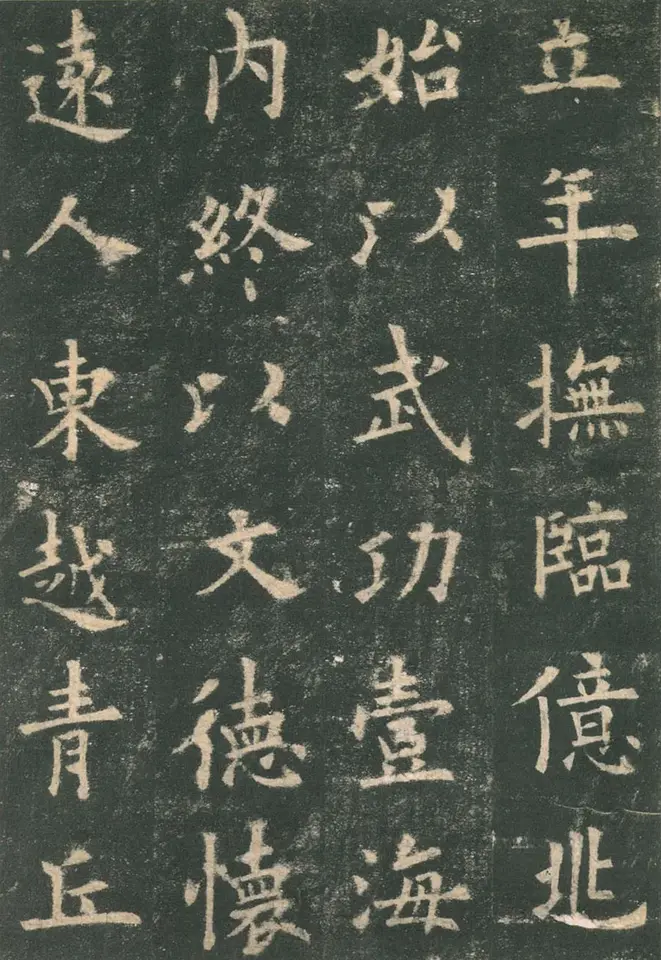
The Zhenguan era witnessed the artistic pinnacle of Ouyang Xun's career. In 632, after Emperor Taizong discovered a sweet water spring at the summer palace of Jiucheng Palace in Linyou, Chancellor Wei Zheng composed the celebratory commemorative prose Jiucheng Palace Liquan Inscription. Ouyang Xun was chosen to execute the stone transcription in regular script. The finished monument displayed exquisite elegance, taut structural tension, and crystalline balance, acclaimed by posterity as the unmatched crowning achievement of Chinese regular script.
In his final years, Ouyang Xun codified his calligraphic methodology in foundational treatises such as Eight Principles, Thirty-Six Methods, and Secrets of Transmission. In 641, the revered calligrapher passed away peacefully in Chang'an at the age of eighty-five. His younger son, Ouyang Tong, inherited his artistic lineage, rising to chancellor and calligraphic prominence, celebrated in art history alongside his father as the "Elder and Younger Ouyangs."
Ouyang Xun holds a monumental position in Chinese calligraphic history for establishing an unyielding canonical model for regular script. Synthesizing the robust stone inscriptions of the Northern Dynasties with the fluid, elegant ink traditions of the Two Wangs (Wang Xizhi and Wang Xianzhi), he founded the renowned "Ou Style."
Characterized by square brushwork, sharp angles, and intricate internal architecture, Ou-style regular script achieves a sublime balance between stern austerity and hidden dynamism. His masterwork Jiucheng Palace Liquan Inscription is celebrated as the "Greatest Inscription Under Heaven," while masterpieces such as Huadu Temple Monk Yong Stupa Inscription, Huangfu Dan Stele, and the ink rubbing Mengdian Tie are universally revered as eternal calligraphic models. During the Song dynasty, book printers in Kaifeng and Zhejiang adopted the Ou style for block printing, directly giving rise to the standardized Song-style typeface that remains the foundation of East Asian typography today.
Beyond his personal brushwork, Ouyang Xun was the premier aesthetician to formulate systematic mechanical and stylistic rules for regular script. In foundational works such as Eight Principles and Thirty-Six Methods, he distilled decades of practice into precise analytical guidelines.
He articulated the foundational principles of compositional balance, structural alignment, brush pressure, and stroke proportion across thirty-six exhaustive rules. Subsequent historical pedagogical models, including Li Chun's "Eighty-Four Methods" during the Ming dynasty and Huang Ziyuan's "Ninety-Two Methods of Structural Form" during the Qing dynasty, were direct elaborations of Ouyang Xun's core framework.
As chief compiler of the 100-scroll Yiwen Leiju, Ouyang Xun created the earliest extant complete imperial encyclopedia in Chinese history. By innovatively categorizing both factual historical precedents and exemplary literary excerpts under unified thematic headings, his work preserved priceless excerpts from over 1,400 ancient texts that were later destroyed during subsequent dynastic conflagrations, ensuring the continuity of early Chinese classical literature.
FIGURES ASSOCIATED WITH THIS DYNASTY