Aristocratic Birth
Born into the prominent Fuca clan of the Manchu Bordered Yellow Banner.
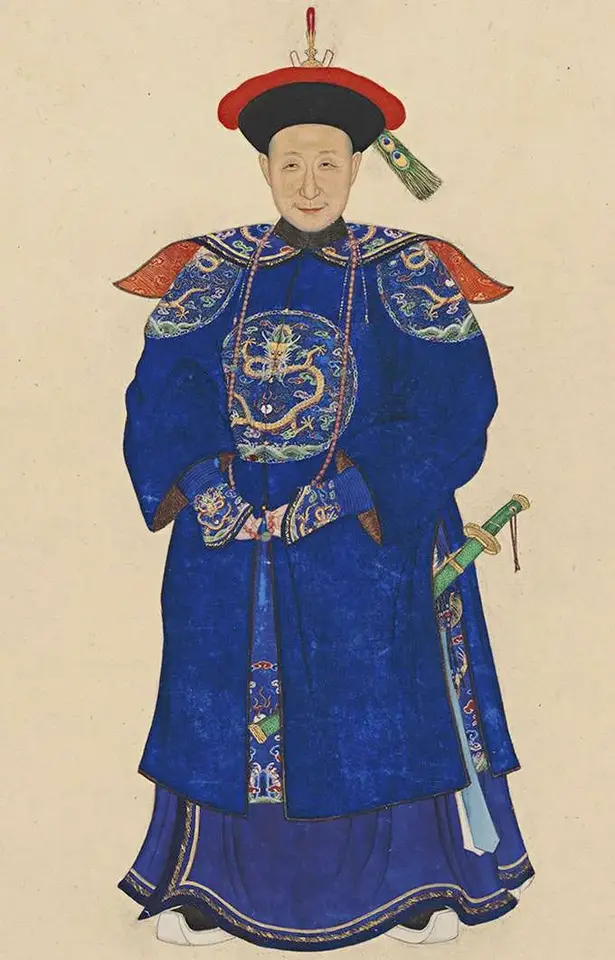
傅恒
Fuheng (傅恒, 1722–1770), courtesy name Chunhe, belonging to the Fuca clan of the Manchu Bordered Yellow Banner, was the foremost grand councilor and supreme military commander of the Qianlong era in the Qing dynasty. The younger brother of Empress Xiaoxian Chun, Fuheng entered court service as an imperial bodyguard and achieved rapid elevation due to his extraordinary administrative acumen and military talent. Appointed to the…
Fuheng (傅恒, 1722–1770), courtesy name Chunhe, belonging to the Fuca clan of the Manchu Bordered Yellow Banner, was the foremost grand councilor and supreme military commander of the Qianlong era in the Qing dynasty. The younger brother of Empress Xiaoxian Chun, Fuheng entered court service as an imperial bodyguard and achieved rapid elevation due to his extraordinary administrative acumen and military talent. Appointed to the Grand Council in 1745, he rose to become Grand Secretary of the Hall of Preserving Harmony and Chief Grand Councilor in 1748 at the age of twenty-seven. He volunteered to command the First Jinchuan Campaign as Field Grand Strategist, enforcing iron military discipline and compelling native chieftain Solobun to surrender, for which he was ennobled as First-Class Duke of Zhongyong. In 1755, when court consensus opposed military action, Fuheng alone championed the Qianlong Emperor's strategic decision to pacify the Dzungar Khanate, organizing nationwide logistical networks that secured victory in Central Asia. During the Sino-Burmese War in 1769, he personally led Qing armies into northern Burma, where he contracted severe tropical malaria. Returning to Beijing in early 1770, he passed away in September at the age of forty-nine, receiving the posthumous title Grand Guardian and honorific Wenzhong. In 1799, he was posthumously elevated to Commandery Prince.
Born into the prominent Fuca clan of the Manchu Bordered Yellow Banner.
Commenced service as Blue Plume Bodyguard, rapidly promoted to First-Class Bodyguard and Vice Minister.
Selected as Grand Councilor, demonstrating remarkable competence in civil and military administration.
Appointed Grand Secretary and Chief Grand Councilor; volunteered to command the Jinchuan front.
Accepted Solobun's surrender, pacified Jinchuan, and received the title First-Class Duke of Zhongyong.
Sole minister championing imperial war against Dzungaria; managed all logistics and communications.
Dispatched as Field Grand Strategist to lead offensive campaigns along the Irrawaddy river basin.
Died of severe tropical fever contracted during the Burmese campaign at age forty-nine; posthumously honored as Grand Guardian, enshrined in the Imperial Ancestral Temple in 1796, and elevated to Commandery Prince in 1799.
Fuheng hailed from one of the most distinguished Manchu noble houses, the Fuca clan of the Bordered Yellow Banner. His great-uncle Mishan had served as Minister of Revenue during the Kangxi reign, strongly advocating the abolition of the Three Feudatories; his father Lirongbao served as Commander of Chahar; and his elder sister was Empress Xiaoxian Chun, the first consort of the Qianlong Emperor. Endowed with exceptional physical vigor, mastery of archery and horsemanship, and literary education, Fuheng was commissioned as a Blue Plume Imperial Bodyguard in 1740. His remarkable administrative talents caught the personal attention of Qianlong, resulting in promotions to Junior Vice Minister of Revenue and Left Censor-in-Chief. In 1745, he was appointed to the Grand Council. In April 1748, at only twenty-seven years of age, Fuheng was elevated to Grand Secretary of the Hall of Preserving Harmony and Chief Grand Councilor, attaining the pinnacle of the Qing civil and military apparatus.
In the autumn of 1748, the Qing military expedition against the indigenous Gyalrong chiefdom of Greater Jinchuan had deteriorated into a humiliating stalemate. Grand Secretary Neqin and General Zhang Guangsi failed to breach stone watchtower defenses, incurring severe casualties. Observing imperial distress, Fuheng voluntarily petitioned to take command. Commissioned as Field Grand Strategist, he arrived at the front lines, promptly executed subordinate officers guilty of insubordination, and restored troop discipline. Personally reconnoitering rugged cliff defenses, Fuheng concentrated artillery bombardments to eliminate stubborn stone fortress bastions and spearheaded relentless uphill assaults. Surrounded and deprived of external routes, Chieftain Solobun knelt before Fuheng's headquarters in February 1749, tendering unconditional submission. Upon returning to Beijing in triumph, Fuheng was elevated to First-Class Duke of Zhongyong and bestowed a ruby court cap finial.
In 1754 and 1755, internal civil conflicts erupted within the Dzungar Khanate, presenting the Qing dynasty with a historic opportunity to end decades of border confrontation. However, haunted by memories of previous military reversals in the western deserts, the majority of imperial princes and senior court officials voiced vehement opposition to an offensive war. Amid pervasive hesitation, Fuheng alone stood shoulder-to-shoulder with the Qianlong Emperor, adamantly endorsing the deployment of expeditionary forces. As Chief Grand Councilor, Fuheng remained on continuous duty in the palace, drafting imperial edicts, standardizing relay horse post-stations across thousands of miles, and organizing provisions and armaments for the armies. His flawless logistical stewardship enabled Qing armies to eradicate the forces of Dawachi and Amursana, securing the northern and southern regions of the Tian Shan and incorporating the vast territories of Xinjiang into the Qing imperial realm.
In 1768, renewed clashes on the Sino-Burmese border resulted in the death of Governor-General Mingrui, shocking the Beijing court. In February 1769, Qianlong appointed Fuheng as Field Grand Strategist to lead a definitive campaign against the Konbaung dynasty of Burma. Arriving on the southwestern frontier, Fuheng mobilized riverine fleets and ground forces, advancing along the Irrawaddy River and capturing critical rebel fortresses at New Town. However, dense tropical humidity and deadly malarial pathogens devastated the Qing ranks. Within weeks, more than half of the expeditionary force fell sick, and prominent generals like Aligun died in camp. Fuheng himself contracted severe malaria, becoming bedridden yet continuing to issue military commands from his cot. Recognizing the impasse, Burmese King Hsinbyushin sued for peace, and Qing forces withdrew. Carried back to Beijing in a litter, Fuheng was visited at his residence by Emperor Qianlong. On September 2, 1770, Fuheng succumbed to chronic complications of the disease at age forty-nine. Deeply grieving, Qianlong attended the funeral in person, conferred the posthumous title Grand Guardian, and granted the honorific Wenzhong.
Assuming supreme field command during an operational stalemate, Fuheng eliminated tactical discord, refined artillery-assault coordination against indigenous stone fortifications, and compelled the submission of the Jinchuan chiefdoms, initiating the celebrated "Ten Great Campaigns" of the Qianlong reign.
Fuheng's political resolve and managerial brilliance provided the vital engine for the Qing conquest of Dzungaria and the western territories. His organization of transport lines and strategic communication across Central Asian deserts permanently secured the borders of northwestern China.
FIGURES ASSOCIATED WITH THIS DYNASTY