Born in Beijing
Born on the 7th day of the 9th lunar month into an Imperial Household bondservant family; trained in classical scholarship, music, and martial arts.
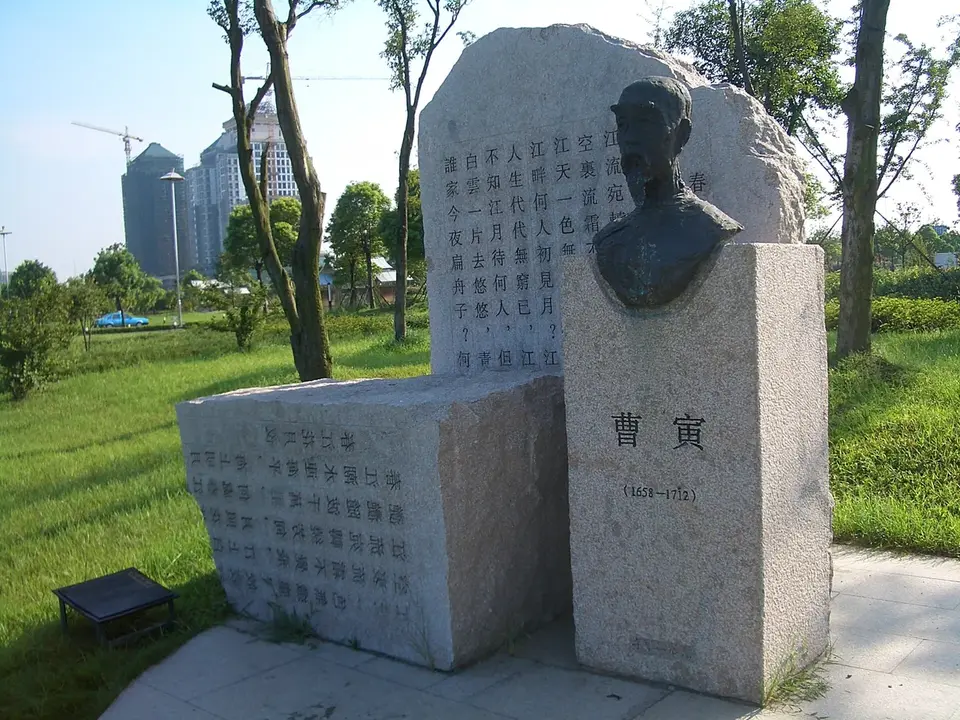
曹寅
Cao Yin (曹寅, October 3, 1658 – August 24, 1712), courtesy name Ziqing (子清), art names Lixuan (荔轩) and Lianting (楝亭), was a member of the Plain White Banner Booi of the Qing Eight Banners. Born in Beijing to an aristocratic bondservant family originating in Liaoyang, he was an eminent statesman, man of letters, playwright, bibliophile, and publisher, celebrated as the grandfather of Cao Xueqin, author of *Dream of the Red…
Cao Yin (曹寅, October 3, 1658 – August 24, 1712), courtesy name Ziqing (子清), art names Lixuan (荔轩) and Lianting (楝亭), was a member of the Plain White Banner Booi of the Qing Eight Banners. Born in Beijing to an aristocratic bondservant family originating in Liaoyang, he was an eminent statesman, man of letters, playwright, bibliophile, and publisher, celebrated as the grandfather of Cao Xueqin, author of Dream of the Red Chamber. His mother, Lady Gu, served as imperial wet-nurse to the Kangxi Emperor. In his youth, Cao Yin served as the emperor's study companion and imperial bodyguard. In 1690, he was named Silk Commissioner of Suzhou, and in 1692 succeeded to the Jiangning Silk Commissionership, concurrently serving four terms as Salt Censor of Lianghuai, supervising imperial silk manufacturing and southern salt revenues for over twenty years. Cao Yin enjoyed unprecedented personal favor and trust from the Kangxi Emperor. During four of the emperor's six southern inspection tours, Cao hosted the imperial entourage at the Jiangning Textile Bureau, organizing lavish temporary palaces. As a cultural leader in Jiangnan, he actively patronized Han literati, built bridges between Manchu and Han cultures, and directed the monumental imperial publication of the 900-volume Complete Tang Poems (Quan Tangshi) and the Peiwen Yunfu. A gifted poet and dramatist, he authored Collected Poems of Lianting and the drama Continuation of the Pipa. In his final years, heavy imperial reception expenditures incurred large treasury deficits, which the Kangxi Emperor shielded from prosecution. Cao passed away in office in Yangzhou in 1712 at the age of fifty-five.
Born on the 7th day of the 9th lunar month into an Imperial Household bondservant family; trained in classical scholarship, music, and martial arts.
Selected as imperial study companion (peibi shicong) to the young Kangxi Emperor, forging deep lifelong intimacy with the sovereign.
Promoted to imperial bodyguard of the third class; subsequently served as director in the Guangchu Department of the Imperial Household.
Appointed Textile Commissioner of Suzhou, managing high-grade imperial silks and regional weaving operations.
Transferred to Jiangning as Silk Commissioner, serving as the crown's chief confidential observer in the south for over twenty years.
Hosted the Kangxi Emperor's third southern tour at Jiangning, receiving personal imperial commendations and calligraphy.
Concurrently appointed Salt Censor of Lianghuai, rotating revenue administration with his brother-in-law Li Xu.
Ordered by imperial edict during the fifth southern tour to establish an editorial bureau in Yangzhou to print the Complete Tang Poems.
Completed the 900-volume woodblock edition of Quan Tangshi, presenting it to the throne to universal literary acclaim.
Protected by the Kangxi Emperor amidst mounting treasury deficits resulting from imperial reception expenses.
Contracted virulent malaria and passed away in Yangzhou on August 24 at age fifty-five; imperial condolences were dispatched to his family.
Cao Yin was born on October 3, 1658, in Beijing into an aristocratic bondservant (booi) household of the Plain White Banner. His ancestors had surrendered to the early Qing in Liaodong and were integrated into the Imperial Household Department (Neiwufu). His father, Cao Xi, served faithfully in the inner palace, while his mother, Lady Gu, was chosen as wet-nurse to Prince Xuanye, the future Kangxi Emperor. Following Xuanye's accession, the emperor treated Lady Gu with familial devotion, referring to her as "the elder of my family." In 1663, Cao Xi was dispatched to Nanjing as the first Jiangning Silk Commissioner, establishing the family's southern residence.
Cao Yin showed early intellectual brilliance, mastering classical Chinese prose, poetry, and calligraphy alongside Manchu and Mongolian. In 1669, following the elimination of the regent Oboi, the young emperor gathered trusted youths to attend his studies. The twelve-year-old Cao Yin was selected as imperial study companion (peibi shicong). Sharing rigorous daily lessons and archery exercises with the emperor, Cao established an intimate personal bond with the sovereign that endured for the rest of his life.
In 1675, at age eighteen, Cao Yin was appointed officer of the ceremonial guard and third-class imperial bodyguard (san deng shiwei). He subsequently served as treasury manager and department director in the Guangchu Storage Office of the Imperial Household Department, acquiring comprehensive mastery over imperial court finances and palace textile procurement.
Following the death of his father Cao Xi in 1684, the Kangxi Emperor personally visited the Cao residence in Nanjing during his first southern tour. In 1690, Cao Yin was appointed Silk Commissioner of Suzhou, supervising the production of exquisite brocades and court embroideries. In November 1692, the emperor reassigned Cao Yin to the paramount post of Jiangning Silk Commissioner.
The Jiangning Textile Commission was far more than a textile manufacturing facility; it served as the Qing monarchy's paramount confidential intelligence outpost in the economic heartland of Jiangnan. Through imperial secret palace memorials (zouzhe), Cao reported directly to the emperor on local commodity prices, harvest yields, intellectual dissidence among southern gentry, and administrative disputes, functioning as the throne's confidential eyes and ears.
Beginning in 1704, to finance expanding court demands, the throne ordered Cao Yin and his brother-in-law Li Xu, Silk Commissioner of Suzhou, to alternate annual terms as Salt Censor of Lianghuai. Managing the vast salt monopolies of Jiangsu and Anhui, Cao stabilized salt quotas, repressed smuggling, and ensured the annual remittance of several million taels in salt levies.
During the Kangxi Emperor's six southern inspection tours, Cao Yin served as host and manager of the imperial traveling palace at Jiangning on four occasions: the third tour in 1699, the fourth in 1703, the fifth in 1705, and the sixth in 1707.
To accommodate the imperial retinue, Cao constructed magnificent courtyards, landscape gardens, and reception pavilions behind the textile bureau, commissioning elite operatic troupes to perform during banquets. The emperor repeatedly granted audience to Cao's mother Lady Gu, writing an imperial plaque reading "Hall of Motherly Grace" (Xuanrui Tang) to honor her lifelong loyalty.
However, the immense expenditures required to construct traveling palaces and provision thousands of imperial retainers cost millions of silver taels, far exceeding statutory allowances. Although Kangxi permitted Cao to offset these expenses through surplus salt revenues, unpaid commercial debts and local administrative demands accumulated, creating immense treasury deficits that would eventually ruin the Cao family.
Cao Yin transformed the Jiangning Textile Bureau into a celebrated salon where southern Han scholars gathered. In an era when lingering Ming loyalism created mutual suspicion between Manchus and Han Chinese, Cao opened his doors to prominent scholars including Zhu Yizun, Shi Runzhang, You Tong, and Cha Shenxing, bridging cultural divides through shared literary passion.
In March 1705, during the fifth southern tour, the Kangxi Emperor commanded Cao Yin to establish an editorial press at the Tianning Temple in Yangzhou to print the Complete Tang Poems (Quan Tangshi). Cao retained twelve renowned scholars, including Peng Dingqiu, to collate rare manuscripts and establish critical biographies. Mobilizing master woodblock carvers and fine rice paper across Jiangnan, Cao completed the 900-volume edition containing 48,900 poems by over 2,200 poets in just over a year.
In 1707, Cao traveled to Beijing to present the completed volumes to the throne. The emperor penned a personal preface, commending the work as a monument of classical civilization. Subsequently, Cao oversaw the printing of the massive rhyming dictionary Peiwen Yunfu. This editorial achievement secured Cao's reputation as one of the preeminent publishers in Chinese history.
In Kangxi's later reign, fierce succession struggles among the imperial princes intensified scrutiny over provincial treasury arrears. Liangjiang Viceroy Gali and Jiangsu Governor Zhang Boxing filed memorials accusing southern commissioners of embezzlement. Aware that the deficits stemmed directly from his own imperial tours, the Kangxi Emperor suppressed the impeachments, reappointing Cao and Li Xu to Lianghuai salt posts to gradually liquidate the shortages.
In July 1712, while conducting salt inspections in Yangzhou, Cao Yin contracted virulent malaria. As his condition deteriorated, Li Xu dispatched emergency memorials requesting Western quinine (jinji'na). The emperor personally inscribed an urgent message on the courier dispatch, ordering fast horses to carry the medicine day and night. However, before the medicine arrived, Cao Yin passed away on August 24, 1712, at the age of fifty-five.
Following Cao's death, Kangxi appointed Cao's son Cao Yong to succeed as Jiangning Silk Commissioner, and when Cao Yong died prematurely, permitted his nephew Cao Fu to be adopted as heir to continue the office, protecting the household until the accession of the Yongzheng Emperor.
Cao Yin's greatest cultural legacy was the compilation and printing of the Complete Tang Poems (Quan Tangshi). Ancient Chinese poetry reached its zenith during the Tang dynasty, but centuries of transmission had corrupted textual editions. Under imperial edict, Cao organized the editorial bureau at Yangzhou, reconciling the primary drafts of Ji Zhenyi and Hu Zhenheng.
Under Cao's direction, master carvers transcribed the texts in elegant standard script and printed them on premium Xuan paper. Completed in 1707, the Yangzhou edition resolved thousands of textual errors, corrupt attributions, and omissions, standing as an enduring pinnacle of Chinese official woodblock printing.
In the decades following the Manchu conquest, southern literati retained strong loyalist sentiments toward the fallen Ming dynasty. Recognizing that enduring peace required cultural reconciliation, Cao opened his residence "Lianting" to eminent poets, scholars, and artists, hosting monthly poetry gatherings.
He sponsored Zhu Yizun's bibliographic projects, printed You Tong's lyrics, and staged the premiere performance of Hong Sheng's masterpiece opera The Palace of Eternal Youth (Changsheng Dian). Through these cultural collaborations, Cao played a pivotal role in reconciling southern gentry with Qing rule, fostering a unified imperial culture.
During his four appointments as Salt Censor of Lianghuai, Cao displayed sophisticated economic acumen. Managing the empire's most lucrative salt production zone, he cracked down on predatory salt cartels while reducing unauthorized transit surcharges.
Cao protected merchants by allowing structured installment payments for past tax deficits and released stored grain during flood seasons to stabilize consumer prices. His fiscal balance maintained stable revenues for the central government while mitigating social unrest throughout Jiangnan.
Cao Yin was himself an accomplished dramatist and poet. He composed several major classical operas, including Continuation of the Pipa (Xu Pipa), dramatizing Cai Wenji's return from the northern steppes, celebrated for its solemn lyricism. His poetry collections, Collected Poems of Lianting, demonstrated profound mastery of Tang and Song poetic aesthetics.
Most importantly, the aristocratic splendor of the Jiangning Textile Bureau, the memories of four imperial receptions, and the family's sudden fiscal collapse were transmitted to his grandson, Cao Xueqin. These lived historical experiences formed the primary creative inspiration and autobiographical foundation for China's greatest classical novel, Dream of the Red Chamber (Hongloumeng).
FIGURES ASSOCIATED WITH THIS DYNASTY