Born in Qiao
Born into the Cao clan in Qiao County; lost his father at age ten and escorted his mother across the Yangtze to Wu.
曹休
Cao Xiu (d. November 8, 228), courtesy name Wenlie, was a native of Qiao County, Pei Commandery, Yu Province (modern Bozhou, Anhui Province). He was a paramount founding general and supreme military commander of the Cao Wei imperial clan during the Three Kingdoms period, rising to Grand Minister of War, created Marquis of Changping, and posthumously honored as Marquis Zhuang. A clan nephew of Cao Cao, he was praised in his…
Cao Xiu (d. November 8, 228), courtesy name Wenlie, was a native of Qiao County, Pei Commandery, Yu Province (modern Bozhou, Anhui Province). He was a paramount founding general and supreme military commander of the Cao Wei imperial clan during the Three Kingdoms period, rising to Grand Minister of War, created Marquis of Changping, and posthumously honored as Marquis Zhuang. A clan nephew of Cao Cao, he was praised in his youth by Cao Cao as the "Thousand-Li Colt of our clan." Orphaned at a young age amid the chaos of the late Han dynasty, Cao Xiu independently managed his father's funeral and escorted his elderly mother across the Yangtze River to find refuge in the Wu region. When Cao Cao raised loyalist forces in the north, Cao Xiu braved countless perils to travel thousands of li back to join him. Deeply moved by his filial piety and martial spirit, Cao Cao treated him like a biological son, having him share quarters and meals with his eldest son Cao Pi and appointing him commander of the elite "Tiger and Leopard Cavalry." During the Battle of Hanzhong in 218 (23rd year of the Jian'an era), Liu Bei dispatched generals Zhang Fei, Ma Chao, and Wu Lan to encamp at Xiabian. Serving as Cavalry Commandant and military consultant, Cao Xiu saw through Zhang Fei's feigned plan to cut off supply roads, boldly advocating an immediate surprise attack against Wu Lan; the Wei army crushed Wu Lan and slew Lei Tong, compelling Zhang Fei and Ma Chao to withdraw and stabilizing the Hanzhong theater. Following the founding of Cao Wei, Cao Xiu succeeded Grand General Xiahou Dun in overseeing the strategic frontier across Qing, Xu, and Yang provinces, serving successively as acting Administrator of Nan Commandery, General Who Conquers the East, and Senior General Who Conquers the East concurrently governing Yang Province. In 222 (3rd year of the Huangchu era), Cao Wei launched a three-pronged invasion against Eastern Wu; Cao Xiu commanded the eastern front at the Battle of Dongkou, shattering the fleet of Wu General of the Front Lu Fan, slaying thousands of enemy troops, and capturing vast quantities of warships. In 226 (7th year of the Huangchu era), as Emperor Wen (Cao Pi) lay mortally ill, he appointed Cao Xiu, Grand General Cao Zhen, Minister of Works Chen Qun, and General Who Pacifies the Army Sima Yi as co-regents to assist young emperor Cao Rui. Following Cao Rui's accession, Cao Xiu was elevated to Grand Minister of War, the pinnacle of ministerial rank. In 228 (2nd year of the Taihe era), deceived by Wu Administrator of Poyang Zhou Fang's feigned surrender with shaven hair, Cao Xiu advanced deep into Shiting, where his army was ambushed and routed by Wu Grand Commander Lu Xun, escaping annihilation only through Inspector of Yu Province Jia Kui's resolute relief. Filled with shame and grief upon his return to court, a malignant ulcer erupted across his back, and he passed away in Luoyang in November 228, posthumously honored as Marquis Zhuang. In 2010, the excavation of Cao Xiu's tomb in Mengjin, Luoyang, Henan, yielded a bronze seal bearing his name, providing tangible archaeological proof of his illustrious career.
Born into the Cao clan in Qiao County; lost his father at age ten and escorted his mother across the Yangtze to Wu.
Traveled thousands of li from the south to join Cao Cao's loyalist army; lauded as the Thousand-Li Colt of the clan.
Served in close attendance to Cao Cao, sharing quarters with Cao Pi and commissioned commander of the Tiger and Leopard Cavalry.
Saw through Zhang Fei's deception at Xiabian and crushed Wu Lan, forcing Zhang Fei and Ma Chao to retreat from Hanzhong.
Elevated to General of the Central Army, made Marquis of Anyang; succeeded Xiahou Dun in commanding Qing, Xu, and Yang provinces.
Commanded eastern army at Dongkou, shattering Lu Fan's fleet in a storm, slaying thousands and capturing naval vessels.
Received Cao Pi's deathbed testament alongside Cao Zhen, Chen Qun, and Sima Yi to guide young emperor Cao Rui.
Created Marquis of Changping and appointed Grand Minister of War, directing the supreme military power of the empire.
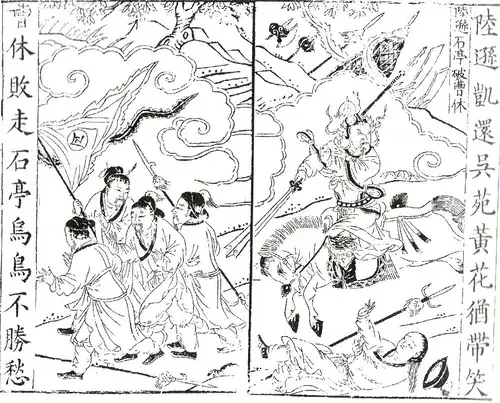
Deceived by Zhou Fang's false surrender into advancing to Shiting, routed by Lu Xun, rescued by Jia Kui at Jiashi.
Died in Luoyang from infected back ulcers born of grief and shame; posthumously honored as Marquis Zhuang; tomb excavated in 2010.
Cao Xiu was born into a prominent branch of the imperial Cao clan in Qiao County, Pei Commandery, during the late reign of Emperor Ling of Han, as a clan nephew of Emperor Wu of Wei (Cao Cao). His grandfather Cao Ding had served as Director of the Imperial Secretariat and Administrator of Wu Commandery during the reigns of Emperors Huan and Ling, enjoying illustrious standing. However, when Cao Xiu was around ten years of age, his father died prematurely, fracturing the household. At that time, the Yellow Turban Rebellion swept the Central Plains, plunging northern China into warlord bloodshed. Young Cao Xiu displayed maturity and filial piety beyond his years, independently managing his father's funeral and escorting his elderly mother across the Yangtze River to seek safety in the Wu region.
While residing in Wu Commandery, local officials and scholars treated Cao Xiu and his mother with warm generosity in memory of Cao Ding's benevolent administration. In the south, Cao Xiu immersed himself in Confucian classics and ancient military strategy while practicing archery and horsemanship daily, forging an unyielding and resolute spirit.
In 190 (1st year of the Chuping era), Cao Cao raised a loyalist army in Chenliu, issuing manifestos across the realm to overthrow the tyrant Dong Zhuo. When news crossed the Yangtze, young Cao Xiu was stirred to action. Knowing his clan leader had raised the standard of righteousness, he resolved not to linger in the south for personal safety. Entrusting his mother to safe care, he buckled on his sword and journeyed northward alone on horseback. Crossing thousands of li through bandit-infested wilderness and contested borders, he arrived safely in Yan Province to enter Cao Cao's military camp.
Cao Cao was overjoyed to see his young clan nephew who had traversed such distance to join him. Gently stroking Cao Xiu's back, Cao Cao exclaimed to his assembled officers: "This is truly the Thousand-Li Colt of our clan!" Moved by his fidelity, Cao Cao raised Cao Xiu alongside his own sons, arranging for him and his heir Cao Pi to share meals and sleep in the same tent.
Under Cao Cao's personal guidance, Cao Xiu grew into an accomplished equestrian archer and battlefield strategist. During the Jian'an era, when Cao Cao hosted a grand assembly at the Bronze Sparrow Terrace in Ye, Cao Xiu took part in archery competitions alongside Cao Hong, Cao Zhen, and Xiahou Yuan, galloping on horseback to hit the bullseye from a hundred paces, drawing thunderous cheers from the troops. Cao Cao formally appointed Cao Xiu commander of the elite "Tiger and Leopard Cavalry," the premier imperial guard unit reserved strictly for trusted royal generals, serving constantly at Cao Cao's side.
From 217 to 219 (22nd to 24th years of the Jian'an era), Cao Cao and Liu Bei clashed in a protracted conflict for control of Hanzhong. In 218, Liu Bei dispatched seasoned generals Zhang Fei, Ma Chao, Wu Lan, and Lei Tong with tens of thousands of elite troops to garrison Xiabian (modern Cheng County, Gansu), aiming to sever the mountain routes between Guanzhong and Hanzhong.
Faced with this threat, Cao Cao sent veteran general Cao Hong to lead the counter-offensive. Knowing that Cao Hong possessed fierce courage but lacked strategic prudence, Cao Cao commissioned Cavalry Commandant Cao Xiu as military consultant, giving Cao Hong secret instructions: "Although you hold the seal of commander-in-chief, you must consult and follow Wenlie's counsel in all operational movements!"
Upon arriving at the front lines, Zhang Fei deployed deceptive tactics. He sent detachments to spread word loudly that Shu forces had seized the Gushan pass to sever the Wei army's rear supply lines. Alarmed, Cao Hong and his senior officers hesitated, urging a halt to investigate and protect their retreat.
Young Cao Xiu saw through the ruse. He argued forcefully to Cao Hong: "If the enemy were truly cutting our rear, they would conceal their movements and spring an ambush; why would they announce their presence beforehand? Zhang Fei is staging a hollow deception to pin our main force down while Wu Lan gathers his dispersed detachments at Xiabian! We must exploit their disarray, mass our elite cavalry, and launch a lightning strike against Wu Lan! Once Wu Lan is crushed, Zhang Fei and Ma Chao will be isolated and compelled to retreat without a fight!"
Persuaded by his reasoning, Cao Hong ordered an immediate assault on Xiabian. The Wei cavalry stormed Wu Lan's camp, slaying General Lei Tong and routing the garrison. Hearing of Wu Lan's defeat, Zhang Fei and Ma Chao realized their deception had failed and withdrew rapidly toward Wudu. Cao Xiu's sharp battlefield acumen secured a decisive victory for Cao Wei, and Cao Cao rewarded him with promotion to Commander of the Central Army.
In 220 (1st year of the Huangchu era), Cao Cao passed away in Luoyang, and Cao Pi succeeded as King of Wei. Cao Xiu was appointed General of the Central Army and enfeoffed as Marquis of Yinshouting, soon elevated to Marquis of Anyang District. Later that year, Cao Pi accepted the abdication of Emperor Xian, founding the state of Cao Wei.
Shortly thereafter, Cao Wei's premier founding pillar, Grand General Xiahou Dun, passed away. Xiahou Dun had long commanded over twenty corps defending the southeastern frontier against Eastern Wu. Appointing his successor was vital to the empire's survival. Emperor Wen (Cao Pi) entrusted this grave task to Cao Xiu, appointing him General Who Conquers the East with acting imperial credentials to supervise military affairs across Qing, Xu, and Yang provinces.
During his tenure, Wu general Sun Shao frequently raided Huai River outposts, but Cao Xiu maintained disciplined garrisons and strengthened beacon defenses, repelling every incursion. When Wu officer Shen Heng sent secret letters offering surrender, Cao Xiu detected the trap, ambushed the approaching Wu detachments, and slew over a thousand enemy soldiers. In recognition, Cao Pi promoted him to Senior General Who Conquers the East and Governor of Yang Province. Cao Pi held Cao Xiu in immense affection; whenever Cao Xiu returned to Luoyang for an audience, the emperor descended from his chariot to greet him in person, sharing imperial banquets and bestowing rare treasures.
In the autumn of 222 (3rd year of the Huangchu era), following Sun Quan's refusal to send his heir as hostage after the Battle of Yiling, Cao Pi launched three armies totaling three hundred thousand troops against Eastern Wu. The eastern column was led by Senior General Who Conquers the East Cao Xiu, accompanied by seasoned veterans Zhang Liao, Zang Ba, and Wang Ling, marching toward Dongkou along the lower Yangtze. Sun Quan appointed General of the Front Lu Fan to command five armies to defend the riverline.
While the two hosts faced each other, a sudden gale whipped the Yangtze into mountainous waves, severing the mooring cables of the Wu fleet. Dozens of large warships were driven toward the northern bank held by Cao Xiu; ships capsized and thousands of Wu soldiers drowned. Seizing the opportunity, Cao Xiu launched an immediate amphibious counterattack.
Cao Xiu ordered Zhang Liao and Zang Ba to attack the stranded vessels; Zang Ba led light boats across the river to raid Xuling, destroying over a thousand defensive outposts, while Cao Xiu commanded the cavalry along the shoreline, killing thousands of Wu troops and capturing thousands of vessels. The Battle of Dongkou severely damaged Eastern Wu's naval strength, forcing Lu Fan to retreat to the southern shore. Following this triumph, Cao Pi elevated Cao Xiu to Grand Minister of War (Da Sima) and granted him the yellow axe of supreme judicial authority, placing him at the head of the Three Excellencies.
In May 226 (7th year of the Huangchu era), forty-year-old Emperor Wen (Cao Pi) fell mortally ill. Summoning Cao Xiu to his bedchamber, the emperor appointed him alongside Senior General of the Central Army Cao Zhen, Minister of Works Chen Qun, and General Who Pacifies the Army Sima Yi as co-regents to assist Crown Prince Cao Rui. Upon ascending the throne, Emperor Ming (Cao Rui) treated Cao Xiu with profound deference, elevating him to Marquis of Changping with an estate of over four thousand households and confirming him as Grand Minister of War.
In 228 (2nd year of the Taihe era), Cao Xiu suffered the most catastrophic defeat of his life. Seeking to break the northern blockade in Huainan, Wu Grand Commander Lu Xun instructed Administrator of Poyang Zhou Fang to execute a feigned surrender. Zhou Fang sent seven secret petitions to Cao Xiu, claiming that tribal rebels had overrun Poyang, that the people hated Sun Quan, and that he wished to surrender the commandery to Wei if Cao Xiu would advance to receive him. To dispel all doubt, Zhou Fang publicly cut off his hair at the gates of Poyang, weeping and swearing allegiance to Heaven.
Eager to win decisive military glory, Cao Xiu believed the ruse. Although Inspector of Yu Province Jia Kui sent memorials warning of deception, Cao Xiu brushed caution aside and petitioned Emperor Ming to lead an army of one hundred thousand troops from Hefei directly to Shiting in Wan County. Emperor Ming ordered Sima Yi toward Jiangling and Jia Kui toward Dongguan in support.
In August, Cao Xiu marched into the narrow defiles of Shiting. Upon reaching the interior of the valley, Zhou Fang vanished, and drums echoed across the surrounding peaks. Wu Grand Commander Lu Xun led the main host in the center, flanked by Quan Cong on the left and Zhu Huan on the right, unleashing ninety thousand elite troops in an ambush from three directions. Hemmed in the narrow valley, the Wei formations were broken and routed. At the climax of the battle, more than ten thousand Wei soldiers were killed or captured, and over ten thousand wagons of baggage, pack animals, and provisions fell into Wu hands.
Cao Xiu led his survivors in a desperate retreat toward the narrow pass of Jiashi. The terrain was precipitous, and Wu general Zhu Huan had already anticipated the retreat, stationing forces to block the gorge. Deprived of food, the Wei army faced total annihilation.
At this critical moment, Inspector of Yu Province Jia Kui, who had previously disagreed with Cao Xiu on strategic matters, acted with patriotic devotion. Anticipating that Cao Xiu would walk into an ambush, Jia Kui forced-marched his troops day and night, seizing the choke point of Jiashi, planting numerous banners, and beating drums to simulate the arrival of massive reinforcements. Believing that the main Wei army had arrived, the pursuing Wu forces broke off the chase. Through Jia Kui's decisive intervention, Cao Xiu was able to bring several tens of thousands of survivors safely out of the valley.
The disaster at Shiting was the most devastating defeat suffered by Cao Wei on the southeastern front. Returning to his base at Qiao County, Cao Xiu was overwhelmed by unbearable humiliation and self-reproach. As Grand Minister of War and founding regent, he had been humiliated by a petty officer's severed hair, losing ten thousand soldiers and staining the dignity of the empire.
Cao Xiu submitted a memorial to Emperor Ming taking full responsibility and begging for capital punishment and dismissal. Recognizing his lifelong fidelity, Emperor Ming sent Cavalry Commandant Yang Ji to Cao Xiu's camp to convey comforting imperial decrees and lavish gifts of silk and treasure.
However, Cao Xiu was proud and unyielding; the inner torment of shame burned within him without relief. Under this crushing psychological burden, a severe carbuncle erupted on his back, becoming severely ulcerated and infected beyond medical remedy. On November 8, 228 (Gengzi day, 9th month of the 2nd year of the Taihe era), Grand Minister of War Cao Xiu passed away in his residence in Luoyang.
Emperor Ming mourned deeply and suspended court, conferring the posthumous title of Marquis Zhuang upon him and allowing his eldest son Cao Zhao to inherit the marquisate.
In 228, Cao Xiu was laid to rest in Mengjin, Luoyang. In 2010, archaeologists from Henan Province excavated a grand brick-chambered tomb in Shlipu Village, Chaoyang Town, Mengjin County. The tomb contained a wealth of artifacts, including gold-inlaid bronze belt hooks, jade pigs, pottery wagons, and delicate ivory ornaments. In the front chamber, excavators unearthed a bronze seal measuring two centimeters square inscribed with the characters "Cao Xiu." Anthropological analysis confirmed that the skeletal remains belonged to a robust male aged around fifty, aligning with historical records of the Grand Minister of War. The discovery was named one of the Top Ten Archaeological Discoveries of China for 2010, offering tangible historical proof of the Thousand-Li Colt's legendary and poignant life.
Orphaned at an early age in the south, traveled thousands of li upon hearing Cao Cao raise his army; Cao Cao embraced him as the Thousand-Li Colt of the clan, raising him like a son and making him commander of the Tiger and Leopard Cavalry.
Exhibited peerless horse archery during the grand banquet at the Bronze Sparrow Terrace in Ye, hitting the center target from a hundred paces on a galloping mount.
Advised Cao Hong at Xiabian in 218, discerning that Zhang Fei's loud warnings of severed roads were a feint; urged a rapid assault that crushed Wu Lan, forcing Zhang Fei and Ma Chao to withdraw.
Appointed in 220 to succeed Xiahou Dun in commanding military forces across Qing, Xu, and Yang provinces, repelling Wu incursions along the Huai River for nearly a decade.
Commanded the eastern column in 222, launching an amphibious assault that shattered Lu Fan's storm-tossed fleet, killing thousands and capturing warships, elevated to Grand Minister of War.
Entrusted with state affairs in 226 alongside Cao Zhen, Chen Qun, and Sima Yi to guide young emperor Cao Rui, created Marquis of Changping as senior regent.
Deceived by Zhou Fang's feigned surrender into advancing to Shiting, rescued by Jia Kui at Jiashi; died in Luoyang from infected back ulcers caused by intense shame, posthumously honored as Marquis Zhuang.
Excavated in 2010 in Mengjin, Luoyang, yielding a personal bronze seal inscribed with "Cao Xiu" and rich artifacts that confirmed his identity and historical station.
FIGURES ASSOCIATED WITH THIS DYNASTY