Rescue at Xingyang
Offered his horse to Cao Cao during the retreat at Xingyang, declaring "the world may do without Hong, but cannot do without you."
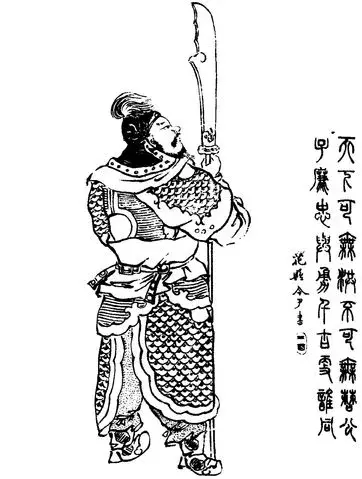
曹洪
Cao Hong was a founding general and prominent imperial clansman of the Cao Wei dynasty during the late Eastern Han and Three Kingdoms periods, and a younger cousin of Cao Cao. Raising troops and exhausting his personal wealth to support Cao Cao's early insurrection against Dong Zhuo, Cao Hong performed an act of heroic devotion at the Battle of Xingyang in 190: when Cao Cao's horse was killed, Cao Hong yielded his own mount,…
Cao Hong was a founding general and prominent imperial clansman of the Cao Wei dynasty during the late Eastern Han and Three Kingdoms periods, and a younger cousin of Cao Cao. Raising troops and exhausting his personal wealth to support Cao Cao's early insurrection against Dong Zhuo, Cao Hong performed an act of heroic devotion at the Battle of Xingyang in 190: when Cao Cao's horse was killed, Cao Hong yielded his own mount, famously proclaiming that "the world may do without Hong, but cannot do without you," guiding Cao Cao across the turbulent Bian River to safety. Throughout the campaigns that established Cao Wei, Cao Hong rendered distinguished military service across northern China. At the Battle of Guandu in 200, Cao Hong was entrusted with commanding the main encampment, repulsing fierce night assaults by Yuan Shao's generals Zhang He and Gao Lan, and subsequently accepting their surrender to seal the northern victory. During the Hanzhong Campaign in 218, he routed Shu Han forces at Xiabian, slaying commanders Wu Lan and Ren Kui and repelling Zhang Fei and Ma Chao. Following Cao Pi's ascension, Cao Hong was named General of Agile Cavalry, but was later imprisoned over personal financial grudges until Empress Dowager Bian intervened to commute his death sentence to civilian status. Restored by Emperor Ming, he was ennobled as Marquis of Lecheng and reappointed General of Agile Cavalry. He died in 232 and was later enshrined in Cao Cao's imperial ancestral temple.
Offered his horse to Cao Cao during the retreat at Xingyang, declaring "the world may do without Hong, but cannot do without you."
Foraged supplies across Dongping and Fan County during severe famine, enabling Cao Cao to defeat Lu Bu.
Suppressed insurrections in Nanyang and routed Liu Biao's detachments, advancing to General of Stern Sharpness.
Commanded the central base at Guandu, repelling Zhang He and Gao Lan and accepting their surrender.
Crushed Shu forces at Xiabian, killing Wu Lan and Ren Kui while forcing Zhang Fei and Ma Chao to withdraw.
Appointed General of Agile Cavalry; later imprisoned and stripped of ranks over past financial refusals to Cao Pi.
Restored under Emperor Ming as Marquis of Lecheng and General of Agile Cavalry; passed away with the posthumous title Marquis Gong.
Cao Hong was a younger paternal cousin of Cao Cao. In late Eastern Han, as the realm fragmented under the despotism of Dong Zhuo, Cao Cao raised a volunteer army in Chenliu, and Cao Hong joined his kinsman as a military marshal. In 190 (Chuping 1), while other coalition forces stalled at Suanzao, Cao Cao pursued Dong Zhuo west toward Luoyang. At Xingyang, Cao Cao fell into an ambush orchestrated by Dong Zhuo's general Xu Rong, suffering catastrophic casualties; Cao Cao's steed was struck down, and enemy cavalry closed in rapidly.
In this desperate predicament, Cao Hong dismounted and presented his horse to Cao Cao. When Cao Cao refused to abandon him, Cao Hong cried out: "The world may do without Hong, but cannot do without you!" Armed with a single sword, Cao Hong ran alongside the galloping mount through the night until reaching the deep currents of the Bian River. Scouting the riverbank under darkness, Cao Hong discovered an abandoned ferryboat, guiding Cao Cao across to escape back to Qiao County.
With their original force decimated, Cao Hong capitalized on his personal friendship with Chen Wen, Inspector of Yangzhou, marching south with over a thousand clan retainers. He recruited two thousand elite troops in Lujiang and gathered several thousand more in Danyang, rendezvousing with Cao Cao at Longkang. This substantial body of seasoned infantry formed the indispensable military core of Cao Cao's emerging power base.
In 194 (Xingping 1), while Cao Cao was campaigning against Tao Qian in Xu Province, Zhang Miao and Chen Gong rebelled and welcomed Lu Bu into Yan Province, seizing nearly all commanderies. Amid severe locust plagues and widespread famine, Cao Hong spearheaded the vanguard, capturing Dongping and Fan County to requisition grain for the starving main army. Re-provisioned, Cao Cao engaged Lu Bu at Puyang, recaptured Dong'a, and dispatched Cao Hong to storm over ten fortified county seats across Jiyin, Shanyang, Zhongmu, and Yangwu. For these achievements, Cao Hong was commissioned as Colonel of Soaring Courage and later Leader of Court Gentlemen Who Displays Martial Prowess.
In 196 (Jian'an 1), Cao Hong led troops to escort Emperor Xian from Luoyang, confronting armed opposition from Dong Cheng and Yuan Shu's general Chang Nu. Following the relocation of the capital to Xu County, Cao Hong was appointed Grand Master of Remonstrance. In 197, when southern commanderies rebelled to support Zhang Xiu, Cao Hong marched into Nanyang, establishing fortified positions at Ye County despite relentless raids from Zhang Xiu and Liu Biao. Cao Hong then launched counter-offensives against Liu Biao's commanders, routing enemy detachments at Wuyang, Duyang, and Bowang. He was promoted to General of Stern Sharpness and ennobled as Marquis of Guoming Pavilion, subsequently rising to Protector-General. In 200, Cao Hong collaborated with Xu Huang to crush the insurgent leader Zhu Bi at Yinqiang.
In October 200 (Jian'an 5), the decisive confrontation between Cao Cao and Yuan Shao culminated at Guandu. Acting upon intelligence provided by turncoat adviser Xu You, Cao Cao prepared to lead a raid of five thousand light horsemen against Yuan Shao's supply depot at Wuchao. Entrusting the survival of his entire army to Cao Hong and senior strategist Xun You, Cao Cao placed them in sole command of the central ramparts.
In response to the Wuchao crisis, Yuan Shao dispatched his premier generals Zhang He and Gao Lan to assault the weakened Cao camp. Faced with massive numerical inferiority, Cao Hong and Xun You maintained unyielding defensive coordination, using concentrated archery and fieldworks to repeatedly repel the assaults. When news arrived that Wuchao was ablaze, Zhang He and Gao Lan recognized that their cause was lost, burned their siege engines, and approached the Cao camp to offer surrender. Initially fearing a ruse, Cao Hong hesitated, but Xun You urged: "Zhang He defected because Yuan Shao rejected his counsel; why should you doubt him?" Cao Hong opened the gates to accept the surrender, precipitating the rout of Yuan Shao's main army. In 204, while Cao Cao was eliminating enemy supply lines at Maocheng, he entrusted Cao Hong with prosecuting the prolonged siege of Ye City until its capitulation.
In 215, Cao Hong accompanied Cao Cao in subduing Zhang Lu in Hanzhong. In 217, Liu Bei launched the Hanzhong Campaign, dispatching Zhang Fei, Ma Chao, and Wu Lan to encamp at Xiabian, threatening to sever the supply line connecting Wudu to Guanzhong. Cao Cao dispatched Cao Hong as commander-in-chief to hold Xiabian, assigning Xin Pi and cavalry officer Cao Xiu as his military aides, secretly advising Cao Xiu: "Although you are designated a military aide, you are the actual commander of this army."
Recognizing the strategic intent, Cao Hong prudently delegated tactical decisions to his younger kinsman. Liu Bei ordered Zhang Fei to march toward Gushan, loudly boasting that he would cut off the retreat of the Cao forces. While other commanders hesitated, Cao Xiu reasoned that an enemy intending to cut off communications would operate covertly, arguing that Zhang Fei was staging a diversion while Wu Lan remained isolated at Xiabian. Embracing the plan, Cao Hong concentrated his forces against Wu Lan.
In early 218 (Jian'an 23), Cao Hong assaulted the Shu camp at Xiabian, slaying commander Ren Kui and decimating thousands of Wu Lan's troops. Wu Lan fled into the hills, where he was killed by indigenous Di tribesmen. Realizing their flank was destroyed, Zhang Fei and Ma Chao retreated toward Shu territory. The victory at Xiabian preserved the northern approach to Hanzhong and safeguarded the Guanzhong frontier.
Despite his battlefield heroism, Cao Hong was notorious for his avaricious temperament, accumulating immense private wealth, lands, and mansions in Qiao County. During his youth, the future Emperor Wen (Cao Pi) had requested a personal loan of one hundred bolts of silk from Cao Hong; Cao Hong's refusal incited enduring resentment.
Upon ascending the throne in 220, Cao Pi elevated Cao Hong to General of the Guards, promoted him to General of Agile Cavalry, and advanced his fief to Marquis of Duyang. However, in 226, Cao Pi exploited a legal infraction committed by one of Cao Hong's household retainers to cast the general into the imperial prison, sentencing him to death for treason. High ministers such as Cao Zhen and Dowager Empress Bian pleaded desperately on his behalf. Enraged, Empress Dowager Bian confronted Cao Pi: "Had Zilian not offered his horse at Xingyang, Wei would possess no empire today!" She then warned Empress Guo that if Cao Hong were executed, she would command the emperor to depose the empress. Terrified, Empress Guo wept and implored Cao Pi for mercy. Forced to yield, Cao Pi spared Cao Hong's life, but stripped him of all offices, revoked his noble rank, and confiscated his entire estate, only returning the properties after continued pressure from his mother.
Cao Pi passed away that same year, and his successor, Emperor Ming (Cao Rui), immediately rehabilitated his great-uncle. Cao Rui appointed Cao Hong General of the Rear, ennobled him as Marquis of Lecheng with an estate of one thousand households, and granted him the elite rank of Specially Advanced. Shortly thereafter, Cao Hong was re-commissioned as General of Agile Cavalry. In 232 (Taihe 6), the veteran commander passed away in Luoyang and was granted the posthumous title Marquis Gong. In 243, Cao Hong was officially enshrined in the ancestral temple of Cao Cao.
Chen Shou judged Cao Hong in the Records of the Three Kingdoms: "The Xiahou and Cao clans were hereditary officials who laid the foundations of the state through close imperial kinship... Cao Hong was present at the inception of the dynasty, and his military contributions were substantial. Yet that he suffered humiliation on account of petty greed was truly lamentable."
Empress Dowager Bian proclaimed his historical importance during his trial: "The foundations between the Liang and Pei regions were built upon Zilian!"
Centuries later, traditional historical commentary acknowledged that while Cao Hong exhibited personal flaws regarding money, his absolute loyalty on the battlefield, his self-sacrificing heroism at Xingyang, and his defensive mastery at Guandu cemented his status among the paramount founding generals of the Cao Wei dynasty.
FIGURES ASSOCIATED WITH THIS DYNASTY