Birth in Mianchi
Born into a scholarly farming family in Mianchi, Henan; deeply devoted to his parents from childhood.
曹端
Cao Duan (1376–1434), courtesy name Zhengfu and art name Yuechuan, was a native of Mianchi, Henan Prefecture, Henan. He was an outstanding thinker, preeminent Neo-Confucian philosopher, and educator in the early Ming dynasty. Together with Xue Xuan and Wu Yubi, he was celebrated as one of the "Three Great Neo-Confucian Scholars of the Early Ming," serving as the pioneering patriarch of the revival and development of Song…
Cao Duan (1376–1434), courtesy name Zhengfu and art name Yuechuan, was a native of Mianchi, Henan Prefecture, Henan. He was an outstanding thinker, preeminent Neo-Confucian philosopher, and educator in the early Ming dynasty. Together with Xue Xuan and Wu Yubi, he was celebrated as one of the "Three Great Neo-Confucian Scholars of the Early Ming," serving as the pioneering patriarch of the revival and development of Song Neo-Confucianism during the Ming dynasty. Naturally gifted with pure filial piety, Cao Duan endured early poverty and lost his biological mother early, studying diligently while deeply investigating the metaphysics and moral philosophy of Song thinkers Zhou Dunyi, Cheng Hao, Cheng Yi, Zhang Zai, and Zhu Xi. In 1408 (6th year of Yongle), he passed the Henan provincial examination as a juren. Observing scholars competing for bureaucratic advancement, Cao Duan deliberately chose modest academic posts, serving for over twenty years as Director of Studies in Puzhou and Huozhou in Pingyang Prefecture, Shanxi. Advocating the core tenets of "dwelling in reverent seriousness, fathoming principles, and uniting knowledge with moral action," he practiced his philosophy personally, transforming local mores and attracting thousands of scholars from afar, thus establishing the intellectual foundation of the renowned Hedong School. Philosophically, he rigorously parsed the Taiji (Supreme Polarity) and the dialectics of principle (li) and material force (qi), authoring seminal works including Exposition of the Diagram of the Supreme Polarity Explained (Taiji Tushuo Shu), Exposition of the Penetrating Book (Tongshu Shu), and Detailed Explanations of the Four Books (Sishu Xiangshuo). Hailed by Ming and Qing scholars as the "foremost Neo-Confucian of the Ming dynasty," he was granted sacrifice in the Temple of Confucius during the Yongzheng reign of the Qing dynasty.
Born into a scholarly farming family in Mianchi, Henan; deeply devoted to his parents from childhood.
Submerged himself in Zhou Dunyi's Taiji Tushuo and Cheng-Zhu philosophy, resolving to illuminate the sagely path.
Passed the Henan provincial civil examination as a juren, earning widespread academic acclaim in the Central Plains.
Appointed Director of Studies in Puzhou, Shanxi, instituting strict educational guidelines and reforming local scholarly morale.
Transferred to serve as Director of Studies in Huozhou, Shanxi, expounding Neo-Confucianism to crowds of students.
Died of overwork in his official quarters in Huozhou at age fifty-nine; the local populace wept and suspended commerce.
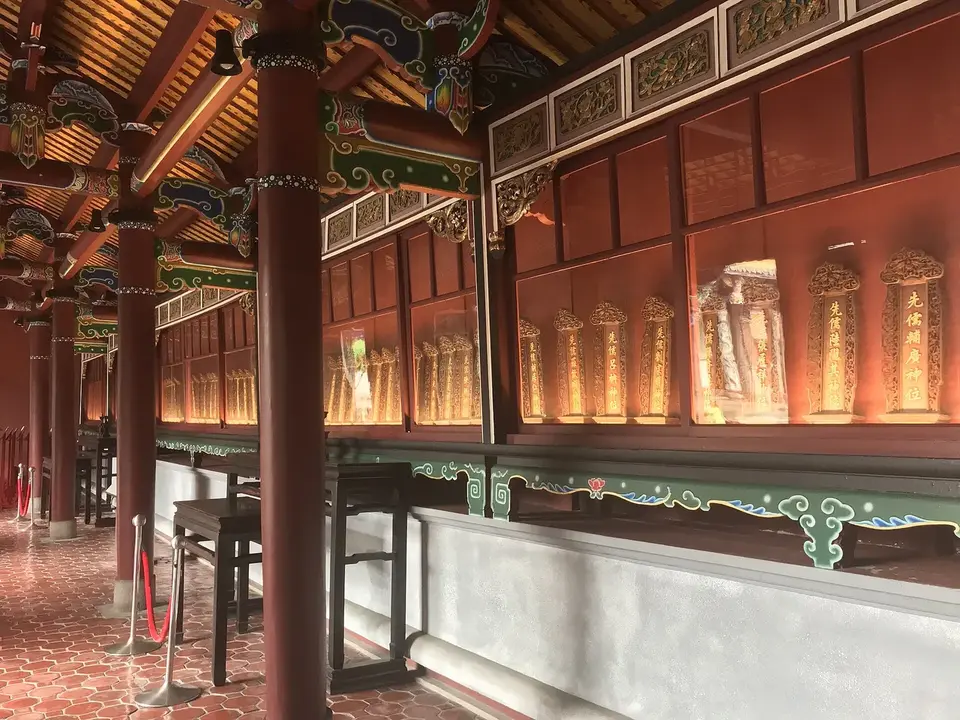
Posthumously enshrined by imperial decree in the Hall of Ancient Worthies at the Temple of Confucius.
Cao Duan was born in 1376 in Mianchi County, Henan. Endowed with sharp intellect and profound natural benevolence, he lost his biological mother at an early age. He served his stepmother with extraordinary devotion, inquiring after her comfort day and night, earning widespread admiration throughout his native district for immaculate filial piety. In his classical pursuits, Cao Duan did not confine himself to rhetorical flourishes or civil service rote memory, but was drawn to the metaphysical teachings of moral nature developed by Northern and Southern Song Neo-Confucians.
In his youth, Cao Duan chanced upon Zhou Dunyi's foundational treatises, An Explanation of the Diagram of the Supreme Polarity (Taiji Tushuo) and Penetrating the Book of Changes (Tongshu). Reading them repeatedly with deep contemplation, he exclaimed: "The true Way resides here! The learning of the ancient sages is none other than this!" He withdrew from worldly society, sitting in quiet meditation to fathom their deepest subtleties. He strictly regulated his thoughts, speech, and physical deportment according to Zhu Xi's Collected Annotations on the Four Books. Even when alone in secluded chambers, he remained neatly robed and serenely upright without a trace of laxity, gradually synthesizing the core teachings of Cheng-Zhu philosophy.
In 1408, at thirty-two years of age, Cao Duan took part in the Henan provincial examinations, achieving the juren degree with brilliant essays on the Book of Changes and moral philosophy. In the early Yongle reign, as central institutions were reestablished, newly minted degree holders aggressively vied for lucrative posts in central ministries or lucrative county magistrateships. Cao Duan, however, viewed wealth and rank as fleeting clouds. Believing contemporary scholars had lost their moral moorings in pursuit of personal gain, he specifically requested appointments in the state educational bureaucracy to devote his life to teaching.
In 1410, the Ministry of Personnel appointed Cao Duan Director of Studies in Puzhou, Pingyang Prefecture, Shanxi. Situated along the Yellow River, Puzhou was an ancient regional center, but its prefectural academy had fallen into neglect, with students merely memorizing rhyming verse for examinations. Upon arrival, Cao Duan led students in repairing the Confucian shrine and instituting rigorous academic regulations. Every morning he delivered lectures on the Analects and Mencius, dissecting textual principles and training scholars to embody filial piety and integrity in daily life. When students committed moral transgressions, Cao Duan avoided corporal punishment, counseling them with genuine tears of sympathy until the transgressors reformed in deep shame. Under his moral influence, scholarly habits in Puzhou were utterly transformed.
In 1418, recognized for stellar pedagogical evaluations, Cao Duan was transferred to become Director of Studies in Huozhou, Shanxi. Scholars across Huozhou rejoiced at his arrival. Cao Duan presided over the Huozhou academy for sixteen years. In addition to delivering lectures at the official academy, he erected a private lecture hall east of the walled city to debate the refined principles of Taiji Tushuo, Tongshu, the I Ching, and Zhang Zai's Western Inscription (Ximing) with scholars traveling from afar. He positioned "reverence" (jing) as the fundamental discipline, frequently advising students: "In learning, nothing takes precedence over reverent seriousness. When no stray thoughts stir within and no improper movements occur without, moral character matures and Heavenly Principle becomes spontaneously manifest."
Leading Confucian scholars of the era, such as Xue Xuan, were deeply moved by his intellectual rigor, and students across the Hedong region traveled thousands of li on foot to study under him. In his teaching, Cao Duan adapted his methods to students' capacities: for gifted pupils, he illuminated the deep metaphysical springs of human nature; for less advanced learners, he drilled the basics of daily etiquette and household ethics. He maintained extreme personal frugality, using his meager salary solely for simple grain while using the surplus to purchase books and subsidize impoverished students. In 1434, exhausted by decades of relentless teaching, Cao Duan passed away peacefully in his official residence in Huozhou at the age of fifty-nine.
On the day of his death, Huozhou gentry and commoners wept in the streets, and local markets suspended business for three days in shared grief. Mourning their beloved mentor, local elders and disciples contributed funds to arrange an honorable burial and erected an ancestral shrine for seasonal sacrifices.
Cao Duan occupies an undisputed foundational position in Ming intellectual history. Following the protracted turbulence of the late Yuan and early Ming dynasties, scholars had largely turned toward ornate literary compositions or Daoist and Buddhist quietism, leaving the Song Neo-Confucian tradition nearly extinguished. Emerging from common obscurity, Cao Duan shouldered the transmission of the Confucian orthodox line (daotong), raising high the banner of Cheng-Zhu Neo-Confucianism.
Huang Zongxi, in The Records of Ming Scholars (Mingru Xue'an), placed Cao Duan at the very head of the first volume on Ming Neo-Confucianism, declaring: "Neo-Confucian learning in the Ming dynasty began with Master Yuechuan." Through rigorous philosophical inquiry and personal moral practice, Cao Duan broke through the intellectual stagnation of the early Ming, reestablishing the classical Confucian path and directly inspiring his successor Xue Xuan to establish the influential Hedong School, serving as the indispensable cornerstone of Ming Confucian development.
Cao Duan was a prolific author who made groundbreaking conceptual contributions to Chinese philosophy. His major surviving works include Exposition of the Diagram of the Supreme Polarity Explained (Taiji Tushuo Shu, 1 volume), Exposition of the Penetrating Book (Tongshu Shu, 1 volume), Detailed Explanations of the Four Books (Sishu Xiangshuo, 22 volumes), and Records of Preserved Learning (Cunxue Lu).
In Taiji Tushuo Shu, Cao Duan tackled the centuries-long philosophical debate surrounding Zhou Dunyi's ambiguous phrase "Non-Polarity yet Supreme Polarity" (Wuji er Taiji). Upholding Zhu Xi's core position that "principle precedes material force" (li zai qi xian), he simultaneously emphasized that principle and force are "neither separate nor confounded" (bu li bu za). He elucidated that the Supreme Polarity is the supreme, unblemished Heavenly Principle inherent in all things, which generates yang in movement and yin in stillness, existing ubiquitously throughout heaven and earth. He formulated the seminal proposition that "Supreme Polarity has no arbitrary beginning in movement or rest, and yin and yang have no temporal genesis in closing and opening," demonstrating that Supreme Polarity is not an entity detached from yin and yang, but the governing Principle operating within their dynamic interplay. His rigorous analysis purged Buddhist and Daoist quietist misinterpretations that had accumulated since the Yuan dynasty, restoring Cheng-Zhu philosophy to doctrinal clarity.
Cao Duan was not merely a philosopher but an exceptional pedagogical reformer. He advanced the educational maxim that "true learning must be realized in concrete action," vehemently opposing abstract, detached academic discourse divorced from personal moral cultivation.
He created an integrated academy curriculum fusing "dwelling in reverence, persevering in moral resolve, investigating principles, and vigorous personal practice." During his tenure in Huozhou, he formulated comprehensive School Precepts and Regulations (Jiaotiao Guiyue), requiring pupils to practice daily self-reflection beginning with filial service and sibling harmony, bringing Neo-Confucianism out of abstract ivory towers into daily community life. His pedagogical model revolutionized academic morale across northern China, generating the practical, grounded Confucian tradition of the Shaanxi, Shanxi, and Henan regions.
History of Ming (Ming Shi, Volume 282, Biographies of Confucians, Biography of Cao Duan) records: "Cao Duan, courtesy name Zhengfu, was a native of Mianchi... celebrated for filial piety. Reading Zhou Dunyi's Taiji Tushuo and Zhang Zai's Western Inscription, he sighed: 'The Way resides here!' Abandoning all peripheral detours, he specialized in the subtle mechanics of nature and principle. Serving as Director of Studies in Puzhou and then Huozhou, he led by personal example, transforming local customs. Scholars hailed him as Master Yuechuan. In the early Ming, those discussing Neo-Confucianism revered Cao Duan, Xue Xuan, and Wu Yubi as supreme masters."
The great early Qing philosopher Huang Zongxi affirmed in Records of Ming Scholars (Mingru Xue'an, Volume 1): "In the early Ming, all who discussed Neo-Confucianism took Cheng Hao, Cheng Yi, and Zhu Xi as their models. Yet in solid, practical personal practice, discovering the truth within oneself, and opening the academic vanguard of an entire dynasty, it truly began with Master Cao Yuechuan of Mianchi."
Qing statesman Zhu Shi praised him in Inquiry into the Origins of Neo-Confucianism (Lixue Yuanyuan Kao): "Master Yuechuan embodied pure heavenly virtue, scrutinizing subtle classical doctrines and vigorously reviving lost scholarship; he stands foremost among all Ming scholars enshrined in the Confucian Temple."
FIGURES ASSOCIATED WITH THIS DYNASTY