Born in Chenliu
Born into a scholarly clan in Yu County, Chenliu, demonstrating filial piety while nursing his bedridden mother for three years.
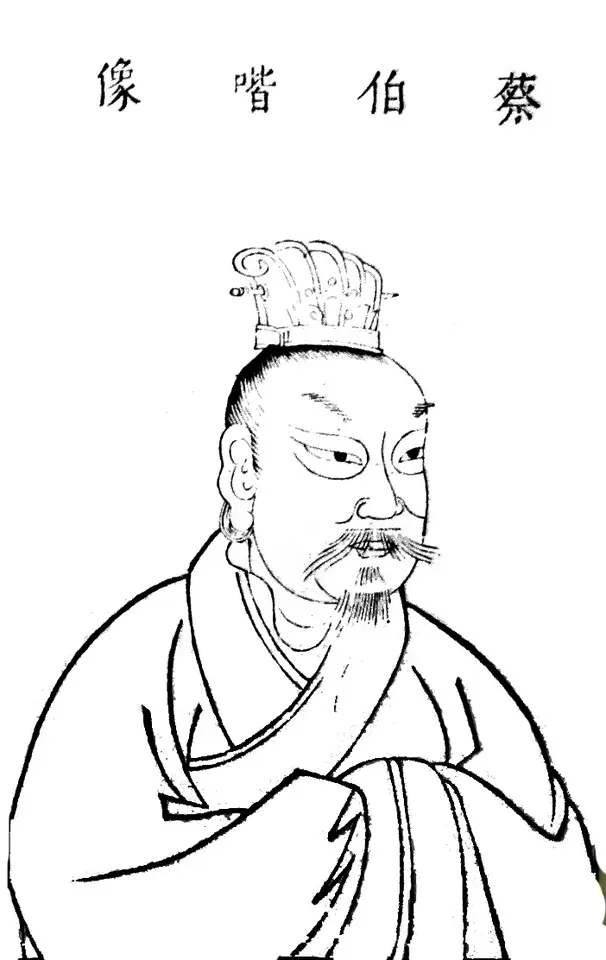
蔡邕
Cai Yong (蔡邕, 133–192 CE), courtesy name Bojie, was a native of Yu County in Chenliu Commandery (modern Qi County, Kaifeng, Henan), and a towering cultural polymath of the middle and late Eastern Han Dynasty who excelled as an author, calligrapher, historian, and music theorist, and was the father of the celebrated poet Cai Wenji. Born into an eminent gentry lineage, he won early regional fame for filial devotion, studying…
Cai Yong (蔡邕, 133–192 CE), courtesy name Bojie, was a native of Yu County in Chenliu Commandery (modern Qi County, Kaifeng, Henan), and a towering cultural polymath of the middle and late Eastern Han Dynasty who excelled as an author, calligrapher, historian, and music theorist, and was the father of the celebrated poet Cai Wenji. Born into an eminent gentry lineage, he won early regional fame for filial devotion, studying classical literature, astronomy, mathematics, and musical acoustics under Grand Tutor Hu Guang. Demonstrating uncompromising personal integrity, he feigned illness during the reign of Emperor Huan to refuse summons by powerful eunuchs. Entering the civil service under Emperor Ling, he served as Court Receptionist and Gentleman Consultant, collating state archives in the Eastern Pavilion (Dongguan). In 175 CE, distressed by corruption and arbitrary scribal alterations in Confucian texts, Cai Yong petitioned the throne to standardize the Six Classics, personally writing the canonical texts in red ink upon stone stelae in clerical script to create the celebrated "Xiping Stone Classics" outside the Imperial Academy in Luoyang. Exiled to remote Shuofang in 178 CE after secretly memorializing against eunuch corruption, he fled into the waterways of the Wu region upon receiving an imperial pardon, living as a fugitive for twelve years. In 189 CE, warlord Dong Zhuo seized control of the court and forced Cai Yong into service under threat of clan extermination, elevating him to General of the Household of the Left and Marquis of Gaoyang Village within days. Following Dong Zhuo's assassination in 122 CE, Cai Yong inadvertently sighed over Dong's death at a banquet hosted by Chancellor Wang Yun; imprisoned by the vindictive minister, he perished in prison despite desperate appeals by Grand Commandant Ma Midi, passing away at age sixty. His innovations in monumental stele inscriptions, the invention of "flying white" calligraphy, and his musical craftsmanship with the Scorched-Tail Zither left an indelible mark on Chinese civilization.
Born into a scholarly clan in Yu County, Chenliu, demonstrating filial piety while nursing his bedridden mother for three years.
Powerful eunuchs summoned him to perform zither music at court; Cai Yong feigned illness at Yanshi and returned home to write Shihui.
Recruited by Minister of Works Qiao Xuan, serving as Magistrate of Ping'a before being assigned to collate texts in the Eastern Pavilion.
Commissioned to standardize the Confucian Six Classics, personally brush-writing the texts onto forty-six stone stelae at the Imperial Academy.
Summoned to the Chongde Hall, he submitted a sealed memorial denouncing eunuch usurpation; betrayed by eunuchs, he was exiled to Shuofang.
Pardoned but subsequently framed by Five Commanderies Prefect Wang Zhi, he fled southward into the Wu region, living in hiding for twelve years.
Warlord Dong Zhuo seized power and threatened to exterminate his clan if he refused office, rapidly promoting him through three high ministerial tribunals in three days.
Created Marquis of Gaoyang Village, accompanied the court's forced migration to Chang'an, and dissuaded Dong Zhuo from usurping sovereign titles.
Following Dong Zhuo's assassination, Cai Yong sighed during a banquet; Wang Yun imprisoned him in the capital jail, where he died at age sixty.
Cai Yong was born into an illustrious scholar-gentry lineage in Yu County, Chenliu Commandery (modern Qi County, Henan Province). His ancestor Cai Xun had served as Magistrate of Mei under Emperor Ping of Han, while his father Cai Leng was revered locally for unblemished personal morality. Cai Yong was celebrated for extraordinary filial devotion: when his mother fell bedridden for three full years, he attended her bedside continuously through blistering summers and freezing winters, going seventy days without untying his sash or sleeping. Following her demise, he constructed a humble mourning hut beside her grave, observing ritual decorum for three years. Local accounts recorded that docile wild hares played near his hut and trees grew intertwined branches, which local populations revered as celestial responses to his filial purity. Living communally with his uncles and cousins across three generations without dividing family estates, he earned universal moral acclaim.
In his youth, Cai Yong studied under Grand Tutor Hu Guang, acquiring profound mastery over Confucian canons, historical annals, mathematical astronomy, acoustics, and esoteric divination. He became exceptionally renowned for his virtuosic zither playing. During the reign of Emperor Huan, corrupt eunuch marquises including Xu Huang and Zuo Guan dominated court affairs; learning of Cai Yong's musical mastery, they urged the emperor to compel his attendance in the capital. Reluctantly departing under commandery escort, Cai Yong traveled as far as Yanshi outside Luoyang before feigning acute illness to return home. Living in secluded retirement, he authored the philosophical dialogue Shihui (Explicating Admonitions), emulating Dongfang Shuo and Yang Xiong to articulate his refusal to compromise moral integrity for political vanity.
Between 170 and 171 CE, Minister of Works Qiao Xuan recognized Cai Yong's virtue and appointed him to his secretarial staff with high honor. Soon afterward, Cai Yong served as Magistrate of Ping'a, before being summoned to the imperial capital as a Court Receptionist to collate archival holdings in the Eastern Pavilion (Dongguan), subsequently rising to Gentleman Consultant. Observing that the restrictive "Three Reciprocal Exclusions" law—which barred officials related by marriage or originating from adjoining provinces from serving as regional inspectors—had left essential provincial posts vacant for years, Cai Yong submitted a courageous memorial urging Emperor Ling to abolish irrational geographical exclusions and appoint capable administrators.
In 175 CE, alarmed that centuries of scribal transcription had introduced pervasive corruptions into Confucian texts and enabled pedantic scholars to fabricate self-serving commentaries, Cai Yong joined senior courtiers Yang Ci and Ma Midi in petitioning Emperor Ling to establish an authoritative version of the Six Classics. With imperial authorization, Cai Yong undertook the monumental task: using red cinnabar ink, he personally brush-wrote the standardized texts of the Book of Changes, Book of Documents, Classic of Poetry, Book of Rites, Spring and Autumn Annals, Gongyang Commentary, and Analects onto forty-six massive stone stelae outside the Imperial Academy in Luoyang. Stonecutters engraved his exact calligraphy, producing the world-renowned "Xiping Stone Classics." Upon completion, scholars and students from across the empire flocked to Luoyang, congesting the thoroughfares with over a thousand carriages daily to copy and verify the authoritative inscriptions.
Emperor Ling harbored a personal fondness for poetry and literary display, patronizing sycophants who established the Hongdu Gate Academy and granting noble titles to unprincipled rhymers. In 177 CE, as celestial omens, severe earthquakes, hail storms, and nomadic Xianbei incursions destabilized the realm, Emperor Ling issued a penitential edict inviting candid political advice. Cai Yong submitted his famous Memorial on Seven Urgent Measures, pleading with the emperor to dissolve the corrupt Hongdu academy, eliminate fraudulent civil appointments, and revive classical moral education.
In July 178 CE, following fresh palace omens, Emperor Ling summoned Cai Yong into the Chongde Hall, granting him a sealed black-satin container to submit uncensored counsel. Driven by patriotic duty, Cai Yong explicitly memorialized that the interference of palace women and eunuch cabals was the root cause of cosmic disorder, naming corrupt high officials such as Grand Commandant Zhang Hao and recommending virtuous elders like Qiao Xuan and Liu Chong. Reading the memorial, Emperor Ling sighed with remorse. However, when the emperor stepped away, chief eunuch Cao Jie illicitly read the document, leaking its contents to the accused ministers, who immediately plotted Cai Yong's destruction.
Exploiting a petty dispute between Cai Yong's uncle Cai Zhi and official Yang Qiu, the son-in-law of eunuch Cheng Huang, the eunuch faction fabricated anonymous accusations alleging that Cai Yong had slandered the sovereign after failing to secure private favors. Emperor Ling believed the slander, casting Cai Yong and his uncle into the imperial prison to await execution. Moved by his innocence, benevolent eunuch Lu Qiang intervened, reminding the emperor of Cai Yong's earlier loyal counsel. Emperor Ling commuted the death sentence to permanent exile in the northern frontier commandery of Shuofang. Yang Qiu dispatched assassins to murder Cai Yong on the road, but the killers were so moved by Cai's moral dignity that they aborted the mission and warned him of the plot; subsequent attempts to poison him through local officials in Wuyuan were similarly foiled by sympathetic subordinates.
During his exile, Cai Yong compiled his historical treatises on rites, astronomy, and imperial ceremonies for the Dongguan Hanji. In 179 CE, Emperor Ling pardoned Cai Yong, permitting him to return to Chenliu. However, on the eve of his departure, Wuyuan Prefect Wang Zhi (brother of eunuch Wang Fu) hosted a banquet where he danced and pressured Cai Yong to drink; despising the eunuch family, Cai Yong remained seated in contempt. Humiliated before his guests, Wang Zhi dispatched secret reports accusing Cai Yong of harboring seditious bitterness. Realizing that returning to Luoyang meant death, Cai Yong fled southward across the Yangzi River with his family. Sheltered by the prominent Yang clan of Mount Tai, he wandered as a fugitive throughout the Wu and Kuaiji regions for twelve years, composing poetry and gathering over ten thousand volumes of classical literature.
In August 189 CE, Emperor Ling died, and general Dong Zhuo led western frontier cavalry into Luoyang, deposing the young emperor and seizing dictatorial power. Seeking prestigious intellectuals to legitimize his military regime, Dong Zhuo summoned Cai Yong to the capital. Cai Yong feigned illness to decline, provoking Dong Zhuo to threaten: "I possess the power to exterminate three generations of a clan; executing Cai Yong is as easy as turning my hand!" Terrified of family annihilation, Cai Yong reluctantly submitted.
Upon his arrival, Dong Zhuo treated him with extraordinary deference, appointing him Libationer of Academicians and engineering an unprecedented series of rapid promotions: within three days, Cai Yong was elevated through the censorate to Master of Writing, subsequently becoming Palace Attendant and General of the Household of the Left, enfeoffed as Marquis of Gaoyang Village. Following the court's forced migration to Chang'an in 190 CE, Dong Zhuo's subordinates urged him to adopt the imperial title "Shangfu" (Venerable Father). Dong Zhuo consulted Cai Yong, who firmly insisted that such supreme honors were reserved for founders like Jiang Ziya after total pacification, successfully dissuading the warlord from open usurpation. He also persuaded Dong Zhuo to discard imperial-style canopies on his carriage after an earthquake. Nevertheless, Dong Zhuo remained tyrannical and unpredictable; recognizing that disaster was inevitable, Cai Yong considered fleeing to Yanzhou, but abandoned the plan because his famous appearance made concealment impossible.
In April 192 CE, Chancellor Wang Yun and general Lu Bu assassinated Dong Zhuo outside the palace in Chang'an. Shortly afterward, Wang Yun convened a victory banquet for senior ministers. During the feast, as officials discussed Dong Zhuo's downfall, Cai Yong reflected upon Dong's personal generosity toward him and felt acute grief over the impending anarchy facing the Han house, inadvertently letting out a heavy sigh with tears in his eyes.
Infuriated, Wang Yun shouted: "Dong Zhuo was an archenemy of the Han who nearly overthrew the state! As an imperial minister, you should rejoice in his destruction; yet remembering private favors, you weep for a traitor! Does this not make you his co-conspirator?" Wang Yun immediately remanded Cai Yong to the judicial tribunal. In prison, Cai Yong submitted a humble petition pleading for the mutilating punishments of facial tattooing and foot amputation, requesting merely to preserve his life to complete the dynastic history of the Eastern Han. Senior statesmen universally sympathized with his plight and pled for his life.
Grand Commandant Ma Midi personally visited Wang Yun, remonstrating: "Bojie is an extraordinary genius who commands intimate knowledge of Han history. He should be permitted to complete the imperial annals as an enduring classic. Moreover, his loyalty and filial piety are famed across the realm; executing him on empty pretexts will forfeit the confidence of the empire!" Wang Yun obstinately refused, asserting: "In antiquity, Han Gaozu spared Sima Qian, allowing him to compose a slanderous history that poisoned posterity. With our young emperor insecure, we cannot allow a treacherous scribbler to operate beside the throne!" Ma Midi departed, lamenting that Wang Yun had abandoned the state's moral pillars and would soon perish. Cai Yong died in the capital prison in May 192 CE at the age of sixty. Scholar-gentry throughout China wept bitterly, while classical master Zheng Xuan lamented: "With Cai Yong gone, who remains to authenticate the history of the Han?"
Cai Yong's most enduring legacy to Chinese civilization was conceiving and executing the Xiping Stone Classics (175–183 CE). Prior to his intervention, classical learning relied on hand-copied bamboo and silk scrolls, which suffered from rampant transcription corruptions and arbitrary ideological alterations by local teachers.
Cai Yong organized the standardization of seven canonical works—the Changes, Documents, Odes, Rites, Spring and Autumn Annals, Gongyang Commentary, and Analects. Writing in vermilion ink upon forty-six colossal marble stelae, Cai Yong executed the entire inscription of over two hundred thousand characters in masterly Han clerical script. Erected outside the Imperial Academy, the stelae provided the first state-authorized orthographic standard in Chinese history. Thousands of scholar-officials traveled from distant provinces to transcribe the texts, establishing a monumental cultural precedent that directly inspired the later invention of woodblock printing.
Cai Yong was one of the supreme masters in Chinese calligraphic history, revered alongside Zhong Yao as a foundational titan of clerical and cursive scripts. His most famous stylistic breakthrough was the invention of "flying white script" (feibai shu). Observing laborers in the imperial library sweeping whitewash across plaster walls with coarse bristle brooms, Cai Yong noted how dry strokes left dynamic ribbons of white space amid streaks of ink. He adapted this aesthetic effect to the writing brush, creating an expressive script defined by rhythmic striations and kinetic vigor, celebrated by Tang theorist Zhang Huaiguan as "transcending human craft to merge with divine nature."
Furthermore, Cai Yong laid the theoretical foundations of Chinese calligraphic aesthetics through treatises including Bi Lun (On the Brush), Jiu Shi (Nine Postures), and Zhuan Shi (Aesthetics of Seal Script). In Bi Lun, he formulated the seminal maxim: "Writing is release; before setting brush to paper, one must dispel worldly anxieties, giving free rein to emotional nature." In Jiu Shi, he derived calligraphic dynamism from natural cosmological principles, asserting that brushwork reflects the primal balance of Yin and Yang. These doctrines elevated calligraphy from scribal mechanics into a sovereign fine art.
Cai Yong was celebrated throughout antiquity as a musical virtuoso and instrument artisan. While living in exile in the Wu region, he heard a piece of paulownia firewood crackling with an unusual resonant pitch inside a peasant's cooking hearth. Recognizing acoustic perfection, he snatched the flaming log from the fire, carving it into a seven-stringed zither whose tone proved hauntingly sweet. Because its base retained scorched marks, it became immortalized as the "Scorched-Tail Zither" (Jiaowei Qin), celebrated alongside the instruments of Duke Huan of Qi and Sima Xiangru among the Four Great Ancient Zithers of China.
Similarly, while visiting Keting, he selected the sixteenth bamboo rafter from a pavilion roof to craft the legendary Keting Flute, famed for its crystal clarity. Historical annals record his uncanny acoustic sensitivity: arriving at a neighbor's feast, he discerned a hidden murderous intent in the zither music drifting from behind a screen, which was subsequently revealed to be a musician watching a mantis stalk a cicada, illustrating his profound comprehension of the psychological resonance of music.
In literary history, Cai Yong was the preeminent master of monumental stele inscriptions during the Han-Wei transition. His epitaphs for contemporaries, including the Stele for Guo Linzong, Stele for Chen Taiqiu, and Stele for Grand Tutor Hu, synthesized classical eulogy with refined parallel prose, establishing the canonical architecture of Chinese mortuary literature. Literary theorist Liu Xie observed in Wenxin Diaolong: "Since the Later Han, stelae have arisen like clouds, but for sheer brilliance of talent, none surpassed Cai Yong."
In rhyme-prose, his Shuxing Fu (Rhapsody on Recounting My Journey) marked the decisive transition from grand imperial epics to intimate lyricism. Composed during his forced journey toward the capital in 160 CE, the rhapsody used historical ruins to lament rampant political corruption, peasant starvation, and official cowardice with profound emotional grief. His Qingyi Fu (Rhapsody on the Maidservant) broke conventional taboos to celebrate private romantic affection, pioneering the subjective emotional awakening characteristic of later Jian'an literature.
Cai Yong labored heroically to preserve the documentary heritage of the Han Dynasty. As an imperial compiler in the Eastern Pavilion and during his years of frontier exile, he worked tirelessly on the Dongguan Hanji, authoring the basic annals of Emperor Ling, composing comprehensive treatises on astronomy, calendar, ritual, and court dress, and completing forty-two supplementary biographies. His historical records became the primary source material utilized by Jin historian Sima Biao and provided the factual backbone for the institutional treatises in Fan Ye's Book of Later Han.
A passionate bibliophile, Cai Yong assembled a private library exceeding ten thousand volumes during decades of turmoil. Before his death, he entrusted four thousand scrolls to his daughter Cai Wenji and gifted several wagonloads of manuscripts to the brilliant young poet Wang Can, fertilizing the literary renaissance of the Cao-Wei era. Cai Wenji subsequently drew upon her father's teachings and remarkable memory to reconstruct over four hundred lost literary works for Cao Cao, ensuring that Cai Yong's cultural flame survived the devastation of the Three Kingdoms.
FIGURES ASSOCIATED WITH THIS DYNASTY