Born to Scholar House
Born in Chenliu into an elite scholar-gentry lineage, receiving classical instruction from her father Cai Yong.
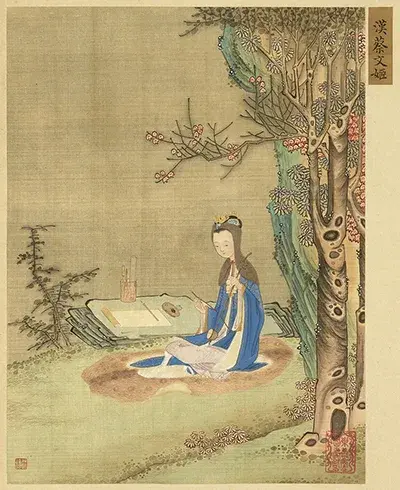
蔡琰
Cai Yan (蔡琰, late 2nd century – 3rd century CE), courtesy name Wenji (文姬, originally Zhaoji / 昭姬, later altered to avoid the taboo of Sima Zhao, Emperor Wen of Jin), was a preeminent female poet, essayist, and musician of the late Eastern Han dynasty, native to Yu County, Chenliu Commandery (modern Qi County, Henan). She was the daughter of Cai Yong, one of the most venerated scholars, calligraphers, and state…
Cai Yan (蔡琰, late 2nd century – 3rd century CE), courtesy name Wenji (文姬, originally Zhaoji / 昭姬, later altered to avoid the taboo of Sima Zhao, Emperor Wen of Jin), was a preeminent female poet, essayist, and musician of the late Eastern Han dynasty, native to Yu County, Chenliu Commandery (modern Qi County, Henan). She was the daughter of Cai Yong, one of the most venerated scholars, calligraphers, and state ministers of the Han empire. Endowed with exceptional erudition, classical training, and musical genius, Cai Yan gained early renown for her extraordinary ability to identify broken strings by ear. In her youth, she married the literatus Wei Zhongdao of Hedong, who died prematurely without issue, prompting her return to her ancestral home. During the catastrophic collapse of the Han empire following Dong Zhuo's regicide and subsequent warlord carnage in the Xingping era (195 CE), Cai Yan was abducted by invading Southern Xiongnu cavalry and carried into northern exile. She spent twelve agonizing years in the steppe grasslands, giving birth to two sons. In 207 CE, Chancellor Cao Cao, having unified northern China and grieving the loss of his close friend Cai Yong's bloodline and scattered library, dispatched imperial envoys laden with a thousand ounces of gold and a pair of precious white jade rings to ransom her back to the Central Plains, an event immortalized as "Wenji's Return to the Han." Upon her return, Cai Yan remarried the agricultural military commandant Dong Si. When Dong Si committed a capital offense, Cai Yan ran barefoot and disheveled into Cao Cao's banquet hall, delivering an impassioned and tearful plea that moved the assembled ministers and secured her husband's pardon. Furthermore, to restore her father's legendary collection of four thousand scrolls destroyed in warfare, she relied entirely upon her prodigious memory to transcribe from recollection more than four hundred ancient classical works without a single error, preserving vital literary heritage for posterity. In literary creation, Cai Yan authored the seminal Poem of Sorrow and Anger (Beifen Shi) in both five-character ancient verse and Chu elegiac metre, creating the earliest known autobiographical narrative poems in Chinese literature; she is also traditionally credited with the immortal musical suite Eighteen Songs of a Nomad Flute (Hujia Shibapai). Her tragic life, literary majesty, and cultural resilience have rendered her an enduring archetype of female intellectual courage in Chinese civilization.
Born in Chenliu into an elite scholar-gentry lineage, receiving classical instruction from her father Cai Yong.
At age nine, correctly identified broken strings from an adjoining chamber while listening to her father play the zither.
Married Wei Zhongdao of Hedong; after his premature death from illness without offspring, returned to Chenliu.
Amidst catastrophic warlord carnage, abducted by invading Southern Xiongnu cavalry and held captive for twelve years.
Cao Cao sent envoys with immense gold and jade to ransom her from the Xiongnu, arranging her remarriage to Dong Si.
Arrived barefoot with disheveled hair at Cao Cao's palace to plead desperately for Dong Si, securing his full pardon.
Recalled and transcribed from memory over four hundred lost pre-Qin and Han classical treatises without error.
Composed the immortal two-part Poem of Sorrow and Anger, detailing wartime devastation and maternal grief.
Associated with the legendary musical masterpiece Eighteen Songs of a Nomad Flute, merging nomadic reed and zither motifs.
Lived quietly in retirement; the exact date of her death remains unrecorded, though her literary fame endured permanently.
Cai Yan was born into the prestigious Cai lineage of Chenliu Commandery during the height of the Eastern Han dynasty's cultural splendor. Her father Cai Yong was an intellectual titan of the realm, holding the offices of Palace Attendant and General of the Household. Revered as an authority in Confucian exegesis, classical prose, and cursive calligraphy, Cai Yong supervised the monumental carving of the Xiping Stone Classics outside Luoyang. Raised in an environment surrounded by thousands of ancient bamboo and silk scrolls, Cai Yan received an elite literary education, mastering classical texts, historiographical annals, poetry, and musical theory from an early age.
According to historical records, when Cai Yan was nine years old, Cai Yong was playing the seven-stringed zither in his private chamber late at night when a silk string suddenly snapped. Sitting in an adjacent room, young Cai Yan remarked without hesitation: "Father, the second string has broken." Astonished, Cai Yong intentionally severed the fourth string. Cai Yan immediately called out: "Now the fourth string has snapped." Puzzled, her father asked whether it was merely a lucky guess. Cai Yan calmly replied: "In ancient times, the Duke of Zhou instituted rites and music, while Master Kuang could discern regional winds through musical pitches; why should it be difficult for your daughter to recognize the tone of a broken string?" Her miraculous auditory acuity astonished scholars in the imperial capital.
Upon reaching marriageable age, Cai Yan was wedded to Wei Zhongdao, a cultured scion of a prominent noble family in Hedong Commandery. The union was intellectually harmonious, yet Wei Zhongdao was chronically frail and succumbed to illness shortly after the wedding, leaving no descendants. Suffering subtle coldness and whispers of blame from the Wei clan, Cai Yan resolved to depart Hedong and return to her ancestral estate in Chenliu.
In 192 CE, the despotic warlord Dong Zhuo was assassinated in Chang'an by Wang Yun and Lü Bu. Chaos erupted across the Guanzhong region as Dong Zhuo's vengeful generals Li Jue and Guo Si stormed the capital, slaughtered Wang Yun, and subjected the heartland to systemic devastation. Cai Yong was imprisoned for expressing grief over Dong Zhuo's sudden demise and died tragically in jail. With her father martyred and family estate ruined, Cai Yan lost her ancestral sanctuary.
In 195 CE, as Li Jue and Guo Si fought bloody factional skirmishes across the Central Plains, the authority of the Han court disintegrated completely. Taking advantage of the vacuum, nomadic Southern Xiongnu cavalry launched devastating predatory raids across Bingzhou and Yuzhou, plundering commanderies and capturing thousands of fleeing civilians. In the panic of war, Cai Yan was seized by nomadic horsemen. Recognizing her graceful demeanor and aristocratic poise, the cavalry commanders transported her far north across the frontier into the steppe grasslands, presenting her to a noble chieftain of the Southern Xiongnu.
For twelve long years, Cai Yan lived in harsh steppe exile. Separated by immense geographic distance, language barriers, and radically contrasting customs, she endured life in nomadic felt yurts, adjusting to a diet of curd, cheese, and mutton amidst blistering blizzards and dust storms. During this prolonged captivity, she bore two sons to her Xiongnu captor. Though bound by maternal love to her children, the agony of cultural alienation and her sorrow over her father's destroyed homeland weighed heavily upon her, creating deep emotional scars.
By 207 CE, Chancellor Cao Cao had achieved military supremacy across northern China, crushing the warlord Yuan Shao and routing the Wuhuan confederacy in the northern borderlands. Upon consolidating power, Cao Cao reflected on his youthful friendship with Cai Yong and lamented that his brilliant mentor had left no surviving sons, with his peerless literary collections lost to the winds of war.
Discovering that Cai Yong's brilliant daughter was surviving as a captive among the Southern Xiongnu, Cao Cao determined to secure her liberty. He dispatched trusted envoys bearing one thousand ounces of pure gold and a pair of flawless white jade ceremonial disks to the steppe court. Awed by Cao Cao's soaring military might, the Xiongnu leadership consented to release Cai Yan. However, under nomadic tribal custom, her two young sons were forbidden to accompany their mother, remaining behind on the steppe.
Torn between longing for her ancestral civilization and the agony of abandoning her flesh and blood, Cai Yan endured an excruciating parting. As her carriage prepared to depart southward, her two sons clutched her garment, wailing in despair. Weeping uncontrollably, Cai Yan embarked on her journey, a historic episode celebrated as "Wenji's Return to the Han."
Arriving in the restored territories past the prime of youth, Cai Yan found her former home reduced to ashes. Taking pity on her destitution, Cao Cao arranged for her to remarry Dong Si, an officer of the agricultural colonies native to Chenliu. Dong Si was a proud and capable military administrator who initially felt estranged by an arranged match to a woman marked by foreign captivity.
In 208 CE, Dong Si committed a grave infraction against strict military penal codes and was sentenced to capital punishment. As Cao Cao was renowned for unbending legal discipline, none of his subordinates dared to intervene. Desperate to prevent another tragedy, Cai Yan disregarded her personal safety and dignity.
Barefoot, with disheveled hair and wearing unadorned robes in the freezing winter cold, Cai Yan rushed to Cao Cao's chancellery. At that moment, Cao Cao was hosting a banquet for dozens of high officials, celebrated literati, and visiting envoys. Hearing of her arrival, Cao Cao announced to his guests: "The daughter of Cai Boxie is outside; today you shall witness her extraordinary wit and eloquence."
Upon entering the grand hall, Cai Yan knelt before the assembly and kowtowed, tearfully pleading for Dong Si's life with immaculate logic, immense dignity, and heartbreaking eloquence. Her sincere grief moved the entire assembly of ministers to tears. Cao Cao remarked with regret: "I share your sorrow, but the execution warrant has already been dispatched. How can it be recalled?" Cai Yan swiftly responded: "Your Excellency commands tens of thousands of fine steeds and legions of fierce warriors; why begrudge a single swift rider to save a dying soul?" Stunned by her brilliance and devoted courage, Cao Cao ordered a mounted courier to gallop forth and halt the execution, formally pardoning Dong Si. Deeply moved by her shivering condition, Cao Cao presented her with a woolen headband, embroidered sash, and shoes. Dong Si was forever transformed by her sacrifice, treating Cai Yan with immense devotion for the rest of their lives.
Following Dong Si's reprieve, Cao Cao conversed with Cai Yan regarding ancient manuscripts: "I recall that Master Cai Yong once possessed four thousand scrolls of ancient texts. Have any survived the devastation?" Cai Yan lamented: "My late father's immense collection was completely plundered during the sack of Luoyang and the flight through Guanzhong. Not a single bamboo scroll remains. However, through my father's instruction, I still retain over four hundred treatises memorized in my mind." Delighted, Cao Cao offered to dispatch twenty skilled scribes to write down her oral recitation. Cai Yan respectfully declined: "Proper decorum dictates that men and women should not converse directly in private. If Your Excellency provides paper and ink, I shall transcribe them myself in standard and cursive scripts."
Retiring to her study, Cai Yan worked tirelessly for several months, reconstructing from memory more than four hundred ancient philosophical, historical, and literary treatises. Upon inspecting the submitted scrolls, Cao Cao found them completely consistent with ancient copies, devoid of any textual omission or corruption. Through her phenomenal intellectual capacity, Cai Yan single-handedly salvaged precious gems of classical Chinese civilization.
Cai Yan's paramount literary legacy rests upon her celebrated Poem of Sorrow and Anger (Beifen Shi), composed in both five-character ancient verse and the Chu elegiac style. This monumental work stands as the earliest extensive autobiographical narrative poem composed by a literatus in Chinese literary history.
The five-character version comprises one hundred and eight couplets (five hundred and forty characters), providing a panoramic chronicle of the cataclysmic collapse of the Eastern Han dynasty. Opening with the line "In the closing years of Han, authority was lost; Dong Zhuo threw the cosmic order into anarchy," the poem candidly depicts the butchery and pillage perpetrated by barbarian and rebel armies across the Central Plains. The stark realism with which she describes severed corpses, captured women, and marching columns of captives elevates the text into an authentic historical epic.
The emotional zenith of the poem centers on her agonizing parting from her two steppe-born sons upon her repatriation. Her visceral portrayal of maternal torment—"My children threw their arms around my neck, weeping bitterly, asking where their mother was going"—embodies unmatched emotional power. This union of sweeping geopolitical tragedy and deeply personal maternal agony shattered the conventional decorative constraints of Han court poetry, laying direct foundational inspiration for the social realism of Du Fu's Three Officials and Three Farewells.
Her companion Chu-style Poem of Sorrow and Anger employs lyrical repetitions and sorrowful cadences to express the psychological dislocation of returning to a desolate homeland where ancestral graves had been violated. Together, these masterpieces earned enduring acclaim, described by Qing dynasty critic Shen Deqian as "the purest and most sorrowful voice of genuine human nature."
In addition to her poetic works, Cai Yan is traditionally celebrated as the creator of the iconic musical and poetic masterpiece Eighteen Songs of a Nomad Flute (Hujia Shibapai). The composition masterfully integrates the desolate, penetrating acoustic qualities of the nomadic reed pipe (hujia) with the refined, introspective resonance of the Chinese zither (guqin).
Structured into eighteen distinct musical sections, the suite charts a profound emotional odyssey. It begins with the initial shock and terror of military abduction, transitions into the cold alienation of nomadic existence, explores the painful maternal dilemma of choosing between ancestral civilization and beloved offspring, and concludes with the tragic realization that returning home brings no respite from haunting wartime grief. The melodies break sharply away from the tranquil equilibrium of conventional court music, incorporating plaintive slides and sorrowful microtones that reflect the turbulent cultural clash between Han Chinese and northern steppe nomadic civilizations.
Although scholarly debates since the Song dynasty have questioned whether the surviving literary text was composed directly by Cai Yan or reconstructed by later Tang-Song literati based on her historical experiences, universal consensus acknowledges that the emotional essence, thematic architecture, and enduring soul of the composition derive directly from Cai Yan's historical return.
The catastrophic destruction of the imperial libraries at the Eastern Lodge and Orchid Pavilion during Dong Zhuo's sack of Luoyang inflicted devastating damage upon ancient Chinese intellectual heritage. Countless pre-Qin and Western Han texts survived only through private family archives, of which Cai Yong's private library of over four thousand scrolls was among the most comprehensive.
Following the total loss of these scrolls in wartime turmoil, Cai Yan accomplished a miraculous act of cultural preservation. Working in isolation, she transcribed from memory over four hundred complete classical treatises, spanning Confucian commentaries, philosophical treatises, and historical narratives.
Cao Cao's textual scholars examined her transcriptions against surviving fragments and found not a single clerical or substantive error. By preserving these texts, Cai Yan rescued indispensable literary lineages that subsequently nourished the burgeoning Jian'an literary renaissance under Cao Pi, Cao Zhi, and the Seven Scholars of Jian'an. Through this monumental feat, Cai Yan cemented her stature not merely as a master of verse, but as an indispensable guardian of Chinese civilization.
Cai Yan holds an exalted position in the annals of Chinese literature and cultural history, celebrated for her profound creative genius, emotional authenticity, and unparalleled cultural dedication.
Fan Ye, in the Book of the Later Han (Hou Han Shu), praised her noble bearing, stating: "Her conduct was upright and her demeanor serene; through her lucid spirit and moral brilliance, she inspired our generation. Cai Yan's ability to discern musical tones was an exemplary manifestation of classical virtue."
Cao Cao marveled at her classical transcription, remarking: "I long lamented that Master Boxie's four thousand scrolls of literature were destroyed in the ashes of war; today Wenji has transcribed over four hundred chapters from memory without a single error. She is truly a miraculous talent of the realm!"
Qing dynasty literary scholar Shen Deqian praised her Poem of Sorrow and Anger in Origins of Ancient Poetry (Gushi Yuan): "Harnessing the melancholy timbre of the nomad flute to lament her desolate life, her genuine emotion reaches ultimate depths, arising naturally as the truest voice of human nature. Its profound sincerity moves the reader so deeply that one can scarcely bear to finish it."
Modern Chinese literary master Guo Moruo observed: "Cai Wenji was not merely a sublime female poet, but a monumental cultural hero of Chinese history. Her Poem of Sorrow and Anger stands as the quintessential poetic history of the turbulent end of the Han dynasty."
FIGURES ASSOCIATED WITH THIS DYNASTY