Birth in Southern Fujian
Born into an agrarian scholarly family in Fengting, Xianyou, educated in strict classical ethics by his mother Lady Lu.
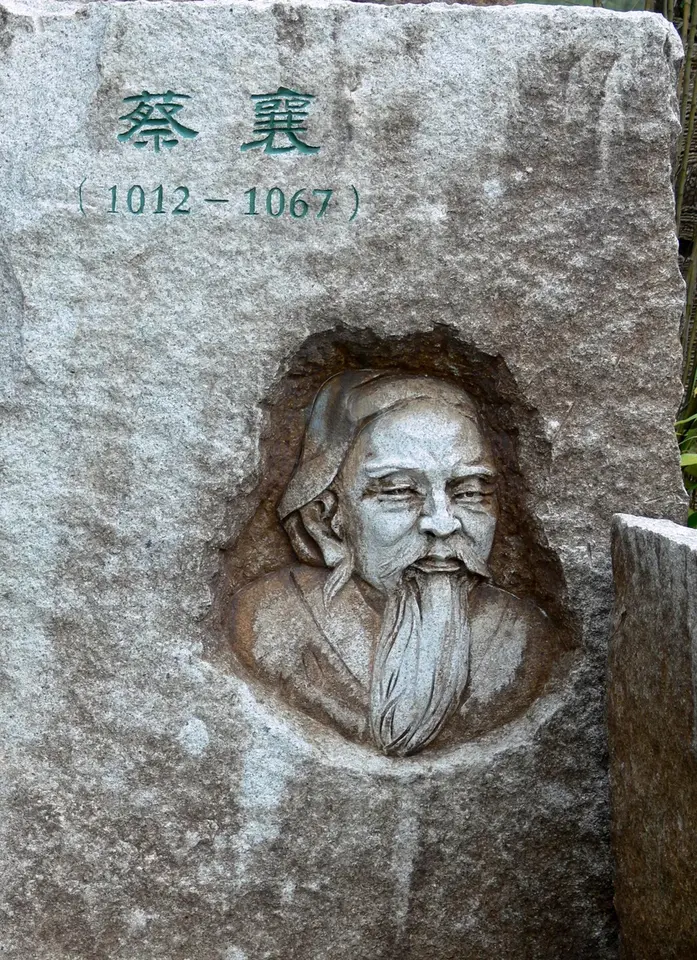
蔡襄
Cai Xiang (蔡襄, 1012–1067), courtesy name Junmo, posthumously honored as Zhonghui, was a native of Fengting Town, Xianyou County, Xinghua (modern Putian, Fujian). He was an extraordinary statesman, reforming minister, master calligrapher, and agricultural scientist under Emperors Renzong and Yingzong of the Northern Song Dynasty. Passing the jinshi examination in 1030 at age nineteen, Cai served in key central and regional…
Cai Xiang (蔡襄, 1012–1067), courtesy name Junmo, posthumously honored as Zhonghui, was a native of Fengting Town, Xianyou County, Xinghua (modern Putian, Fujian). He was an extraordinary statesman, reforming minister, master calligrapher, and agricultural scientist under Emperors Renzong and Yingzong of the Northern Song Dynasty. Passing the jinshi examination in 1030 at age nineteen, Cai served in key central and regional posts including Censor, Drafter of Imperial Edicts, Prefect of Quanzhou, Fuzhou, Kaifeng, and Hangzhou, advancing to Academician of the Duanming Hall and State Finance Commissioner. At court, he was renowned for unbending integrity; during the Qingli Reforms, he championed Fan Zhongyan and Ouyang Xiu, authoring the celebrated Poem on Four Worthies and One Incompetent, which won fame even in the Khitan Liao empire. In regional governance, he built the monumental Luoyang Bridge (Wan'an Bridge) in Quanzhou, inventing the "raft foundation" and pioneering the biological "oyster-planting foundation technique" in maritime engineering, while planting pines along seven hundred li of postal highways. In calligraphy, his majestic regular script and elegant running hand placed him among the legendary "Four Masters of Song calligraphy" (Su, Huang, Mi, Cai). In agriculture and science, he revolutionized the imperial tribute tea industry by creating the "Small Dragon Tea Cakes" and authored the foundational tea classic Tea Record (Chalu), as well as the world's first pomological monograph Record of Lychees (Lizhi Pu). He passed away in 1067 at fifty-six, posthumously honored as Vice Minister of Personnel.
Born into an agrarian scholarly family in Fengting, Xianyou, educated in strict classical ethics by his mother Lady Lu.
Passed the imperial examinations at age nineteen; appointed Gentleman for Ceremonial Service and Judge of the Western Capital in Luoyang.
Penned Poem on Four Worthies and One Incompetent to defend Fan Zhongyan and condemn slanderer Gao Ruone, winning international renown.
Appointed Assistant in the Palace Library, Imperial Diary Drafter, and Censor, vigorously advancing the Qingli Reforms.
Appointed Prefect of Fuzhou; built the Wudong Sluice canal system to block saltwater and established the official prefectural academy.
Promoted to Fiscal Commissioner of Fujian; innovated the Beiyuan Small Dragon Tea Cakes and authored the seminal treatise Tea Record.
Reassigned as Prefect of Quanzhou; resolved to tame the perilous oceanic crossing and launched the Luoyang Bridge project.
The cross-sea Luoyang Bridge was completed; inscribed the Record of the Wan'an Bridge stele and completed the Record of Lychees.
Governed Kaifeng with rigorous discipline, promoted to State Finance Commissioner managing empire-wide revenue, authoring Cai Xiang's Zhiping Accounting Compendium.
Appointed Academician of the Duanming Hall and Prefect of Hangzhou; dredged West Lake waterways and six urban wells, stabilizing grain prices.
Retired due to illness to his native Fengting in Xianyou, passing away peacefully on August 16 at age fifty-six; posthumously titled Zhonghui.
Cai Xiang was born into an agrarian and scholarly household in Chiling Village, Cixiao Township, Fengting, Xianyou County, Xinghua. His father, Cai Xiu, was mild, prudent, and dedicated to righteousness, while his mother, Lady Lu, hailed from an eminent literary family and possessed extensive classical erudition. Lady Lu instructed Cai Xiang with strict maternal discipline, teaching him the Analects and Classic of Filial Piety in childhood. Under her tutelage, Cai Xiang studied day and night and practiced Jin and Tang calligraphy, becoming celebrated as a prodigy throughout southern Fujian.
In 1030, at the youthful age of nineteen, Cai Xiang left Fujian to take the metropolitan examinations in Kaifeng, passing with high honors and receiving his first appointment as Judge of the Western Capital in Luoyang. As the Northern cultural capital, Luoyang gathered leading literati of the era. During his judicial tenure, Cai formed enduring bonds with Ancient Prose pioneers Yin Zhu, Ouyang Xiu, and Mei Yaochen. Astounded by the young magistrate's unbending moral character, erudition, and powerful calligraphy, Ouyang Xiu and Yin Zhu treated him as an intimate comrade, instilling in him a lifelong commitment to Confucian governance.
In 1036, a major political crisis erupted when Grand Councilor Lü Yijian demoted Fan Zhongyan to Raozhou for submitting a chart detailing bureaucratic nepotism. When Censors Ouyang Xiu, Yu Jing, and Yin Zhu defended Fan, they were summarily banished from the capital. Meanwhile, Right Admonition Censor Gao Ruone flattered the Grand Councilor by slandering the exiled reformers as a treasonous faction.
Outraged by Gao's cowardice, the twenty-five-year-old Cai Xiang penned the immortal Poem on Four Worthies and One Incompetent. He boldly praised Fan Zhongyan, Ouyang Xiu, Yin Zhu, and Yu Jing as selfless pillars of the realm, while castigating Gao Ruone as a shameless sycophant. The poems created a sensation throughout Kaifeng; paper prices soared, and merchants printed copies on silk fans sold as far north as the Khitan Liao empire. Even the Liao court was deeply impressed by Cai's moral courage.
In 1043, Emperor Renzong launched the Qingli Reforms. Upon the recommendation of Fan Zhongyan and Han Qi, Cai Xiang was appointed Imperial Diary Drafter and Censor. In this capacity, he presented trenchant memorials, including Memorial on Appointing Censors and Ten Strategies for Frontier Defense, fearlessly protecting reformist policies.
Following the collapse of the Qingli Reforms in 1047, Cai Xiang requested regional assignment and was appointed Prefect of Fuzhou. Confronted with ruined waterworks and severe saltwater intrusion that salinized vast farmland along the Min River, Cai surveyed the topography and directed the construction of the Wudong Sluice. The engineering project successfully blocked incoming ocean tides and stored freshwater to irrigate tens of thousands of mu of farmland, bringing lasting prosperity to the local peasantry.
In cultural reform, Cai eradicated abusive shamanic cults, tearing down hundreds of superstitious shrines that misled commoners. Simultaneously, he allocated public revenues to construct the Fuzhou Prefectural Academy and the Five Classics Lecture Hall, inviting eminent scholars to lecture on Confucian canons. Under his administration, the local youth turned from superstition to classical study, fundamentally elevating regional scholar-official culture.
In 1051, Cai Xiang was promoted to Fiscal Commissioner of Fujian, overseeing regional revenue, salt, tea, and grain transport. Visiting the Beiyuan imperial tea plantations in Jianzhou (modern Jian'ou), Cai conducted a thorough investigation into tribute tea harvesting and processing.
Recognizing that the conventional "Big Dragon Tea Cakes" were cumbersome and burdened local tea planters, Cai collaborated with veteran tea masters to develop the exquisite "Small Dragon Tea Cakes" (Miyunlong). With its refined aroma and pristine white foam, this tribute tea became the crowning luxury of Song tea culture. To ensure scientific processing techniques endured, Cai composed his celebrated two-volume treatise Tea Record (Chalu), presenting it to Emperor Renzong, who praised it highly.
In 1053, after concluding mourning for his mother, Cai Xiang was assigned as Prefect of Quanzhou. At the time, Quanzhou was a flourishing departure port on the Maritime Silk Road, teeming with international maritime merchants. However, the Wan'an Crossing over the Luoyang River estuary spanned five li across turbulent waters, where treacherous oceanic tides routinely capsized passenger skiffs, drowning hundreds of travelers each year.
Previous attempts by local officials to construct a bridge had collapsed due to fierce sea currents and unstable underwater foundations. Determined to eliminate this ancient hazard, Cai Xiang mobilized skilled artisans, local gentry, and commoners to launch the cross-sea Wan'an Bridge project. Cai surveyed the tidal mudflats in person, directed underwater foundation laying, and donated his personal salary to lead public fundraising.
While the bridge project was in its most difficult foundation phase, Emperor Renzong summoned Cai Xiang to the capital in 1056 as Drafter of Imperial Edicts and Hanlin Academician. During his absence, work on the bridge slowed dramatically without his direct oversight. Yearning to complete the great maritime undertaking, Cai petitioned the throne in 1058 to return to Fujian, and Emperor Renzong graciously reappointed him Prefect of Quanzhou.
Upon returning, Cai supervised construction day and night. He directed workers to deposit massive boulders along the bridge axis to create an underwater stone embankment, inventing the world-renowned "raft foundation." To protect the piers against ferocious wave erosion, he innovated the biological "oyster-planting technique," introducing oysters into pier crevices so that their calcium secretions naturally cemented the boulders into an impregnable monolith. In December 1059, after six grueling years of labor, the 360-zhang-long cross-sea stone beam bridge was triumphantly completed. Cai personally composed and inscribed the monumental stone stele Record of the Wan'an Bridge, celebrated across China as a masterpiece of prose, engineering, and calligraphy. In Quanzhou, he also organized the planting of hundreds of thousands of pine trees along the 700-li highway between Fuzhou and Quanzhou, known affectionately as "Cai Lord's Pines."
In 1060, following his extraordinary administrative record in Quanzhou, Cai Xiang returned to Kaifeng as Academician of the Duanming Hall and Prefect of the capital. In Kaifeng, he enforced laws impartially, curbed abusive syndicates, and transformed municipal public safety within months.
That autumn, Emperor Renzong appointed Cai State Finance Commissioner, granting him full authority over the imperial treasury, salt and iron monopolies, and national grain supply. Cai audited provincial tax rolls, eliminated duplicative reporting, and established strict revenue quotas. He authored Cai Xiang's Zhiping Accounting Compendium, detailing state fiscal administration and slashing redundant state expenditures.
In 1065, suffering from chronic foot ailments, Cai Xiang requested a regional post to recuperate, and Emperor Yingzong appointed him Prefect of Hangzhou. In Hangzhou, he continued his benevolent administration, dredging West Lake and the Six Wells, regulating maritime commerce, and stabilizing food prices.
In early 1067, his illness worsening, Cai retired to his ancestral estate in Fengting, Xianyou. On August 16 of that year, he passed away peacefully at age fifty-six. Emperor Shenzong posthumously conferred upon him the title Vice Minister of Personnel and the posthumous name Zhonghui, while his lifelong friend Ouyang Xiu composed his famous funerary epitaph.
Cai Xiang's premier achievement in civil engineering and applied science was the construction of the Luoyang Bridge (Wan'an Bridge) in Quanzhou, recognized as China's earliest large-scale cross-sea stone beam bridge.
Cai solved the monumental problem of marine foundation shifting by inventing the "raft foundation," throwing millions of tons of granite into the channel along the bridge axis to create an artificial underwater reef upon which spindle-shaped piers were erected. Most ingeniously, he pioneered the "oyster-planting technique," deliberately cultivating oysters along the stone joints so that their natural calcium secretions cemented the loose boulders into an impregnable monolith. This represents the world's earliest documented application of biological engineering to civil construction. The bridge transformed Quanzhou into the preeminent maritime hub of medieval global trade.
In the arts, Cai Xiang was the elder statesman and revered pioneer of the "Four Masters of Song calligraphy" (Su, Huang, Mi, Cai).
Synthesizing the rigorous architecture of Yan Zhenqing and Yu Shinan with the lyrical grace of Wang Xizhi, Cai created a majestic regular script and an ethereal running style that defined Northern Song aesthetic dignity. Su Shi proclaimed in Dongpo's Colophons: "Cai Junmo's genius is supreme and his learning profound; mind and hand harmoniously united, he stands as the very first of our dynasty." When Prime Minister Han Qi built the Zhoujin Hall in Xiangzhou, Cai inscribed Ouyang Xiu's essay, meticulously copying each character until perfection was attained, creating the immortal "Bainuo Stele." His surviving masterworks include Record of the Wan'an Bridge, Zhoujin Tang Ji, Li Sao Jing, and the Letter on Gout (Jiaqi Tie).
As a statesman, Cai Xiang was an unblemished moral beacon. He was not only fearless in submitting remonstrance to the throne, but remarkably humble in accepting criticism from local citizens.
While governing Fuzhou during the Lantern Festival, local scholar Chen Lie displayed an immense satirical lantern protesting the heavy expense placed upon commoners. Inspecting the streets incognito, Cai read the critical poem and felt deeply self-reproachful, immediately cancelling the municipal illumination tax and inviting Chen Lie to lecture at the prefectural academy. When corrupt minister Xia Song passed away, his family offered a fortune for Cai to compose his funerary inscription, but Cai flatly refused, demonstrating unwavering moral backbone.
Cai Xiang revolutionized the harvesting and processing of Beiyuan tribute tea in Jianzhou. He refined over twenty delicate processing stages including fresh bud picking, steaming, pressing, grinding, molding, and baking, creating the peerless "Small Dragon Tea Cakes."
To systematically codify tea aesthetics and brewing, Cai authored the two-volume treatise Tea Record (Chalu) during the Huangyou era. The first volume systematically analyzed tea color, fragrance, aroma, grinding, and water boiling, while the second volume evaluated tea vessels, establishing the supremacy of Jianzhou black-glazed teaware (Jian ware) for white tea froth. Tea Record established the foundational aesthetic model for Song tea contests and East Asian tea culture.
In botanical science, Cai Xiang authored Record of Lychees (Lizhi Pu) in three volumes in 1059 while governing Quanzhou, recognized as the earliest pomological monograph in world history.
Divided into seven treatises, the work comprehensively investigated the history of lychee cultivation, geographical environments, blossoming habits, and thirty-two elite cultivars such as Chenzi and Songjiaxiang. It documented grafting, pruning, pest management, and cold-water preservation techniques. Widely translated into Western languages, it remains an acknowledged classic of historical agronomy.
Cai displayed pioneering ecological and humanitarian foresight during his administrative tenure in Fujian. Observing that travelers suffered severe heat exhaustion and roadbed collapse along the steep coastal roads, Cai organized soldiers and civilians to plant hundreds of thousands of pine trees along seven hundred li of postal highways stretching from Fuzhou through Putian and Xianyou to Quanzhou.
The dense green corridor stabilized road embankments, prevented soil erosion, and shielded traveling merchants from blazing sun and typhoons. Local folk songs celebrated the green canopy as "Cai Lord's Pines," establishing a timeless legacy of public ecological works.
FIGURES ASSOCIATED WITH THIS DYNASTY