Birth in Jianyang
Born into an elite intellectual lineage; second son of the prominent scholar Cai Yuanding.
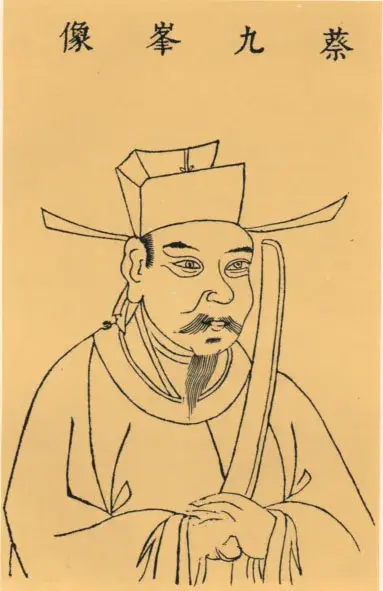
蔡沈
Cai Chen (蔡沈, 1167–1230), courtesy name Zhongmo, styled Master Jiufeng, native to Jianyang in Fujian, was an illustrious Neo-Confucian philosopher, classical exegete, and numerologist of the Southern Song Dynasty, recognized as the premier intellectual heir of Zhu Xi's School of Principle. Born into an intellectual family as the second son of the calendar and music scholar Cai Yuanding, Cai studied directly under Zhu Xi.…
Cai Chen (蔡沈, 1167–1230), courtesy name Zhongmo, styled Master Jiufeng, native to Jianyang in Fujian, was an illustrious Neo-Confucian philosopher, classical exegete, and numerologist of the Southern Song Dynasty, recognized as the premier intellectual heir of Zhu Xi's School of Principle. Born into an intellectual family as the second son of the calendar and music scholar Cai Yuanding, Cai studied directly under Zhu Xi. Disdaining imperial examinations and bureaucratic office, he spent his life in scholarly seclusion beneath Mount Jiufeng in Wuyi, known to contemporaries as Master Jiufeng. On his deathbed, Zhu Xi entrusted the unfinished commentary on the Book of Documents to Cai Chen. Diligently fulfilling his master's testament over decades of research, Cai composed the landmark six-volume Commentary on the Documents (Shu Jizhuan). The work was subsequently canonized during the Yuan, Ming, and Qing dynasties as the official civil service examination standard, shaping Confucian education for seven centuries. In his declining years, Cai developed the numerological cosmology of the Great Plan, authoring Hongfan Huangji, which stood alongside Shao Yong's cosmological treatises as a pinnacle of Song Neo-Confucian numerology. He died in 1230, was posthumously honored as Junior Mentor of the Crown Prince, and was enshrined in the Confucian Temple.
Born into an elite intellectual lineage; second son of the prominent scholar Cai Yuanding.
Traveled to Mount Wuyi with his father to enter Zhu Xi's academy, mastering Neo-Confucian metaphysics.
Accompanied his father into political banishment in Daozhou during the Qingyuan Factional Ban, burying his father there.
Zhu Xi on his deathbed entrusted his incomplete draft notes on the Book of Documents to Cai Chen.
Completed the six-volume Commentary on the Documents after a decade of hermetic labor in the Jiufeng Academy.
Formulated an expansive numerological cosmology in his philosophical treatise Hongfan Huangji.
Passed away peacefully at the Jiufeng Academy at sixty-four; later enshrined in the Imperial Confucian Temple.
Cai Chen was born in 1167 during the Qiandao reign in Jianyang, Fujian. His father, Cai Yuanding, was a preeminent authority on astronomy, calendar science, musical harmonics, and geography, whom Zhu Xi lauded as an irreplaceable titan among contemporary scholars. Growing up in a rigorous philosophical environment, Cai was introspective, modest, and dedicated to investigating the fundamental principles of heaven and earth.
In 1182 (Chunxi 9), Cai accompanied his father to the Hanquan Academy in Mount Wuyi, formally becoming a disciple of Zhu Xi. Under Zhu's direct instruction, Cai cultivated the core Cheng-Zhu practice of investigating things to extend knowledge (gewu zhizhi), delving into the Four Books and Five Classics with relentless concentration.
During the early Qingyuan era under Emperor Ningzong, Chief Councilor Han Tuozhou monopolized power, proscribing the Cheng-Zhu school as \"false learning.\" Cai Yuanding was condemned as a primary instigator and banished to remote Daozhou in Hunan. The thirty-one-year-old Cai Chen abandoned comfort to accompany his aging father on foot across thousands of miles. In 1198 (Qingyuan 4), Cai Yuanding succumbed to southern miasma in exile. Enduring profound grief, Cai Chen transported his father's coffin home on his shoulders, performing filial funeral rites that earned widespread public veneration.
In 1200 (Qingyuan 6), Zhu Xi fell gravely ill at Kaoting in Jianyang. Having produced comprehensive commentaries on almost all Confucian classics, Zhu deeply regretted that his commentary on the Book of Documents remained uncompleted due to the convoluted textual history of the text. On his deathbed, Zhu summoned Cai Chen alone to his bedside, handing over his personal draft manuscripts and commanding: \"I am old; the completion of the Documents belongs to you. Strive to illuminate the sagely teachings!\" Cai knelt, weeping, and vowed to dedicate his life to fulfilling his teacher's mission.
Fulfilling Zhu Xi's dying commission, Cai Chen renounced examination ambitions and declined official summonses, retiring to the Jiufeng mountains south of Jianyang. Establishing the Jiufeng Academy among pine-clad hills, he adopted the title Master Jiufeng.
For a decade, Cai lived behind closed doors. He collated Han and Tang textual annotations, Song commentaries, and ancient bronze inscriptions, critically verifying the authenticity of variants in the Documents. Guided by Zhu Xi's rational methodology, he discarded mystical apocryphal speculations to illuminate the central political heart-transmission of the ancient sage kings. In 1209 (Jiading 2), Cai completed the six-volume Commentary on the Documents. Luminous in style and penetrating in exegesis, the work circulated immediately among southern scholars, establishing itself as the authoritative interpretation of the canon.
Following the completion of Shu Jizhuan, Cai turned toward cosmological numerology. In 1220 (Jiading 13), developing the nine divisions of the Great Plan (Hongfan) and assimilating Shao Yong's numerological charts from Huangji Jingshi, he completed the monumental five-volume Hongfan Huangji. The work united numerological calculation with ethical governance, expanding the metaphysical horizons of Neo-Confucianism.
In 1230 (Shaoding 3), Cai passed away peacefully at the Jiufeng Academy at the age of sixty-four. The Southern Song court posthumously conferred Junior Mentor of the Crown Prince. In 1362, the Yuan Dynasty court ennobled him as Baron of Chong'an and granted enshrinement in the Imperial Confucian Temple.
Cai Chen's crowning contribution to Chinese intellectual history was his authoritative Commentary on the Documents (Shu Jizhuan). Fulfilling Zhu Xi's legacy, Cai presented a systematic exposition of the ancient classic. He discarded convoluted Han commentaries and repudiated interpolations in the pseudo-Kong Anguo text, emphasizing the ethical essence of sage-kingship: \"The human mind is precarious, the moral mind is subtle; be refined, be unified, hold fast to the Mean.\"
When the Yuan Dynasty reinstated metropolitan examinations during the Yanyou era, Cai's commentary was promulgated alongside Zhu Xi's Original Meaning of the Book of Changes and Collected Commentaries on the Book of Songs as the official state textbook. Maintained throughout the Ming and Qing dynasties, Shu Jizhuan remained compulsory reading for generations of imperial scholars, cementing its role in traditional Chinese political philosophy.
Cai Chen was both an ethical theorist and the consummate master of Song Neo-Confucian numerology. In Hongfan Huangji, he asserted that metaphysical principle precedes vital force (li zai qi xian) and that numerological structures illuminate universal principle. Expanding the nine categories of the Great Plan, he constructed an intricate mathematical matrix of eighty-one chapters and 6,561 permutations, linking mathematical laws with astronomical seasons, political institutions, and moral self-cultivation.
The scholar Huang Ruijie praised his accomplishment: \"The Changes possessed hexagram images through four sages, yet the Great Plan received numbers from Yu without transmission. Master Jiufeng produced Huangji, completing eighty-one chapters and 6,561 permutations.\" Zhen Dexiu famously affirmed: \"Cai's numerology matches the achievements of the Three Sages' Book of Changes.\"
FIGURES ASSOCIATED WITH THIS DYNASTY