Birth in Zhenyang
Born into a scholarly family on the eighteenth day of the eighth lunar month; lost his father early and was taught classical poetry by his mother Zhang Zao.
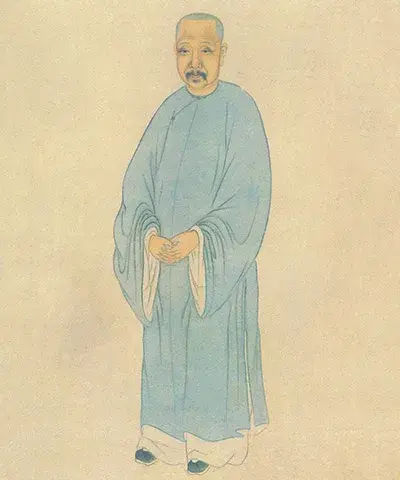
毕沅
Bi Yuan (毕沅, September 29, 1730 – August 24, 1797), courtesy name Xiangheng (纕蘅) and art name Qiufan (秋帆), who also styled himself the Hermit of Mount Lingyan (灵岩山人), was a native of Zhenyang County, Taicang Prefecture, Jiangnan. He was an eminent Qing Dynasty classical philologist, historian, epigrapher, historical geographer, and premier provincial statesman who achieved first honors (zhuangyuan) in the 1760 imperial palace…
Bi Yuan (毕沅, September 29, 1730 – August 24, 1797), courtesy name Xiangheng (纕蘅) and art name Qiufan (秋帆), who also styled himself the Hermit of Mount Lingyan (灵岩山人), was a native of Zhenyang County, Taicang Prefecture, Jiangnan. He was an eminent Qing Dynasty classical philologist, historian, epigrapher, historical geographer, and premier provincial statesman who achieved first honors (zhuangyuan) in the 1760 imperial palace examination. Born into a prominent scholarly gentry lineage, Bi Yuan was mentored in his youth by his mother Zhang Zao and later studied under Wu literary leader Shen Deqian and foundational philologist Hui Dong, developing encyclopedic mastery across classical commentaries, ancient phonology, bronze and stone inscriptions, and historical geography. Entering imperial governance, Bi Yuan advanced from Secretary of the Grand Secretariat and Secretary in the Grand Council to Senior Compiler in the Hanlin Academy, subsequently serving as Judicial Commissioner and Financial Commissioner of Shaanxi, Governor of Shaanxi, Governor of Henan, Governor of Shandong, and twice as Governor-General of Huguang. Throughout his three decades of regional stewardship, he demonstrated practical mastery in flood control, famine alleviation, and regional stabilization. In Shaanxi and Gansu, he combated famines, reclaimed wasteland across Guanlong, restored the Guanzhong Academy, and preserved historical imperial tombs and the Forest of Stone Steles in Xi'an. In Henan, he intercepted granary transit fleets to regulate market prices, dredged the Jialu and Huiji rivers, and surveyed Mount Tongbai to establish the authentic source of the Huai River. In Huguang, he engineered the Yanglinzhou diversion dams on the Jingjiang section of the Yangtze River and suppressed regional rebellions. Bi Yuan's viceregal private secretariat became the intellectual epicenter of the Qianlong-Jiaqing Han Learning movement, patronizing over forty leading scholars including Zhang Xuecheng, Shao Jinhan, Hong Liangji, Sun Xingyan, Wang Zhong, and Duan Yucai. He directed the compilation of the monumental 220-volume Continued Zizhi Tongjian (Xu Zizhi Tongjian), bridging the chronological historiography of the Song, Liao, Jin, and Yuan dynasties, and published essential series such as Jingxun Tang Congshu, Guanzhong Shengji Tuzhi, and Guanzhong Jinshi Ji. He died of illness while commanding troops in the field in 1797 at age sixty-eight.
Born into a scholarly family on the eighteenth day of the eighth lunar month; lost his father early and was taught classical poetry by his mother Zhang Zao.
Commenced advanced classical studies at Mount Lingyan in Suzhou under poetic master Shen Deqian and Han Learning founder Hui Dong.
Succeeded in the Shuntian provincial examinations, subsequently receiving appointment as Secretary in the Grand Secretariat and entering the Grand Council.
Won first place (zhuangyuan) in the imperial palace examination after substituting on night watch, receiving appointment as Senior Compiler in the Hanlin Academy.
Transferred from the imperial academy to provincial governance as Intendant of the Gong-Qin-Jie Circuit in Gansu, surveying frontier military agricultural colonies.
Promoted to Judicial Commissioner of Shaanxi; memorialized Emperor Qianlong on severe Gansu droughts, securing tax remissions of four million taels.
Appointed Governor of Shaanxi, dredging the Longdong Canal in Jingyang, reclaiming farmland, and protecting ancient imperial tombs.
Mobilized military logistics to suppress the Su Forty-Three uprising; demoted in rank following the Gansu granary embezzlement case but retained in office.
Coordinated provisions and relay logistics across Shaanxi and Gansu for Grand Secretary Agui's campaign against Tian Wu, earning imperial commendations.
Transferred to Governor of Henan; intercepted 200,000 piculs of transit grain to stabilize market prices and identified the authentic source of the Huai River.
Reappointed Governor-General of Huguang during the catastrophic Jingjiang Yangtze floods, engineering the Yanglinzhou dikes and hosting Zhang Xuecheng.
Commissioned to direct military provisioning in Jingzhou and Changde for the suppression of Miao uprisings, awarded the double-eyed peacock feather.
Commanded frontline operations against the White Lotus uprising in Hubei, personally retaking Dangyang and receiving the hereditary title of Light Chariot Commander.
Passed away from exhaustion on the third day of the seventh lunar month in a Dangyang inn during military operations; posthumously awarded the title Grand Tutor.
Bi Yuan was born on September 29, 1730, in Zhenyang County, Taicang Prefecture, Jiangnan. His family traced its ancestry to Xiuning in Huizhou, Anhui Province, migrating to Kunshan in Suzhou during the late Ming wars before settling in Taicang. Following the creation of Zhenyang County from Taicang, the Bi family registered locally. Bi Yuan lost his father in early childhood, and his household experienced financial hardship, leaving his upbringing entirely to his mother, Zhang Zao. A noted literary figure of Jiangnan, Zhang Zao authored the poetry collection Peiyuan Tang Shiji.
Recognizing her son's exceptional intellectual promise, Zhang Zao personally instructed Bi Yuan in the Classic of Poetry (Mao Shi) and the Elegies of Chu (Li Sao) from age six. Bi Yuan possessed a photographic memory, mastering classical rhyming meters by age ten, examination prose composition by age twelve, and classical poetry by age fifteen. When Bi Yuan subsequently departed the capital to govern Shaanxi, his mother composed a 270-character "Admonition to My Son", exhorting him to apply his learning selflessly to the public good. Following her death, Emperor Qianlong bestowed an imperial calligraphy reading "Classic Admonitions Maintain the Clan" (Jing Xun Ke Jia), prompting Bi Yuan to name his study the Hall of Classical Instruction (Jingxun Tang).
As a young scholar, Bi Yuan resided at Mount Lingyan in Suzhou to pursue rigorous classical training. There he studied under Shen Deqian, a dominant arbiter of poetry, and Hui Dong, the renowned founder of the Suzhou Han Learning school. Shen Deqian trained him in classical stylistic discipline, while Hui Dong guided him in ancient philology and Han dynasty commentaries. This dual immersion enabled Bi Yuan to transcend the sterile formulaic prose of examination manuals, establishing the empirical, source-critical methodology that shaped his lifelong scholarship.
In 1753, at the age of twenty-four, Bi Yuan passed the Shuntian provincial civil examinations as a juren. In 1757, he obtained appointment as Secretary in the Grand Secretariat, drafting imperial decrees and ministerial correspondences. His clarity and speed earned him selection into the Grand Council as an administrative secretary (known colloquially as the "Junior Grand Council"), where he gained firsthand exposure to military logistics, frontier administration, and empire-wide tax records.
In March 1760, Bi Yuan sat for the metropolitan examination alongside Grand Council colleagues Zhu Zhongguang and Tong Fengsan. On the evening prior to the publication of results, Zhu Zhongguang was scheduled to stand night watch. Eager to discover the exam results and confident that his superior calligraphy would win him the palace exam, Zhu prevailed upon the accommodating Bi Yuan to substitute for him. While standing watch alone, Bi Yuan reviewed an extensive imperial report detailing irrigation, soil conditions, and military agricultural colonies in Xinjiang. Finding the memorial engaging, Bi Yuan committed its precise institutional details and topographical analyses to memory.
When the metropolitan roster was released, all three candidates were certified as palace examination participants. For the palace examination in April, Emperor Qianlong personally crafted a policy question concerning military agriculture in newly pacified Xinjiang. While other examinees struggled with the specialized frontier topic, Bi Yuan composed an exceptionally thorough and practical essay citing exact geography and grain quotas. Emperor Qianlong was deeply impressed by the policy acumen of the paper, personally elevating Bi Yuan to first place (zhuangyuan) over Zhu Zhongguang. Contemporary literati celebrated Bi Yuan's triumph as a just reward for his generous integrity.
After receiving appointment as Senior Compiler in the Hanlin Academy, Bi Yuan advanced to Reader and Left Supervisor of the Household. In 1767, Emperor Qianlong appointed him Intendant of the Gong-Qin-Jie Circuit in Gansu to apply his practical talents to regional affairs. Bi accompanied the governor-general outside Jiayuguan to inspect military pasturelands and desert agriculture. In 1770, he rose to Judicial Commissioner of Shaanxi. During an imperial tour, Bi Yuan reported directly to Emperor Qianlong on severe droughts and grain shortfalls in Gansu, moving the emperor to issue widespread famine relief and remit four million taels in delinquent provincial taxes.
In 1773, Bi Yuan became Governor of Shaanxi. Confronting massive logistical demands during the Second Jinchuan War, he organized efficient grain convoys that kept imperial forces fully supplied. When the Yellow, Luo, and Wei rivers inundated farmland across Chaoyi and adjacent counties, Bi Yuan directed disaster response teams, distributing stored grain to save countless lives. He recruited displaced migrants to reclaim eighty qing of abandoned fertile soil across Xingping, Zhouzhi, Fufeng, and Wugong, and dredged the historic Longdong Canal in Jingyang to irrigate several thousand hectares of drought-prone farmland.
Bi Yuan was an ardent champion of Northwest cultural preservation. Reverencing the regional Neo-Confucian tradition of Guan Learning established by Song thinker Zhang Zai, he funded the extensive renovation of the ancient Guanzhong Academy, personally lecturing on classical texts. He established the hereditary position of Five Classics Doctor for the descendants of King Wen and King Wu of the Western Zhou, protecting archaic royal tumuli. Furthermore, he directed the comprehensive collection of hundreds of endangered Northern Dynasties and Tang stone tablets, transporting them to the Confucian Temple in Xi'an and laying the foundational core of today's world-famous Forest of Stone Steles.
In governing regional security across Shaanxi and Gansu, Bi Yuan balanced legal severity with popular welfare. When criminal syndicates terrorized Jiezhou and Qinzhou, he dispatched forces to dismantle local factions, fortified mountain passes against fugitive criminals, and authored the widely distributed tract Lament for the Misled Commoners (Ai Yu Min) to instruct local magistrates. He also encouraged Gansu peasants to cultivate arable plots in Xinjiang, bolstering regional stability.
In 1781, Muslim leader Su Forty-Three initiated a major rebellion in Hezhou, Gansu. Bi Yuan coordinated troop mobilizations with General Wumitai and Provincial Commander Ma Biao, earning the first-rank official insignia upon the campaign's success. However, an extensive provincial corruption scandal soon erupted when authorities uncovered that former Gansu Financial Commissioner Wang Danwang and regional officials had fabricated drought disasters to embezzle millions of taels from imperial relief treasuries. Imperial Censor Qian Feng impeached Bi Yuan for negligence in failing to uncover the systemic embezzlement during his years of regional supervision.
Bi Yuan submitted a contrite memorial acknowledging administrative oversight, volunteering to contribute 50,000 taels of silver from personal savings toward military provisions. In 1782, Emperor Qianlong demoted his official rank to the third grade while retaining him in office as governor. Following the conclusion of mourning for his mother in 1783, Bi was restored to first-rank status and reconfirmed as Governor of Shaanxi. When the Tian Wu rebellion erupted in Gansu in 1784, Bi handled military transport and relay logistics for Grand Secretary Agui with exceptional diligence, earning renewed imperial commendations.
In February 1785, Bi Yuan was transferred to Governor of Henan. The central plains had suffered successive droughts and locust plagues, depleting municipal granaries and leaving the populace destitute. Immediately upon taking office, Bi Yuan memorialized to intercept 200,000 piculs of south-to-north transit grain passing through Henan, distributing it to regional granaries for controlled-price sales. He prohibited commercial grain hoarders from inflating market prices, rapidly stabilizing grain costs throughout the province.
To resolve systemic seasonal flooding between the Yellow and Huai river basins, Bi Yuan directed massive public engineering projects to dredge the Jialu and Huiji rivers, draining summer floodwaters and reopening arterial water transportation between Kaifeng, Luoyang, and Jiangnan. In the same year, Emperor Qianlong commissioned Bi Yuan to verify the true geographic source of the Huai River. Bi personally scaled Mount Tongbai, tracing subterranean channels to establish that the true headwaters emerged from the spring of Taizan Peak, submitting detailed maps to the throne. Highly pleased, Emperor Qianlong authored the celebratory essay Record of the Huai River Source (Huaiyuan Ji) in his honor.
In 1786, Bi Yuan was elevated to Governor-General of Huguang and awarded the yellow riding jacket. In 1788, catastrophic floods caused a massive breach along the Jingjiang section of the Yangtze River at Wancheng Dike, threatening Jingzhou Prefecture. Bi Yuan was reappointed Governor-General of Huguang and granted one million taels of silver to orchestrate disaster mitigation.
Upon surveying the torrential currents, Bi Yuan departed from the passive strategy of merely raising the northern levee. He observed that downstream bends and the Jiaojinzhou sandbar obstructed the flow, pushing the current into the northern bank. Bi directed laborers to construct an extensive earth levee across the southern Yanglinzhou flat, anchoring it with a protruding stone weir known as the "Chicken-Beak Stone Dam." This structural barrier redirected the flood current southwards, scouring away sand deposits and permanently relieving pressure on the Wancheng Dike. Subsequently, he fortified levees in Xiangyang, Changde, and Qianjiang, and blasted dangerous shoals through the Three Gorges to secure Yunnan copper shipments. In Wuchang, he established an editorial bureau, providing 200,000 personal volumes to enable Zhang Xuecheng to compile the Hubei Tongzhi and Shiji Kao.
In 1795, Bi Yuan received his third appointment as Governor-General of Huguang. When Miao rebels under Shi Sanbao rose in Hunan and Guizhou, Bi oversaw troop mobilization and logistics from Jingzhou and Changde. His flawless management of munitions and grain supplies earned him the imperial award of the double-eyed peacock feather.
In 1796, White Lotus rebel leader Nie Renjie spearheaded an insurrection in Zhijiang, seizing Baokang, Laifeng, and Zhushan before marching on Xiangyang. Despite his advanced age, Bi Yuan hurried from Chenzhou to direct defensive deployments. Although the town of Dangyang briefly fell, prompting the Jiaqing Emperor to draft an order of dismissal, Bi Yuan recaptured the city before the decree arrived, capturing rebel commander Zhang Zhengmo. Delighted by the victory, the throne restored his viceregal office and conferred upon him the hereditary title of Second-Class Light Chariot Commander. Bi went on to capture key leaders Shi Sanbao, Wu Bansheng, and Wu Bayue.
By the summer of 1797, years of grueling campaigns left Bi Yuan physically debilitated. On August 24, 1797 (the third day of the seventh lunar month), he passed away in an inn at Dangyang during active military service, at age sixty-eight. The Jiaqing Emperor initially granted him the posthumous title Grand Tutor. However, following Emperor Qianlong's passing in 1799, Emperor Jiaqing purged the political network of Grand Secretary Heshen. Bi Yuan was posthumously blamed for initial failures in containing the White Lotus uprising, leading to the revocation of his titles and the confiscation of his estate. He was interred at Mount Lingyan in Suzhou.
Bi Yuan's preeminent scholarly achievement was his compilation of the 220-volume, 2.35-million-word chronological history Continued Zizhi Tongjian (Xu Zizhi Tongjian). Dissatisfied with Xu Qianxue's earlier draft Zizhi Tongjian Houbian, which suffered from careless omissions and biased depictions of the Liao and Jin dynasties, Bi devoted two decades and substantial personal funds to craft an authoritative sequel to Sima Guang's original masterpiece.
Recruiting distinguished historians including Shao Jinhan, Zhang Xuecheng, and Qian Daxin, Bi Yuan treated the Song, Liao, Jin, and Yuan dynasties with balanced historiographical rigor. Consulting more than 110 private records, literary collections, and gazetteers, he restored lost records concerning the northern states. Following Sima Guang's rule of narrative objectivity, he eliminated arbitrary moralizing commentary ("Your Minister Remarks"), allowing facts to demonstrate causation. He placed critical collation notes directly beneath the main narrative in the style of Hu Sanxing's commentary. Celebrated for textual precision, the work remains universally acknowledged as the definitive sequel to Sima Guang's history, frequently published alongside it as the Standard and Continued Zizhi Tongjian.
Bi Yuan possessed an exceptional passion for mentoring scholars, transforming his viceregal yamen in Shaanxi, Henan, and Huguang into the intellectual cradle of classical philology. Spending thousands of taels of silver annually to support impecunious men of letters, he was hailed throughout China as the worthy successor to Song Luo. Contemporary scholar Hong Liangji recorded that Bi Yuan extended generous stipends and quiet research environments to any scholar demonstrating intellectual merit.
More than forty leading scholars of the era benefited from his patronage, including historiographical theorist Zhang Xuecheng, historian Shao Jinhan, philologists Sun Xingyan, Hong Liangji, Wang Zhong, and Duan Yucai, epigraphers Huang Yi and Qian Dian, and poets Huang Jingren and Yang Fangcan. In Bi Yuan's secretariat, Zhang Xuecheng composed Wenshi Tongyi, Duan Yucai refined his commentaries on the Shuowen Jiezi, and Sun Xingyan explored ancient legal codes. Bi's financial generosity, exemplified by gifts of silver to impoverished scholars like Wang Zhong and Huang Jingren, earned him the enduring loyalty of the literati.
During his tenure as Governor of Shaanxi, Bi Yuan prioritized educational revitalization. Recognizing that Northwest intellectual culture had languished since the Ming-Qing transition, he attributed this decline to decaying regional academies. Bi Yuan allocated substantial treasury funds to rebuild and expand the historic Guanzhong Academy in Xi'an, which had been founded in the Song Dynasty.
The reconstruction erected spacious lecture halls and acquired thousands of rare classical volumes. Bi Yuan invited eminent Confucian scholars to assume the academy presidency and regularly delivered personal lectures on classical philology. His intervention revitalized the intellectual climate across the Northwest. Over the subsequent two decades, the majority of Shaanxi candidates passing the provincial and metropolitan examinations had studied at the Guanzhong Academy, inaugurating a golden age of regional academic renewal.
Bi Yuan made monumental contributions to Chinese epigraphy and archaeological conservation. In Shaanxi, he compiled the 30-volume Guanzhong Shengji Tuzhi, pioneering the geographic branch of gazetteer scholarship, and authored Guanzhong Jinshi Ji, examining over 1,500 ancient inscriptions.
Witnessing the dilapidation of royal burial mounds across the Shaanxi plain, Bi allocated official funds to renovate the tombs of Zhou kings Wen, Wu, Cheng, and Kang, securing an imperial appointment of a Five Classics Doctor to oversee their worship. He erected commemorative stone markers at dozens of monumental imperial mausoleums, including the Changling tomb of Emperor Gaozu of Han, Maoling of Emperor Wu of Han, Zhaoling of Emperor Taizong of Tang, and Qianling of Emperor Gaozong and Wu Zetian. Furthermore, he gathered hundreds of scattered Northern Wei, Sui, and Tang dynasty steles across the province, transporting them to the Xi'an Confucian Temple to create the core installation of the modern Xi'an Forest of Stone Steles.
Bi Yuan was a distinguished bibliophile, maintaining private libraries containing over 200,000 volumes at his Mount Lingyan estate and official residences. To safeguard rare ancient manuscripts from extinction, he selected twenty-one irreplaceable ancient works, engaging Sun Xingyan and Hong Liangji to collate them word by word for the publication of Jingxun Tang Congshu.
The collection incorporated ancient texts including Shan Hai Jing, Lvshi Chunqiu, Shi Ming Shu Zheng, Xia Xiao Zheng Kao, Yanzi Chunqiu, Song Minqiu's Chang'an Zhi, and Shu Xi's Jin Taikang Sannian Diji. Produced with exquisite Song-style calligraphy and woodblock carving, the collection won immediate acclaim as a masterwork of Qing Dynasty publishing and remains an essential reference for classical philology.
During the 1788 Jingjiang flood emergency, Bi Yuan demonstrated innovative hydraulic engineering. Rejecting the conventional approach of repeatedly elevating the northern levee, he formulated a strategy of "constricting water to flush sand and diverting currents southwards."
Bi constructed a multi-mile protective earthen levee along the southern Yanglinzhou sandbar and erected the projecting "Chicken-Beak Stone Dam" at the critical turning point of the river. The masonry weir deflected high-volume floodwaters toward the south, utilizing the natural velocity of the Yangtze to scour obstructing sandbars while ending destructive eddies against the northern Wancheng Dike. He then overhauled the Laolong Dike in Xiangyang, the Shigui Dike in Changde, and the Xianren Dike in Qianjiang, while dredging dangerous shoals along the Three Gorges to secure commercial and copper transit routes.
While serving as Governor of Henan, Bi Yuan applied rigorous empirical methods to resolve longstanding geographic ambiguities. Following contradictory historical records in the Tribute of Yu regarding the source of the Huai River, Emperor Qianlong directed Bi to conduct an exhaustive field survey. Bi Yuan traversed the Tongbai mountain range, verifying that the primary headwaters originated from a mountain fissure at Taizan Peak in Henan.
Bi measured coordinates, recorded tributary convergences, and mapped elevation profiles, presenting a comprehensive memorial that resolved centuries of erroneous geographical assumptions. Emperor Qianlong commemorated this empirical achievement by penning the imperial essay Record of the Huai River Source (Huaiyuan Ji), creating an admired historical record of imperial-scholarly cooperation in scientific geography.
During the devastating Henan drought of 1785, Bi Yuan averted mass starvation through bold administrative initiative. Confronting empty regional granaries, he intercepted 200,000 piculs of imperial tribute grain traversing Henan from Jiangnan, channeling the supply into regional granaries for controlled distribution to stabilize grain prices.
Simultaneously, he recognized that sediment deposition from the Yellow River had paralyzed the Jialu and Huiji rivers. Mobilizing thousands of laborers, Bi Yuan directed extensive dredging and lock-construction projects across central Henan. The renewed channels eliminated seasonal inundation and restored navigable connections between the Yellow River, the Huai River, and the Grand Canal, creating an enduring transportation route for regional agricultural trade.
Bi Yuan revolutionized traditional gazetteer compilation by applying rigorous empirical standards. Operating under the principle of relying upon documented records over hearsay, he established the "epigraphic school" of local geography, utilizing hydrological features to clarify mountain ranges and administrative evolutions. In every province he governed, Bi initiated provincial and local gazetteer projects.
Under his patronage and editorial supervision, scholars produced definitive works including Yan Changming's Xi'an Fuzhi, Hong Liangji's Changwu Xianzhi and Chunhua Xianzhi, Sun Xingyan's Liquan Xianzhi and Binzhou Zhi, Qian Dian's Chaoyi Xianzhi, and Zhang Xuecheng's Hubei Tongzhi. Contemporary historian Wang Mingsheng praised Bi Yuan's gazetteer scholarship as far surpassing conventional compilations, elevating the scientific caliber of Qing regional historiography.
Addressing the chronic economic fragility of the Northwest, Bi Yuan pursued substantial agricultural development. In 1773, he recruited displaced farmers to reclaim eighty qing of fertile wasteland across Xingping, Zhouzhi, Fufeng, and Wugong, providing cattle, plows, and seed grain to transform scrubland into productive farms, while encouraging emigration to agricultural colonies in Xinjiang.
To resolve systemic droughts in the Guanzhong basin, Bi Yuan surveyed ancient Han and Tang irrigation networks, identifying that the historic Jing River diversion channel had become clogged with silt. He funded the extensive clearing of the Longdong Canal in Jingyang, constructing stone sluices to draw fresh water across thousands of hectares of arable land in Sanyuan, Jingyang, and Gaoling counties. The project stabilized agricultural yields, prompting grateful local farmers to erect commemorative shrines celebrating his governance.
FIGURES ASSOCIATED WITH THIS DYNASTY