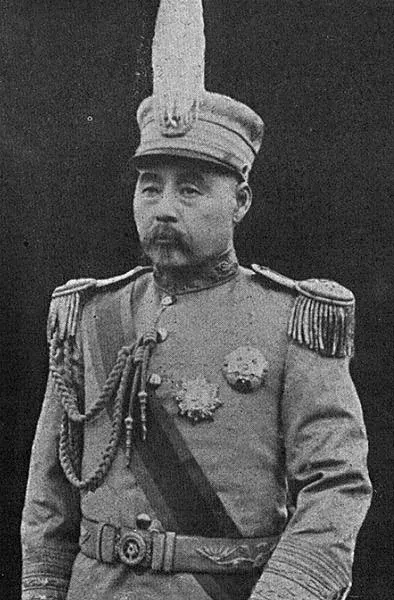
Biography
Early Life and Academic Excellence
Feng Guozhang was born on January 7, 1859, in West Shijing Village, Hejian County, Zhili Province. His family was originally a prominent and affluent agricultural household; his grandfather, Feng Pizhen, owned over three hundred mu of arable land. However, following repeated failures in imperial examinations, his father, Feng Chuntang, succumbed to chronic melancholia. Compounded by severe droughts, floods, and regional rebellions, the family fortune steadily decayed. The youngest of four brothers, Feng Guozhang attended local village schools and the Maogong Academy. In 1881, assisted by relatives, he entered the prestigious Lianchi Academy in Baoding to study classical literature and mathematics, but severe financial destitution forced him to withdraw in 1883 to support his household by manual labor.
Determined to break through poverty and pursue a career in state service, the twenty-five-year-old Feng journeyed to Dagu in 1884 to enlist in the Huai Army, entering the Zhizi Battalion as a private soldier through the introduction of a kinsman. Being literate and skilled in abacus calculation, Feng frequently assisted illiterate soldiers in drafting letters home and helped the quartermaster audit food procurement records. His modest temperament and administrative competence earned the deep trust of Battalion Commander Liu Qi. In 1885, Viceroy of Zhili and Beiyang Commissioner Li Hongzhang established the Beiyang Military Academy in Tianjin to train modern professional officers on Western standards. Recommended by Liu Qi, Feng was admitted to the inaugural infantry class. He applied himself diligently to tactics, ordnance handling, field fortification, topography, and geometry. In 1888, he passed the local examinations to earn the Licentiate degree; in July 1889, he graduated with distinction and was retained by Academy Director Yinchang as an infantry instructor.
The Japanese Survey Mission and Xiaozhan Training
In 1893, eager for active operational field service, Feng joined the headquarters of Provincial Commander Nie Shicheng. Upon the eruption of the First Sino-Japanese War in 1894, he accompanied Nie's forces to Korea, participating in engagements along the Yalu River and the defenses of Motianling. Amid bitter winter operations, Feng directly witnessed the catastrophic defects of old-style Chinese forces: obsolete weaponry, fragmented command hierarchies, and undisciplined troop formations. He recognized that traditional military institutions were completely incapable of confronting modern industrialized armies.
Following the Treaty of Shimonoseki in 1895, the Qing court initiated comprehensive military modernization. Highly recommended by Nie Shicheng, Feng was appointed military attache to Yu Geng, the Qing envoy to Japan. During his mission in Tokyo and Yokohama, Feng gathered exhaustive documentation on the Japanese Imperial Army General Staff, regimental drill manuals, logistical supply systems, war games, and field telecommunications. Translating and organizing these manuals, he produced multi-volume illustrated treatises on modern military systems. In the spring of 1896, Feng returned to China and presented his illustrated compendium to Yuan Shikai, who was then organizing the Newly Created Army at Xiaozhan. Impressed by Feng's mastery of modern doctrine, Yuan immediately appointed him Assistant Director of the Camp Training Bureau and Superintendent of the Infantry Academy.
At Xiaozhan, Feng integrated German army regulations with Chinese field conditions, serving as primary compiler of core manuals such as Detailed Illustrated Explanations of Training Regulations. He personally demonstrated tactical marching, volleys, advancing under fire, and field entrenchment, winning profound admiration from subordinates. Alongside Duan Qirui (artillery) and Wang Shizhen (staff command), Feng became one of Yuan Shikai's essential lieutenants, forming the "Beiyang Three Heroes." Contemporary observers characterized Wang as the "Dragon" (cunning strategist), Duan as the "Tiger" (aggressive commander), and Feng as the "Dog" (tenacious, disciplined battlefield executor). When Yuan Shikai was appointed Governor of Shandong in 1899, Feng commanded the Right Martial Vanguard Corps into western Shandong, founding military officer schools in Jinan and demonstrating high organizational proficiency in suppressing local uprisings.
Central Staff Leadership and Commanding the Imperial Guards
Following Li Hongzhang's death in 1901, Yuan Shikai succeeded as Viceroy of Zhili and Beiyang Commissioner, establishing the Beiyang Military Administration in Baoding and appointing Feng as Director of the Training Bureau to oversee the expansion of regular army divisions. In 1903, the Qing court created the Commission for Army Reorganization under Prince Yikuang, with actual operational authority resting with Yuan Shikai. Feng was appointed Director of the Military Orders Bureau, tasked with standardizing national army divisional tables, authorizing tactical manuals, inspecting regional units, and organizing grand maneuvers, thereby serving as an architect for China's thirty-six modern divisions.
In 1907, the Commission was absorbed into the Ministry of War, and Feng was appointed Superintendent of the Nobles Military Academy, tasked with instructing Manchu princes and nobles in staff operations and strategic command, which broadened his influence across high imperial circles. In 1909, Prince Regent Zaifeng dismissed Yuan Shikai from office. Seeking to reclaim military power for the imperial clan, the court established the Royal Imperial Guards under Prince Zaitao and Minister Tie Liang. Recognizing their own lack of command experience, the imperial princes turned to Feng, appointing him Commander of the First Brigade and subsequently Commander-in-Chief of the Imperial Guards. Feng instituted strict German-style training and modern armaments, transforming this ten-thousand-man Manchu force into the premier combat unit in the capital, effectively holding the military key to Beijing.
The Battle of Yangxia and the Imperial Abdication
On October 10, 1911, the Wuchang Uprising erupted in Hubei, prompting numerous provinces to declare independence from the Qing Dynasty. As imperial forces under Minister of War Yinchang stalled, the Qing court was compelled on October 14 to recall Yuan Shikai as Viceroy of Huguang with supreme command over southern expeditionary forces.
To secure operational control, Yuan appointed Feng Guozhang as Commander-in-Chief of the First Army. Arriving at the Hankou front on October 27, Feng directed intense artillery bombardments against revolutionary forces commanded by Huang Xing along Liujiamiao and the Dazhimen rail lines. To break urban defensive positions, his forces set fire to commercial districts in Hankou, capturing the city on October 31. The delighted Qing court conferred upon Feng the title of Baron of the Second Rank. Feng subsequently directed pontoon crossings of the Han River, storming the fortress positions of Guishan in Hanyang. On November 27, Feng took Hanyang, positioning artillery directly opposite the revolutionary headquarters in Wuchang.
Just as the capture of Wuhan appeared imminent, Yuan Shikai, seeking to leverage the revolutionary threat to compel the Qing court to abdicate, ordered Feng to halt the advance and open truce negotiations. Yuan reassigned Feng to Beijing as Military Governor of Chahar, transferring southern field command to Duan Qirui. Returning to the capital, Feng resumed command over the Imperial Guards. When imperial loyalists in the Royalist Party attempted armed resistance, Feng entered the guard barracks, personally pledging that imperial abdication would preserve noble pensions and maintain guard units intact. His diplomacy eliminated the court's final armed shield. On February 12, 1912, Empress Dowager Longyu promulgated the abdication decree, terminating over two millennia of imperial monarchy.
Umpiring the Great Imperial Autumn Maneuvers
In the autumns of 1905 and 1906, the Qing government staged the largest modern military field exercises in imperial Chinese history at Hejian in Zhili and Zhangde in Henan. Designed to evaluate modern divisional structures and demonstrate defense modernization to foreign military attaches, the maneuvers assembled tens of thousands of elite troops from northern and southern divisions, including the Beiyang Second, Fourth, and Fifth Divisions and the Hubei Eighth Division. Feng Guozhang was appointed Commander-in-Chief of the Northern Army and Deputy Chief Umpire of the Central Evaluation Bureau for both exercises.
During these operations, Feng established operational scenarios, scoring rubrics, and field assessment criteria. Directing the Northern Army through intricate maneuvers, he executed infantry skirmish advances, coordinated creeping artillery barrages, and simulated trench-breaching assaults. Feng prioritized battlefield communications and supply logistics, deploying extensive field telephone lines and optical relay stations. In his post-maneuver evaluations, Feng provided rigorous critiques of operational deficiencies, earning acclaim from British, German, Japanese, and French military observers for his tactical erudition.
Governing Jiangsu and Securing the Southeast Base
Following the establishment of the Provisional Republican Government in Beijing in 1912, Feng served as Chief of Military Affairs in the Presidential Office and Military Governor of Zhili, stabilizing the capital region against garrison mutinies. In the spring of 1913, following the assassination of Song Jiaoren, Sun Yat-sen launched the Second Revolution, and Huang Xing declared Jiangsu independent. Yuan Shikai appointed Feng as Pacification Commissioner of Jianghuai and Commander-in-Chief of the Second Army to quell the southern uprising.
Advancing south along the Tianjin-Pukou Railway, Feng shattered revolutionary forces in Xuzhou and Bengbu before forcing a crossing of the Yangtze River. On September 1, his forces captured Nanjing, extinguishing the uprising. In December, Yuan appointed Feng Military Governor of Jiangsu. Establishing his headquarters in Nanjing, Feng reorganized regional garrison forces, modernized coastal and riverine fortifications, and asserted command over wealthy commercial corridors in Jiangsu and Zhejiang. While Yuan Shikai attempted to curb his autonomy, Feng cultivated ties with Jiangnan financiers and gentry, established local armories, and stockpiled revenues. This operational independence consolidated the Zhili warlord faction under Feng's leadership, creating a powerful regional counterbalance to Beijing.
Resisting Monarchical Restoration and the Five Generals Telegram
In 1915, Yuan Shikai accelerated schemes to restore monarchy under the Hongxian regime. To appease Feng, Yuan arranged for his family tutor, Zhou Di, to marry the widowed general and promised him an imperial dukedom. Skeptical of monarchical revival, Feng journeyed to Beijing in September to ascertain Yuan's intentions. Yuan falsely swore that he had no monarchical ambitions, claiming that his failing health and incapable sons made taking the throne suicidal. Shortly after Feng's return to Nanjing, however, the imperial restoration was officially decreed.
Furious at being deceived, Feng broke with Yuan. When Cai E launched the National Protection War in Yunnan in December 1915, Feng feigned severe illness, repeatedly refusing appointments to command northern expeditionary forces against the south. In March 1916, Feng covertly coordinated with General Li Chun of Jiangxi, General Zhu Rui of Zhejiang, General Tang Xiangming of Hunan, and General Jin Yunpeng of Shandong to issue the famous "Five Generals Secret Telegram." The dispatch demanded that the south cancel its declarations of independence while the north abolish the monarchy, punish imperial conspirators, and force Yuan Shikai to resign. The telegram shattered Yuan's political legitimacy from within his own military base; Yuan revoked the monarchy on March 22 and died in disgrace on June 6.
The Acting Presidency and Rivalry with Duan Qirui
Following Yuan Shikai's death, Li Yuanhong succeeded to the presidency, Duan Qirui became premier, and Feng was elected Vice President, electing to remain in Nanjing to safeguard southern interests. In May 1917, the First Factional Crisis between Li and Duan over entering World War I led to Duan's dismissal, prompting Li to summon royalist general Zhang Xun to mediate. Zhang entered Beijing and attempted to restore the abdicated Qing emperor Puyi. Duan mobilized forces at Machang to quell the restoration, while Feng declared from Nanjing that he was assuming the acting presidency. Following Zhang's swift defeat, Li resigned, and Feng entered Beijing on August 1 to serve as Acting President, with Duan reinstated as Premier.
Feng's tenure was dominated by the Second Factional Crisis against Duan Qirui. When Sun Yat-sen established the Constitutional Protection Military Government in Guangzhou, Duan, supported by Japanese loans and arms, pursued "Unification by Force" to conquer southern territory for his Anhui faction. Feng opposed this policy, advocating "Peaceful Unification" to prevent the depletion of northern resources and the overexpansion of Anhui influence.
Secret Maneuvers and the Armistice at Hengyang
Amid intense pressure from Duan's militarist cabinet, Feng used the frontline autonomy of Zhili field commanders to neutralize northern offensives. In the autumn of 1917, Duan sent his protege Fu Liangzuo to govern Hunan, where he was quickly routed by southern forces. Duan then deployed the Zhili Third Division under Cao Kun and forward commander Wu Peifu to retake Hunan. Wu fought victoriously to Yuezhou, Changsha, and Hengyang; however, Duan withheld rations from Zhili troops while installing Anhui loyalist Zhang Jingyao as Military Governor of Hunan.
Recognizing the simmering fury among Zhili commanders, Feng covertly instructed Cao and Wu that Zhili forces must not sacrifice themselves to aggrandize Anhui hegemony. With Feng's secret sanction, Wu Peifu halted operations at Hengyang in the spring of 1918, signing a local armistice with southern forces. In August, Wu issued a nationwide peace circular calling for an immediate ceasefire and national reconciliation. This maneuver crippled Duan's offensive, destroying his campaign for military dictatorship and forcing his cabinet to resign.
Retirement to Tianjin and Industrial Philanthropy
In retaliation for the collapse of his southern campaign, Duan dispatched Xu Shuzheng to invite Fengtian warlord Zhang Zuolin's armies inside the Great Wall to intimidate the presidency, while utilizing the Anfu Club to control elections for the new parliament. Confronted by combined Anhui-Fengtian military pressure, Feng agreed to an arrangement under which both he and Duan would simultaneously step down. In August 1918, the Anfu Parliament elected Xu Shichang as president. On October 10, Feng issued a circular announcing the expiration of his presidential term, retiring to his residence in the British Concession of Tianjin.
In retirement, Feng devoted himself to promoting modern industry, education, and banking. He invested hundreds of thousands of silver dollars to establish the Sino-Japanese Exchange Bank, the Chee Hsin Cement Company in Tangshan, the Luanzhou Coal Mine, and textile manufacturing plants. In mid-December 1919, Feng visited Beijing to inspect his enterprises, contracting severe lobar pneumonia amid bitter winter cold. Realizing his condition was fatal, he dictated a final testament to Secretary-General Zhang Yilin for President Xu Shichang, expressing profound regret that peaceful national unification had not been achieved during his lifetime. In his final circular to provincial governors, he urged: "Let all military and civil leaders place the nation first, cease warfare, and rescue the people from suffering." Feng passed away in Beijing on December 28, 1919, at the age of sixty. The government decreed half-mast mourning, conferred upon him the rank of General of the Army, Special Class, and accorded him a state funeral.
Major Achievements
Formulating China's Modern Infantry Tactics
During the transitional modernization of the late Qing army, Feng Guozhang was the paramount architect of China's transformation from traditional regional battalions into modern regular infantry divisions. At the Beiyang Military Academy and the Xiaozhan training grounds, he synthesized German and Japanese army regulations, authoring foundational military textbooks such as Detailed Illustrated Explanations of Training Regulations and the Infantry Drill Regulations. He codified three-rank continuous fire, squad tactical movements, field entrenchment, and skirmish lines, establishing standardized merit-based officer examinations that formed the instructional core of Chinese armies for decades.
Directing the Military Orders Bureau and the Nobles Military Academy, Feng supervised the Hejian and Zhangde autumn maneuvers, enforcing unified divisional structures across the empire. He introduced live-fire exercises, night-combat training, and battlefield telecommunications into daily readiness, eliminating the chaotic fragmentation of late imperial defense forces. The officers trained under his supervision formed the leadership backbone of early Republican armies.
Operational Command at the Battle of Yangxia
Following the outbreak of the 1911 Revolution, Feng took command of the First Army on the Hubei front, reversing early imperial retreats through tactical coordination. In the campaigns to storm Hankou and Hanyang, he concentrated heavy artillery barrages, utilized railway mobility, and executed river-crossing assaults against fortified positions at Guishan, breaking revolutionary resistance and placing Wuchang under direct bombardment. This tactical victory provided decisive leverage for Yuan Shikai to restrain imperial reactionaries, compel the court's peaceful abdication, and negotiate a political settlement that averted catastrophic civil war.
Opposing the Hongxian Monarchy and Safeguarding the Republic
During Yuan Shikai's monarchical restoration, Feng stood as the most prominent internal opponent within the Beiyang establishment. Resisting aristocratic titles and material incentives, he remained in Nanjing and orchestrated the "Five Generals Secret Telegram," which undermined Yuan's legitimacy and forced the abolition of the Hongxian regime. In the 1917 restoration crisis, he mobilized forces to suppress royalist rebels and preserve constitutional principles. As Acting President, he resisted militarist escalation, advocating peaceful political settlement to protect national unity.
Pioneering Regional Industry and Financial Development
Throughout his tenure in Jiangsu and his subsequent retirement, Feng championed modern industrial development. In Jiangsu, he protected merchant capital, reformed salt and transit duties, and supported textile manufacturing in Wuxi, Changzhou, and Nantong. In Tianjin, he invested substantial private capital into the Sino-Japanese Exchange Bank, the Chee Hsin Cement Company, and the Luanzhou Coal Mine, becoming one of the earliest high-ranking military figures to channel wealth into heavy industry and modern corporate finance.