Birth in Sultaniyya
Born in the newly founded imperial capital of Sultaniyya as the second son of Öljaitü Khan.
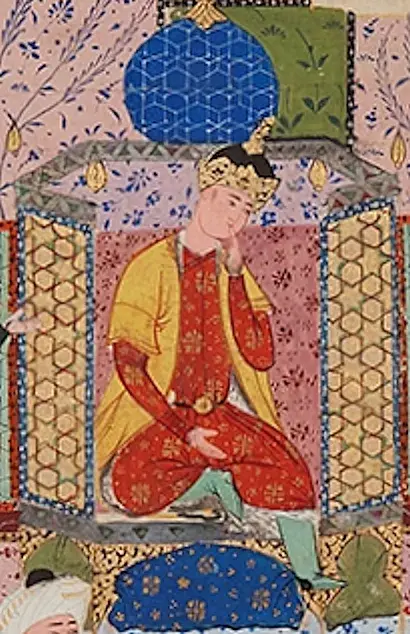
不赛因
Abu Sa'id (不赛因, 1305–1335), formally Abu Sa'id Bahadur Khan, was an imperial prince of the Mongol Empire and the ninth Ilkhan of the Ilkhanate, reigning from 1316 until 1335. He was the son of Öljaitü Khan, a great-great-grandson of Hulagu Khan, and a sixth-generation direct descendant of Genghis Khan. Ascending the throne at the capital of Sultaniyya in 1316 at the age of eleven following his father's demise, his early…
Abu Sa'id (不赛因, 1305–1335), formally Abu Sa'id Bahadur Khan, was an imperial prince of the Mongol Empire and the ninth Ilkhan of the Ilkhanate, reigning from 1316 until 1335. He was the son of Öljaitü Khan, a great-great-grandson of Hulagu Khan, and a sixth-generation direct descendant of Genghis Khan. Ascending the throne at the capital of Sultaniyya in 1316 at the age of eleven following his father's demise, his early reign was dominated by Amir Chupan, the paramount military commander of the Taichi'ut clan. Chupan concentrated supreme civil and military authority in his own hands while appointing his sons as governors across strategic provinces. In 1319, when the Golden Horde invaded Azerbaijan, the adolescent Abu Sa'id personally accompanied the army to the front lines at Mianeh, rallying his troops to crush the invaders. In recognition of his valor, his generals acclaimed him as "Bahadur" (the Valiant), establishing his royal title as Abu Sa'id Bahadur Khan. As he reached adulthood, Abu Sa'id determined to end the oppressive dominance of the Chupanid faction. In 1327, leveraging popular discontent over Chupanid rapacity, he executed a swift coup, executing Chupan's sons and breaking the family's hold on power to assume direct personal rule. During his independent governance, he negotiated a landmark peace treaty with the Mamluk Sultanate of Cairo, terminating over six decades of continuous warfare in the Near East. He also reformed provincial taxation and patronized Persian Islamic culture, guiding the realm into a period of prosperity. In 1335, while mobilizing against another northern incursion by Uzbeg Khan of the Golden Horde, Abu Sa'id died suddenly in Karabakh at the age of thirty. Dying without an heir, his demise precipitated the immediate disintegration of the unified Ilkhanate into rival warring successor states.
Born in the newly founded imperial capital of Sultaniyya as the second son of Öljaitü Khan.
Enthroned as the ninth Ilkhan at age eleven under the regency of Amir Chupan.
Personally rallied troops to decisively defeat an invading Golden Horde army, earning the royal title Bahadur.
Concluded the historic Treaty of Aleppo with Sultan al-Nasir Muhammad of Egypt, ending long-standing frontier hostilities.
Staged a decisive court purge to eliminate Amir Chupan and his lineage, restoring central authority to the khan.
Restored royal finances, reduced agrarian levies, and sponsored Persian historical scholarship and manuscript illumination.
Died abruptly while leading imperial forces against the Golden Horde, triggering the catastrophic partition of the Ilkhanate.
Abu Sa'id was born in 1305 in Sultaniyya, the magnificent new capital constructed by his father Öljaitü. Reared in the royal court, he was schooled in Mongol equestrian warfare alongside Persian courtly etiquette and Islamic learning.
In December 1316, Öljaitü died prematurely. The eleven-year-old Abu Sa'id was elevated to the throne by the council of Mongol princes and grandees. Owing to the sovereign's youth, the senior general Amir Chupan assumed dictatorial powers as grand commander and protector of the realm. Chupan consolidated absolute control over the administrative machinery, appointing his sons to governorships across Azerbaijan, Khorasan, Iraq, and Anatolia. The royal treasury and state revenues were largely diverted to the Chupanid household, reducing the young khan to a decorative figurehead.
Despite living under Chupan's shadow, Abu Sa'id possessed an intrepid and martial character. In 1319, Khan Ozbeg of the Golden Horde dispatched an army of tens of thousands across the Caucasus to annex the prosperous pasturelands of Azerbaijan. Border garrisons retreated in disarray, prompting Chupan to mobilize the imperial host.
The fourteen-year-old Abu Sa'id insisted on joining the campaign in person, donning heavy lamellar armor and riding to the front. During the fierce pitched battle on the plains of Mianeh, the Ilkhanid vanguard began to buckle under enemy cavalry charges. Drawing his sword, Abu Sa'id rode into the fray, rallying his personal guards and exhorting the commanders to hold their ground. Inspired by the young monarch's bravery, the Mongol cavalry counterattacked, driving the Golden Horde forces into a chaotic rout.
This victory elevated Abu Sa'id's standing among the nomadic aristocracy. In celebration, the imperial kurultai formally bestowed upon him the honorific title "Bahadur" (the Valiant), an event commemorated with celebratory edicts acknowledged by the Yuan imperial court in Dadu.
As Abu Sa'id matured, relations with Amir Chupan deteriorated into an open struggle for supreme power. Chupan's sons governed their provinces with ruthless arrogance, levying extortionate taxes and defying imperial directives. Matters reached a crisis when Chupan's son Timurtash rebelled openly in Anatolia, declaring himself independent sovereign before being pardoned through his father's intercession.
Tensions were exacerbated by personal friction within the court. Abu Sa'id became enamored with Baghdad Khatun, Chupan's daughter and the wife of the nobleman Hasan Buzurg. When Chupan repeatedly obstructed the khan's attempts to wed her, Abu Sa'id resolved to destroy the entire Chupanid clan.
In 1327, Abu Sa'id struck at Tabriz. He ordered the arrest and execution of Chupan's son Dimashq Khwaja, who was present at court, and issued imperial proclamations declaring Chupan an outlaw. Deprived of imperial legitimacy, Chupan's provincial forces disintegrated. Chupan fled toward Herat, where he was captured and executed by the local ruler, and his severed head was dispatched to Sultaniyya. Abu Sa'id systematically confiscated Chupanid estates, bringing fourteen years of aristocratic oligarchy to a decisive close.
Assuming direct control of the state, Abu Sa'id proved to be an astute diplomat and administrative reformer. Recognizing that prolonged conflicts drained state finances, he finalized the historic 1323 peace agreement with the Mamluk Sultanate of Cairo, terminating decades of frontier warfare over Syria. This diplomatic settlement secured transcontinental caravan routes, facilitating commerce between the Persian Gulf and the Mediterranean.
Domestically, Abu Sa'id patronized Persian bureaucrats and Islamic scholars. He streamlined postal communications, reduced burdensome peasant levies, and financed major urban architectural projects. During his reign, historian Hamdallah Mustawfi composed the celebrated historical chronicle Selected History (Tarikh-i Guzida), and the workshops of Tabriz produced some of the finest illuminated manuscripts of the Islamic world.
This golden age was abruptly shattered in late 1335. Informed that Uzbeg Khan was again marching southward across the Caucasus, Abu Sa'id mobilized his army and marched toward the northern border. While encamped on the Karabakh steppe, he was struck by a virulent illness and died suddenly at the age of thirty. Contemporary rumors alleged that he was poisoned by Baghdad Khatun out of jealousy over the khan's new favored consort, Dilshad Khatun.
Because Abu Sa'id left no surviving male heir, his death plunged the Ilkhanate into chaos. Rival Mongol factions and provincial warlords elevated competing puppet khans, fracturing the empire into the Jalayirid, Chupanid, and Muzaffarid principalities. The unified realm established by Hulagu Khan vanished forever.
Personally rallied the army at the Battle of Mianeh in 1319 to repel the Golden Horde invasion, earning the title Bahadur Khan.
Executed a decisive royal coup in 1327 to eliminate Amir Chupan and his sons, restoring independent imperial authority to the khan.
Concluded the historic Treaty of Aleppo in 1323, ending over six decades of warfare and revitalizing Near Eastern trade routes.
Maintained internal stability and economic recovery across Greater Iran, serving as the final ruler to govern a unified Ilkhanate before its fragmentation.
FIGURES ASSOCIATED WITH THIS DYNASTY