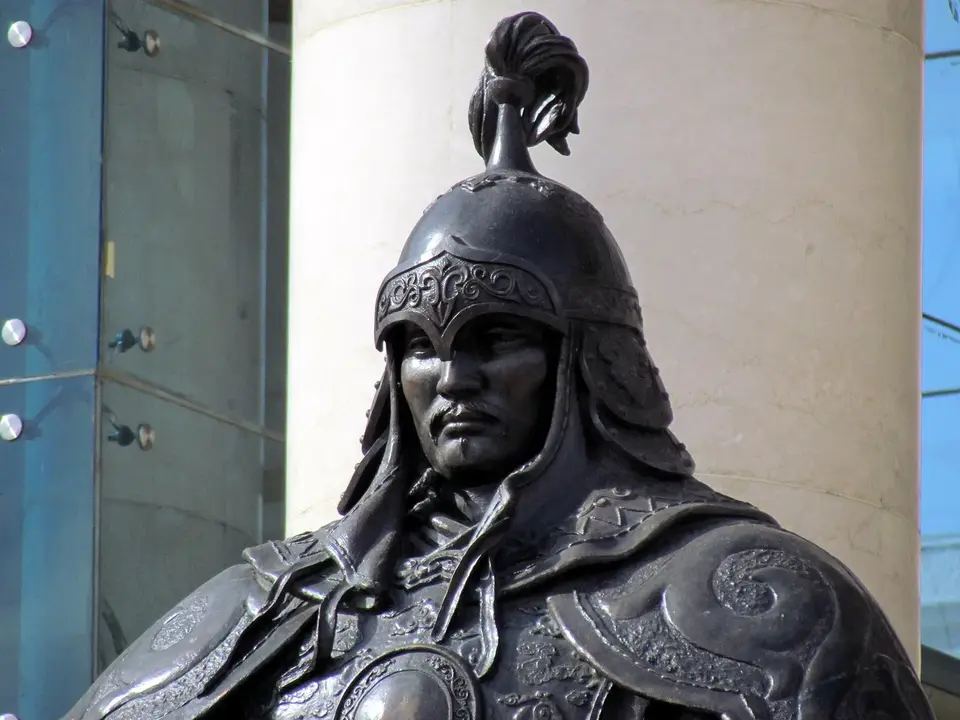
Biography
Youthful Fellowship and the Oath of Anda
Bo'orchu was born in 1162 into the aristocratic Arlat clan on the Mongolian plateau. His father, Naqu Bayan, was a chieftain renowned for vast herds and immense prestige. From early youth, Bo'orchu possessed a commanding physique, great equestrian skill, and an open, generous character.
Around 1177, when Temujin was living in extreme poverty following his father Yesugei's death, horse thieves raided his encampment, stealing his family's eight gelded horses. The sixteen-year-old Temujin tracked the raiders alone across the steppe for three days. Exhausted, he encountered sixteen-year-old Bo'orchu pasturing horses near the Onon River. Recognizing Temujin's extraordinary charisma and desperate plight, Bo'orchu exclaimed: "I shall ride with you to recover them!" Bo'orchu provided Temujin with a fresh mount and, leaving his own herds behind, joined the pursuit. After days of riding, they ambushed the thieves, fought off resistance, and recovered the stolen herd.
When Temujin offered half the recovered horses as a reward, Bo'orchu declined, saying: "I rode with you out of honor and brotherhood, not for gain!" Admiring his son's noble character, Naqu Bayan blessed their friendship. Temujin and Bo'orchu swore an oath of eternal brotherhood (anda), inaugurating a bond that altered the history of Eurasia.
Unification Wars and Heroic Devotion
In 1189, when the Borjigin clan acclaimed Temujin as Khan, Bo'orchu brought his Arlat clan to pledge allegiance. Temujin appointed him and Jelme as commanders of his personal guards, consulting them on military strategy.
Throughout the wars that unified the nomadic tribes, Bo'orchu demonstrated brilliant tactical acumen and unflinching loyalty. In 1190, during the Battle of the Thirteen Wings, Temujin's rival Jamukha attacked with thirty thousand warriors. Commanding the second wing, Bo'orchu withstood fierce charges, allowing Temujin to withdraw safely into the Jerene gorge.
In 1202, during the campaign against the allied tribes at Dalan Nemurges, a sudden blizzard struck the battlefield. Temujin fell asleep exhausted on the frozen ground. Disregarding his own comfort, Bo'orchu held a heavy felt blanket over the sleeping Khan through the night, remaining motionless despite freezing rain and sleet. When dawn broke, his legs were numb and frostbitten. Temujin awoke, weeping with gratitude, and embraced Bo'orchu as a brother. In subsequent campaigns that crushed the Taichi'ut, Kereit, and Naiman confederations, Bo'orchu served as vanguard commander, securing victories that paved the way for imperial unification.
Imperial Investiture and Commander of the Right Wing
In 1206, Genghis Khan assembled the nomadic leaders at the Onon River in a grand kurultai, establishing the Mongol Empire. Before his assembled armies, Genghis Khan recalled Bo'orchu's early loyalty, declaring: "When the sky was dark and the road uncertain, you sheltered me from the rain; when arrows flew in battle, you shielded my body with your bow. You and Muqali have been to me like the shafts of a chariot and the arms of a body!"
Genghis Khan ranked Bo'orchu first among all founding generals, naming him senior of the "Four Steeds" alongside Muqali, Boroqul, and Chilaun. Bo'orchu was granted immunity from punishment for nine offenses and appointed Commander of the Right Wing (Right Hand Myriarchy), commanding all territory from the Altay Mountains to the Khentii Mountains. Additionally, he was designated Supreme Commander of the Keshig, the elite imperial bodyguard, making him the central pillar of military governance.
Campaigns in China, Central Asia, and Martyrdom
As senior field marshal, Bo'orchu took part in the empire's major campaigns abroad.
In 1211, during the invasion of the Jurchen Jin dynasty, Bo'orchu led the right-wing column through Yehuling, annihilating the elite forces of Jin commander Wanyan Chengyu at Xuanping and pushing across Juyong Pass toward the Central Plains. In 1219, when the Shah of Khwarazm massacred a Mongol caravan, Genghis Khan led his armies west. Bo'orchu was charged with mentoring imperial princes Chagatai and Ogedei, directing the complex sieges of Otrar, Bukhara, and Samarkand, coordinating mounted cavalry attacks with siege engineers.
In 1226, during the final expedition against the Tangut Western Xia, the veteran commander, worn by decades in the saddle, fell mortally ill in the military camp and died at the age of sixty-five. Genghis Khan mourned his passing. In 1301, Emperor Chengzong of Yuan posthumously bestowed upon Bo'orchu the titles of Grand Preceptor, Senior Commissioned Unequaled in Honor, and Prince of Guangping, with the posthumous title Wuzhong. His descendants hereditarily commanded the Right Hand Myriarchy and the Keshig, remaining one of the most powerful families in the Yuan Dynasty.
Major Achievements
Reclaiming the Stolen Horses and Forging the Imperial Coalition
At the lowest point of Genghis Khan's fortunes, Bo'orchu's selfless intervention altered the course of steppe history. The sixteen-year-old Temujin was friendless, and the loss of eight horses threatened his family's survival.
Without considering personal danger, Bo'orchu rode alone with Temujin into hostile territory to recover the herd, refusing all payment. This heroic act forged an indissoluble bond between two leaders. Through this alliance, Temujin attracted his first core group of loyal warriors, laying the bedrock upon which the Mongol Empire was erected.
Governing the Right Wing and Institutionalizing the Keshig
In the administrative architecture of the 1206 Mongol Empire, Bo'orchu bore immense responsibility. Genghis Khan divided the empire into Left and Right Wings, entrusting the vast Right Wing to Bo'orchu, who governed military garrisons and civil chiliarchies across western Mongolia and the Altay mountains.
Furthermore, Bo'orchu served as Supreme Commander of the Keshig, the ten-thousand-strong imperial guard that served as both a security force and an administrative academy for training future generals and bureaucrats. Bo'orchu's disciplined leadership maintained imperial security through decades of war, establishing a model of royal guard organization that endured throughout the Yuan Dynasty.
Guiding Imperial Princes in Central Asian Conquests
During the Western Campaign against Khwarazm, Bo'orchu was entrusted with guiding the Khan's elder sons, Chagatai and Ogedei.
In the sieges of major fortified cities along the Silk Road, such as Otrar and Samarkand, Bo'orchu instructed the princes in tactical maneuvers, supply coordination, and siegecraft. His strategic wisdom and disciplined command ensured victory in difficult urban warfare and trained the future leaders of the Chagatai and Ilkhanate realms.