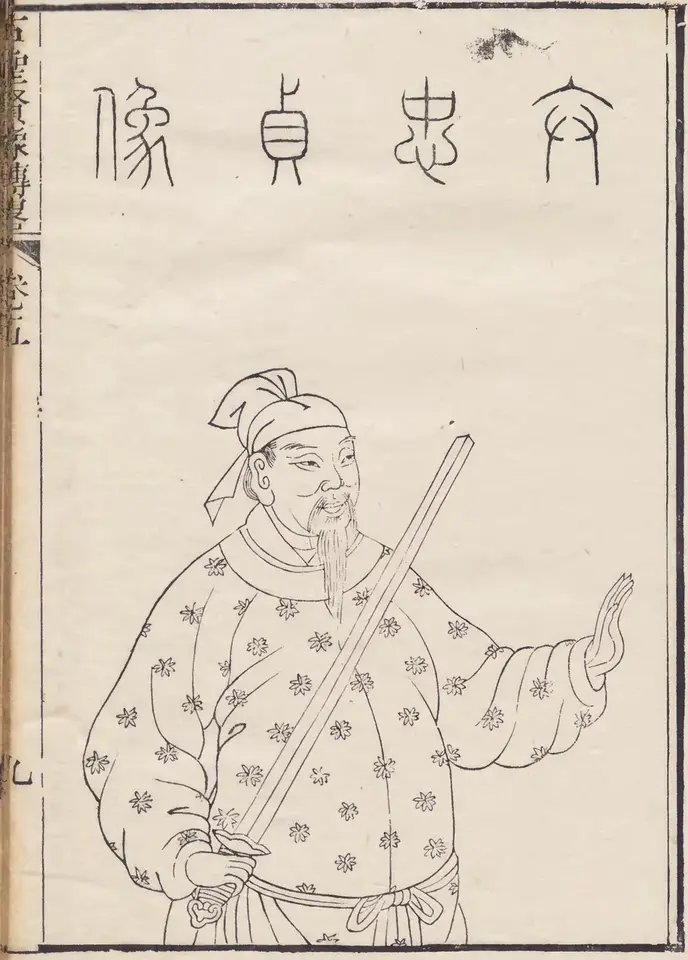
Life and Career
Lineage of Six Dragons and Crossing the River
Bian Kun was born into a distinguished gentry lineage in Yuanju County of Jiyin Commandery. His grandfather Bian Tong had served as Internal Scribe of Langye in Western Jin, while his father Bian Cui and five uncles all achieved high administrative honors in the ministerial chancellery, earning universal acclaim across the northern gentry as the "Six Dragons of the Bian Clan." Growing up in an environment of classical propriety and high civic virtue, Bian Kun was celebrated from his youth for grave solemnity and profound moral restraint. Although the regional administrations of Sizhou and Yanzhou, alongside high-ranking generals, repeatedly issued invitations for him to enter public office, Bian Kun declined with modesty. During the disastrous War of the Eight Princes, his father Bian Cui was falsely accused and executed by Sima Ai, Prince of Changsha, prompting Bian Kun to retire to his ancestral home in filial mourning.
During the Yongjia era of Emperor Huai, Bian Kun answered an imperial summons to serve as Gentleman of the Golden Cavalry and inherited his father's noble title of Duke of Chengyang. In the fifth year of Yongjia (311 CE), the Yongjia Catastrophe erupted as the armies of Han Zhao sacked Luoyang and captured the emperor. Bian Kun escorted his extended family south across the Huai River to seek refuge with his brother-in-law Pei Dun, Inspector of Xuzhou. Pei Dun appointed Bian Kun as Acting Chancellor of Guangling. Confronted with thousands of displaced refugees along the river, Bian Kun administered relief with compassionate clarity and strict discipline, swiftly restoring social peace to the area.
In 317 CE, Sima Rui (Prince of Langye) established his government at Jiankang and recruited Bian Kun into his headquarters as Military Consulting Adjutant, entrusting him with the selection and appointment of civil officials. Bian Kun discharged these duties with meticulous impartiality, winning immense respect from Sima Rui. Following the founding of the Eastern Jin dynasty, Bian Kun was elevated to Mentor of the Crown Prince, Cavalier Attendant-in-Ordinary, Palace Attendant, Supervisor of the Household of the Crown Prince, and Palace Attendant. Holding core offices that combined mentoring the heir apparent with censorial oversight, Bian Kun maintained an immaculate standard of decorum, earning the reverence of nobles and statesmen alike.
Guidance of Crown Prince and Defeating Wang Dun
During the Taixing and Yongchang eras, Crown Prince Sima Shao (the future Emperor Ming) revered learning and placed complete trust in Bian Kun as both his personal mentor and senior counselor. Bian Kun instructed the heir to venerate Confucian classics and uphold imperial laws, leaving a lifelong imprint on Sima Shao's statecraft. Upon ascending the throne in 323 CE as Emperor Ming, Sima Shao promoted Bian Kun to Master of Writing for the Ministry of Personnel, placing central bureaucratic appointments in his hands.
In 324 CE, warlord Wang Dun fell mortally ill in Wuchang and launched a desperate rebellion against the imperial court, dispatching his brother Wang Han and general Qian Feng with tens of thousands of troops to march on Jiankang. Emperor Ming personally rode out to coordinate defense forces, appointing Bian Kun as General of the Central Army to command the elite palace guards along the perimeter of the capital. In fierce fighting, Bian Kun held the palace ramparts resolutely against the rebel assault, buying critical time for loyalist relief armies to encircle and crush the insurgent forces. Following the victory, the court conferred upon Bian Kun the noble title of Duke of Jianxing County and subsequently appointed him General of the Army to direct the imperial garrison.
In the third year of Taining (325 CE), Emperor Ming fell critically ill. At his bedside, the dying emperor issued a solemn decree appointing Bian Kun, Minister of Education Wang Dao, General of Chariots and Cavalry Xi Jian, and Director of the Chancellery Yu Liang as testamentary guardians to assist the four-year-old Crown Prince Sima Yan (Emperor Cheng). Following Emperor Cheng's accession, Bian Kun was elevated to Prefect of the Masters of Writing and General of the Right Guard, taking up residence in the inner palace alongside Yu Liang to jointly preside over central imperial governance.
Rigid Rectitude and Championing Confucian Norms
Bian Kun was unyielding in his adherence to principle, regarding the preservation of classical rituals and imperial authority as his paramount duty. On the day of Emperor Cheng's coronation, elder statesman Wang Dao feigned illness and failed to attend the grand court ceremony. Standing before the assembled ministers, Bian Kun rebuked Wang Dao in a stern voice: "Lord Wang is an indispensable pillar of the altar of state! When the late emperor lies in his casket and the young sovereign has newly ascended the throne, is this a time for a minister to plead illness?" Hearing of this public reprimand, Wang Dao rushed to the palace in great embarrassment. Later, Wang Dao claimed illness to skip morning audience while privately traveling outside the city to attend a lavish farewell banquet for Xi Jian. Discovering this duplicity, Bian Kun filed a formal impeachment against Wang Dao for undermining imperial statutory law to indulge personal relationships, demanding that the officials involved be dismissed. The entire court was awed by his uncompromising integrity.
During this period, many noble youths who had crossed the Yangtze abandoned Confucian conventions, aping the nihilistic and exhibitionist habits of earlier eccentrics such as Wang Cheng and Xie Kun. They unfastened their robes, drank recklessly, and neglected state duties in favor of ethereal conversationalism. Bian Kun despised this decadent trend, openly castigating them at court: "These self-indulgent figures defy sacred rituals and corrupt imperial morals—no crime is graver than this! The catastrophic collapse of Western Jin was fundamentally precipitated by such frivolous men discarding dynastic governance!" Bian Kun guided state decisions through classical statutory precedents, restoring institutional discipline to the nascent Eastern Jin administration.
Observing his exhausting administrative dedication, a courtier once remarked playfully: "You never permit yourself a moment of leisure, always looking as if you have stones in your mouth. Is that not far too exhausting?" Bian Kun smiled calmly and replied: "If all of you gentlemen pride yourselves on lofty detachment and effortless elegance, who else but I should undertake the tedious, unglamorous burdens of governing the empire?" His selfless sense of public duty moved all principled observers.
Foreseeing Insurrection and Heroic Martyrdom
In 327 CE, Director of the Chancellery Yu Liang, who dominated the court, resolved to curb the growing autonomy of Su Jun, Internal Scribe of Liyang. Yu Liang proposed: "General Su Jun possesses a rapacious and treacherous nature; if his military command is not curbed now, it will become uncontrollable in the future, just as Chao Cuo advised Emperor Jing of Han to strip the feudal princes of their lands." Yu Liang recommended promoting Su Jun to Minister of Finance in Jiankang, an apparent honor that would strip him of his private army. The court courtiers cowered in silence.
Prefect of the Masters of Writing Bian Kun stood alone in passionate opposition, warning Yu Liang: "Su Jun commands veteran, hardened legions stationed at Liyang, right at the doorstep of the capital. If you abruptly summon him to court, you will back him into a corner and trigger an immediate insurrection, imperiling the imperial throne! We should gradually dismantle his influence over time rather than acting rashly!" Blinded by arrogance, Yu Liang disregarded Bian Kun's warning and issued the summons. Enraged by the imperial edict, Su Jun joined forces with Zu Yue of Shouchun and launched a massive armed rebellion, storming toward Jiankang.
In early 328 CE, Su Jun's rebel legions smashed through the outer defenses and reached Donglingkou outside the capital. The terrified court commissioned Bian Kun as Commander-in-Chief of Military Affairs East of the Great Pontoon Bridge, holding the imperial tally, concurrently serving as General of the Army to direct frontline defenses. Although suffering from a painful back carbuncle and physical exhaustion, Bian Kun led his guards into combat against the rebels at Xiling. When Xiling fell, Bian Kun retreated to Qingxi, rallying his men in desperate hand-to-hand combat amidst smoke and flames. As rebel forces breached the palace gates, Bian Kun refused to retreat an inch. Gripping his sword, he charged directly into the enemy ranks, sustaining dozens of severe wounds before falling heroically on the battlefield at the age of forty-eight.
At that tragic moment, his eldest son Bian Zhen (Gentleman of the Cavalcade) and second son Bian Xu (Chief Commandant of Imperial Chariots) were serving at his side. Seeing their father slaughtered by the rebels, the two brothers wept aloud and swore not to survive him. Brandishing their weapons, they plunged into the thick of the enemy swarm, slaying dozens of rebel horsemen before dying heroically beside their father's body. The sacrifice of father and sons on the same day moved the entire southern empire to tears. After the rebellion was crushed in 329 CE, the court posthumously bestowed upon Bian Kun the offices of Palace Attendant, General of Agile Cavalry, and Specially Advanced with Equal Privileges to the Three Excellencies, granting him the premier posthumous title of Marquis Zhongzhen and offering imperial sacrifices of the highest grade. His sons were likewise posthumously ennobled, sealing their eternal reputation as a family whose devotion to state and kin knew no peer.
Major Achievements
Formulating Dynastic Rites and Educating the Heir
Serving as Mentor to the Crown Prince, Palace Attendant, and Master of Writing, Bian Kun systematically schooled the future Emperor Ming in classical governance and institutional law, while delineating strict boundaries between private interest and public authority within the chancellery, establishing enduring administrative traditions for the Eastern Jin court.
Defending the Capital during Wang Dun's Rebellion
In 324 CE, Bian Kun commanded the central palace garrison as General of the Central Army, holding key positions against Wang Han's rebel army and preventing the fall of Jiankang, which earned him elevation to Duke of Jianxing County and appointment as General of the Army.
Testamentary Regency and Enforcement of Legal Authority
As testamentary co-regent to the infant Emperor Cheng in 325 CE, Bian Kun managed central state policy with uncompromising integrity. He publicly rebuked Wang Dao for skipping the coronation and impeached him for illicit social gatherings, restoring imperial majesty and judicial order to the court.
Resolute Defense of Classical Propriety
Confronting the nihilistic and indulgent conversationalism prevalent among southern aristocratic elites, Bian Kun courageously condemned their abandon as the fundamental malady that caused the collapse of Western Jin, providing a vital moral bulwark for Confucian propriety.
Prescient Assessment of Su Jun's Insurrection
When Yu Liang insisted on summoning Su Jun to strip him of his command, Bian Kun foresaw with exceptional strategic clarity that premature pressure would force Su Jun into armed rebellion, offering unheeded yet accurate warnings of the approaching disaster.
Glorious Martyrdom of Father and Sons
During the desperate battle for Jiankang in 328 CE, Bian Kun led his troops into frontline combat despite debilitating illness, dying heroically on the battlefield. His two sons Bian Zhen and Bian Xu charged into the enemy vanguard to die alongside their father, creating an immortal legacy of simultaneous loyalty to sovereign and father that resonated through Chinese history.