Born in Licheng
Born into an official and scholarly family in Jinan, Shandong, showing remarkable talent and reading extensively from youth.
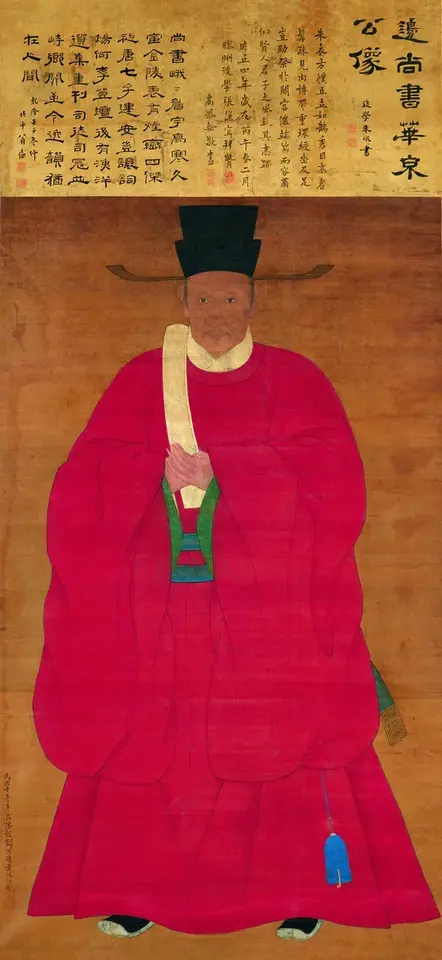
边贡
Bian Gong (边贡; 1476–1532), courtesy name Tingshi and art name Huaquan, was a native of Licheng, Jinan Prefecture, Shandong. He was a distinguished literary figure, poet, bibliophile, and one of the core leaders of the Former Seven Masters during the Hongzhi, Zhengde, and Jiajing eras of the Ming Dynasty. In 1496, he earned the jinshi degree at the early age of twenty. He was initially appointed Erudite of the Court of…
Bian Gong (边贡; 1476–1532), courtesy name Tingshi and art name Huaquan, was a native of Licheng, Jinan Prefecture, Shandong. He was a distinguished literary figure, poet, bibliophile, and one of the core leaders of the Former Seven Masters during the Hongzhi, Zhengde, and Jiajing eras of the Ming Dynasty. In 1496, he earned the jinshi degree at the early age of twenty. He was initially appointed Erudite of the Court of Imperial Sacrifices and was soon promoted to Supervising Secretary of the Office of Scrutiny for War. During his tenure, he did not avoid powerful dignitaries, submitting memorials impeaching arrogant military supervisors and incompetent generals, gaining wide acclaim for his fearless remonstrance. At the turn of the Hongzhi and Zhengde eras, Bian Gong formed a close literary fellowship with Li Mengyang, He Jingming, Xu Zhenqing, Wang Jiusi, Kang Hai, and Wang Tingxiang. They spearheaded the Archaising Literary Movement, advocating that prose must follow the Qin and Han dynasties and poetry must model the High Tang, vigorously sweeping away the weak and formulaic Cabinet Style. Because he refused to align with the dominant eunuch faction led by Liu Jin, he was demoted and dispatched to local posts, serving successively as Prefect of Weihui and Jingzhou and Educational Commissioner of Henan. In these roles, he observed popular suffering, composed poignant poems reflecting civilian hardships, and reformed civil examination selection to elevate scholars from impoverished families. During the early Jiajing reign, Bian Gong was rehabilitated and appointed Vice Minister of the Court of Imperial Sacrifices in Nanjing in charge of the Translation Bureau, later serving as Minister of the Court of the Imperial Stud. Carefree and unconventional by nature, he was passionately devoted to book collecting and wandering among rivers and mountains. After being impeached and dismissed from office on charges of heavy drinking and neglecting administrative duties, he retired to the shores of Daming Lake in Jinan, constructing the renowned Wanjuan Pavilion to house tens of thousands of rare volumes. In 1532, an accidental fire completely destroyed his lifelong collection. Overcome with grief, he fell gravely ill and died at the age of fifty-seven. His poetry is celebrated for its graceful elegance and crisp cadence, directly influencing Wang Shizhen and the later Divine Charm School of the Qing Dynasty. He was the author of the Huaquan Collection.
Born into an official and scholarly family in Jinan, Shandong, showing remarkable talent and reading extensively from youth.
Passed the metropolitan examination and obtained the jinshi degree at age twenty; appointed Erudite of the Court of Imperial Sacrifices and promoted to Supervising Secretary of the Office of Scrutiny for War.
Submitted memorial directly exposing frontier military abuses and impeaching influential eunuchs and aristocratic commanders.
Joined Li Mengyang and He Jingming in championing classical revival in poetry and prose, forming the core of the Former Seven Masters.
Sent out to serve as Prefect of Weihui and subsequently Prefect of Jingzhou after resisting the corrupt eunuch faction of Liu Jin.
Reappointed after observing mourning for his father, serving as Assistant Surveillance Commissioner for Education in Henan and upholding meritocracy in exams.
Recalled upon the accession of the Jiajing Emperor to serve as Vice Minister of the Court of Imperial Sacrifices in Nanjing and director of the Translation Bureau.
Promoted to Minister of the Court of the Imperial Stud; repeatedly requested retirement due to fatigue and bohemian disposition.
Dismissed following censorial impeachment over indulgence in drinking; retired to Jinan and established the Wanjuan Pavilion by Daming Lake to preserve rare books.
A catastrophic fire consumed his entire library of rare books; devastated by grief, he fell severely ill and passed away at age fifty-seven.
Bian Gong hailed from an established bureaucratic and scholarly lineage, receiving rigorous classical Confucian training from early childhood. In 1496, during the ninth year of the Hongzhi reign, he succeeded in the metropolitan examinations to become a jinshi when he was merely twenty years of age. Achieving early fame, he initially received an appointment as Erudite of the Court of Imperial Sacrifices before rising to Supervising Secretary in the Office of Scrutiny for War.
In the Ming bureaucratic structure, supervising secretaries in the Six Offices of Scrutiny were charged with examining imperial edicts, auditing memorial transmissions, and monitoring official malfeasance. During his tenure, Bian Gong demonstrated unyielding integrity, disregarding personal danger to impeach incompetent field commanders and corrupt supervisory eunuchs, submitting a celebrated memorial on frontier security.
At the time, the supervising eunuch Miao Kui enjoyed deep imperial favor, while field operations were headed by imperial kinsman Duke of Baoguo Zhu Hui and Right Censor-in-Chief Shi Lin. Bian Gong’s direct, unsparing remonstrance created a powerful impression at court, establishing his public reputation as an upright official dedicated to the defense of the realm.
During this period, the renowned man of letters Li Mengyang served as a secretary in the Ministry of Revenue. Concurrently, scholars such as He Jingming, Xu Zhenqing, Wang Jiusi, Kang Hai, and Wang Tingxiang also successively earned degrees and entered central ministerial and archival posts. Bian Gong developed close personal ties and exchanged verse with them, coalescing into the literary circle celebrated in history as the Former Seven Masters.
From the late Yingzong reign onward, Ming governance had suffered from growing factional corruption and social strain. By the Hongzhi era, upright ministers sought to check eunuch power and restore state vigor. In literature, Li Mengyang and He Jingming led an intellectual drive against the decadent and formulaic Cabinet Style, declaring that prose must follow the Qin and Han and poetry must mirror the High Tang.
This classical revivalist movement gained widespread adherents throughout the empire. Bian Gong occupied a prominent position among these scholars, composing verse that blended rigorous classical meter with lyrical grace, standing out alongside Li Mengyang and He Jingming as one of the chief standard-bearers of Northern verse during the mid-Ming period.
Following the accession of the Zhengde Emperor, the eunuch faction headed by Liu Jin seized supreme influence at court. Upright officials who stood against eunuch dictatorship faced persecution or banishment. Unwilling to flatter the dominant eunuchs, Bian Gong was reassigned away from the capital, initially as Prefect of Weihui and subsequently transferred to Jingzhou Prefecture in Huguang.
Jingzhou occupied a vital geopolitical position along the middle reaches of the Yangtze River, having recently experienced localized turmoil and logistical burdens associated with frontier supply lines. In his capacity as prefect, Bian Gong prioritized administrative relief, curbing extortionate clerical levies and stabilizing the livelihood of the war-weary population.
Despite official isolation from the capital, Bian Gong continued his literary composition during his regional administration. He maintained frequent correspondence with fellow literary masters across regional posts, using his poetic voice to articulate ethical responsibility and lament the arbitrary governance plaguing the central administration.
During his local governance in Weihui and Jingzhou, Bian Gong directly observed the bitter conditions under which peasants, laborers, and conscripts lived. Deeply touched by their hardship, he departed from the purely imitative tendencies of classical revivalism to pen socially conscious ballads.
His notable compositions from this era include Lament on Bridge Construction and Ballad of the Boat Trackers, which depicted the misery of commoners pressed into grueling corvee labor under severe climatic conditions. These works demonstrated his authentic empathy for ordinary subjects and enriched the thematic depth of his poetry.
Furthermore, when serving as Assistant Surveillance Commissioner for Education in Shanxi and Henan, he actively suppressed aristocratic interference in local examinations. He inspected regional academies, evaluated lower-degree holders with rigorous fairness, and fostered an academic climate focused on both moral rectitude and substantive scholarship.
When Bian Gong’s father passed away, he resigned from his educational commissioner post in accordance with Confucian ritual propriety to observe the three-year mourning period. He escorted his father’s coffin back to his ancestral hometown in Licheng, Jinan, where he spent his days in quiet study, filial seclusion, and literary compilation.
During this period of familial retirement, Bian Gong devoted himself to collecting historical texts, stone inscriptions, and ancient calligraphic fragments. His residence became a gathering place for local scholars, whom he instructed in poetry and classical literature.
Upon completing the prescribed mourning period, he was summoned back to the imperial administration, reaffirming his standing as an esteemed elder statesman and literary authority whose repute had weathered political turbulence.
With the accession of the Jiajing Emperor in 1521, many officials sidelined during previous reigns received promotions and rehabilitation. Bian Gong was appointed Vice Minister of the Court of Imperial Sacrifices in Nanjing in charge of the Translation Bureau, and was later elevated to Minister of the Court of the Imperial Stud.
However, Bian Gong had grown increasingly disillusioned with bureaucratic infighting and ideological polarization. He adopted a deliberately detached, bohemian lifestyle, indulging in wine, poetry, and book collecting. In 1530, supervising censors impeached him on grounds of negligence and excessive drinking, leading to his formal dismissal from the imperial service.
Freed from administrative duties, Bian Gong returned permanently to Licheng. Along the scenic banks of Daming Lake, he constructed the Wanjuan Pavilion, gathering tens of thousands of rare scrolls and historical records, dedicating his final years entirely to bibliophile curation and verse.
Bian Gong’s poetic output was prolific throughout his life, culminating in his collected works entitled the Huaquan Collection. His poetry is distinguished by its melodious tonal harmony, clear imagery, and exquisite lyrical polish, particularly in the five-character and seven-character regulated verse and quatrain forms.
Notable poems such as his commemorative verse Visiting the Shrine of Wen Tianxiang exhibited lofty historical reverence and patriotic sentiment, employing vivid imagery to eulogize national martyrs. His landscape and occasional poems captured the natural beauties of Jinan and regional posts with crystalline clarity.
His poetry bridged the formal rigor demanded by the Archaising Movement with genuine personal emotion, avoiding the harsh rigidity that sometimes characterized the work of other revivalist poets of the period.
Throughout his career, Bian Gong enjoyed an honored reputation among literary connoisseurs. While later critics occasionally remarked on the mildness of his poetic themes and his reliance on occasional verse composed for official farewells and seasonal commemorations, his formal mastery of classical metrics was universally acknowledged.
His five-character and seven-character regulated poetry remained widely admired for its acoustic beauty, serene atmosphere, and effortless technical control. Within the Former Seven Masters, Bian Gong represented the faction that prioritized harmonious aesthetics alongside classical imitation.
His emphasis on natural grace and evocative resonance profoundly inspired subsequent generations of Shandong writers. In the early Qing period, the distinguished literary master Wang Shizhen praised Bian Gong as a foundational pioneer of the Divine Charm School of Chinese poetic theory.
Bian Gong strode across the Hongzhi and Zhengde literary scene with polished diction and elegant verse. Combining unbending censorial integrity in his early career with an expansive, carefree artistic temperament in his later years, he stands as a major poetic figure in Ming history.
"Bian Gong possessed refined and outstanding poetic talent, with meticulous metric discipline. Rising together with Li Mengyang and He Jingming, he championed the High Tang style and vigorously eliminated the base and feeble forms of the Cabinet Style. His five-character verse was exceptionally pure and lofty, imbued with profound reflection and elevated resonance, truly marking him as a master of his generation." — History of Ming (Ming Shi), Volume 286, Biographies 174, "Literary Figures II"
"Master Huaquan possessed gorgeous literary brilliance and resonant acoustic harmony. His quatrains and brief poems attained the true essence of the High Tang, possessing natural divine charm and genuinely pioneering the poetic atmosphere of our current dynasty." — Wang Shizhen, Qing Dynasty literary leader, Yuyang Poetry Talks (Yuyang Shihua)
FIGURES ASSOCIATED WITH THIS DYNASTY