Birth
Born into the Zhu family in Jincheng Commandery (or Jurong), displaying precocious wisdom.
418 CE–514 CE
宝志
Baozhi (宝志, 418–514), secular surname Zhu, also written as Baozhi (保志) and respectfully known as Chan Master Zhigong or Master Bao, was a native of Jincheng Commandery (or Dongyang Town in Jurong, modern Nanjing). He was an illustrious thaumaturgic Buddhist master and philosophical teacher during the Southern Dynasties, serving as Imperial Preceptor to Emperor Wu of Liang and celebrated alongside Bodhidharma and Fu Dashi as…
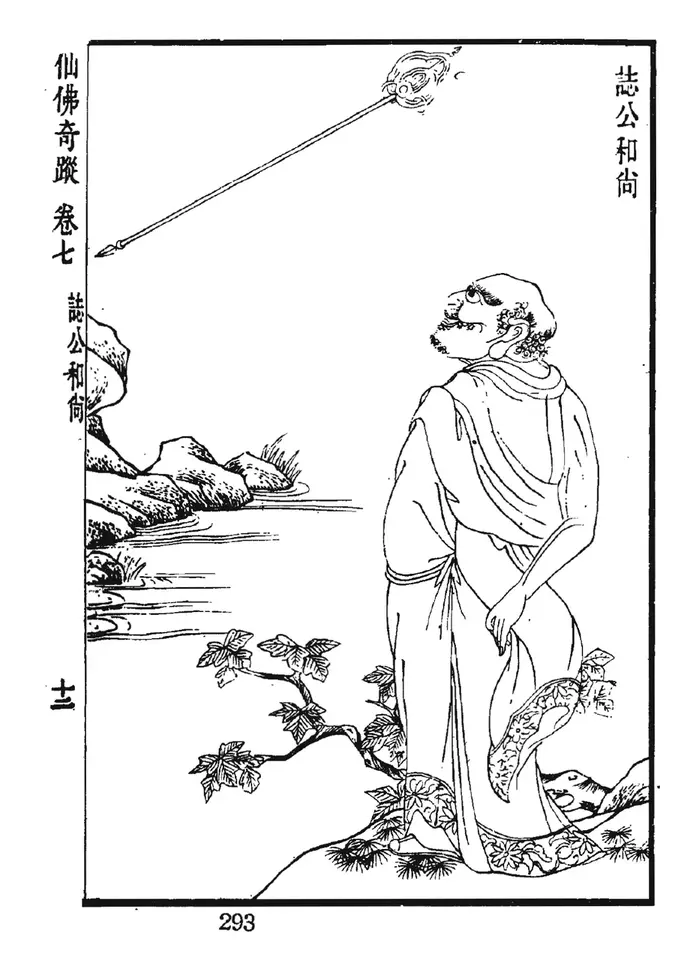
Baozhi (宝志, 418–514), secular surname Zhu, also written as Baozhi (保志) and respectfully known as Chan Master Zhigong or Master Bao, was a native of Jincheng Commandery (or Dongyang Town in Jurong, modern Nanjing). He was an illustrious thaumaturgic Buddhist master and philosophical teacher during the Southern Dynasties, serving as Imperial Preceptor to Emperor Wu of Liang and celebrated alongside Bodhidharma and Fu Dashi as one of the Three Great Masters of the Liang Dynasty. In his youth, Baozhi entered Daolin Monastery on Mount Zhong under the tutelage of Master Fajian, practicing Chan meditation for decades and mastering both monastic discipline and meditative absorption. From the early Taishi era of Southern Song, he began displaying unorthodox and wonder-working behavior, possessing no fixed residence, carrying a monk's staff hung with scissors, a bronze mirror, and colored ribbons, and walking barefoot through the bustling avenues of Jiankang. His utterances frequently took the form of prophetic verses that were verified by unfolding political events, winning the reverence of southern society. Emperor Wu of Southern Qi initially imprisoned him on charges of misleading the masses, but was moved by his miraculous omnipresence and his prescience regarding meal deliveries by Crown Prince Wenhui and Prince of Jingling, subsequently releasing and honoring him in Hualin Garden. When Xiao Yan founded the Liang dynasty, he lifted all imperial restrictions, revering Baozhi as Imperial Preceptor and consulting him on Buddhist philosophy and state governance. Baozhi consistently urged the emperor toward compassion, benevolence, and judicial restraint. In 514, Baozhi passed away peacefully without illness at the age of ninety-seven. Emperor Wu financed a lavish state funeral at Dulongfu on Mount Zhong, building Kaishan Monastery (predecessor of Linggu Monastery) over his tomb, with Lu Chui composing the epitaph and Wang Yun carving the stele. In 984, Emperor Taizong of Song posthumously honored him as Master Bao with the title Master of Daolin True Enlightenment.
Born into the Zhu family in Jincheng Commandery (or Jurong), displaying precocious wisdom.
Renounced secular life at age seven under Master Fajian at Daolin Monastery on Mount Zhong, mastering meditation and precepts.
Walked barefoot through Jiankang with long hair, carrying a staff hung with a mirror and scissors, offering accurate prophecies.
Fasted for days with radiant health, composing prophetic verses that attracted widespread reverence from gentry and commoners.
Imprisoned by Emperor Wu of Qi for alleged popular deception; displayed bilocation and predicted the crown prince's arrival, moving the emperor to house him in Hualin Garden.
Wandered in bundled winter rags and predicted bloodstains in the palace, foretelling the violent demise of Emperor Xiao Zhaoye.
Honored by Emperor Wu of Liang with unrestricted palace entry; consulted daily on Buddhist doctrine and administrative morals.
Recommended expounding the Srimala Sutra at Huaguang Hall during severe drought, bringing torrential rains with a basin of water and a knife.
Foretold his departure, handed a lit candle to palace guards, and passed away at age ninety-seven, interred at Mount Zhong (later honored as Master of Daolin True Enlightenment in 984).
Baozhi was born with the secular surname Zhu, his ancestral home recorded as Jincheng Commandery (in modern Gansu, or an emigre commandery in the Huai valley), while other sources state he was a native of Dongyang Town in Jurong (modern Qixia District, Nanjing). Details regarding his parentage are sparse, but historical accounts affirm his early spiritual inclination and detachment from secular ambitions. In 424, at the tender age of seven, he bade farewell to his family and entered Daolin Monastery, a renowned sanctuary upon Mount Zhong near the imperial capital Jiankang, where he received ordination under Master Fajian.
Following his novice training, Baozhi resided within the meditation cloisters of Daolin Monastery, immersing himself in Mahayana sutras and the rigorous discipline of samatha-vipasyana meditation for over fifty years. He observed the monastic code with uncompromising severity, braving winter freezes and summer heat while practicing continuous vigilance without lying down to sleep. In an era when Daolin Monastery stood as the preeminent meditation center of southern China, Baozhi cultivated a profound command of classical texts including the Lotus Sutra, the Mahaparinirvana Sutra, and the Vimalakirti Nirdesa Sutra, mastering the formless essence of liberation and establishing the spiritual foundation for his future engagement with imperial rulers.
During the early Taishi reign of Southern Song (465), when Baozhi was approaching fifty years of age, his outward behavior underwent a dramatic transformation. Abandoning regular monastic routines, he moved about without a permanent dwelling, ate at irregular hours, allowed his hair to grow several inches long, and walked barefoot through the busy streets of Jiankang in all seasons. He carried an iron staff adorned with a pair of scissors, a bronze mirror, and strips of colored silk, singing or weeping unpredictably along urban thoroughfares.
By the Jianyuan era of Southern Qi (479), his miraculous abilities became widely manifest. He would fast for days without displaying hunger or fatigue, his complexion remaining radiant. When conversing with people, his enigmatic phrases initially baffled listeners, but within months or years, every prediction was vindicated by historical events. His verses, composed in cryptic prophetic style, circulated widely among gentry and commoners alike, who revered him as a living divinity.
Following his accession, Emperor Wu of Qi (Xiao Ze) grew suspicious that Baozhi was beguiling the populace with occult arts, and ordered the magistrate of Jiankang to imprison him. The following morning, market vendors witnessed Baozhi walking freely through town, while jailers found him sitting quietly in his cell. Baozhi calmly informed the guards that two carriages bearing meals in golden bowls were arriving; moments later, Crown Prince Wenhui (Xiao Changmao) and Prince of Jingling (Xiao Ziliang) arrived at the prison in person to offer food and reverence.
Magistrate Lu Wenxian reported the incident to the throne. Astonished by his spiritual powers, Emperor Wu personally welcomed Baozhi into the imperial palace, housing him in the rear apartments of Hualin Garden with freedom of movement. When summoned to an imperial banquet in Hualin Garden, Baozhi arrived wearing three layers of cloth hats. Shortly thereafter, Emperor Wu died, followed by the brief reigns and violent depositions of Xiao Zhaoye and Xiao Zhaowen—three imperial successions within a single year, fulfilling the omen of the three hats.
Amid the dynastic collapse of Southern Qi, Xiao Yan raised troops at Xiangyang and marched downstream, founding the Southern Liang dynasty in 502 as Emperor Wu. Having long venerated Baozhi's spiritual stature, the new emperor issued an edict proclaiming that Master Baozhi moved through mundane dust while abiding in mystical transcendence, untouched by water or fire, fearless before serpents and tigers, his meditation beyond the comprehension of ordinary mortals. Emperor Wu granted Baozhi unrestricted access to the inner palace and forbade courtiers from impeding his movements.
Emperor Wu frequently hosted Baozhi at court, consulting him on doctrinal subtleties and royal governance. When the emperor inquired into the longevity of his reign, Baozhi smiled and replied, "Yuanjia, Yuanjia." Emperor Wu took this as an omen that his dynasty would endure twice as long as the thirty-year Yuanjia reign of Emperor Wen of Song. It was only during the Hou Jing rebellion in 548, when Emperor Wu starved to death in Taicheng at eighty-six—the exact lifespan of Emperor Wen—that contemporaries grasped the prophecy's grim precision.
In the winter of 506, severe drought afflicted Jiangdong, drying wells and parching farmland while official rain prayers failed. Baozhi advised Emperor Wu to expound the Srimala Sutra at Huaguang Hall to invoke rainfall. The emperor appointed Master Fayun to preach the text, and rain fell that very night. Baozhi further instructed that a basin of water topped with a knife be placed before the hall, unleashing torrential downpours that saturated hills and valleys, filling the populace with joy.
Baozhi exerted immense influence on Buddhist liturgy. Tradition holds that Emperor Wu's deceased consort, Empress Chi, had fallen into the lower realm of python spirits due to jealousy, appearing in the emperor's dreams to plead for deliverance. Deeply grieved, Emperor Wu commissioned Baozhi to gather scriptural passages and compile a ten-volume penitential ritual. Leading eminent monks in repentance rites, they liberated the empress to the Trayastrimsa Heaven. This ritual became the celebrated Repentance Ritual of Emperor Liang (Compassionate Bodhimanda Repentance), performed across centuries. Baozhi also established a hermitage at Mount Hua (modern Mount Baohua in Jurong), preaching the Mahayana precepts to monastic assemblies, inspiring later generations to rename the mountain Baohua.
In the winter of 514, while resting in the rear chambers of Taicheng, Baozhi turned to his attendants and remarked, "The Bodhisattva of former days must depart today." Monastic and lay followers wept upon hearing his words. Soon after, Baozhi passed away peacefully without illness, sitting upright with a radiant, lifelike expression and emitting fragrant perfumes. Prior to his passing, he handed a burning candle to the palace gatekeeper Wu Qing, who conveyed it to the emperor. Weeping over the news, Emperor Wu sighed that the master would no longer linger in the mundane world, and that the candle signified a request for the crown to arrange his burial.
Emperor Wu spent ten thousand ounces of gold from the palace treasury to conduct a lavish state burial at Dulongfu on Mount Zhong. The emperor erected Kaishan Monastery (the historical predecessor of Linggu Monastery) beside the tumulus, crowning the tomb with a five-story wooden pagoda. Literary courtiers Lu Chui and Wang Yun were commanded to author the epitaph and carve the commemorative stele, while court master painter Zhang Sengyao was commissioned to paint his likeness. Tradition records that as Zhang raised his brush, Baozhi touched his own forehead, causing his skin to open and reveal the golden, radiant countenance of the Eleven-Headed Avalokitesvara, leaving the painter awestruck and unable to capture the divine visage.
From his initial manifestation of thaumaturgic acts to his passing in late Tianjian, Baozhi traveled through Jiangdong for fifty years, living to ninety-seven. In 984, Emperor Taizong of Song posthumously created him Master Bao and granted him the title Master of Daolin True Enlightenment. In the Qing dynasty, an iron casket discovered in the pagoda of Grand Bao'en Monastery in Nanjing revealed the Illustration of Baozhi Expounding Precepts, proving that Baozhi had erected ordination platforms over 130 years before Dao Xuan did in the Tang dynasty. Chan traditions revere Baozhi alongside Fu Dashi as paramount thaumaturgic bodhisattvas, while folk traditions celebrate him as a protective manifestation of Avalokitesvara.
Baozhi played a transformative role in shifting Southern Dynasties Buddhism from abstract metaphysical inquiry toward contemplative practice and ritual repentance. Emphasizing the unity of calm meditation and analytical wisdom, he spent fifty years in monastic seclusion at Daolin Monastery before deploying skillful thaumaturgic means to awaken the public. Collaborating with Master Fayun, he established the Compassionate Bodhimanda Repentance (Repentance Ritual of Emperor Liang), creating a comprehensive liturgical framework of confession and universal liberation that became the most widely practiced repentance ceremony in East Asian Buddhism.
In monastic discipline, he founded cloisters and expounded the bodhisattva precepts at Mount Baohua. The archaeological discovery of the Illustration of Baozhi Expounding Precepts from Grand Bao'en Monastery confirms his pioneering role in constructing tiered ordination platforms, cementing Mount Baohua's historical status as the premier ancestral sanctuary of the Vinaya school in China.
Holding the revered status of Imperial Preceptor, Baozhi exercised profound moral authority over Emperor Wu of Liang, directing the monarch away from hollow ostentation toward compassionate, pragmatic governance. He consistently cautioned the emperor to govern through benevolence, lighten penal sentences, and alleviate popular burdens.
He relieved catastrophic droughts through the recitation of the Srimala Sutra, forewarned the throne of political instability through prescient verses, and checked imperial hubris through karmic teachings. In the prisons of Southern Qi and the halls of Liang, he deployed spiritual transcendence to restrain sovereign excess, earning praise from dynastic historians as a sage counselor who corrected imperial faults.
Baozhi's spiritual activities were concentrated around Jiankang (modern Nanjing), Jurong, and Yangzhou. Beginning his career at Daolin Monastery on Mount Zhong, he frequented Waguan, Longguang, and Xinghuang monasteries, as well as the imperial compounds of Hualin Garden and Taicheng. He founded the spiritual retreat at Mount Baohua in Jurong, and was laid to rest at Dulongfu on Mount Zhong, witnessing the transition across Song, Qi, and Liang.
Baozhi interacted extensively with royal houses, scholar-officials, and monastic leaders. Under Southern Qi, Crown Prince Wenhui and Prince of Jingling Xiao Ziliang provided him with food and patronage; under Liang, Emperor Wu and Crown Prince Zhaoming attended his lectures regularly. Celebrated literati including Shen Yue, Jiang Yan, Lu Chui, and Wang Yun admired his eloquence and spiritual insight. In the sangha, he engaged in doctrinal debates with prominent scholars Fayun and Baoliang, while legendary accounts record his philosophical encounters with Bodhidharma upon the patriarch's arrival in Jinling.
FIGURES ASSOCIATED WITH THIS DYNASTY