Birth in Qiongzhou
Born in Qiongshan, Qiongzhou, on the 15th day of the 3rd lunar month, originally named Ge Changgeng.
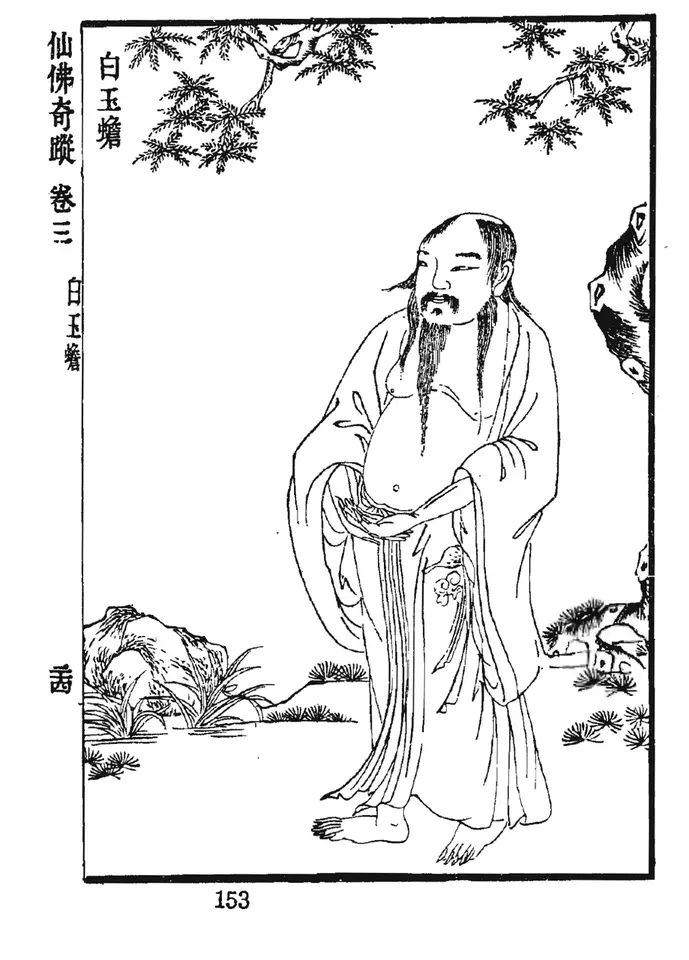
白玉蟾
Bai Yuchan (白玉蟾, 1194–1229 CE, alternative tradition 1134–1229 CE), original name Ge Changgeng (葛长庚), courtesy names Baisou (白叟) and Ruhui (如晦), art names Haiqiongzi (海琼子), Qiongshan Daoren (琼山道人), and Hainan Weng (海南翁), was a native of Qiongshan, Qiongzhou (modern Haikou, Hainan), tracing his ancestral lineage to Minqing, Fujian. He was an eminent Daoist master, philosopher, poet, and calligraphic…
Bai Yuchan (白玉蟾, 1194–1229 CE, alternative tradition 1134–1229 CE), original name Ge Changgeng (葛长庚), courtesy names Baisou (白叟) and Ruhui (如晦), art names Haiqiongzi (海琼子), Qiongshan Daoren (琼山道人), and Hainan Weng (海南翁), was a native of Qiongshan, Qiongzhou (modern Haikou, Hainan), tracing his ancestral lineage to Minqing, Fujian. He was an eminent Daoist master, philosopher, poet, and calligraphic artist of the Southern Song dynasty. He is revered as the Fifth Patriarch of the Daoist Internal Alchemy Southern Lineage (Jindan Pai Nanzong) and is universally recognized as the institutional founding father who transformed the Southern Lineage from an esoteric master-disciple tradition into an open, nationwide clerical order. Endowed with exceptional intellectual brilliance from early youth, Bai Yuchan mastered the Confucian classics, historical treatises, and literary composition under the tutelage of his scholar-grandfather. At age twelve, he sat for the imperial Child Examination in Qiongzhou; when commanded to compose a poem on a textile loom, he produced an expansive verse embracing the entire cosmos, but the orthodox examiners deemed it excessively proud and disqualified him. Disillusioned with bureaucratic civil examinations, he abandoned worldly aspirations to seek eternal transcendence. At age sixteen, he entered the Daoist life, cultivating respiratory and meditative arts amidst the remote caves of Mount Limu and Mount Songlin on Hainan Island. Crossing the treacherous Qiongzhou Strait alone with only a broken umbrella, Bai Yuchan undertook an arduous pilgrimage across thousands of miles throughout southern and central China. In eastern Zhejiang, he encountered Chen Nan (Master Niwan), the Fourth Patriarch of the Southern Lineage, who accepted him as an intimate disciple at Mount Luofu in Guangdong and transmitted to him the innermost secrets of the Golden Elixir and Shenxiao Thunder Rites. After overcoming internal alchemical crises with extraordinary perseverance, Bai Yuchan achieved complete mastery of internal alchemical cultivation. Institutionally, Bai Yuchan broke with the century-long practice of esoteric solitary cultivation. Taking up residence at Zhizhi Hermitage on Mount Wuyi in Fujian, he established the Ziyang Sect, structured a decentralized clerical governance system centered on local shrines (jing), and openly ordained literati disciples, including Peng Si and Liu Yuanzhang. Philosophically, he championed the synthesis of the Three Teachings, integrating Confucian moral self-cultivation, Chan Buddhist sudden enlightenment, and Daoist inner alchemy into a holistic practice of "dual cultivation of nature and life-force" (xingming shuangxiu). He reinterpreted Thunder Magic as the spontaneous resonance of personal vital energy rather than external sorcery, elevating Daoist ritual into a sophisticated philosophy of mind. A supreme poet and calligrapher whose works opened new paths for late imperial wild cursive script, Bai Yuchan remains a towering cultural giant in Chinese intellectual and religious history.
Born in Qiongshan, Qiongzhou, on the 15th day of the 3rd lunar month, originally named Ge Changgeng.
Sat for the Child Examination at age twelve; composed the magnificent Loom Poem, but examiners rejected him for alleged arrogance.
Formally renounced secular pursuits at age sixteen, cultivating ascetic breath regulation in rock grottos on Mount Limu and Mount Songlin.
Journeyed across the Qiongzhou Strait to the mainland carrying only a broken umbrella; endured severe poverty while traveling sacred mountains.
Met Chen Nan in eastern Zhejiang; traveled to Mount Luofu to receive transmission of the Golden Elixir knife-spoon formula and Shenxiao Thunder Rites.
Arrived at Mount Wuyi in Fujian, gathering Daoist companions to discuss alchemical mysteries and composing the celebrated Account of the Cloud Nest.
Invited by the recluse Zhan Yanfu to assume the abbotship of Zhizhi Hermitage and Chongyou Temple, establishing his spiritual headquarters.
Initiated prominent literati disciples including Peng Si; established the jing shrine network, dramatically expanding the Southern Lineage.
Officiated over imperial sacrificial liturgies at Yulong Palace in Xishan and Ruiqing Palace on Mount Jiugong, declining subsequent imperial court summons.
Traveled to Lin'an to submit an imperial memorial urging defense reforms; faced political obstruction from corrupt chancellor factions and retreated to the mountains.
Transcended mortality during winter along the Xu River in Jiangxi at age thirty-six (according to primary disciple records).
Bai Yuchan was born Ge Changgeng into a family of scholarly heritage tracing its origins to Minqing in Fuzhou. His grandfather, Ge Youxing, served as an educational official in Qiongzhou, relocating the family south across the sea to Hainan Island. On the fifteenth day of the third lunar month in 1194 CE (the fifth year of the Shaoxi era under Emperor Guangzong; an alternative tradition places his birth in 1134 CE), Ge Changgeng was born in Wuyuan, Qiongshan. His father, Ge Zhenye, died prematurely while Changgeng was still a tender infant. Driven by destitute economic circumstances, his mother remarried into a Bai family of Chengmai, and the youth took his stepfather's surname, adopting the personal name Yuchan (Jade Toad) and courtesy names Baisou and Ruhui, later styling himself Haiqiongzi (The Pearl of the Southern Seas) and Qiongshan Daoren (The Daoist of Mount Qiong).
Raised in the maritime environment of Hainan, Bai Yuchan demonstrated extraordinary intellectual faculties from early childhood. Under his grandfather's guidance, he read the Confucian classics, Dynastic Histories, and philosophical treatises with total recall, composing accomplished poetry before adolescence. The Song imperial court maintained the Child Examination (tongzi ke) for candidates under age fifteen who displayed mastery of classical treatises and poetic composition, granting successful candidates direct metropolitan rank and official appointment.
In 1205 CE (the first year of the Kaixi era), the twelve-year-old Bai Yuchan was presented for the examination in Qiongshan. The chief examiner instructed him to compose a verse on the spot based on a weaver's loom. Without hesitation, Bai Yuchan seized a brush and wrote: "The vast mountains and rivers serve as the loom, / A hundred flowers like brocade and willows like silk; / In the empty azure space a fabric is woven, / As the twin shuttles of sun and moon fly across the heavenly vault." The verse displayed astonishing metaphysical scale, envisioning the cosmos itself as a textile loom. However, the rigid and pedantic examiner regarded such sweeping metaphors as brazenly haughty and insolent, refusing to pass him and rebuking him sharply before the assembly.
This harsh bureaucratic rejection delivered a profound psychological shock to the precocious youth. Witnessing the pettiness of the civil service system, Bai Yuchan lamented in his Autumn Night Rhapsody: "A thousand-league steed exists beneath heaven, / Yet alas, there is no Wang Liang to guide its reins!" He immediately severed all desires for mundane bureaucratic honors, resolving instead to seek the imperishable realm of spiritual liberation and physical transcendence.
In 1209 CE (the second year of the Jiading era, at age sixteen), Bai Yuchan formally renounced secular kinship ties and took Daoist monastic vows. He first entered the pristine rainforests of Mount Limu in central Hainan to seek reclusive immortals. Finding no master capable of answering his deepest metaphysical inquiries, he retreated to Mount Songlin (also known as Mount Dan'er), located twenty leagues northeast of Danzhou. Mount Songlin rose eighty rods in height, crowned by a natural stone chamber named the Bowang Terrace that measured ten feet tall, while below the northern crags lay the expansive North Rock Cave.
Within this sheltered limestone grotto, Bai Yuchan constructed a thatched hut and dwelt in profound solitary contemplation. Upon the mountain summit, he manually dug a well to draw clean water for inner meditative cultivation. Over several years, he subsisted upon vaporous breath circulation and wild herbs, exploring ancient methods of inner embryonic breathing and seasonal fire phasing, capturing his spiritual state in lines such as: "Upon the boughs the red plum blossoms mature, / At the beak's edge yellow fledgling swallows learn to take flight." Local villagers marveled at his ascetic rigor and posthumously erected a shrine within the rock crevices to venerate him as the White-Robed Lord (Baiyi Gong).
Recognizing that Hainan Island stood at the extreme southern periphery of the empire and that the profoundest textual traditions and living patriarchs dwelled amidst the famed mountains of mainland China, Bai Yuchan resolved to embark upon a continental pilgrimage.
In 1210 CE, the young ascetic crossed the stormy waters of the Qiongzhou Strait. He carried no baggage save a ragged oiled umbrella and three hundred copper coins, walking barefoot without straw sandals or rain gear. Upon reaching Luoyuan County in Fujian, impoverished and lacking food, he offered himself as a manual domestic servant in Xingfu Buddhist Monastery, fetching water and chopping firewood in exchange for coarse gruel. Yet his spiritual determination was unyielding; within a fortnight, he departed the monastery to resume his northern march.
Over subsequent years, Bai Yuchan traversed Guangdong, Jiangxi, Fujian, Zhejiang, Hunan, Hubei, Sichuan, and Guangxi. He ascended Mount Wudang to examine talismanic registers, climbed Mount Tiantai, explored the grottos of Mount Huotong, visited Mount Longhu, and entered Mount Qingcheng in Sichuan, where an enigmatic elder transmitted to him the esoteric commentary of the Scripture of Salvation (Duren Jing). Along his journey, he walked under scorching summer heat until his soles blistered and bled, and sheltered under dripping eaves in freezing autumn storms where intolerant villagers drove him away. Through all humiliations, he remained serene, recording: "When hunger strikes I eat, when fatigue arrives I sleep."
In eastern Zhejiang, Bai Yuchan met the wandering master Chen Nan (known as Master Niwan), the Fourth Patriarch of the Daoist Internal Alchemy Southern Lineage. Chen Nan recognized Bai Yuchan's extraordinary physical endowment and spiritual purity, bringing him to his retreat at Mount Luofu in Guangdong. There, Chen Nan transmitted the core formula of the Great Ultimate knife-spoon elixir (taiyi daogui) and the secret Thunder Rites of the Shenxiao tradition. Bai Yuchan meditated intensely in a mountain shelter, quickly grasping the essence of the teachings. To temper his character, Chen Nan dispatched him on another extensive itinerant tour, saying: "Only through enduring manifold worldly trials can a scholar bear the weight of the Great Dao; seek diligently outside for some years, and I shall await you here."
Returning to Mount Luofu after years of wandering, Bai Yuchan demonstrated refined spiritual attainment. Chen Nan expounded to him the Treatise on the Convergence of the Great Dao into Unity, detailing the fire-phasing sequence of embryonic transformation, and bestowed upon him the Secret Formula for Preserving Life. During his subsequent solitary retreats, Bai Yuchan experienced a catastrophic internal alchemical crisis when improper thermal regulation caused his volatile elixir to disperse. Rather than falling into despair, he meticulously studied Zhang Boduan's Four Hundred Words on the Golden Elixir, resolved the intricate dynamics of bathing and protective regulation, and ultimately brought his internal elixir to complete spiritual crystallization.
In 1213 CE (the sixth year of the Jiading era), Chen Nan underwent mortal dissolution in Linzhang, leaving Bai Yuchan as the sole bearer of the Southern Lineage patriarchate. Since its initial founding by Zhang Boduan in the eleventh century, the Southern Lineage had maintained an intensely secretive, solitary master-disciple mode of transmission through Shi Tai, Xue Shi, and Chen Nan. It possessed neither communal monastic temples nor established public congregations.
Bai Yuchan perceived that in an era marked by Mongol threats, Jurchen invasions, and widespread spiritual yearning among the southern literati, maintaining an isolated, hermetic tradition risked the extinction of its profound insights. In the autumn of 1215 CE, he traveled to Mount Wuyi in northwestern Fujian, gathering Daoist associates Hong Zhichang, Chen Shoumo, and Tang Jirui by the Nine-Bend Stream to expound metaphysical doctrine, recording their encounters in his famous prose essay Account of the Cloud Nest (Yunwo Ji).
In 1216 CE, the prominent Mount Wuyi recluse Zhan Yanfu funded the reconstruction of Zhizhi Hermitage and, holding Bai Yuchan in profound reverence, invited him to become its permanent abbot. Bai Yuchan assumed leadership over Zhizhi Hermitage and the adjacent Chongyou Temple, formally establishing the "Ziyang Sect" in honor of First Patriarch Zhang Boduan.
From this base, Bai Yuchan inaugurated an open clerical system. Adapting the ancient twenty-four administrative parishes (zhi) of Celestial Master Daoism, he created a network of local Daoist shrines known as jing (quarries of silence), establishing the Crane Forest Shrine (Helin Jing), the Purple Radiance Shrine (Ziguang Jing), and the Green Calyx Shrine (Bizhi Jing). These shrines served as localized centers where literati disciples practiced internal meditation, recited scriptures, and received formal ordination. Prominent scholars and state officials, including Peng Si, Liu Yuanzhang, Zhao Ruqu, Ye Guxi, and Chen Shoumo, flocked to his altar to accept initiation. Disciples recorded that he "trod across rivers and lakes, his renown filling the world, while those following him were as thick as autumn hair," transforming the Southern Lineage into a major nationwide religious movement.
Bai Yuchan's extraordinary spiritual presence attracted wide imperial attention. In the spring of 1218 CE (the eleventh year of the Jiading era), he traveled to the Western Hills of Nanchang in Jiangxi, where Emperor Ningzong had dispatched court emissaries bearing palace incense to celebrate a national state liturgy (guojiao) at Yulong Wanshou Palace. Regional magistrates and imperial messengers urged Bai Yuchan to mount the ceremonial dais and preside over the rituals. His serene demeanor and immaculate liturgical performance drew immense crowds, with onlookers packed tightly like living walls. Shortly thereafter, during severe regional droughts, officials invited him to preside over rain-praying liturgies at Ruiqing Palace on Mount Jiugong. Bai Yuchan executed Shenxiao thunder invocations, and torrential rain promptly ended the famine. Emperor Ningzong issued an imperial edict summoning him to the imperial capital, but Bai Yuchan declined royal patronage and quietly slipped away into the mountains.
Despite his transcendence of mundane power, Bai Yuchan remained deeply concerned for popular welfare. In the late Jiading era, corrupt chancellor Shi Miyuan dominated the Southern Song court, fostering bureaucratic venality while northern borders deteriorated. In 1222 CE (the fifteenth year of the Jiading era), appalled by state decay, Bai Yuchan marched directly to the imperial palace gates in Lin'an (modern Hangzhou) to submit an urgent imperial memorial (fuque shangshu), diagnosing critical frontier vulnerabilities, fiscal extortion, and administrative abuses. His courageous memorial was intercepted and suppressed by court sycophants, and he narrowly evaded political imprisonment.
Grieved by imperial indifference, Bai Yuchan penned fierce satirical indictments of aristocratic corruption: "Mountains and rivers languish as trees and grasses wither; / Yet those living in heavenly mansions plead their hardships!" Shaking the dust from his garments, he abandoned the capital, dedicating his remaining days to traveling through Jiangxi and Zhejiang, dispensing medicinal remedies and talismans to relieve distressed commoners.
From 1223 CE onward, Bai Yuchan traveled primarily through Jiangxi, visiting Linjiang, Linchuan, the Xu River basin, and Yujiang. In his final years, he focused intensely on guiding senior disciples Peng Si and Liu Yuanzhang in compiling and collating the extensive corpus of Southern Lineage scriptures, liturgical treatises, and alchemical poems.
Historical sources record differing traditions regarding the year and locale of his departure. According to the earliest and most authoritative contemporary record—the preface to the Collected Works of Master Haiqiong Yuchan compiled by his chief disciple Peng Si in 1241 CE, corroborated by Yuan dynasty historian Zhao Daoyi's Comprehensive Mirror of Immortals—Bai Yuchan departed this life during the winter of 1229 CE (the second year of the Shaoding era under Emperor Lizong) along the banks of the Xu River in Jiangxi at the age of thirty-six. Zhao Daoyi explicitly refuted secular rumors of premature death, maintaining that Bai Yuchan achieved divine dissolution (shijie).
A second prominent tradition, emerging in late Ming local gazetteers and promoted by eighteenth-century Daoist Peng Zhu, asserted that he lived from 1134 to 1229 CE, attaining an age of ninety-six years. A third popular legend in Hainan maintains that he returned to his native island in his advanced years and ascended into immortality from the Immortal Flight Cliff (Feixian Ya) atop Mount Wenbi in Ding'an. Regardless of chronological variations, his immense textual and spiritual legacy established him as one of the most brilliant luminaries in Chinese Daoist history.
Bai Yuchan's most significant historical contribution to Chinese Daoism was his transformation of the Southern Lineage from an unorganized, subterranean master-disciple tradition into an institutionalized, public religious order.
Prior to his ministry, the predecessors of the Southern Lineage—Zhang Boduan, Shi Tai, Xue Shi, and Chen Nan—operated as private practitioners who transmitted alchemical secrets to single individuals without founding monasteries or drafting public ordinations. This lack of institutional infrastructure left the lineage highly vulnerable to fragmentation.
Bai Yuchan transformed Zhizhi Hermitage and Chongyou Temple on Mount Wuyi into the permanent liturgical headquarters of the Ziyang Sect. To organize his rapidly expanding congregation, he established the jing shrine network, dividing southern administrative regions into structured spiritual parishes such as the Crane Forest Shrine and Purple Radiance Shrine. Each shrine maintained precise liturgical registers, meditative guidelines, and moral compacts. By actively recruiting educated scholar-officials and integrating Daoist theology with Song elite culture, Bai Yuchan created an intellectualized religious establishment that rivaled the northern Quanzhen order founded by Wang Chongyang, earning him the consensus recognition among modern intellectual historians as the true institutional creator of Daoist Southern Lineage.
In the realm of religious philosophy, Bai Yuchan accomplished an unprecedented synthesis of Confucian moral metaphysics, Chan Buddhist epistemology, and Daoist physical cultivation, articulating a comprehensive doctrine of "dual cultivation of nature and life-force" (xingming shuangxiu).
Bai Yuchan advocated that an adept must "comprehend the Three Teachings and master the Nine Schools." In his natural philosophy, he formulated a proto-materialist cosmology of "Chaotic Infinitude" (hundun wuji). In his Commentary on the Daodejing (Daode Baozhang Zhu), he argued that the natural cosmos operates according to inherent, unalterable laws independent of personal deities: "The great creation is silent: winds whistle of themselves, the earth murmurs of itself; in winter ice thaws naturally, in spring grasses sprout spontaneously." Human cultivation must align with objective seasonal and energetic cycles rather than superstitious contrivance.
In epistemology, Bai Yuchan explicitly rejected claims of innate mystical illumination, advancing an empirical doctrine of "knowledge acquired through learning" (xue er zhi zhi). In his Daily Records (Riyong Ji), he stressed that spiritual insight arises from rigorous lifelong study, keen observation, and unwavering mental concentration. Adopting the Neo-Confucian principle of "reverent mindfulness" (jingshen), he declared: "Reverence and caution penetrate heaven and earth; humans should regard themselves as potential sages, for under heaven there has never been an immortal who was not first a moral sage." Simultaneously, he absorbed Chan Buddhist sudden enlightenment, rejecting external mechanical scriptures in favor of illuminating the primordial mind: "A single phrase penetrates the mysterious; why waste ten thousand scrolls of alchemical texts?"
In liturgical ritual, Bai Yuchan executed a revolutionary reform by fully integrating external Shenxiao Thunder Rites (leifa) with internal alchemical self-cultivation.
Throughout the Northern and Southern Song periods, practitioners of popular Thunder Magic frequently degenerated into superstitious exorcisms, relying upon talismanic paper and theatrical hand gestures. Bai Yuchan reinterpreted Thunder Magic as the external deployment of internally cultivated vital energy (qi). He posited that the human body is a microcosm of heaven and earth, and that the interaction of yin and yang within the human organs generates authentic cosmic thunder.
He instituted the supreme liturgical maxim: "Internal cultivation produces the elixir; external application produces the rite" (neilian chengdan, waiyong chengfa). Without cultivating the pure golden elixir of vital essence, energy, and spirit within, drawing paper talismans was completely hollow. By anchoring magical ritual firmly within psycho-physical cultivation and moral sincerity, Bai Yuchan cleansed Song ritualism of shamanistic vulgarity, bequeathing an alchemical-liturgical framework that profoundly influenced late imperial Daoist movements, including the Qingwei and Zhengyi lineages.
Bai Yuchan was an extraordinarily prolific scholar whose writings encompass philosophical commentaries, liturgical handbooks, and poetic anthologies.
His Commentary on the Precious Chapter of the Daodejing (Daode Baozhang Zhu) offered a lucid, elegant interpretation of Laozi's eighty-one chapters, celebrated for stripping away convoluted scholasticism; it was subsequently preserved in the official Ming dynasty Daoist Canon (Zhengtong Daozang). His extensive discourses were compiled by disciples into monumental collections, including the Sayings of True Master Bai of Haiqiong (Haiqiong Bai Zhenjun Yulu), Collected Works of Master Haiqiong Yuchan (Haiqiong Yuchan Xiansheng Wenji), and Essential Guidelines for Alchemical Restoration Across Nine Heavens. Furthermore, Bai Yuchan systematized dynamic physical regimens, formulating the renowned "Yuchan Qigong" exercises, which remain celebrated in traditional Chinese therapeutic physical culture.
Beyond his religious achievements, Bai Yuchan achieved enduring renown in Chinese art history as a master of poetry, calligraphy, and ink painting.
In poetry, he inherited the romantic, transcendent vigor of Li Bai and Qu Yuan, praised by critics for combining celestial elevation with muscular emotional force. His verse Early Spring (Zaochun) was selected for the canonical anthology Poems of a Thousand Masters (Qianjia Shi), recited across generations. His prose essay Account of the Orange Recluse (Juyin Ji) demonstrated astonishing classical erudition, weaving historical anecdotes of filial piety into a profound allegorical defense of reclusion. Throughout his itinerant life, he maintained an ardent love for his native Hainan, frequently styling himself "The Old Man of Hainan" and writing poignant poems longing for his tropical homeland while passionately decrying the social misery of war-torn agrarian peasants.
In calligraphy, Bai Yuchan was one of the preeminent virtuosos of the Southern Song period. He mastered all four script types: his standard script blended the structural majesty of Yan Zhenqing and Liu Gongquan with the antique grace of the Six Dynasties Epitaph on a Crane; his wild cursive script reached supreme heights, dynamic and kinetic like coiling dragons, directly prefiguring the expressive cursive masterpieces of Ming masters Zhu Yunming and Xu Wei. Surviving masterpieces, including the cursive Clear and Resonant Air Poem (Tianlang Qiqing Shi Tie, National Palace Museum, Taipei), standard script Six Poems on Hermit Lu Peak (Shanghai Museum), and running-cursive Inscription for the Foot-Pavilion (Zuxuan Ming, Palace Museum, Beijing), are designated Grade-One National Cultural Treasures. In ink painting, his expressive, spontaneous depictions of plum blossoms, bamboo, and self-portraits pioneered new aesthetic horizons for Song spiritual art.
FIGURES ASSOCIATED WITH THIS DYNASTY