Biography
Ancestral Lineage and Displaced Youth
Bai Xingjian was born in 776 in Xinzheng, Henan. His ancestral home was located in Xiagui (modern Weinan, Shaanxi), and his father, Bai Jigeng, held office as Vice Prefect of Xiangzhou. Bai Xingjian was the third son in his family, four years younger than his famous brother Bai Juyi. Growing up during the chaotic rebellions of autonomous regional garrisons across northern China, the family was forced to relocate repeatedly between Xingyang, Fuli in Suzhou, Xiangyang, and the coastal Yue region.
Educated in classical historiography and poetry by his scholarly family, Bai Xingjian exhibited exceptional intellectual acuity under the tutelage of his elder brother. In 794, his father Bai Jigeng died in office, casting the household into financial distress. Bai Juyi and Bai Xingjian maintained an inseparable brotherly bond through years of hardship. In 800, Bai Xingjian sat for the imperial examination in Chang'an for the first time, but was unsuccessful amid fierce competition.
Examination Success and Service in Sichuan
Undeterred by failure, Bai Xingjian returned to his studies, refining his mastery of parallel prose and regulated rhapsody. In 807, he sat for the examinations once more and secured his jinshi degree, formally launching his career within the Tang civil bureaucracy. In 808, he was appointed Collator in the Palace Library, sharing living quarters with Bai Juyi in the Xinchang ward of Chang'an. Immersed in rare manuscripts held in the imperial archives, his literary reputation expanded rapidly. In the spring of 809, he accompanied Bai Juyi and scholar Li Jian on excursions along the Qujiang Pool, composing during this period his celebrated psycho-narrative treatise Record of Three Dreams.
In 811, his mother Lady Chen passed away. Observing traditional filial piety, Bai Xingjian relinquished his post to observe mourning for three years in a simple cottage at Xiagui. In 813, senior minister Lu Tan was appointed Military Commissioner of Eastern Jiannan. In 814, upon concluding his mourning rituals, Bai Xingjian answered Lu Tan's invitation to travel into Sichuan, joining the military staff at Zizhou as Administrative Secretary. Over several years of service, Bai Xingjian managed official memorials, military correspondence, and legal documentation with consummate precision, earning the deep trust of Commissioner Lu.
The Yiling Gathering and Sanyou Cave Inscriptions
In 817, Military Commissioner Lu Tan passed away, prompting Bai Xingjian to depart Sichuan and journey eastward along the Yangtze to reunite with Bai Juyi, who was then serving in exile as Marshal of Jiangzhou. In late 818, Bai Juyi was reassigned as Prefect of Zhongzhou, and Bai Xingjian accompanied him up the Yangtze Gorges toward his new provincial assignment.
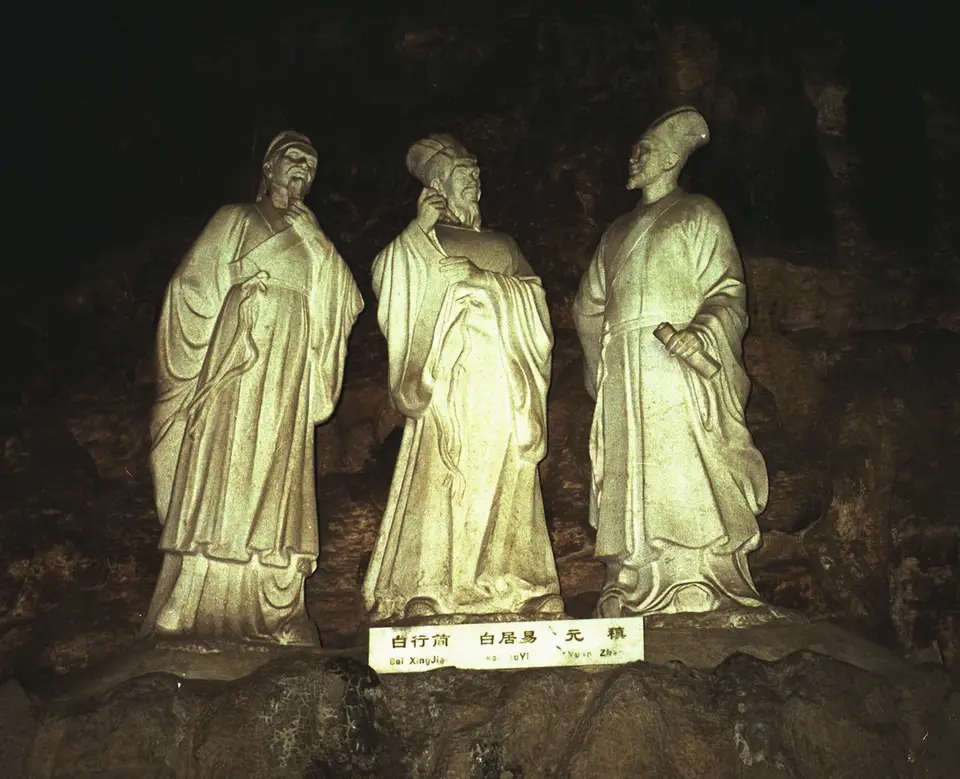
In March 819, the brothers' vessel arrived at Yiling in Xiazhou (modern Yichang, Hubei), where they encountered their close friend Yuan Zhen, who was traveling eastward after completing his tenure as Marshal of Tongzhou. Overjoyed by the chance reunion, the trio halted their journeys to explore the scenic gorges together for three days. Ten miles west of Yiling at the entrance of Huangniu Gorge, they discovered a secluded, dramatic karst cave overlooking the river. They celebrated with wine inside the cavern by candlelight, and at Yuan Zhen's suggestion, each composed a twenty-rhyme classical poem inscribed directly onto the limestone walls, accompanied by Bai Juyi's immortal preface The Sanyou Cave Preface, which christened the formation "Three Travelers Cave." The event became one of the most celebrated literary excursions in imperial history. Continuing westward, Bai Xingjian reached Zhongzhou in late March, where he authored the landscape verse Gazing at the Southern Mountains of the Commandery.
Metropolitan Auditing and Rhapsody Mastery
In 820, following the accession of Emperor Muzong, Bai Juyi was recalled to the central court as Director of the Bureau of Receptions and Drafter of Edicts. In 821, Bai Xingjian was summoned to Chang'an and appointed Left Rectifier of Omissions, charged with submitting frank admonitions to the throne. Diligent and unyielding before powerful factions, he was transferred in 823 to Vice Director of the Bureau of Gates.
In 824, Bai Xingjian was elevated to Vice Director of the Bureau of Public Revenues, supervising state fiscal disbursements. When military officers at the strategic Zhenwu frontier garrison accused their commander Heba Zhi of concealing and falsifying acreage records on state military colonies (yingtian) to embezzle troop provisions, the court dispatched Bai Xingjian as Imperial Commissioner to inspect the northern perimeter. Defying intimidation by frontier commanders, Bai Xingjian conducted meticulous field measurements and audited grain ledgers, exposing a massive network of corruption orchestrated by Heba Zhi. Cornered by the irrefutable evidence, Heba Zhi committed suicide by poison. Bai Xingjian's courage in cleaning up frontier military administration garnered wide acclaim at court. That same year, he composed his enduring narrative masterpiece The Tale of Li Wa.
Final Appointments and Posthumous Legacy
In 825, under Emperor Jingzong, Bai Xingjian was appointed Grand Master for Court Dispersion and Director of the Bureau of Receptions. At this time, Bai Juyi was serving as Prefect of Suzhou, prompting frequent expressions of separation anxiety, including the deeply moving poem Dreaming of Xingjian. In 826, Bai Xingjian was reassigned as Director of the Bureau of Provisions. That winter, worn down by rigorous official responsibilities, he succumbed to illness in his Chang'an residence at the age of fifty-one.
Upon receiving the tragic news, Bai Juyi was devastated, composing heartfelt sacrificial elegies mourning his beloved brother and personally supervising the transport of his coffin to the family cemetery in Xiagui. Bai Xingjian had been a prolific writer throughout his life, with the Old Book of Tang recording an eleven-volume collected works. During his period of mourning, Bai Juyi painstakingly gathered and edited all surviving manuscripts of his deceased sibling, publishing them as the twenty-volume Collected Works of Director Bai (Bai Langzhong Ji), ensuring that his exquisite rhapsodies, official memorials, and narrative prose were preserved for posterity.
Major Achievements
Pioneering Classical Fiction with The Tale of Li Wa
Bai Xingjian's foremost contribution to Chinese literary history was his authoring of The Tale of Li Wa, recognized as a supreme masterpiece of Tang dynasty chuanqi romance. The narrative recounts the journey of scholar Zheng of Xingyang, who falls passionately in love with the famed Chang'an courtesan Li Wa, squanders his wealth, is abandoned to become a destitute singer of dirges, and is beaten nearly to death by his enraged father. Rescued and nursed back to health by Li Wa, who sternly urges him to pursue scholarship, Zheng achieves the highest honors in the civil service examinations, culminating in their marriage and public redemption. Bai Xingjian departed radically from conventional didacticism, portraying an underprivileged female entertainer with moral nobility, emotional independence, and psychological complexity. Celebrated by modern writer Lu Xun as "tender and captivating," the work directly inspired Yuan dynasty zaju dramas and the classic Ming dynasty play The Embroidered Jacket (Xiu Ru Ji).
Philosophical Narrative in Record of Three Dreams
Composed in 809, Bai Xingjian's Record of Three Dreams represents a pioneering investigation into the interplay of subconscious dream phenomena and external reality. Structured into three thematic case studies—a traveler who dreams of visiting home while his family simultaneously observes his spectral arrival, a sedentary person dreaming of an excursion where friends encounter him, and two individuals who experience identical dreams—the work combines rigorous analytical argumentation with imaginative prose. Bai Xingjian established a profound philosophical template for the exploration of subjective consciousness that shaped the development of subsequent Tang and Song anomaly accounts.
Leading Figure of the Exquisite School of Regulated Rhapsody
Following the mid-eighth century, the imperial civil examinations elevated regulated rhapsody (lüfu) to a mandatory criterion for assessing jinshi candidates, sparking a renaissance in parallel prose composition. Bai Xingjian was honored alongside Li Cheng, Wang Qi, Bai Juyi, and Zhang Zhongsu as one of the "Five Great Masters of Mid-Tang Rhapsody," serving as the prime exemplar of the "clear and exquisite" school. His eighteen surviving rhapsodies preserved in the Complete Tang Prose, including Rhapsody on the Crescent Moon Mistakenly Startling the Fish and Rhapsody on the Pining Wife Turning to Stone, are celebrated for their delicate natural observation, metrical perfection, and natural balance devoid of artificial verbosity.
Eradication of Military Farm Corruption in Zhenwu
In 824, as Vice Director of Public Revenues, Bai Xingjian led a high-stakes auditing commission into the Zhenwu frontier garrison. Confronting powerful entrenched generals who had fabricated acreage registers to siphon imperial military funds, Bai Xingjian personally surveyed agrarian boundaries and cross-examined accounting records. His unbending integrity exposed the financial corruption of garrison commander Heba Zhi, leading to the commander's suicide and the institutional reorganization of northern frontier agricultural production.