Birth in Bianliang
Born into a prominent scholar-official household in Kaifeng, with ancestral origins traced to Yuzhou, Shanxi.
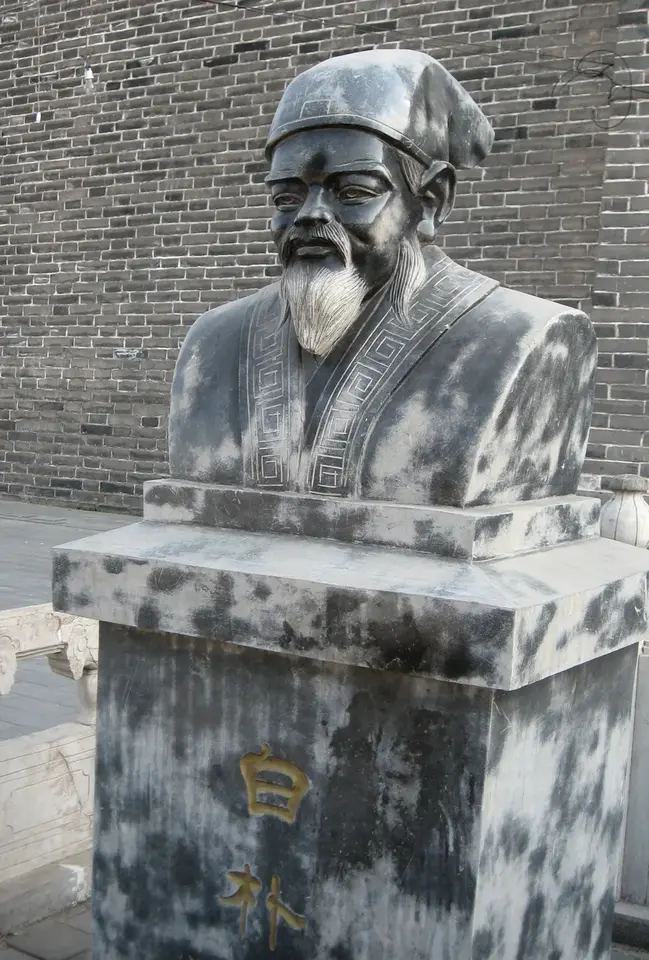
白朴
Bai Pu (白朴, 1226–after 1306), originally named Bai Heng, courtesy names Renfu and Taisu, and art name Langu, was an exceptional literary figure, playwright, and lyricist active during the late Jin and early Yuan dynasties. Along with Guan Hanqing, Ma Zhiyuan, and Zheng Guangzu, he is revered as one of the Four Great Yuan Playwrights. He hailed from an illustrious scholar-official lineage under the Jurchen Jin dynasty; his…
Bai Pu (白朴, 1226–after 1306), originally named Bai Heng, courtesy names Renfu and Taisu, and art name Langu, was an exceptional literary figure, playwright, and lyricist active during the late Jin and early Yuan dynasties. Along with Guan Hanqing, Ma Zhiyuan, and Zheng Guangzu, he is revered as one of the Four Great Yuan Playwrights. He hailed from an illustrious scholar-official lineage under the Jurchen Jin dynasty; his father Bai Hua was an imperial examination graduate who attained the post of Associate Director of the Bureau of Military Affairs. Following the siege and sack of Bianliang by Mongol forces in 1233, Bai Pu was separated from his mother in the chaotic flight. He was rescued and raised by Yuan Haowen, the supreme literary master of northern China and an intimate friend of his father. Yuan treated him as his own child, providing him with a rigorous education in classics and poetry that laid the foundation for his erudition. Resolute in preserving his loyalty to the fallen Jin dynasty, Bai Pu steadfastly rejected administrative office, turning down a high-level recommendation from Chancellor Shi Tianze in 1261 at age thirty-six to wander among rivers and mountains before residing permanently in Jiankang. Bai Pu holds a monumental position in Chinese theatrical history. His two landmark zaju dramas, Rain on the Wutong Tree (Wutong Yu) and Over the Wall and on Horseback (Qiangtou Mashang), represent twin summits of tragic pathos and comedic defiance. The former mourns the transient rise and fall of dynasties through Tang Minghuang and Consort Yang, while the latter celebrates feminine agency and marital freedom against patriarchal ritualism. He also left behind the poetic anthology Tianlai Ji and numerous surviving sanqu songs. After revisiting Yangzhou in 1306, his subsequent whereabouts remain unknown.
Born into a prominent scholar-official household in Kaifeng, with ancestral origins traced to Yuzhou, Shanxi.
Mongol troops besieged Bianliang; his father fled alongside Jin Emperor Aizong to Guide, leaving the family in the capital.
Bianliang fell; his mother perished; Yuan Haowen rescued young Bai Pu and his sister, raising and educating them in Liaocheng and Guanshi.
His father Bai Hua returned north to serve under General Shi Tianze in Zhending; Yuan Haowen escorted the siblings to reunite with their father.
At age thirty-six, he firmly declined Chancellor Shi Tianze's official summons to court, leaving home to travel through the Han River and Kaifeng regions.
Journeyed through Jiujiang, Baling, and the Yueyang Pavilion, lamenting the destruction of southern towns and composing poems on dynastic ruin.
Settled in Jinling (Jiankang), spending decades with southern literati writing verse, while declining further invitations to officialdom.
Re-visited Yangzhou during his old age; his subsequent movements and the exact time of his death remain unrecorded.
Bai Pu belonged to an eminent family of scholar-officials in the Jurchen Jin realm. His father Bai Hua passed the imperial civil examinations under Emperor Xuanzong and served as Associate Director of the Bureau of Military Affairs, widely recognized for his literary refinement. His uncle Bai Ben also held an examination degree and governed counties, while his second uncle was a renowned poet. In 1232, the Mongol army launched a massive offensive against Bianliang (Kaifeng), pounding the fortifications with catapult artillery. Emperor Aizong fled eastward toward Guide (Shangqiu), compelling Bai Hua to accompany the imperial retinue while leaving his family behind in the capital. In March 1233, Mongol troops breached Bianliang, looting the metropolis and slaughtering civilians. In the devastation, Bai Pu was separated from his mother, who died amid the chaos.
Fortunately, Yuan Haowen, the grand master of northern literature, was trapped in the capital. He searched through the ruined city, rescued seven-year-old Bai Pu and his elder sister, and shielded them from famine and marauding soldiers. In late spring 1233, Yuan Haowen escorted the children across the Yellow River to Liaocheng and subsequently found sanctuary in the entourage of Zhao Tianxi, magistrate of Guanshi in Shandong. Though a destitute refugee himself, Yuan Haowen cared for the siblings with parental tenderness. When Bai Pu contracted a fatal epidemic fever, Yuan cradled him in his arms continuously for six days until the boy sweated profusely and recovered. Recognizing Bai Pu's natural intellect, Yuan personally tutored him in the Confucian canon, poetic craftsmanship, and ethical integrity, instilling in him the profound literary tradition of northern China.
Following the annihilation of the Jin dynasty, Bai Hua briefly surrendered to the Southern Song and served as a sub-prefectural official in Junzhou, before returning north to enter the service of the Mongol-appointed Han commander Shi Tianze in Zhending (modern Zhengding, Hebei). In autumn 1237, as Yuan Haowen returned to Taiyuan from Guanshi, he escorted young Bai Pu and his sister through Zhending to rejoin their father after five years of separation.
Deeply moved by the family reunion, Bai Hua composed the lyric Mantangfang celebrating their return and thanked Yuan Haowen in moving verse: "Behold me turned truly into a stray hound, relying on your grace to shelter my fallen fledglings." Settling in Zhending, Bai Pu applied himself diligently to classical composition and poetic verse under his father's instruction, quickly winning acclaim across northern cultural circles. Yuan Haowen, who visited Zhending regularly while compiling his historical chronicles of the Jin, closely reviewed Bai Pu's scholarly progress, encouraging him with the famous verse: "Our families share generations of friendship; among all talented youth, you alone stand virtuous."
However, the childhood trauma of war, the violent loss of his mother, and the fall of the Jin dynasty left permanent scars on Bai Pu's psyche. Viewing the Mongol conquest as barbaric and humiliating, he resolved never to serve the conquerors. He abandoned all ambitions for civil advancement, identifying himself as a dispossessed loyalist (yimin) and channeling his grief and philosophical detachment into theatrical plays and song lyrics.
In 1261, when Bai Pu was thirty-six, Emperor Shizu (Kublai Khan) ordered regional pacification commissioners to recommend men of literary ability for imperial appointment. Grand Chancellor Shi Tianze, then governing from the central administration, strongly proposed Bai Pu for court office. Bai Pu adamantly refused. Realizing that rejecting the powerful chancellor made remaining in Zhending uncomfortable, he departed his home to embark on extensive travels across the Han River, Bianliang, and Huai Prefecture, publicly reaffirming his vow to remain an unbending recluse.
In 1277, shortly after the collapse of the Southern Song, Bai Pu traveled to Jiujiang and ascended the Yueyang Pavilion overlooking Lake Dongting. Gazing upon the desolation wrought by warfare, he composed sorrowful verses lamenting how past splendor had yielded to bloodshed and ruined landscapes. Everywhere he traveled—from the ancient Six Dynasties capital of Jinling to the overgrown terraces of Hangzhou—he poured his historical grief into poignant verse.
In 1280, Bai Pu established his permanent residence in Jiankang (Nanjing). When regional associates once again urged him to enter Mongol officialdom, he declined on the pretext of aging into retirement. He spent his remaining decades boating on the Qinhuai River and Lake Xuanwu, sharing wine, song, and dramatic composition with local poets and courtesans. In 1306, during the Dade era of Emperor Chengzong, Bai Pu revisited Yangzhou; following this journey, his traces disappeared from historical records.
In the realms of plot construction and dramatic characterization, Yuan zaju theater matured into a sophisticated performing art, establishing the foundations of traditional Chinese dramatic literature. While narrative theater originated during the Song and Jin dynasties, no complete scripts survived from those periods. Yuan zaju achieved rigorous musical and theatrical standards, integrating verse elegance, modal arrangements, and stage movements. Infusing deep classical learning into vernacular playwriting, Bai Pu significantly elevated the literary standing of Chinese drama.
The early Yuan catalog Lu Gui Bu by Zhong Sicheng recorded fifteen plays by Bai Pu, and later compilations identified sixteen distinct titles, including Rain on the Wutong Tree, Over the Wall and on Horseback, Dong Xiuying's Romance at the East Wall, and The Legend of Liang Shanbo and Zhu Yingtai.
Bai Pu's paramount contribution to Yuan theatrical history is the tragedy Rain on the Wutong Tree (Tang Minghuang Qiuye Wutong Yu, abbreviated as Wutong Yu). Adapted from Bai Juyi's epic poem Song of Everlasting Sorrow (Changhen Ge) and Chen Hong's Biography of the Song of Everlasting Sorrow, the drama depicts the tragic romance between Emperor Xuanzong of Tang (Li Longji) and Consort Yang Guifei against the backdrop of the cataclysmic An Lushan Rebellion. Rather than dwelling solely on romantic intimacy or moralistic condemnation of imperial indulgence, Bai Pu transformed the historical narrative into a profound meditation on dynastic vulnerability, lost glory, and existential grief.
The fourth act is celebrated by dramatic scholars as one of the supreme achievements of lyrical theater in Chinese literature. With melancholic imagery, Bai Pu portrays the abdicated emperor living in desolate isolation in the Western Palace on a rainy autumn night. Having caught a momentary dream of Consort Yang in the Palace of Eternal Youth, the old monarch is suddenly jarred awake by raindrops pattering on the broad leaves of the parasol tree (wutong) outside his window. The monotonous, relentless dripping amplifies his overwhelming grief and powerlessness. Qing critic Li Diaoyuan remarked in Yucun Dramatic Discourse that among dozens of Yuan plays on the Mawei slope tragedy, Bai Pu's was incomparable, while modern scholar Wang Guowei praised it as the crowning masterpiece of Yuan operatic tragedy.
Contrasting sharply with the solemn melancholy of Wutong Yu, Bai Pu's other surviving drama, Over the Wall and on Horseback (Pei Shaojun Qiangtou Mashang), is an exuberant and spirited romantic comedy. Borrowing thematic elements from Bai Juyi's poem Drawing a Silver Pitcher from the Bottom of the Well, which carried a cautionary warning against elopement, Bai Pu overturned traditional patriarchal morality to create a vibrant hymn praising romantic autonomy and feminine dignity.
The protagonist, Li Qianjin, is depicted as an articulate, fearless, and proactive young woman who initiates a courtship with scholar Pei Shaojun after catching his eye over an orchard wall. She elopes with him, living secretly in his family courtyard for seven years and bearing two children. Even when discovered and cast out by Pei's authoritarian father, Li Qianjin refuses to accept the stigma of an immoral eloper, fiercely defending her personal choices. When Pei passes the imperial examinations and his father visits her with gifts to apologize, she vehemently denounces their cowardice before relenting for her children's sake. The play remains celebrated alongside Romance of the Western Chamber as one of the four great romantic dramas of the Yuan period.
Beyond theatrical scripts, Bai Pu was a revered master of classical lyric meters (ci). His lyric collection Tianlai Ji (Sounds of Nature), compiled during his lifetime, reflected the sweeping and robust style of Yuan Haowen while conveying deep lamentation for lost dynasties and personal displacement. More than two hundred of his ci lyrics survive through Qing compilations prepared by Zhu Yizun and Hong Sheng.
In vernacular songs (sanqu), thirty-seven of Bai Pu's short songs (xiaoling) and four complete song suites (taoshu) have been preserved. Characterized by dignified phrasing, unadorned emotional sincerity, and melodic naturalness, his sanqu verse provided an aesthetic bridge between the refined classical tradition of northern literati and the emerging vitality of Yuan theater. Wang Guowei asserted that in chronological sequence and theatrical achievement, the Four Great Playwrights should be properly enumerated as "Guan, Bai, Zheng, and Ma."
FIGURES ASSOCIATED WITH THIS DYNASTY