Birth in Umbria
Born in Magione near Perugia, Umbria; entered the newly established Order of Friars Minor in his youth.
柏朗嘉宾
Giovanni da Pian del Carpine (柏朗嘉宾, c. 1182–1252), born near Perugia in Umbria, Italy, was a medieval papal legate, veteran Franciscan friar, and distinguished explorer. As an early disciple of Saint Francis of Assisi, Carpine accumulated extensive diplomatic and administrative experience while serving as provincial minister across Saxony and Germany. In the early 1240s, the second Mongol western expedition under Batu Khan…
Giovanni da Pian del Carpine (柏朗嘉宾, c. 1182–1252), born near Perugia in Umbria, Italy, was a medieval papal legate, veteran Franciscan friar, and distinguished explorer. As an early disciple of Saint Francis of Assisi, Carpine accumulated extensive diplomatic and administrative experience while serving as provincial minister across Saxony and Germany. In the early 1240s, the second Mongol western expedition under Batu Khan swept across Eastern Europe, crushing Polish and Hungarian chivalric armies at Legnica and Mohi, sending shockwaves throughout Christendom. To investigate Mongol military intentions, political institutions, and negotiate a cessation of hostilities, Pope Innocent IV dispatched the sixty-year-old Carpine in April 1245 as his chief apostolic envoy to the Mongol court. Departing from Lyon, Carpine traversed Poland, Kievan Rus, and the lower Volga steppes, where he was received by Batu at Sarai before continuing across the vast Central Asian deserts to reach the imperial headquarters near Karakorum in July 1246. At Karakorum, Carpine witnessed the formal coronation of Güyük Khan as the third Khagan of the Mongol Empire. He delivered Innocent IV's papal bulls and secured Güyük's formal reply in Persian. Returning safely to Lyon in the autumn of 1247, Carpine presented his mission report and authored the monumental Historia Mongalorum (History of the Mongols Whom We Call Tartars), the earliest comprehensive European ethnographic and political study of the Mongol people. His sober and detailed observations dispelled medieval European myths and laid the foundation for the Western study of inner Asian civilization.
Born in Magione near Perugia, Umbria; entered the newly established Order of Friars Minor in his youth.
Served as Franciscan provincial minister in Saxony, Cologne, and Spain, overseeing pastoral organization and diplomatic conciliation.
Commissioned by Pope Innocent IV at the Council of Lyon to lead a diplomatic delegation to the Mongol Empire.
Reached Batu Khan's encampment at Sarai on the lower Volga and was instructed to proceed to the imperial capital Karakorum.
Arrived at Dalan Daba near Karakorum, attended Güyük's imperial enthronement kurultai, and obtained the Persian text of the sovereign edict.
Returned to Lyon, reported in person to Pope Innocent IV, and completed his written treatise Historia Mongalorum.
Elevated by the Holy See to the archbishopric of Antivari in Dalmatia (modern Bar, Montenegro).
Died while discharging his pastoral duties in the archdiocese of Antivari.
Giovanni da Pian del Carpine was born at Pian di Carpine (modern Magione) near Perugia in central Italy. In his youth, he embraced the Franciscan ideal of voluntary apostolic poverty, becoming one of the earliest companions of Francis of Assisi. Renowned for his classical learning and practical tact, Carpine gained widespread esteem within the order.
Beginning in the 1220s, Carpine was assigned to expand Franciscan institutions north of the Alps. He served successively as warden, custodian, and provincial minister in Saxony, Germany, and Spain. Over two decades, he inspected northern bishoprics, arbitrated jurisdictional disputes between territorial nobility and diocesan clergy, and demonstrated high-level administrative ability and diplomatic perseverance.
In 1241, Mongol forces commanded by Batu and general Subutai invaded Poland and Hungary, annihilating knightly armies at the battles of Legnica and Mohi and pursuing retreating forces to the shores of the Adriatic. Although the death of Ögedei Khan prompted the sudden withdrawal of the Mongol vanguard eastward, Western European monarchs and the Holy See remained gripped by existential terror.
To ascertain the military capabilities and future strategic plans of the Mongol Empire and to encourage peaceful coexistence, Pope Innocent IV convened the First Council of Lyon in April 1245. He appointed the sixty-three-year-old Carpine as his apostolic legate to the eastern rulers.
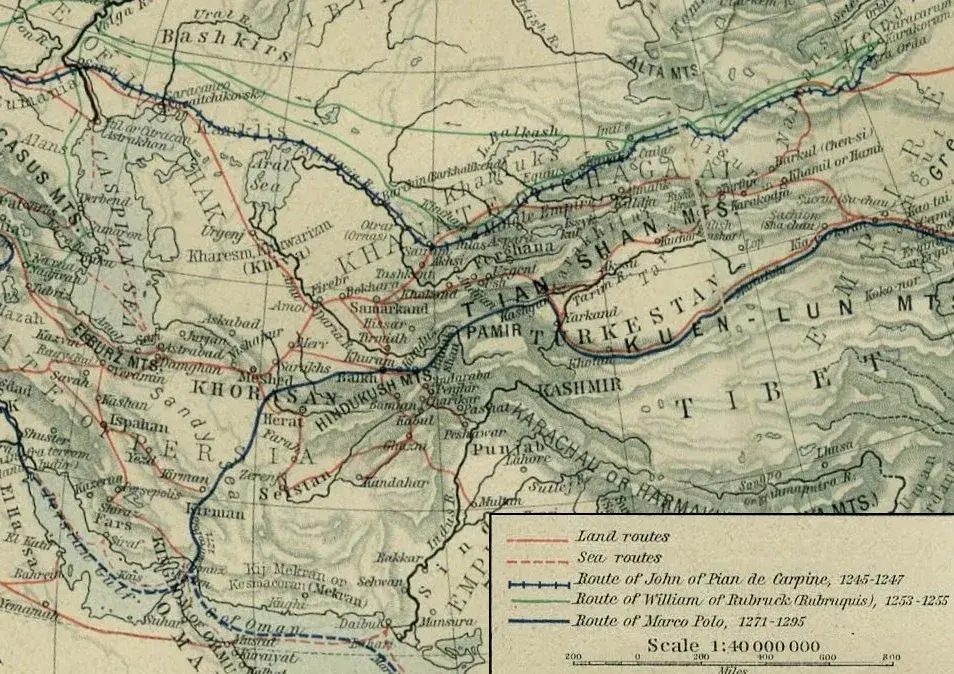
Departing Lyon on Easter Day 1245 accompanied by Brother Stephen of Bohemia and later joined by Brother Benedict the Pole, Carpine carried the papal bull Cum non solum. The small party traveled through Bohemia and Poland to Kievan Rus, continuing on horseback across the snow-covered plains of the Dnieper and Don rivers. In April 1246, the envoys arrived at Sarai on the lower Volga, the encampment of Batu Khan. Batu examined the papal missive and ordered the legates to proceed immediately to Karakorum to attend the grand imperial kurultai. Riding post horses and traversing three thousand miles of harsh semi-desert and the Altai Mountains under extreme weather conditions, the exhausted envoys reached the imperial camp at Dalan Daba on July 22, 1246.
Carpine's arrival coincided with an epochal political assembly. Following the regency of Empress Töregene (Naimanjin), Mongol princes and foreign rulers gathered in the Orkhon Valley to confirm the succession of the supreme khaganate.
On August 24, 1246, Carpine witnessed the enthronement of Güyük Khan. Thousands of delegates, including the Russian grand duke Yaroslav II, the king of Cilician Armenia, representatives of the Abbasid caliph of Baghdad, and princes of the Golden Horde and Chagatai Khanate, assembled across expansive tent encampments. Carpine and his companions, clad in brown friars' robes, stood as the sole Western European eyewitnesses to this gathering.
Following the ceremony, Güyük Khan granted Carpine an imperial audience. When presented with Innocent IV's plea that the Mongols desist from invading Christian lands and accept baptism, Güyük rejected the moral admonition. In November 1246, the imperial chancery issued a royal decree in Persian and Turkic bearing the seal of the supreme khagan. The letter asserted that Mongol conquests were ordained by the Eternal Heaven, demanding that the Pope and European kings travel to Karakorum in person to offer submission and tribute, warning that refusal would result in their treatment as mortal enemies.
Though diplomatic reconciliation was not achieved, Carpine accomplished his mission of gathering vital intelligence. Departing the Mongol court on November 13, 1246, the delegation endured severe blizzards and provisions shortages across Central Asia, crossing the Dnieper back into Kiev in June 1247, where they were received with jubilation.
In the autumn of 1247, Carpine arrived in Lyon, delivering Güyük's sealed missive directly to Pope Innocent IV. Utilizing his travel notes and interviews, he completed Historia Mongalorum, the first comprehensive European analytical treatise on the Mongol Empire. Divided into nine detailed chapters, the work meticulously documented Mongol geography, physical appearance, social customs, military tactics, armor, battle formation, and dynastic history.
Recognizing his extraordinary fortitude and diplomatic services, Innocent IV appointed Carpine as a papal courtier and subsequently elevated him to Archbishop of Antivari (modern Bar, Montenegro). Carpine administered his archdiocese until his death in August 1252.
Modern and pre-modern historians uniformly recognize Giovanni da Pian del Carpine as a pioneering figure in the history of Eurasian intercultural diplomacy. He was the first Western European scholar-diplomat to pierce the isolation of inner Asia and produce a systematically documented account of the steppe empire.
The French Sinologist Paul Pelliot observed that Carpine's Historia Mongalorum constitutes far more than a conventional pilgrim itinerary; it represents a rigorous, dispassionate military and political intelligence analysis whose accuracy regarding Mongol tribal origins, tactical discipline, and institutional structures remains of peerless value.
Historical geographers emphasize that Carpine's overland journey bridged the geographic divide between Latin Christendom and the Mongol Empire, opening the diplomatic corridor subsequently traveled by William of Rubruck and Marco Polo.
FIGURES ASSOCIATED WITH THIS DYNASTY