Captured by Insurgents
Coerced by rebelling Qiang and auxiliary tribes to serve as their supreme commander.
韩遂
Han Sui (韩遂, died 215), originally named Han Yue with the courtesy name Wenyue, was a prominent military warlord who held autonomous sway over Liang Province (modern Gansu and eastern Qinghai) for more than three decades during the late Eastern Han dynasty. Endowed with administrative literacy and military cunning, he was initially coerced into leading an indigenous Qiang and auxiliary tribal revolt in 184, which advanced…
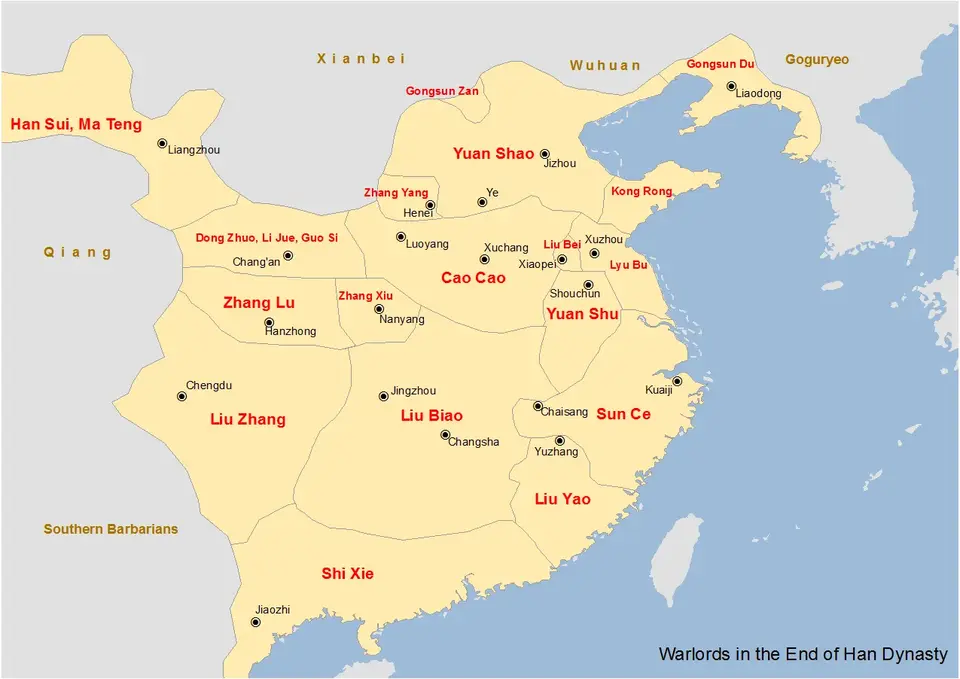
Han Sui (韩遂, died 215), originally named Han Yue with the courtesy name Wenyue, was a prominent military warlord who held autonomous sway over Liang Province (modern Gansu and eastern Qinghai) for more than three decades during the late Eastern Han dynasty. Endowed with administrative literacy and military cunning, he was initially coerced into leading an indigenous Qiang and auxiliary tribal revolt in 184, which advanced into the Guanzhong region under the slogan of purging palace eunuchs. Skillfully navigating warfare against distinguished Han commanders such as Huangfu Song, Zhang Wen, Dong Zhuo, and Sun Jian, Han Sui liquidated internal rival leaders to assume sole command of the western frontier armies. He formed an alliance and sworn brotherhood with Ma Teng, though the two subsequently waged destructive civil warfare over territory in Liang Province. In 211, fearing that Cao Cao's expedition against Zhang Lu in Hanzhong was a pretext to annex Guanxi, Han Sui joined Ma Chao in uniting ten western divisions in armed rebellion. During the Battle of Tong Pass, Cao Cao sowed discord between Han Sui and Ma Chao using smeared personal letters, precipitating a total collapse of the insurgent coalition. After successive defeats against Cao Cao's general Xiahou Yuan in 214, Han Sui died in Xiping in 215, marking the definitive integration of the northwest into the Cao Wei domain.
Coerced by rebelling Qiang and auxiliary tribes to serve as their supreme commander.
Clashed with Zhang Wen, Dong Zhuo, and Sun Jian at Meiyang before retiring to Jincheng.
Purged rival chieftains Beigong Boyu, Li Wenhou, and Wang Guo, taking absolute command.
Entered Chang'an to submit to Li Jue, appointed General Who Pacifies the West and allied with Ma Teng.
Warred against sworn brother Ma Teng over Liang territory, killing Ma Teng's wife and sons.
Reconciled with Ma Teng through the mediation of Zhong Yao, dispatching his son as a hostage to Xuchang.
Joined Ma Chao to lead ten western divisions comprising one hundred thousand cavalry at Tong Pass.
Fell victim to Cao Cao's psychological warfare, leading to internal distrust and defeat at the Battle of the Wei River.
Suffered a crushing defeat by Xiahou Yuan at Xianqin, fleeing westward to Xiping.
Passed away in Xiping (or was killed by mutinous subordinates), ending his thirty-year dominion.
Han Sui, originally named Han Yue, belonged to an established, influential lineage in Jincheng Commandery within Liang Province. Endowed with broad strategic vision, legal knowledge, and personal bravery, he served as an administrative clerk in the provincial headquarters and traveled to Luoyang as an emissary to deliver memorial petitions. In the winter of 184, simultaneous with the Yellow Turban Rebellion, auxiliary Qiang and Xiongnu forces mutinied in Jincheng, slaying the Colonel of the Western Qiang. Seeking a respected Han leader of high status to legitimize their rebellion, the tribal insurgents kidnapped Han Yue. Recognizing that refusal meant instant death, he changed his personal name to Han Sui and assumed the position of supreme political and military advisor. He mobilized more than one hundred thousand Han and nomadic warriors under the public slogan of punishing palace eunuchs and marching eastward toward Chang'an.
Alarmed by the sudden collapse of the northwestern perimeter, the Han court dispatched supreme commanders including Zhang Wen, Huangfu Song, Dong Zhuo, and Sun Jian to stem the invasion. In 185, at the Battle of Meiyang, Han Sui's vanguard was checked by imperial armies, prompting him to withdraw to the strongholds of Yuzhong and Jincheng. Han Sui possessed profound tactical versatility, capitalizing on the high mobility of Liang cavalry forces to conduct fluid guerrilla warfare. In 187, demonstrating ruthless political survival skills, he orchestrated the elimination of rival commanders Beigong Boyu, Li Wenhou, and Wang Guo, absorbing their veteran contingents. He declared himself grand administrator and established absolute dominance over Jincheng, becoming an immovable autonomous warlord beyond imperial control.
Following Dong Zhuo's assassination in 192, warlords Li Jue and Guo Si seized control of Chang'an. To secure their western flanks, they bestowed upon Han Sui the title General Who Pacifies the West and Commander of Jincheng. Han Sui entered Chang'an, where he concluded an alliance and swore mutual brotherhood with fellow Liang commander Ma Teng. However, intense friction over grazing pastures, grain supplies, and recruitment sparked fratricidal conflict in 195. The former allies waged continuous warfare across Liang Province; Han Sui launched a raid that killed Ma Teng's wife and sons, while Ma Teng counterattacked, devastating the civilian economy. In 199, as Cao Cao prepared for the decisive confrontation against Yuan Shao at Guandu, he dispatched Sili Colonel Zhong Yao to pacify Guanxi. Zhong Yao appealed to their strategic interests, successfully convincing both commanders to cease hostilities. Han Sui sent his son to the imperial court at Xuchang as a hostage and provided auxiliary cavalry to assist Cao Cao in defeating Yuan Shao's generals in Hedong.
In the spring of 211, Cao Cao dispatched Zhong Yao and Xiahou Yuan to march through Guanxi under the pretext of invading Hanzhong to destroy the religious warlord Zhang Lu. Suspecting that Cao Cao intended to swallow the western territories by surprise, Ma Teng's son Ma Chao urged Han Sui to form an alliance. Ma Chao pleaded: "Now I abandon my father and treat you as my father; you must abandon your son in Xuchang and treat me as your son." Persuaded by the collective pressure of the western generals, Han Sui joined Ma Chao in mobilizing ten western divisions, totaling over one hundred thousand elite cavalry, to fortify Tong Pass. Cao Cao marched west in person to direct operations. After crossing the Wei River, Cao Cao exploited his youthful acquaintance with Han Sui from their days in Luoyang. Cao Cao invited Han Sui to a parley between the battle lines, conversing cordially solely about capital memories while avoiding military matters, which aroused profound suspicion in Ma Chao. Soon after, Cao Cao sent Han Sui a private letter marked with conspicuous alterations and deletions, leading Ma Chao to believe Han Sui was secretly erasing evidence of a betrayal. Paralyzed by mutual suspicion, the Guanxi alliance fractured, allowing Cao Cao's forces to execute a crushing combined assault in September 211 along the southern bank of the Wei River.
Following the disaster at the Wei River, Han Sui escaped to Jincheng. Although Cao Cao offered him the title General Who Conquers the West in an attempt to induce surrender, Han Sui refused to submit. In 214, Cao Cao's general Xiahou Yuan executed an aggressive offensive across the Longyou mountains, crushing Han Sui's defense line at Xianqin. Han Sui evacuated Jincheng and retreated to Xiping in modern Qinghai, where his son-in-law Yan Xing turned against him. In the spring of 215, the aged warlord died of illness in Xiping at over seventy years of age (though some contemporary chronicles claim he was assassinated by mutinous retainers). His severed head was sent to Cao Cao at Ye, bringing a definitive end to more than thirty years of autonomous militarized rule in Liang Province and cementing Wei dominion over the northwest.
From 184 to 215, Han Sui successfully maintained an independent military regime across Liang Province. Balancing diplomatic alliances between indigenous nomadic tribes and Han landowning elites, he resisted repeated campaigns by the Han central government and subsequent warlords, making his regime the longest-lasting autonomous domain of the late Eastern Han period.
In 211, Han Sui served as the paramount commander of the ten allied western divisions, commanding one hundred thousand cavalry against Cao Cao's elite central armies. The Battle of Tong Pass and the ensuing campaign along the Wei River represented the fiercest geostrategic contest in northern China during the transition toward the Three Kingdoms.
FIGURES ASSOCIATED WITH THIS DYNASTY