Imperial Favor
Served as a Palace Gate Guard; won Emperor Wu's favor by shielding him in a gale, appointed Prefect of Weiyang Stables.
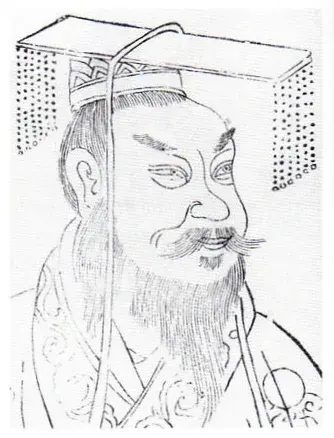
上官桀
Shangguan Jie (上官桀, ?–80 BC), courtesy name Shaoshu (少叔), was a prominent military commander, imperial in-law, and regent of the Western Han Dynasty. Originating from an influential lineage in Shanggui of Longxi Commandery, he entered the imperial palace as a robust bodyguard in the Palace Gate division, gaining the favor of Emperor Wu after steadfastly holding a carriage canopy to shield the monarch from severe…
Shangguan Jie (上官桀, ?–80 BC), courtesy name Shaoshu (少叔), was a prominent military commander, imperial in-law, and regent of the Western Han Dynasty. Originating from an influential lineage in Shanggui of Longxi Commandery, he entered the imperial palace as a robust bodyguard in the Palace Gate division, gaining the favor of Emperor Wu after steadfastly holding a carriage canopy to shield the monarch from severe storms. He subsequently served as Prefect of the Weiyang Stables, Attendant, and Chamberlain for the National Treasury. During the Taichu era, he served as Grain-Collecting Captain under Li Guangli in the campaign against Dayuan, earning appointment as Chamberlain for the Palace Revenues for his daring pursuit of hostile remnants into the territory of Kangju. In 87 BC, as Emperor Wu lay mortally ill, he issued a testamentary decree appointing Shangguan Jie as General of the Left, commissioning him alongside Huo Guang, Jin Midi, and Sang Hongyang to serve as co-regents to assist the eight-year-old Emperor Zhao, ennobling him as Marquis of Anyang. Following Emperor Zhao's accession, Shangguan Jie forged a close political alliance with Huo Guang through intermarriage; his granddaughter (who was also Huo Guang's maternal granddaughter) was crowned Empress. However, when Huo Guang firmly rejected Shangguan's attempts to secure an aristocratic marquisate for the princess's paramour Ding Wairen, and with the Shangguan clan growing arrogant in palace politics, relations fractured irreparably. In 80 BC, Shangguan Jie conspired with Prince Dan of Yan, Imperial Censor Sang Hongyang, and Grand Princess Eyigan to stage an armed coup to assassinate Huo Guang and depose Emperor Zhao. The plot was exposed, and Shangguan Jie was executed alongside his entire clan in the public marketplace.
Served as a Palace Gate Guard; won Emperor Wu's favor by shielding him in a gale, appointed Prefect of Weiyang Stables.
Appointed Grain-Collecting Captain under Li Guangli, attacking the city of Yucheng and advancing to Kangju; made Chamberlain for the Palace Revenues.
Named General of the Left by Emperor Wu's deathbed decree to co-govern with Huo Guang, Jin Midi, and Sang Hongyang; created Marquis of Anyang.
Supported his son Shangguan An in having his young daughter installed as Empress to Emperor Zhao, cementing supreme court influence.
Attempted to secure a marquisate for Ding Wairen, the favorite of Princess Eyigan; deeply alienated when Huo Guang refused.
Conspired with Prince Dan of Yan to submit a forged memorial accusing Huo Guang of treason; exposed when the young Emperor Zhao saw through the fraud.
Plotted to ambush Huo Guang during an imperial banquet and seize sovereign power; betrayed by informants and executed with his clan.
Shangguan Jie hailed from Shanggui County in Longxi Commandery, an esteemed martial lineage on the western frontier. In his youth, he was noted for immense physical strength and martial agility, earning selection into the elite Palace Gate Guard detachment that protected Emperor Wu of Han. On an imperial journey to the Ganquan Palace, the royal procession was caught in a sudden, violent tempest accompanied by driving rain. While the carriage horses reared and imperial attendants fell back in disarray, Shangguan Jie unhitched the heavy ceremonial canopy and held it aloft with bare hands directly over Emperor Wu's chariot. Despite gale-force winds and torrential rains, Shangguan Jie matched the pace of the sprinting team, keeping the canopy perfectly stable so that not a single raindrop touched the emperor's robes. Deeply impressed by his physical stamina and composure, Emperor Wu promoted him to Prefect of the Weiyang Stables upon returning to Chang'an.
Shortly thereafter, Emperor Wu suffered a severe illness. Upon recovery, the monarch inspected the imperial stables and discovered that the horses had grown lean and sickly. Incensed, Emperor Wu roared: "Do you presume that I would never live to ride these horses again!" and ordered his immediate arrest. Shangguan Jie prostrated himself before the throne, weeping bitterly as he replied: "Upon hearing that Your Majesty was stricken with illness, your servant spent day and night in agonizing torment, praying for Your Majesty's health; how could my mind be attentive to the weight of beasts!" Tears cascaded down his face, soaking his collar. Moved by his emotional devotion, Emperor Wu judged him to be exceptionally loyal, canceling his punishment and elevating him to the inner circle as Palace Attendant, progressively promoting him to Chamberlain for the National Treasury.
In 104 BC, determined to acquire the heavenly horses of Dayuan to crush nomadic cavalry, Emperor Wu dispatched Senior General Li Guangli on an expedition across the Pamir Mountains. Shangguan Jie was commissioned as Grain-Collecting Captain, bearing operational responsibility for logistical supply while directing forward vanguard detachments. During the second expedition, following the investment of the citadel of Yucheng, Li Guangli detached Shangguan Jie with an elite mobile strike force to storm the fortress. The king of Yucheng fled into the northern wastes, but Shangguan Jie pursued him relentlessly across several hundred leagues to the borders of Kangju, killing the enemy general and bringing the northern oasis states into submission. When the expedition returned victorious to Chang'an, Emperor Wu commended him for his audacity in deep desert operations, promoting him to Chamberlain for the Palace Revenues. During the turbulent Crown Prince Liu Ju succession crisis and the rebellions of Mang Tong, Shangguan Jie commanded loyal palace guards to capture the conspirators, cementing his status as an indispensable defender of the throne.
In the second month of 87 BC, Emperor Wu fell terminally ill at the Wuzuo Palace. Designating his eight-year-old son Liu Fuling (Emperor Zhao) as imperial heir, Emperor Wu summoned his most trusted ministers to receive his final testament. The dying monarch commissioned Attendant Huo Guang as Grand General and Marshal of State, Chamberlain for the National Treasury Shangguan Jie as General of the Left, Attendant Jin Midi as General of Chariots and Cavalry, and Grain-Collecting Captain Sang Hongyang as Imperial Censor, creating a quadruple regency council to govern the empire. Following Emperor Wu's demise, the regency council ratified the posthumous distribution of honors. Citing his earlier battlefield capture of Mang Tong, the court formally invested Shangguan Jie as Marquis of Anyang.
In the initial years of Emperor Zhao's reign, the boy emperor's youth created delicate court politics. Huo Guang directed civilian policy from the outer court, while Shangguan Jie controlled palace security from the inner palace, cooperating in harmony. This political alliance was cemented by marriage: Shangguan Jie's son, Shangguan An, had married Huo Guang's eldest daughter prior to Emperor Wu's passing. Whenever Huo Guang took temporary administrative leave, all state matters were routinely delegated to Shangguan Jie. Because Emperor Zhao was orphaned, his elder sister, Grand Princess Eyigan, resided within the palace to supervise his personal care. The princess maintained an illicit liaison with her retainer Ding Wairen; wishing to avoid public scandal, Huo Guang and Shangguan Jie permitted Ding Wairen to serve within the inner chambers.
In 83 BC, the princess sought to select imperial consorts for Emperor Zhao. Shangguan An urged his father-in-law Huo Guang to introduce his own young daughter (Shangguan Jie's granddaughter and Huo Guang's maternal granddaughter) into the palace. Huo Guang declined on the grounds that the child was barely six years old. Thwarted by his father-in-law, Shangguan An approached Ding Wairen, promising that if the princess backed the girl's candidacy, Shangguan would ensure Ding Wairen was ennobled as a full marquis and formally wed to the princess. Ding Wairen persuaded the princess, and the six-year-old Lady Shangguan was inducted as an imperial consort, being formally invested as Empress in 82 BC. Following this success, Shangguan An was promoted to General of Agile Cavalry and created Marquis of Sangle, elevating the Shangguan clan to unprecedented prominence.
However, the alliance soon collapsed into open hostility. Honoring his pact, Shangguan Jie repeatedly petitioned Huo Guang to ennoble Ding Wairen as a marquis, which would allow him to marry the princess under imperial protocol. Huo Guang adamantly refused, citing Ding Wairen's lack of military achievement and dissolute reputation. Furthermore, when Shangguan Jie sought appointments for his private partisans, Huo Guang systematically vetoed the nominations in adherence to established statutes. Shangguan An grew increasingly arrogant, openly comparing his authority to that of Huo Guang. Feeling patronized and marginalized despite their status as the Empress's closest kin, Shangguan Jie and his son resolved to eliminate Huo Guang and seize total control of the imperial government.
Shangguan Jie orchestrated a broad anti-Huo coalition, uniting with Imperial Censor Sang Hongyang, who resented Huo Guang's centralization of state finance, as well as Grand Princess Eyigan and Ding Wairen. Most significantly, Shangguan Jie opened secret communications with Prince Dan of Yan, Emperor Wu's eldest surviving son, who deeply coveted the imperial throne. In the autumn of 81 BC, while Huo Guang was conducting a review of the capital garrisons outside Chang'an, the conspirators had Prince Dan's emissaries submit an urgent memorial accusing Huo Guang of high treason, alleging that he was deploying troops without authorization and conspiring with Han ambassador Su Wu.
However, the fourteen-year-old Emperor Zhao displayed extraordinary intellectual discernment. Withholding the petition, the young monarch summoned Huo Guang to court the following morning and comforted him warmly: "The Grand General conducted his military inspection only yesterday, and the movements of the Guangming Colonel were carried out under my explicit instruction. Furthermore, the Prince of Yan resides more than a thousand leagues away; how could a courier travel from Yan to Chang'an in a single day? This memorial is plainly a malicious fabrication concocted by conspirators within the capital to frame the Grand General!" Emperor Zhao ordered the immediate arrest of the petitioner, sending the Shangguan faction into profound panic.
Recognizing that administrative maneuvers could not unseat Huo Guang, Shangguan Jie resolved to launch an armed insurrection. In the ninth month of 80 BC, Shangguan Jie, Sang Hongyang, the princess, and Ding Wairen finalized a violent plot: the princess would host an elaborate banquet at her estate, inviting Huo Guang, whereupon hidden assassins would cut him down. The conspirators would then forge an imperial decree from the Empress Dowager to depose Emperor Zhao and welcome Prince Dan of Yan to Chang'an. Privately, Shangguan Jie harbored even darker intentions, whispering to his confidants that once Huo Guang was slain, he would assassinate Prince Dan as well, ascending the imperial throne himself.
On the eve of the coup, an agricultural official named Yan Cang, who had been recruited into the plot, grew terrified of execution and revealed the conspiracy to Minister of Finance Yang Chang. Yang Chang alerted Remonstrance Official Du Yannian, who informed Huo Guang. Acting with ruthless dispatch, Huo Guang mobilized imperial bodyguards and elite cavalry to encircle the conspirators' residences before they could strike. Chancellor Tian Qianqiu deployed imperial tallies to lock down the city gates. The imperial soldiers overwhelmed the rebel strongholds; Shangguan Jie and Shangguan An were captured after violent resistance and summarily executed in the marketplace alongside Sang Hongyang and Ding Wairen, their entire households suffering extermination. Princess Eyigan and Prince Dan of Yan committed suicide in their palaces. The nine-year-old Empress Shangguan was spared due to her tender age and her status as Huo Guang's maternal granddaughter, retaining her imperial title. Shangguan Jie's reckless pursuit of autocratic power thus ended in the complete destruction of his lineage.
During the second expedition against Dayuan in 104 BC, Shangguan Jie played an essential tactical role as Grain-Collecting Captain. Far from acting merely as a supply clerk, he displayed exceptional frontline courage in the trackless expanses of Central Asia.
His rapid assault against the fortress of Yucheng and his aggressive pursuit of the hostile king across desert sands to the frontier of Kangju demonstrated the tactical ferocity of Han cavalry. His success earned Emperor Wu's commendation for daring deep operations, elevating him from a minor palace retainer into the ranks of the Nine Ministers.
In 87 BC, amidst the volatile succession crisis surrounding Emperor Wu's demise, Shangguan Jie was appointed General of the Left and one of the four principal regents entrusted with safeguarding the child Emperor Zhao.
Throughout the precarious early years of the regency, Shangguan Jie exercised operational command over the Weiyang Palace guard detachments. Working in tandem with Huo Guang, he effectively neutralized subversive designs from ambitious imperial princes, ensuring that the western empire navigated the fragile transition from Emperor Wu's expansionist reign to the stable consolidation of the Zhaoxuan Era.
The trajectory of the Shangguan clan under Emperor Zhao serves as a classic illustration of the perils of consort family overreach in the Western Han political system. Leveraging the installation of his granddaughter as Empress, Shangguan Jie attempted to construct an imperial court that subverted established meritocratic norms.
His desperate willingness to ally with regional kings, corrupt palace favorites, and dissenting fiscal ministers culminated in an armed coup d'état that threatened the very foundations of the dynasty. His rapid eradication by Huo Guang underscored the resilience of Han bureaucratic institutions and reinforced the absolute supremacy of ministerial regency during the middle Western Han period.
FIGURES ASSOCIATED WITH THIS DYNASTY