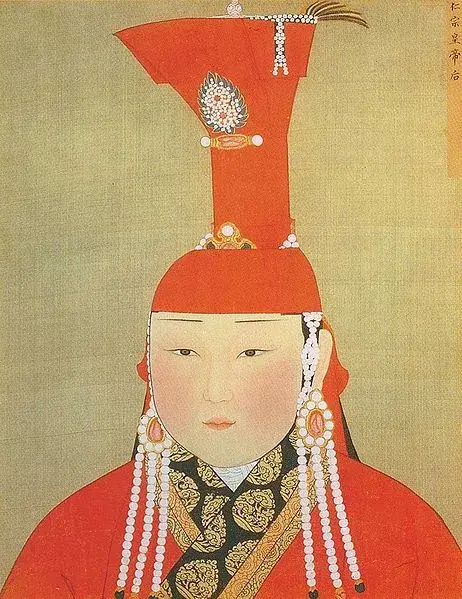
斡兀立·海迷失
Historical portrait of Oghul Qaimish
Image creditsArmenianPatroit · CC0Image source

Third Regent Empress of the Mongol Empireprincipal consort of Güyük Khan

Oghul Qaimish (斡兀立·海迷失)

斡兀立·海迷失

Oghul Qaimish (斡兀立·海迷失, died 1252), of the Oghul clan (also identified as a daughter of Qutuqa Beki, chieftain of the Oirat tribe), was the third regent empress of the Mongol Empire and the principal third consort of Emperor Dingzong (Güyük Khan). In March 1248 (the third year of Güyük's reign), Güyük Khan died abruptly at Hengxiangyir (in present-day Jinghe County, Xinjiang) during a westward expedition. In the resulting…

Mongol Empire (大蒙古国)

PROFILE

Oghul Qaimish (斡兀立·海迷失, died 1252), of the Oghul clan (also identified as a daughter of Qutuqa Beki, chieftain of the Oirat tribe), was the third regent empress of the Mongol Empire and the principal third consort of Emperor Dingzong (Güyük Khan). In March 1248 (the third year of Güyük's reign), Güyük Khan died abruptly at Hengxiangyir (in present-day Jinghe County, Xinjiang) during a westward expedition. In the resulting constitutional vacuum, Empress Oghul Qaimish assumed the regency with the conditional consent of Prince Batu and imperial clan princes, ruling as regent over the empire for more than three years while championing the succession of young Shiremün. Her regency was marked by intense internecine friction among the Mongol ruling aristocracy. Her two biological sons, Qucha and Naqu, established rival princely courts in direct defiance of her authority, producing an anarchic state of affairs known as "one realm under three masters." Regional princes freely issued independent decrees, administrative discipline collapsed, and severe droughts ravaged the Eurasian steppes. In the summer of 1251, Prince Batu of the Golden Horde and the Toluid matriarch Sorghaghtani Beki convened a general kurultai at Qöte'ü-aral along the Kherlen River, formally crowning Möngke Khan as Great Khan and permanently transferring supreme power from the Ögedeid line to the Toluid lineage. Refusing to concede defeat, Oghul Qaimish conspired with Ögedeid princes to launch a preemptive rebellion and performed shamanic sorcery against Möngke. In 1252, the plot was uncovered; Möngke ordered her arrest, interrogation, and execution by drowning. In 1266 (the third year of the Zhiyuan era), Emperor Shizu (Kublai Khan) posthumously honored her as Empress Qinshu.

Posthumous Name
Empress Qinshu (钦淑皇后, posthumously honored by Kublai Khan)
Dynasty
Mongol Empire (大蒙古国)
Date of Death
1252 (Möngke 2 / Chunyou 12, Song Lizong)
Highest Post & Noble Titles
Regent Empress of the Mongol Empire (监国摄政皇后), Posthumously honored as Empress Qinshu
Major Offices
Regent Empress of the Mongol Empire, Third Empress of Emperor Dingzong (Güyük Khan)
Identity
Third Regent Empress of the Mongol Empire, principal consort of Güyük Khan

LIFE TIMELINE

Relationship graph

BIOGRAPHY

Life and Career

Noble Lineage and Imperial Marriage

Oghul Qaimish traced her origins to an illustrious aristocratic lineage of the steppe nomadic tribes. Historical sources offer slight variations regarding her exact tribal background: Western scholars such as Constantine d'Ohsson, citing Persian chronicles including the Jami al-Tawarikh of Rashid al-Din, identify her as a daughter of Qutuqa Beki, the powerful ruler of the Oirat tribe, while French sinologist Paul Pelliot argued that she belonged to the Oghul clan of the Merkit tribe. The Oirats had rendered critical military service during the early campaigns of Genghis Khan, earning the enduring privilege of hereditary intermarriage with the Golden Family.

Upon coming of age, Oghul Qaimish wedded Güyük, the eldest son of Ögedei Khan, entering the imperial ordo as one of his primary consorts. The official History of Yuan (Yuan Shi) identifies her as Güyük's Third Empress. She bore Güyük two prominent sons, Qucha (Khoja) and Naqu, establishing considerable political stature and clan influence within the central imperial court.

Sudden Demise of Güyük and Imperial Regency

In March 1248 (the third year of Güyük's reign), Güyük Khan mobilized a massive armed force to inspect his ancestral appanage in Emil (modern Emin County, Xinjiang). During the journey, he fell critically ill and died suddenly at the encampment of Hengxiangyir. His abrupt passing triggered an existential succession crisis across the empire. Prince Batu, commander of the Golden Horde stationed in Central Asia, harbored deep personal animosity toward Güyük stemming from their quarrel during the European Campaign and adamantly opposed the succession of Güyük's direct sons.

In this delicate impasse, Empress Oghul Qaimish withheld immediate public announcement of Güyük's death until military order was secured. She dispatched confidential couriers to negotiate with Batu and the influential Toluid matriarch Sorghaghtani Beki, proposing that she assume executive custody of imperial affairs in accordance with steppe precedent until a general assembly could elect a sovereign. Recognizing the need to avert immediate civil war, both factions assented. In the autumn of 1248, Oghul Qaimish formally assumed the regency, taking control of the imperial seals and governing administration at Karakorum, following the prior precedent of Empress Töregene Khatun.

Administrative Paralysis and Disunity

Throughout her regency, Oghul Qaimish remained fiercely dedicated to preserving the supreme khanate within the Ögedeid dynasty. Honoring the stated preference of the late Ögedei Khan, she championed the candidacy of his favored grandson Shiremün (son of Kochu) as the legitimate heir to the throne. However, this initiative sparked fierce resentment and open defiance from her own biological sons, Qucha and Naqu.

Believing that as Güyük's direct sons they possessed a superior hereditary claim, Qucha and Naqu set up rival palatial encampments and administrative courts in their respective appanages. The brothers issued independent decrees, distributed fiefs and official appointments, and openly challenged their mother's central authority, plunging the realm into an administrative fragmentation described as "one realm under three masters." Sensing the impotence of central governance, regional princes and military governors abused their privileges by levying unauthorized taxes on civilian communities. To compound these political woes, the Mongolian plateau suffered severe, unremitting droughts during these years; rivers ran dry, wild grass fires erupted across the steppes, and vast herds of livestock perished, creating acute fiscal and economic exhaustion.

In foreign relations, Oghul Qaimish received an official embassy sent by King Louis IX of France at her seasonal camp in the Tarbagatai region in 1250, led by Dominican friar André de Longjumeau. Interpreting the European gifts as vassal tribute, she responded with characteristic imperial pride, issuing a rescript demanding that the French monarch render formal submission and pay regular annual tribute to the Mongol Empire.

Dynastic Transition to the Toluid Lineage

The pervasive factionalism and administrative decay of Oghul Qaimish's regency provided Prince Batu with the ideal pretext to dismantle Ögedeid preeminence. Acting in close coordination with the politically astute Sorghaghtani Beki, Batu summoned an imperial kurultai at Ala-Qamaq north of Lake Issyk-Kul in 1250, where he forcefully proposed the election of Möngke, the eldest son of Tolui.

Oghul Qaimish and the Ögedeid princes fiercely contested the assembly, arguing that Batu had violated ancestral oaths that pledged the imperial throne perpetually to the descendants of Ögedei so long as any survived. Despite these protests, Batu's brother Berke convened a plenary kurultai at Qöte'ü-aral along the Kherlen River in the summer of 1251. With the Ögedeid and Chagatai branches largely boycotting the proceedings, Möngke was formally proclaimed Great Khan, decisively shifting supreme authority over the empire from the line of Ögedei to the house of Tolui.

Refusing to accept the outcome, Shiremün, Qucha, and Naqu devised a daring conspiracy to assassinate Möngke during post-inauguration festivities, hiding extensive weapons and armor within civilian supply wagons. However, the plot was accidentally discovered by Möngke's falconer, Keshik. Möngke dispatched princes Hulagu and Mengser to surround and capture the conspirators, executing dozens of senior aristocratic co-conspirators.

Accusations of Sorcery and Execution

Following the suppression of the armed mutiny, Oghul Qaimish remained isolated in her private encampment outside Karakorum. In the initial phase of his reign, Möngke adopted a cautious stance, sending an envoy to summon her for a formal imperial audience. Defiant and embittered, Oghul Qaimish castigated the envoy, loudly denouncing the Toluids for betraying solemn dynastic pledges and refusing to pay homage to the newly crowned sovereign.

In the summer of 1252, Möngke Khan established his summer headquarters at Karakorum to conduct a thorough judicial purge of remaining opposition networks. Royal judge Mengser uncovered evidence that Oghul Qaimish and Qadaqach, the mother of Shiremün, had held secret shamanic rituals within their private tents, employing incantations, sorcery, and effigies to curse Möngke with lethal illness in a desperate bid to reclaim royal authority. Infuriated by this spiritual treason, Möngke ordered her immediate arrest.

During the subsequent trial, judge Mengser subjected Oghul Qaimish to degrading public interrogation, stripping her of all clothing in open court to force a complete confession of her conspiratorial activities. Following the judicial verdict, Oghul Qaimish and Shiremün's mother were sewn into heavy felt sacks and thrown into the river to drown. Her sons Qucha and Naqu were stripped of their princely privileges and placed under permanent military surveillance in remote border garrisons, permanently breaking Ögedeid political power in the imperial center. In 1266 (the third year of the Zhiyuan era), Emperor Shizu (Kublai Khan) rehabilitated her memory in the imperial ancestral temple, posthumously honoring her as Empress Qinshu.

Major Achievements

Preservation of Central Continuity During Interregnum

Following the unexpected demise of Güyük Khan on a distant western frontier, Oghul Qaimish prevented an instantaneous rupture of the empire by skillfully negotiating a temporary regency agreement with Prince Batu and the Toluid lineage. For over three years, she maintained the diplomatic and administrative operations of the central ordo at Karakorum, receiving foreign embassies from Europe and the Islamic world and sustaining formal statehood during a perilous transition.

Staunch Defense of Ögedeid Legitimacy

Throughout her political career, Oghul Qaimish exhibited an unyielding commitment to the hereditary legitimacy of the Ögedeid dynasty. Confronting the combined military and diplomatic pressure of the Jochid and Toluid factions, she consistently invoked the ancestral oaths laid down by Genghis Khan and Ögedei Khan, tenaciously championing Shiremün's rightful claim to the throne and displaying extraordinary political resolve in the face of inevitable dynastic change.

Steppe Shamanism and Political Authority

Oghul Qaimish's reliance on traditional shamanic rituals and protective incantations exemplifies the vital intersection between steppe spiritual beliefs and female political power in the early Mongol Empire. Her use of esoteric spiritual practices as instruments of dynastic defense and political struggle offers historians valuable insight into the cultural and religious world of early nomadic imperial courts before widespread adoption of world religions.

Chronology

  • ca. 1206 (Taihe Era, Jin) | Birth | Born into a prominent steppe clan (Oirat or Merkit Oghul), later wedded to Güyük as his third consort.
  • 1230 (Taizong 2, Mongol Empire) | Birth of Sons | Bore Güyük two prominent sons, Qucha and Naqu, rising in stature within the Ögedeid household.
  • 1246 (Dingzong 1, Mongol Empire) | Imperial Consort | Güyük ascended the throne as Great Khan; Oghul Qaimish assumed a prominent position within the imperial ordo.
  • 1248 (Dingzong 3, Mongol Empire) | Assumption of Regency | Güyük Khan died abruptly at Hengxiangyir; Oghul Qaimish assumed executive regency with the backing of Batu.
  • 1249 (Dingzong 4, Mongol Empire) | Princely Fragmentation | Sons Qucha and Naqu established independent courts, resulting in administrative disarray termed "one realm under three masters."
  • 1250 (Dingzong 5, Mongol Empire) | Reception of French Embassy | Granted an audience to King Louis IX's envoy André de Longjumeau in the Tarbagatai region, demanding French vassal submission.
  • 1251 (Xianzong 1, Mongol Empire) | Dynastic Transfer | Batu and Sorghaghtani Beki elevated Möngke Khan to the throne at Qöte'ü-aral; an Ögedeid assassination plot was dismantled.
  • 1252 (Xianzong 2, Mongol Empire) | Trial and Execution | Accused of practicing shamanic sorcery against Möngke, stripped during interrogation, and executed by drowning in felt; posthumously honored as Empress Qinshu in 1266.

Personal Relationships

  • Husband: Borjigin Güyük, third Great Khan of the Mongol Empire (Emperor Dingzong), eldest son of Ögedei Khan.
  • Eldest Son: Borjigin Qucha (Khoja), eldest son of Güyük who established an independent court during his mother's regency, exiled to western Karakorum after the failed rebellion.
  • Second Son: Borjigin Naqu, second son of Güyük who participated in princely dissension and was relegated to a border post.
  • Protege: Borjigin Shiremün, grandson of Ögedei and son of Kochu, chosen successor whom Oghul Qaimish supported for the imperial throne, ultimately executed.
  • Political Ally turned Rival: Borjigin Batu, founder of the Golden Horde and eldest grandson of Genghis Khan, who initially assented to her regency before orchestrating the accession of Möngke.
  • Political Adversary: Sorghaghtani Beki, senior widow of Tolui and mother of Möngke, who engineered the dynastic transfer of imperial power to the Toluid line.
  • Successor and Executioner: Borjigin Möngke, fourth Great Khan of the Mongol Empire (Emperor Xianzong), who crushed the Ögedeid insurrection and ordered her execution.

Historical Evaluation

  • Song Lian (History of Yuan, Biographies of Empresses and Consorts): "Empress Qinshu of Dingzong was named Oghul Qaimish. Upon Dingzong's demise, she held the child and listened to governance behind the veil for six months. In the second year of Zhiyuan, she was granted the posthumous name Empress Qinshu." (Reflecting the concise official imperial record of her regency and ancestral canonization).
  • William of Rubruck (Mission to Asia): "Möngke Khan spoke to us of the late Empress Oghul Qaimish with great indignation, condemning her chaotic administration and declaring that her nature had been vile, base, and completely consumed by demonic sorcery." (Documenting the uncompromisingly hostile verdict rendered by Möngke's triumphant court).
  • Ke Shaomin (New History of Yuan): "Upon Dingzong's passing, the princes harbored divergent ambitions. Empress Oghul Qaimish sought to preserve the ancestral house of Ögedei, yet she was incapable of skillful statecraft and instead succumbed to occult sorcery to her own ruin. How tragic!" (Analyzing her inability to maneuver successfully against superior political foes during an unprecedented dynastic crisis).

Related Entries

  • Güyük
  • Möngke
  • Töregene Khatun
  • Sorghaghtani Beki
  • Shiremün
  • Yuan Shi

FIGURES ASSOCIATED WITH THIS DYNASTY

Bibliography

  • Yuan Shi (History of Yuan), Volume 114, Biography 1: Empresses and Consorts I: Empress Qinshu
  • Yuan Shi (History of Yuan), Volume 2, Basic Annals 2: Basic Annals of Dingzong
  • Yuan Shi (History of Yuan), Volume 3, Basic Annals 3: Basic Annals of Xianzong
  • Xin Yuan Shi (New History of Yuan), Volume 104, Biography 1: Empresses and Consorts
  • Jami al-Tawarikh (Compendium of Chronicles), Volume 2: Reign of Güyük Khan (by Rashid al-Din)