Born in Dadu
Eldest son of Emperor Huizong; his mother Lady Gi was elevated to Second Empress (Empress Gi).
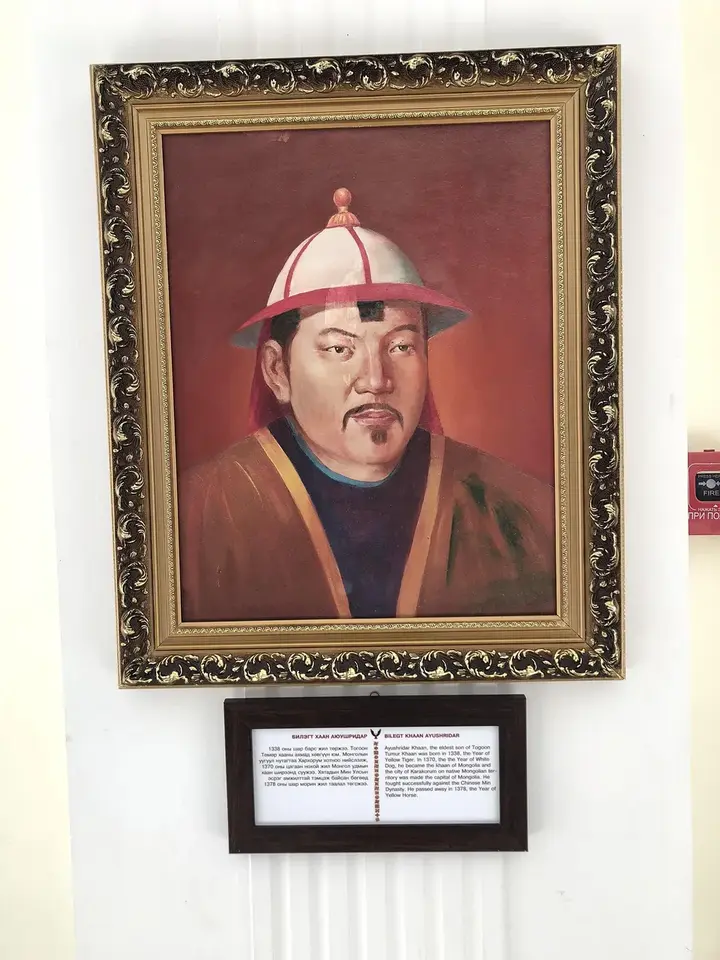
爱猷识理达腊
Ayushiridara (爱猷识理达腊, 1339–1378), clan name Borjigin, regnal title Biligtü Khan, of Mongol ethnicity, was the eldest son of Emperor Huizong of Yuan (Toghontemür, Emperor Shundi) and Empress Gi (Öljei Khutugh), the last crown prince of the unified Yuan dynasty, and the second emperor of Great Yuan following its retreat to the northern steppes (Emperor Zhaozong of Northern Yuan). In his early youth, Ayushiridara was fostered…
Ayushiridara (爱猷识理达腊, 1339–1378), clan name Borjigin, regnal title Biligtü Khan, of Mongol ethnicity, was the eldest son of Emperor Huizong of Yuan (Toghontemür, Emperor Shundi) and Empress Gi (Öljei Khutugh), the last crown prince of the unified Yuan dynasty, and the second emperor of Great Yuan following its retreat to the northern steppes (Emperor Zhaozong of Northern Yuan). In his early youth, Ayushiridara was fostered in the household of Right Grand Councilor Toghto, where he was immersed in Chinese culture and Neo-Confucian classics. In 1349, he entered the Duanben Hall under the tutelage of prominent Han minister Li Haowen, systematically mastering Confucian statecraft and historical precedents. In 1353, he was formally invested as Crown Prince. Amid the late Yuan Red Turban rebellions, severe factionalism engulfed the central court; Ayushiridara and Empress Gi clashed with Emperor Huizong's loyalists, allying with Köke Temür (Wang Baobao) against warlord Bolad Temür. In 1368, Ming general Xu Da captured Dadu, forcing Ayushiridara and Emperor Huizong to flee north to Kaiping and Yingchang. In 1370, Emperor Huizong died in Yingchang, and Ayushiridara broke through Ming encirclement to Karakorum (Harhorin), where he ascended the imperial throne and adopted the reign title Xuanguang, known historically as Emperor Zhaozong of Northern Yuan. In 1372, Emperor Taizu of Ming (Zhu Yuanzhang) mobilized 150,000 elite troops under Xu Da, Li Wenzhong, and Feng Sheng in a three-pronged invasion to capture Karakorum and extinguish Northern Yuan. Demonstrating resolute strategic composure, Ayushiridara appointed veteran commander Köke Temür as central army commander. Employing deep Fabian tactics along the Tuul and Orkhon rivers, the Northern Yuan forces lured the Ming vanguard into a devastating ambush, winning the decisive "Battle of Lingbei," annihilating tens of thousands of Ming elite troops and shattering Ming aspirations to subjugate the steppes. This triumph enabled Northern Yuan to secure its territorial domain across Mongolia and sustain imperial legitimacy. Ayushiridara passed away in Karakorum in 1378 at the age of forty, receiving the temple name Zhaozong. His life witnessed the fall of Yuan authority across China proper while cementing the survival of the imperial Great Yuan state on the northern steppes.
Eldest son of Emperor Huizong; his mother Lady Gi was elevated to Second Empress (Empress Gi).
Enrolled in Duanben Hall to study Confucian classics and imperial precedents under Li Haowen.
Officially proclaimed Crown Prince of Great Yuan, granted the golden seal, and placed in charge of palace bureaus.
Empress Gi sought to pressure Huizong to abdicate, embroiling the prince in bitter central factional strife.
Warlord Bolad Temür invaded Dadu and confined Empress Gi; Ayushiridara escaped to Taiyuan to join Köke Temür.
Köke Temür escorted the prince back to Dadu; Bolad Temür was assassinated, and the prince assumed supreme command.
Ming armies approached Dadu; Ayushiridara accompanied Huizong in a midnight retreat to Kaiping.
Huizong died at Yingchang; Ayushiridara escaped to Karakorum and ascended the throne as Emperor Zhaozong.
Commissioned Köke Temür to ambush Xu Da's 150,000-man Ming army at Lingbei, securing northern territories.
Passed away in Karakorum after an eight-year reign at age forty; canonized with the temple name Zhaozong.
Ayushiridara was born on December 24, 1339, in the imperial palace of Dadu. His birth mother, Lady Gi, originally a tribute lady from Goryeo, was elevated to Second Empress (Empress Gi) in 1340 following the birth of the imperial son. In the same year, Emperor Huizong eliminated the former heir presumptive El Tegüs (son of Emperor Wenzong), and because the infant son born to Empress Bayan Khutugh died prematurely, Ayushiridara became the undisputed heir to the Great Yuan throne.
Following imperial custom, young princes were fostered in ministerial residences. Ayushiridara was placed in the household of Right Grand Councilor Toghto, regarding Toghto as his foster father and growing up alongside Toghto's son Kharachan. The Toghto household was deeply immersed in Chinese literary culture; Ayushiridara began his education under Han scholar Zheng Shen, studying the Classic of Filial Piety and Analects. Returning to the palace at age six, he was instructed in the Uyghur-Mongol script in 1348 and Chinese classics in 1349. In October 1349, Emperor Huizong established the Duanben Hall within the palace, appointing renowned scholar and Vice Supervisor of the Household Li Haowen to direct the prince's education.
Li Haowen compiled specialized textbooks, including the eleven-volume Essential Lessons of the Classics for Duanben Hall, 106 chapters of Historical Stories of Dynastic Rulers, and the Grand Precepts for Imperial Guidance. Ayushiridara demonstrated sharp intelligence, memorizing thousands of characters daily, mastering Chinese poetry, and learning the qin and se zithers. Palace attendants once released hunting falcons and hounds along the corridors to tempt him away from his books, yet the prince remained seated serenely at his desk, absorbed in study. Contemporary poet Zhang Yu commemorated his dedication in verse: "Deep in Duanben Hall the embroidered couch stands high; scholars gather round with literary grace. While astral riders know but horses, he grows accustomed to gold paper and jade brushes."
In June 1353, Emperor Huizong issued an imperial edict formally investing fourteen-year-old Ayushiridara as Crown Prince of Great Yuan, bestowing a golden seal and establishing official household bureaus. However, across central and southern China, the Red Turban rebellions had erupted with unstoppable fury, shaking the dynasty to its foundations. Yet instead of uniting against external rebellions, the imperial court in Dadu descended into destructive internecine strife.
As the Crown Prince grew to adulthood, Empress Gi's political ambitions surged. From 1358 onward, frustrated by Huizong's indolence and indulgence in esoteric palace rituals, Empress Gi privately approached Grand Councilor Taiping, urging him to force Huizong's abdication so Ayushiridara could take the throne. Taiping firmly refused, citing ancestral loyalty; consequently, the Empress and Crown Prince regarded Taiping as an adversary and engineered his banishment and death. Subsequently, the Crown Prince built a powerful palace faction, dominating the Bureau of Imperial Household Affairs (Zhongzheng Yuan) and the Censorate, employing eunuch Bak Bul-hwa to manage inner affairs, which brought him into open conflict with Huizong's "Emperor's Faction."
This central factional struggle soon escalated into regional civil wars among rival warlords. Shaanxi commander Bolad Temür supported the Emperor's faction, while Chaghan Temür and his adopted son Köke Temür (Wang Baobao) in Shanxi backed the Crown Prince. In 1364, Bolad Temür invaded Dadu under the banner of "clearing treacherous courtiers," imprisoning Empress Gi and abolishing the Crown Prince's bureaus. Ayushiridara fled on horseback under cover of darkness, riding continuously to Köke Temür's headquarters in Taiyuan. In 1365, Köke Temür marched on Dadu on behalf of the Crown Prince. Huizong ordered Bolad Temür assassinated, allowing Ayushiridara to re-enter Dadu under Köke Temür's armed escort. Huizong was compelled to appoint the Crown Prince Grand Marshal Pacifying the Army, granting him supreme command over empire-wide forces.
Beyond inner court politics, Ayushiridara became deeply involved in relations with Goryeo. Empress Gi's relatives in Goryeo, led by Gi Chul, had monopolized power relying on Yuan imperial backing. In 1356, King Gongmin of Goryeo purged the Gi clan and severed tributary allegiance. Weeping bitterly, Empress Gi urged Huizong and the Crown Prince to dispatch a punitive expedition.
In 1362, Ayushiridara led forces to Liaoyang, mobilizing regional troops and enthroning royal kinsman Tas Temür as new ruler of Goryeo before dispatching an army across the Yalu River. However, Yuan forces suffered a crushing defeat at Anju at the hands of Goryeo commanders Choe Yeong and Yi Seong-gye. This military failure damaged the Crown Prince's international prestige and led Liaodong commanders like Naghachu to pursue semi-autonomous courses. Simultaneously, civil strife between Bolad Temür and Chaghan Temür ravaged northern China. Ayushiridara issued princely edicts attempting to mediate, yet his favoritism toward Chaghan Temür deepened animosities, leaving northern frontier defenses fractured.
Following his accession in Karakorum, Ayushiridara displayed adept steppe diplomacy. He dispatched envoys to Goryeo and Liaodong, investing King Wang Jeon as Left Vice Director of the Eastern Expedition Branch Secretariat, restoring formal tributary relations. Concurrently, he supported Naghachu's fortified redoubt at Jinshan, creating a dual-pronged defensive alignment shielding eastern Mongolia and northern frontiers against Ming advances.
The decade-long internal strife exhausted the military reserves and economic vitality of the Yuan empire in China proper. Following Bolad Temür's demise, distrust arose between Ayushiridara and Köke Temür, prompting the prince to encourage northwestern generals Li Siqi and Zhang Liangbi to oppose Köke Temür, paralyzing northern defenses just as Ming forces advanced.
In July 1368, Ming generals Xu Da and Chang Yuchun led a massive northern expedition, capturing Tongzhou and closing in on Dadu. Recognizing that defeat was inevitable, Emperor Huizong and Crown Prince Ayushiridara abandoned resistance. On the night of September 10, 1368, the imperial family and hundreds of mounted attendants opened the Jiande Gate and fled north, terminating nearly a century of unified Yuan rule over China proper.
The court retreated to Kaiping (Shangdu). In June 1369, Chang Yuchun captured Kaiping, driving Huizong and Ayushiridara into Yingchang near Lake Dali. Yingchang suffered from severe supply shortages and epidemics. On May 23, 1370, sixty-one-year-old Emperor Huizong died in Yingchang.
As Huizong expired, Ming general Li Wenzhong executed a surprise cavalry strike surrounding Yingchang. Displaying personal courage, Ayushiridara led a small band of mounted warriors, broke through Ming lines, and fled into the vast Gobi Desert, although his son Maidarbal and several consorts were captured and taken to Nanjing. After arduous journeys across desert sands, Ayushiridara arrived at the ancient Mongol capital of Karakorum (Harhorin).
In June 1370, Ayushiridara mounted the imperial throne in Karakorum with the regnal title Biligtü Khan, inaugurating the Xuanguang era as Emperor Zhaozong of Northern Yuan. Setting aside past animosities, he appointed Köke Temür as Left Grand Councilor and Prince of Henan, delegating supreme military command to him. Concurrently, he re-established imperial administration in Karakorum, reconstituting the Secretariat and Bureau of Military Affairs, minting Xuanguang copper coins, and maintaining orthodox Great Yuan calendar titles.
In January 1372, Emperor Taizu of Ming launched a massive 150,000-man northern expedition to eradicate Northern Yuan. General Xu Da led the central column from Yanmen Pass toward Karakorum; Li Wenzhong commanded the eastern column via the Tuul River; Feng Sheng advanced west through Gansu. Taizu aimed to envelop Karakorum and capture Zhaozong.
Facing existential crisis, Emperor Zhaozong and Köke Temür executed a masterly defense. Xu Da's central army advanced unchecked across the Khangai Mountains. Köke Temür practiced scorched-earth tactics, feigning retreat to lure Xu Da deep into the basin between the Tuul and Orkhon rivers. In May 1372, Köke Temür joined forces with commander He Zongzhe, launching a coordinated cavalry encirclement in the Battle of Lingbei.
Fighting raged continuously for twenty-four hours. Northern Yuan cavalry swept down upon exhausted Ming lines, shattering their formations. Xu Da escaped with difficulty, suffering over 10,000 casualties (with some sources citing tens of thousands), while Li Wenzhong's eastern column also suffered severe losses. Lingbei concluded as an overwhelming Northern Yuan triumph.
The victory at Lingbei was the most decisive strategic success in Northern Yuan history. It halted Ming expansion into the steppes, compelled the Ming dynasty to abandon ambitions of annexing Mongolia, and forced them to construct defensive wall networks along the northern border. Zhaozong's leadership preserved Northern Yuan's military strength and established a lasting geopolitical stalemate across the desert.
In April 1378, Ayushiridara died in Karakorum at age forty. The court conferred the temple name Zhaozong, the regnal title Biligtü Khan, and the posthumous name Emperor Wucheng Hexiao. His younger brother Tögüs Temür succeeded to the throne. Emperor Zhaozong weathered the collapse of imperial rule in China, preserving the lineage of Chinggis Khan on the northern plains.
Ayushiridara represented the late Yuan Mongol crown prince with the deepest classical Han education. Fostered in Toghto's household, he studied for years under Li Haowen in Duanben Hall.
Guided by specialized texts on imperial history, he mastered the Six Classics, Mongol and Chinese scripts, poetry, and musical arts. His focus was evidenced when he ignored falcons and hounds paraded before his study hall. This cultural grounding gave him strategic sophistication during complex late Yuan ethnic politics and shaped his commitment to preserving Han-style imperial institutions after retreating to Karakorum.
Ayushiridara's role in the Zhizheng era reflected the institutional decay and warlordism of the late Yuan dynasty. Supported by Empress Gi, he was drawn into a premature struggle to compel Huizong's abdication.
This conflict resulted in Grand Councilor Taiping's death, the rise of eunuch Bak Bul-hwa, and fierce civil war between Bolad Temür and Köke Temür. The destructive strife exhausted imperial treasuries and veteran forces, creating a power vacuum in southern and central China that facilitated Zhu Yuanzhang's rapid northern conquest.
Amid the total collapse of Yuan authority across China, Ayushiridara demonstrated unyielding resolve. When Yingchang fell and his family was captured, he led a small force through Ming cavalry lines, traversed the Gobi Desert, and reached Karakorum.
Proclaiming the Xuanguang era and reconciling with Köke Temür, he rebuilt central governance, minted imperial coins, and preserved Great Yuan dynastic continuity, preventing the regime from disintegrating into fragmented pastoral tribes.
The Battle of Lingbei in 1372 stands as one of the pivotal military confrontations in fourteenth-century Eurasia. Confronted by Xu Da's 150,000-strong invasion army, Zhaozong and Köke Temür executed deep defensive luring tactics.
Trapping Ming columns between the Tuul and Orkhon rivers, Northern Yuan cavalry routed Xu Da's host, shattering the myth of Ming invincibility and forcing Zhu Yuanzhang to adopt defensive wall fortifications. Lingbei secured Northern Yuan survival, establishing a decades-long strategic balance between Ming and the steppe empire.
FIGURES ASSOCIATED WITH THIS DYNASTY