Biography
Dong Zhuo's Cavalry Commander and Campaigns in Guandong
Guo Si originated from the remote northwestern frontier of Liangzhou, where mixed Han and Qiang populations cultivated formidable horsemanship and martial prowess. He enlisted in regional frontier garrisons and joined Dong Zhuo's forces during pacification campaigns in the northwest. Impressed by his boldness, proficiency in mounted combat, and capacity to direct aggressive cavalry maneuvers, Dong Zhuo elevated Guo Si to the rank of colonel within his core inner circle. Liu Ai, Chief Clerk to Dong Zhuo, observed that Li Jue and Guo Si possessed tactical instincts and field command capabilities exceeding those of eastern warlord Sun Jian.
In 1889, Dong Zhuo led his western legions into Luoyang following the chaos triggered by General-in-Chief He Jin, deposing the young emperor and establishing military hegemony over the Han court. In response, regional leaders across eastern China organized a coalition to overthrow him. In 191, after burning Luoyang and relocating the capital west to Chang'an, Dong Zhuo dispatched his son-in-law, General of the Household Niu Fu, to fortify Shan County (in modern Shan Prefecture, Henan) as a strategic bastion protecting the western approaches.
Niu Fu deployed Guo Si alongside colonels Li Jue and Zhang Ji at the head of tens of thousands of infantry and cavalry to conduct spoiling attacks beyond the Hangu Pass. Veteran Han commander Zhu Jun attempted to counter them in Henan, but Guo Si and Li Jue crushed his formations in a pitched engagement at Zhongmou. Capitalizing on their victory, Guo Si's forces swept across Chenliu and Yingchuan, looting towns, slaughtering populations, and seizing tens of thousands of livestock and captives, which greatly solidified Guo Si's standing among Liangzhou commanders.
The Liangzhou Counteroffensive and the Fall of Chang'an
In April 192, Minister over the Masses Wang Yun and General of the Household Lü Bu orchestrated the assassination of Dong Zhuo within Weiyang Palace. Shortly thereafter, Niu Fu was betrayed and murdered by his own subordinates in Shan County, leaving Liangzhou troops dispersed and leaderless. Terrified of collective retribution, Li Jue, Guo Si, and Zhang Ji sent emissaries to Chang'an requesting an imperial amnesty. However, Wang Yun arrogantly refused to grant pardons to Liangzhou officers, declaring an intention to disband their units and execute key ringleaders.
Confronted with imminent destruction, the officers contemplated disbanding their troops and fleeing in disguise to their northwestern hometowns. Colonel Jia Xu intervened decisively, warning that solitary fugitives could be arrested by a single village head. Jia Xu urged them instead to lead their troops westward, rallying fellow Liangzhou soldiers along the way to attack Chang'an, avenge Dong Zhuo, and take control of the state apparatus.
Convinced by Jia Xu's logic, Guo Si and Li Jue spread rumors throughout the countryside that the imperial court planned to exterminate all Liangzhou people. Tens of thousands of desperate soldiers rallied to their banners. When Wang Yun sent former Dong Zhuo commanders Hu Zhen and Xu Rong to intercept them at Xinfeng, Xu Rong was killed in battle and Hu Zhen surrendered. By the time Guo Si and Li Jue reached the walls of Chang'an, their combined host had swelled to over one hundred thousand seasoned fighters, completely encircling the capital.
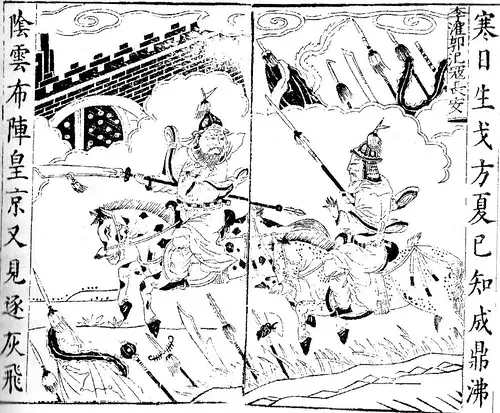
During the siege, Guo Si commanded operations outside the north gate. Relying on his personal combat prowess, Lü Bu rode forth and challenged Guo Si to single combat to decide the contest. Guo Si accepted the challenge and engaged Lü Bu in mounted combat. Lü Bu struck Guo Si with his spear, inflicting a serious shoulder wound; however, Guo Si's escort cavalry charged forward, rescuing their commander from capture.
In June 192, internal disaffection broke Chang'an's defenses. Shu soldiers guarding the city gates revolted and admitted the besiegers. Liangzhou infantry and cavalry flooded into the streets, routing Lü Bu in brutal urban warfare and forcing him to flee east with several hundred horsemen. Liangzhou soldiers sacked the capital, killing high-ranking ministers including Minister of Ceremonies Zhong Fu, Grand Groom Lu You, and Grand Herald Zhou Huan. Wang Yun was captured and executed in the public marketplace, while Guo Si and Li Jue coerced Emperor Xian into issuing decrees legitimizing their rebellion and handing them total control of the imperial government.
Dictatorship in Chang'an and Repelling Western Invasions
With Chang'an under their absolute military control, Guo Si and Li Jue consolidated their authority over the court. Li Jue appointed himself General of Chariots and Cavalry, Director of Retainers, and Marquis of Chiyang, while Guo Si became General of the Rear and Marquis of Meiyang, with fellow commander Fan Chou named General of the Right and Marquis of Wannian. The three warlords dominated the imperial Secretariat, treating imperial prestige with utter contempt.
In March 194, northwestern warlords Ma Teng and Han Sui formed an alliance with court conspirators including Imperial Attendant Ma Yu, Remonstrance Consultant Zhong Shao, and Yizhou Governor Liu Yan to launch a combined offensive against Chang'an. As allied forces approached the capital, Guo Si, Li Jue, and Fan Chou mobilized their elite cavalry. In a decisive confrontation at Changpingguan, Liangzhou forces smashed the coalition, killing over ten thousand enemy troops. Conspirators within the capital were executed, while Ma Teng and Han Sui fled back into Liangzhou.
Following this victory, Fan Chou allowed his fellow townsman Han Sui to disengage without pursuit, arousing the deep paranoia of Li Jue. Soon after, Li Jue assassinated Fan Chou at a banquet and annexed his troops. This purge terrified remaining commanders, shattering the fragile trust between Guo Si and Li Jue. Although the court subsequently promoted Guo Si to General of Chariots and Cavalry, the rivalry between the two surviving dictators escalated into open hostility.
Feud with Li Jue and Devastation of the Imperial Capital
The simmering feud between Guo Si and Li Jue erupted into open warfare in early 195. Li Jue frequently hosted Guo Si at banquets, occasionally hosting him overnight. Guo Si's wife, harboring intense jealousy and fearing that Li Jue intended to murder her husband and seize his command, actively sabotaged their relationship. On one occasion, she smeared fermenting beans onto food sent by Li Jue and fed it to a dog, which died from unrelated causes, convincing Guo Si that he was being poisoned. Later, after falling ill following an evening banquet at Li Jue's residence, Guo Si consumed liquid feces to induce vomiting, completely convinced of Li Jue's murderous intent.
In March 195, Guo Si conspired with military commanders close to the emperor, including Yang Ding, intending to seize Emperor Xian during an imperial audience and transfer him to his own camp. However, word leaked to Li Jue, who acted preemptively. Li Jue dispatched his nephew Li Xian with three thousand elite horsemen to storm the imperial palace. They seized Emperor Xian and Empress Fu, forced them into crude carts, transported them to the fortified northern fortress, and set fire to palace buildings after pillaging imperial silks and libraries.
Enraged by Li Jue's preemptive strike, Guo Si retaliated by surrounding the Secretariat and government compounds, seizing over one hundred high-ranking ministers—including Grand Commandant Yang Biao and Minister of Works Zhang Xi—and detaining them as human shields in his camp. The sovereign and the entire civil administration were thus reduced to pawns in an armed contest between competing warlords.
For several months, Chang'an was transformed into an urban battlefield. Catapults and arrows rained down between the northern and southern encampments, with missiles frequently striking the emperor's quarters. Daily skirmishes swept through residential avenues as both sides plundered markets and dwellings. Compounded by severe regional droughts, this urban civil war decimated the Guanzhong basin. Grain prices escalated to half a million cash per picul, driving populations to cannibalism. Unburied skeletons lined city avenues, and hundreds of thousands of civilians perished from starvation and violence.
Emperor Xian dispatched courtier Huangfu Li to negotiate an armistice. While Guo Si agreed to comply with imperial instructions, Li Jue reacted with fury, denouncing Guo Si as an insignificant horse thief who had no right to claim parity. Only when General Zhang Ji arrived from Shan County with an army to mediate did the exhausted factions agree to halt hostilities and permit Emperor Xian to embark on an eastward journey toward Luoyang.
Pursuing the Imperial Train and the Massacre at Hongnong
In July 195, Emperor Xian departed the ruins of Chang'an, escorted by Guo Si, Yang Ding, Yang Feng, and Dong Cheng, while Li Jue remained at Chiyang. As the entourage moved eastward past Xinfeng, Guo Si realized that leaving the Guanzhong plains would terminate his leverage over the central government.
Guo Si secretly plotted to divert the imperial carriage toward Gaoling or the western hills to reassert personal custody over the monarch. However, Imperial Attendant Yang Qi detected the plot and alerted Emperor Xian, prompting loyalist generals Yang Feng and Dong Cheng to position their troops defensively. Realizing his plan had been uncovered, Guo Si abandoned the convoy and retreated into the southern mountains, where he made common cause with his former adversary Li Jue to launch a joint pursuit and recapture the emperor.
In November 195, combined armies led by Li Jue and Guo Si overtook the imperial train at Dongjian in Hongnong Commandery. The escort forces led by Dong Cheng and Yang Feng were overwhelmed by the ferocity of the Liangzhou cavalry. The battle turned into a rout; over one hundred court officials were slaughtered, imperial carriages and documents were seized, and imperial regalia was looted.
The emperor fled toward Caoyang under the protection of White Wave militia leaders Li Le and Han Xian and Southern Xiongnu cavalry led by Qubei. However, Li Jue and Guo Si mounted renewed assaults, defeating the defenders once more. Emperor Xian was forced to cross the freezing Yellow River on small boats under cover of night. Soldiers desperate to escape clung to the gunwales, only for their fingers to be severed by sword strokes, filling the river with floating corpses. After the imperial train reached Anyi and Eastern Guandong warlords moved to receive the monarch, Li Jue and Guo Si recognized that they could no longer cross the river and withdrew their battered forces to Guanzhong.
Isolation in Guanzhong and Downfall
In 196, Emperor Xian reached the ruins of Luoyang, where Cao Cao arrived with a disciplined army, escorting the emperor to the new capital at Xuchang and securing absolute legitimacy under imperial authority.
Deprived of the imperial court, Li Jue and Guo Si lost all remaining legal and political authority. Their forces dwindled rapidly amidst severe supply shortages and regional hostility. The prominent families and commoners of Guanzhong harbored profound hatred for the Liangzhou warlords, and subordinate commanders defected systematically. Guo Si retreated into the rugged countryside surrounding Meiyang, where his remaining troops disintegrated into bands of marauding bandits.
In 197, as Cao Cao systematically reasserted imperial authority over the northwestern commanderies, Guo Si's subordinate officer Wu Xi realized that their faction was doomed. In a surprise night attack within the Meiyang encampment, Wu Xi assassinated Guo Si. Wu Xi severed Guo Si's head and dispatched it to Cao Cao's headquarters in Xuchang. The warlord who had terrorized the capital, routed imperial commanders, and brought ruin to the Guanzhong plains met his end at the hands of his own soldier, terminating the influence of his military faction.
Major Achievements
Instigating the Liangzhou Counteroffensive and Sacking the Imperial Capital
In the critical weeks following Dong Zhuo's assassination in 192, when the imperial government's refusal to grant amnesty pushed Liangzhou forces toward total destruction, Guo Si played an essential role alongside Li Jue in adopting Jia Xu's audacious counteroffensive strategy.
By mobilizing provincial solidarity among demoralized soldiers, Guo Si helped assemble an army of over one hundred thousand men that stormed Chang'an, overthrowing Wang Yun's fledgling civil administration. His personal duel against Lü Bu highlighted the aggressive martial prowess that characterized frontier cavalry commanders. This conquest permanently dismantled the fragile constitutional authority of the late Han central government, reducing the imperial court to a captive instrument of rival warlords and accelerating the division of the realm into independent regional domains.
Holding the Imperial Court Hostage and Devastating the Guanzhong Region
Throughout their three-year joint dominance in Chang'an, Guo Si and Li Jue subjected the imperial capital to unprecedented political coercion and material exploitation. Lacking statecraft and interested primarily in military dominance, their rule represented naked military extortion.
When internal rivalries fractured their partnership, Guo Si took the extreme measure of detaining over one hundred court ministers as physical hostages in his military camp, matching Li Jue's abduction of the emperor. The resulting urban warfare between their armies destroyed palaces, markets, and municipal infrastructure. This conflict ruined the agricultural prosperity and demographic foundations that had sustained Chang'an for four centuries, transforming the fertile Guanzhong basin into an unpopulated wasteland and irrevocably shifting the geopolitical center of northern China eastward.
Pursuing the Imperial Eastward Migration and Accelerating the Rise of Cao Cao
The fierce pursuit of Emperor Xian across Hongnong in 195 marked the final dramatic military campaign conducted by the Liangzhou military faction. In attempting to regain custody of the monarch, Guo Si demonstrated formidable battlefield effectiveness, crushing escort armies at Dongjian and Caoyang.
However, this relentless aggression permanently severed any possibility of accommodation between the Liangzhou commanders and the traditional court elite. By driving the desperate emperor across the Yellow River and into the protective embrace of Cao Cao, Guo Si's violent pursuit directly provided Cao Cao with the opportunity to receive the monarch, consolidate political legitimacy, and establish the foundations of the Cao Wei state. Consequently, Guo Si's actions precipitated his own swift political irrelevance and fatal demise.