Birth into Eminent Lineage
Born into the prominent Deng clan of Xinye, Nanyang, inheriting a prestigious tradition rooted in founding general Deng Yu.
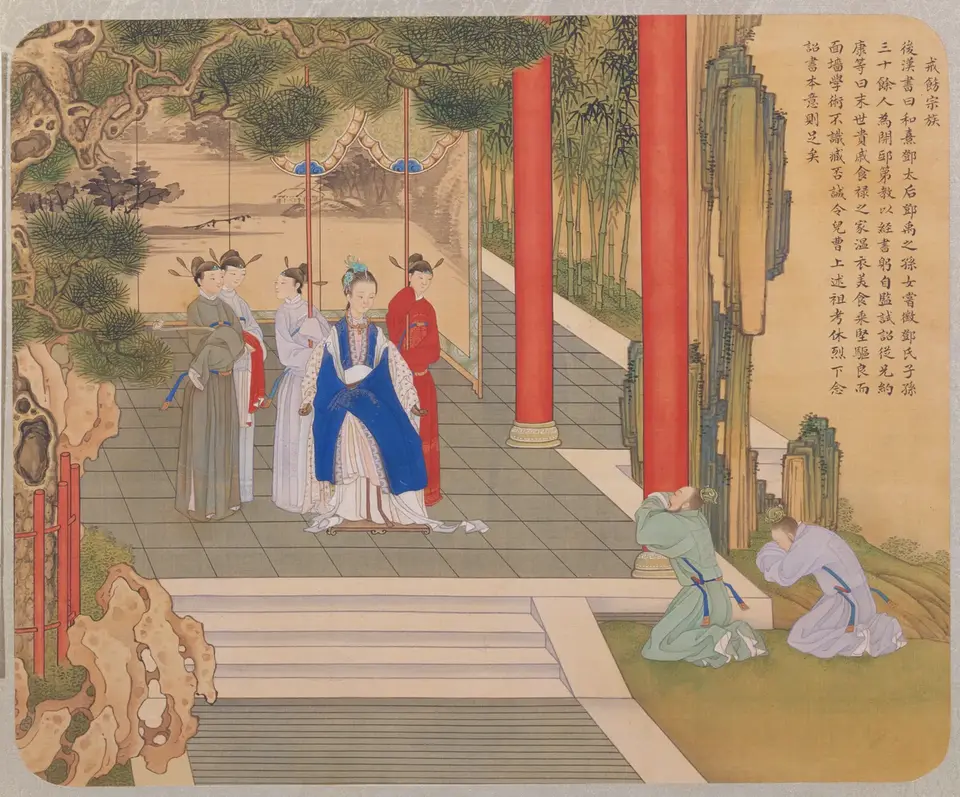
邓绥
Deng Sui (81–121) was a native of Xinye County in Nanyang Commandery, the granddaughter of the founding Eastern Han statesman Deng Yu and the daughter of Deng Xun, Colonel Protecting the Qiang. Renowned as one of the most capable female rulers in Chinese history and the second empress of Emperor He of Han, she is posthumously remembered as Empress Hexi. Having mastered classical histories, mathematics, and calligraphy in her…
Deng Sui (81–121) was a native of Xinye County in Nanyang Commandery, the granddaughter of the founding Eastern Han statesman Deng Yu and the daughter of Deng Xun, Colonel Protecting the Qiang. Renowned as one of the most capable female rulers in Chinese history and the second empress of Emperor He of Han, she is posthumously remembered as Empress Hexi. Having mastered classical histories, mathematics, and calligraphy in her youth, Deng entered the imperial palace in 95 and was consecrated as empress in 102. Following Emperor He's demise in 105, she enthroned the hundred-day-old infant Emperor Shang, assuming supreme regency as empress dowager and issuing imperial rescripts in her own name. When Emperor Shang died in infancy the following year, Deng elevated the thirteen-year-old Liu Hu (Emperor An), continuing her direct reign over the empire for sixteen continuous years. During her administration, the realm endured severe natural calamities, catastrophic Yellow River breaches, persistent droughts, and devastating western Qiang nomadic rebellions. Deng ruled with commanding resolution, enforcing frugal court expenditures, distributing relief grain, promoting brilliant commanders like Yu Xu to suppress frontier insurgencies, and patronizing literary scholars like Ban Zhao and Xu Shen. Her steady governance steered the Eastern Han through acute domestic and foreign crises, earning her enduring historical praise as an exemplary female sovereign.
Born into the prominent Deng clan of Xinye, Nanyang, inheriting a prestigious tradition rooted in founding general Deng Yu.
Admitted to the imperial palace due to her moral reputation and classical learning, being created an Imperial Noble Consort the next year.
Enthroned as empress following the deposition of Empress Yin, actively refusing nepotistic promotions for her relatives and enforcing austerity.
Emperor He passed away; she enthroned the infant Emperor Shang and assumed sovereign regency as empress dowager.
Following Emperor Shang's early death, she orchestrated the succession of Emperor An and maintained her personal supervision of the court.
Western Qiang tribes launched a massive uprising across Liangzhou; Deng rejected defeatist proposals to abandon the province and organized defense.
Appointed capable strategists such as Yu Xu and Ren Shang to pacify the Qiang incursions, restoring order along the Hexi Corridor.
Passed away from illness in the Jiade Hall at Luoyang at age forty-one, being entombed with Emperor He in the Shenling Mausoleum.
Deng Sui was born in the sixth year of the Jianchu reign (81) into the distinguished Deng family of Xinye in Nanyang. Her paternal grandfather was Deng Yu, the foremost general among the Cloud Terrace Twenty-Eight Commanders who aided Emperor Guangwu in restoring the Han, while her father Deng Xun had achieved renown as Colonel Protecting the Qiang. Deng Sui demonstrated extraordinary intellectual precocity, reading historical annals at age six and mastering the Book of Songs and the Analects by age twelve. In 95, she was summoned into the imperial palace and officially created an Imperial Noble Consort in 96. Dignified, humble, and observant of court decorum, she consistently maintained respectful restraint despite the overt jealousy of Empress Yin. In 102, after Empress Yin was deposed in connection with witchcraft scandals, Emperor He issued an imperial edict establishing Deng Sui as empress. In this paramount position, Deng adamantly declined excessive enfeoffments for her brothers and drastically reduced lavish luxury tributes from peripheral provinces, establishing an ethos of rigorous frugality.
In the twelfth month of the Yuanxing reign (105), Emperor He passed away at a young age, leaving behind an infant son, Liu Long, who was barely one hundred days old. Deng Sui decisively enthroned the child as Emperor Shang and assumed authority as empress dowager, declaring herself sovereign and personally handling the daily affairs of state. When the young emperor passed away in the autumn of 106, Deng preserved political stability by coordinating with her elder brother, General of Chariots and Cavalry Deng Zhi, to enthrone thirteen-year-old Liu Hu, known as Emperor An. Deng continued to govern as regent. During this era, the Eastern Han empire was battered by relentless environmental catastrophes, including catastrophic floods along the Yellow River, protracted droughts, locust swarms, and earthquakes. To preserve the state, Deng instituted profound administrative austerity, reducing imperial household allowances, curtailing royal banquets, reforming local administration, and distributing public grain reserves to save destitute peasants from starvation.
The most formidable external ordeal of Deng's regency was the widespread Western Qiang insurrection that erupted in 107. Nomadic tribes devastated Liangzhou and the Guanzhong approaches, threatening the imperial heartland. Confronted by defeatist proposals from high ministers advocating the complete abandonment of Liangzhou, Deng forcefully dismissed such concessions, recognizing that relinquishing the western provinces would leave the ancient capital of Chang'an defenseless. She appointed resolute commanders such as Ren Shang and Yu Xu, deploying deceptive logistical tactics and aggressive encirclement to subdue the insurgent tribes over a decade of combat. Alongside frontier defense, Deng ardently championed Confucian scholarship. She invited the renowned female historian Ban Zhao to teach imperial concubines and complete the Book of Han, supported the lexicographer Xu Shen in compiling the groundbreaking analytical dictionary Shuowen Jiezi, and established palace academies for imperial kinsmen. In the third month of 121, Deng Sui died of overwork in the Jiade Hall at Luoyang, aged forty-one, and was laid to rest beside Emperor He in the Shenling Mausoleum.
Throughout her sixteen-year regency, Deng Sui guided the empire through unprecedented environmental crises, historically termed the "Decade of Floods and Droughts." She issued imperial decrees abolishing superfluous palace expenses, dispersing royal hunting parks, paring back imperial banquets, and redirecting immense treasury funds toward famine relief. By dispatching commissioners to oversee the distribution of emergency grain and granting widespread tax remissions to afflicted regions, she ensured the survival of millions of destitute refugees and maintained dynastic cohesion.
When the massive Qiang rebellion broke out and defeatist courtiers lobbied to retreat eastward, Deng exhibited profound strategic vision. She perceived Liangzhou as the geopolitical shield protecting the imperial center and refused to surrender Han territory. By orchestrating nationwide fiscal resources to sustain frontier garrisons and appointing ingenious field commanders, she successfully suppressed the uprisings, reopened the Silk Road, and reaffirmed Han authority over the western marches.
FIGURES ASSOCIATED WITH THIS DYNASTY