Biography
Illustrious Heritage and Imperial Marriage
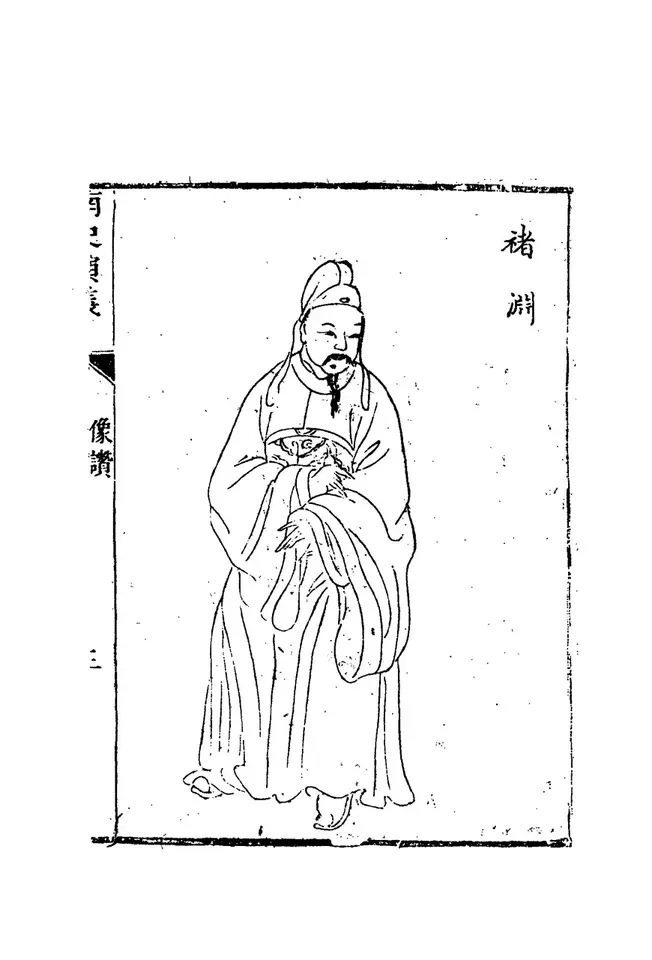
Chu Yuan was born into the prestigious Chu lineage of Yangdi in Henan, one of the foremost aristocratic clans of the southern dynasties. His grandfather Chu Xiuzhi served as Minister of Ceremonies under Emperor Wu of Song, while his father Chu Zhanzhi rose to General of Agile Cavalry and married Princess Shi'an, daughter of Emperor Wu. Steeped from childhood in orthodox Confucian ritual and aristocratic etiquette, Chu Yuan was renowned not only for broad scholarship and gentle speech, but for extraordinary physical elegance, refined posture, and tranquil poise, acclaimed across the southern elite as a paragon of nobility.
In 454, at the age of twenty, Chu Yuan married Princess Nanjun, daughter of Emperor Wen of Song (Liu Yilong). With father and son marrying imperial princesses across two generations, the Chu clan cemented its standing at the absolute apex of court prestige. Following the union, Chu Yuan was appointed Commandant of Escorting Cavalry, subsequently holding refined court offices including Gentleman of Writings and Companion to the Crown Prince.
In 460, upon his father's death, Chu Yuan inherited the ancestral title of Marquis of Duxiang. During the reign of Emperor Xiaowu, he served successively as Gentleman of the Imperial Secretariat, Senior Clerk to the Minister over the Masses, and Vice Director of Personnel. While directing official appointments, he adhered strictly to bureaucratic precedent and impartial decorum, winning broad esteem.
Chu Yuan was exceptionally filial. When his birth mother, Lady Guo, passed away, he observed mourning with such devastating grief that he was emaciated beyond recognition within days. Throughout a year of mourning, he neglected grooming and washing; his natural complexion was visible only where tears had cut paths through the grime on his cheeks. Profoundly moved, Emperor Ming of Song issued a special edict forbidding excessive lamentation and prohibiting condolence visits, ordering him to preserve his health.
Resisting Degeneracy and Gaining Universal Esteem
In 465, the despotic and depraved Emperor Qianfei (Liu Ziye) assumed the throne. His elder sister, Princess Shanyin (Liu Chuyu), pursued unbridled hedonism, petitioning the emperor for thirty handsome male companions to attend her chambers. Enchanted by Chu Yuan's extraordinary looks and aristocratic grace, the princess demanded that the emperor assign Chu Yuan to her mansion.
Liu Ziye ordered Chu Yuan to lodge in the Western Pavilion for ten days. Each night, Princess Shanyin visited his quarters to entice and pressure him. Chu Yuan remained solemn and erect, standing in formal court robes from dusk until dawn without wavering for ten consecutive nights. Enraged, the princess taunted him: "You possess a beard bristling like halberds; how is it that you lack all manly passion?" Chu Yuan serenely replied: "Though unworthy, I would never dare violate the fundamental rites and moral codes of the imperial court." Frustrated, the princess released him. His unyielding purity under intense coercion earned widespread admiration. During this ordeal, Chu Yuan formed an enduring friendship with the princess's husband, He Ji, who so meticulously emulated Chu Yuan's manners that contemporaries nicknamed him "Little Lord Chu."
After Emperor Ming (Liu Yu) assassinated Liu Ziye and ascended the throne, he held Chu Yuan in immense regard, remarking before the assembled court: "Chu Yuan walks with such deliberate and graceful steps that this demeanor alone qualifies him to be a grand chancellor!" He promoted Chu Yuan to Palace Attendant and Minister of Personnel. When the future Emperor Gao of Qi was still heir apparent, he presented Chu Yuan with a magnificent silver-pillar lute (pipa) with a gold-inlaid neck in tribute to his musical artistry.
Chu Yuan possessed legendary equanimity. On one occasion, a fire erupted in his capital residence, smoke and flames rapidly encroaching upon the halls. As household members panicked and fled, Chu Yuan remained calmly seated in his chamber, serenely directing servants to fetch his carriage and only departing once the full ceremonial escort was assembled.
During the early Taishe era, following widespread civil conflicts, Regional Inspector of Xuzhou Xue Andu defected to Northern Wei. Northern Wei forces raided the Huai and Si river regions. Emperor Ming dispatched Chu Yuan to inspect and console northern armies. Upon his return, Chu Yuan astutely diagnosed the vulnerability of the frontier defenses, memorializing that fortresses west of Xuyi were understrength and urging immediate reinforcement of Ruyin and Jingting, which Emperor Ming adopted to stabilize the southern border.
Imperial Co-Regency and Court Intrigues
In his twilight years, Emperor Ming grew pathologically suspicious, executing numerous prominent imperial princes. In 472, falling critically ill, Emperor Ming summoned Chu Yuan to the palace. Intending to eliminate his capable younger brother, Prince of Jian'an Liu Xiuren, the emperor was met with tearful and impassioned remonstrance from Chu Yuan, who condemned fraternal slaughter. Though the execution proceeded, Emperor Ming deeply respected Chu Yuan's integrity.
Shortly before his death, Emperor Ming issued an imperial decree appointing Chu Yuan Director of the Imperial Secretariat, General of the Guard, and Cavalier Regular Attendant, charging him alongside Prefect of the Masters of Writing Yuan Can with the solemn regency of the ten-year-old Emperor Houfei (Liu Yu, Prince of Cangwu). Grasping their hands, the dying emperor committed the future of the state to their stewardship.
Following the accession of the young emperor, Chu Yuan and Yuan Can governed collaboratively, promoting institutional frugality to counter the excessive luxury of preceding reigns. However, palace eunuchs Ruan Dianfu and Wang Daolong usurped administrative channels, openly practicing bribery and destabilizing governance. In 474, Prince of Guiyang Liu Xiufan rebelled, advancing his armies directly to the gates of Jiankang. Chu Yuan and Yuan Can garrisoned the imperial palace to calm court and civilian panic, while General of the Right Guards Xiao Daocheng engaged and destroyed the rebel army at Xinting.
Prior to the rebellion, while serving as Intendant of Danyang, Chu Yuan had observed Xiao Daocheng passing through the streets, remarking presciently to his cousin Chu Zhao that Xiao possessed the bearing of a future ruler. Following the suppression of Liu Xiufan, Xiao Daocheng was elevated to Leader of the Central Guard; when Xiao modestly submitted a memorial offering to decline the promotion, Chu Yuan and Yuan Can forcefully persuaded him to accept. Xiao Daocheng, Yuan Can, Chu Yuan, and Liu Bing became known as the "Four Nobles," consolidating Xiao's command over the central palace guards.
The Conspiracy at Stone City
As Emperor Houfei matured, his cruelty escalated into unmanageable madness. He frequently roam the streets at night with armed retinues to rob merchants, murdered subjects with weapons, and repeatedly threatened high ministers. Xiao Daocheng deliberated state affairs with Yuan Can and Chu Yuan. While Yuan Can insisted the young ruler might still be reformed and that deposing emperors was unwarranted, Chu Yuan privately concluded that the Liu Song mandate was exhausted and threw his support entirely behind Xiao Daocheng.
In July 477, Xiao Daocheng coordinated with the emperor's attendants to assassinate Liu Yu in his sleep, elevating Prince of Ancheng Liu Zhun as Emperor Shun. Xiao Daocheng assumed total control of the imperial administration as Minister of Works and Supervisor of the Masters of Writing.
Xiao Daocheng's usurpation provoked profound outrage among Liu Song loyalists. In the winter of 477, Regional Inspector of Jingzhou Shen Youzhi mobilized an army in Jiangling to march against Xiao Daocheng. Sensing an opportunity to restore imperial authority, Yuan Can conspired with Minister over the Masses Liu Bing, General Huang Hui, and Ren Houbo to mount a counter-offensive from the Stone City, planning to coordinate with palace guards to eliminate Xiao. Warning that Chu Yuan might betray them, conspirators advised secrecy, but Yuan Can, relying on their shared deathbed charge from Emperor Ming, dispatched an emissary to enlist Chu Yuan's cooperation.
Betraying all regency obligations, Chu Yuan immediately rode to Xiao Daocheng's headquarters to disclose the entire plot. When Xiao Daocheng consulted him on strategy, Chu Yuan counseled: "Shen Youzhi's distant revolt will fail to sustain itself; your foremost duty is to crush the internal threat at Stone City and secure the capital." Xiao Daocheng deployed elite assault forces against Stone City. The citadel fell, and Yuan Can, Liu Bing, and their families were slaughtered. Chu Yuan's betrayal extinguished the last loyalist defense of the Liu Song dynasty.
Foundational Governance in Qi and Public Disgrace
With internal opposition crushed, the Liu Song dynasty rapidly unraveled. In 479, Xiao Daocheng was created King of Qi with the Nine Bestowals. Chu Yuan enthusiastically advocated for the dynastic transition, citing the Western Jin precedent of He Zeng transferring from Wei to Jin service to request employment in the Qi royal administration. In April 479, Emperor Shun was forced to abdicate, and Xiao Daocheng ascended the throne as Emperor Gao of Southern Qi.
In 479, Emperor Gao rewarded Chu Yuan by appointing him Minister over the Masses (Situ), Palace Attendant, Director of the Imperial Secretariat, and Supervisor of the Masters of Writing, ennobling him as Duke of Nankang with a fief of 3,000 households. As premier chancellor, Chu Yuan codified the imperial protocol requiring separate formal edicts for appointing Supervisors of the Masters of Writing, establishing a lasting administrative standard. When Northern Wei forces renewed frontier attacks, Emperor Gao contemplated drafting all unemployed aristocrats into military service; Chu Yuan forcefully intervened, arguing that such conscription was useless in combat and would cause domestic panic, prompting the emperor to rescind the order.
Despite his supreme office, Chu Yuan's betrayal of Yuan Can and abandonment of the Song dynasty drew universal contempt from the elite and common populace. A popular song in Jiankang lamented: "Better to die with Yuan Can at Stone City than to live like Chu Yuan!" Contemporary satirists ridiculed his pale eyes, calling them "a white rainbow piercing the sun," an omen of Song's ruin.
During an imperial assembly, Chu Yuan held up a waist fan to block the sun; outspoken scholar Liu Xiang brushed past him, sneering: "Having committed such shameful deeds, you should have no face to meet others; what use is hiding behind a fan?" Chu Yuan angrily barked: "How dare a humble commoner speak with such insolence!" Liu Xiang retorted: "I merely lack the cruelty to slaughter Yuan Can and Liu Bing for wealth and rank, which is why I remain an honest commoner!" Veteran general Shen Wenji publicly rebuked him before Emperor Wu: "Chu Yuan proclaims himself a loyal chancellor; I truly do not know how he will face Emperor Ming of Song when he descends into the underworld!"
Even his immediate family disdained his choices. His cousin Chu Zhao openly condemned his treachery and prayed for his early demise. His eldest son, Chu Ben, was so overcome with grief and shame over the destruction of the Liu Song that he steadfastly refused all office under Southern Qi, dying of voluntary starvation and sorrow.
In 482, Emperor Gao died, and Emperor Wu (Xiao Ze) succeeded him. Distressed by ominous celestial phenomena, Chu Yuan repeatedly petitioned for retirement due to failing health, though the emperor repeatedly declined his requests. In autumn 482, Chu Yuan died at his ministerial residence at the age of forty-eight.
Throughout his career, Chu Yuan maintained personal asceticism. He distributed imperial gold and silk gifts to impoverished clan members and disciples, leaving no wealth upon his death and incurring debts totaling hundreds of thousands of cash. Emperor Wu wept bitterly, posthumously granting him the title of Grand Preceptor, sixty ceremonial lictors, and the posthumous name Wenjian. Though eminent scholar Wang Jian composed an elaborate eulogy extolling his virtue and achievements, historical verdict permanently condemned his betrayal of regency fidelity.