Born in Xiangyang
Born into a prominent Xiangyang military clan, displaying precocious intellect by memorizing classical poems at age six and practicing calligraphy at seven.
米芾
Mi Fei (米芾, 1051–1107, also widely transcribed as Mi Fu), courtesy name Yuanzhang (元章), literary names Xiangyang Jushi (襄阳居士) and Haiyue Waishi (海岳外史), and celebrated by contemporaries as Mi Nangong (米南宫), Mi Xiangyang (米襄阳), and Mi Dian (米颠), was a native of Xiangyang who later settled in Dantu, Runzhou. He was an eminent calligrapher, painter, connoisseur, and art theorist of the Northern…
Mi Fei (米芾, 1051–1107, also widely transcribed as Mi Fu), courtesy name Yuanzhang (元章), literary names Xiangyang Jushi (襄阳居士) and Haiyue Waishi (海岳外史), and celebrated by contemporaries as Mi Nangong (米南宫), Mi Xiangyang (米襄阳), and Mi Dian (米颠), was a native of Xiangyang who later settled in Dantu, Runzhou. He was an eminent calligrapher, painter, connoisseur, and art theorist of the Northern Song dynasty. In the history of Chinese calligraphy, Mi Fei is revered alongside Su Shi, Huang Tingjian, and Cai Xiang as one of the Four Masters of the Song, representing the highest summit of the Song dynasty expressive calligraphic aesthetic. Mi Fei was born into an illustrious military lineage, with his fifth-generation ancestor Mi Xin serving as a founding general of the Northern Song. Because his mother had served as wet nurse and governess to Grand Empress Dowager Gao, Mi Fei entered civil officialdom through hereditary imperial privilege as Collator in the Palace Library. Throughout his official career, he served as Defender of Lin'gui, Magistrate of Hanguang, Administrator of Lianshui Military Prefecture, Doctor of the Court of Imperial Sacrifices, Erudite of Copying, Vice Director of a Bureau in the Ministry of Rites, and Administrator of Wuwei Military Prefecture. In governance, he was known for his integrity and forthright refusal to flatter superiors, dredging the Cai River in Lianshui and suppressing superstitious local shrines, though his eccentric behavior and passion for ancient stones earned him the affectionate moniker "Madman Mi." Artistically, Mi Fei achieved peerless mastery by assimilating the classical brush methods of the Jin and Tang dynasties, pioneering an dynamic style celebrated for its brushwork that projected force in all directions. His execution was praised as profound, deliberate, and exhilarating, preserved in immortal masterworks including the Shusu Tie, the Tiaoxi Poem Scroll, the Yanshan Ming, and the Duojinglou Poem Album. In painting, he overturned rigid linear contour traditions by inventing horizontal ink dots known as the "Mi dot texture", co-founding with his son Mi Youren the celebrated "Mi Cloud Mountains" style of literati landscape painting. His critical treatises, including Shushi, Huashi, Yanshi, and Baozhang Daifang Lu, remain landmark classics in Chinese art criticism.
Born into a prominent Xiangyang military clan, displaying precocious intellect by memorizing classical poems at age six and practicing calligraphy at seven.
Awarded the civil post of Collator in the Palace Library by imperial grace in recognition of his mother's devoted service as imperial nurse.
Appointed Defender of Lin'gui County in Guizhou, performing administrative duties while touring the karsts of Guilin and studying Tang stone carvings.
Traveled to Huangzhou to visit Su Shi, who praised his talent and advised him to trace his calligraphic foundations directly back to the Wei and Jin masters.
Acquired Wang Xianzhi's authentic Mid-Autumn Manuscript, prompting him to construct the Baojin Studio at Dantu in Runzhou to preserve treasured Jin dynasty relics.
Attended the historic cultural salon hosted by imperial consort Wang Shen alongside Su Shi and Li Gonglin, authoring the celebrated Record of the Elegant Gathering in the Western Garden.
Composed his signature calligraphic triumphs, the Tiaoxi Poem Scroll and the Shusu Tie, demonstrating total mastery of dynamic running script.
Concluded at age forty-one that his original given name was overly cumbersome and prone to mispronunciation, officially adopting the single character Fei.
Appointed Administrator of Lianshui Military Prefecture, dredging the Cai River to secure regional flood defense and dismantling unauthorized local shrines.
Traveled to Changzhou in the summer heat to welcome the pardoned Su Shi, presenting medicinal remedies and sharing emotional literary dialogues before Su's passing.
Summoned to imperial audience by Emperor Huizong to paint palace screens, receiving appointment as Erudite of Copying and obtaining a prized imperial inkstone.
Promoted to Vice Director of a Bureau in the Ministry of Rites in the Southern Palace, giving rise to his enduring literary honorific "Mi Nangong."
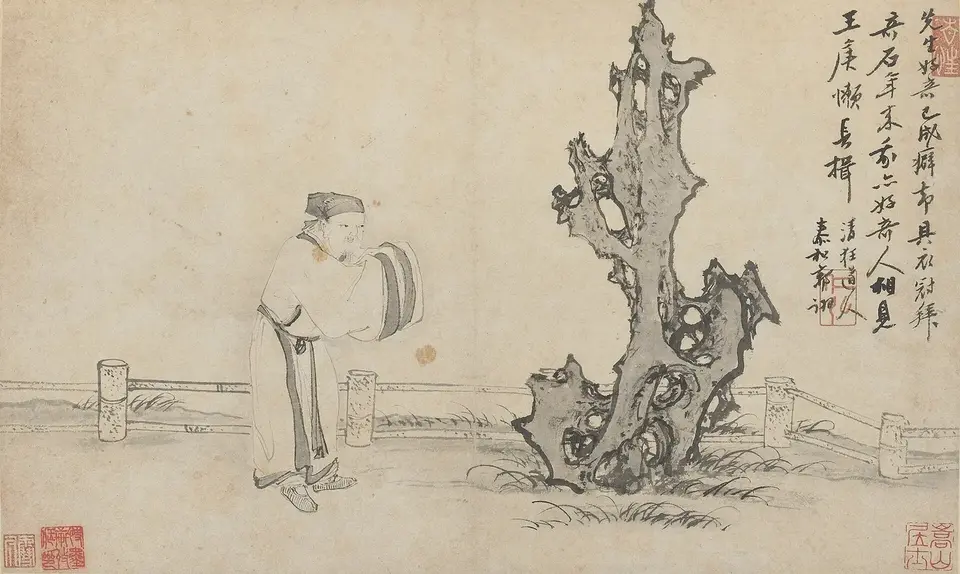
Reassigned to Wuwei Military Prefecture following censorial criticism, famously bowing in ceremonial court robes before an ancient craggy boulder and addressing it as venerable elder.
Transferred as Administrator of Huaiyang Military Prefecture, passing away peacefully in office at age fifty-seven, later interred at Mount Huanghe near Helin Temple in Zhenjiang.
Mi Fei's ancestral origins traced back to the Xi people of northern China. His fifth-generation ancestor, Mi Xin, served as a valiant military commander under Emperor Taizu of Song, attaining the rank of Military Commissioner of Baoping and standing among the distinguished founding figures of the Northern Song dynasty. His great-grandfather and grandfather continued family traditions in military and civil offices, relocating the clan to Kaifeng. His father Mi Zuo served as General of the Left Militant Guard and was posthumously honored as Grand Master of Palace Counsel. Mi Fei's mother, Lady Yan, served as a trusted governess and wet nurse to Grand Empress Dowager Gao during the latter's youth, earning high imperial favor.
In 1051 (3rd year of Huangyou), Mi Fei was born in Xiangyang. Displaying precocious intellectual gifts from early childhood, he could recite hundreds of classical poems by age six. At seven, under his family's guidance, he began practicing calligraphy by copying Yan Zhenqing's regular script and the ancient stele Record of the Xiangyang Prefectural Academy engraved by the local Tang master Luo Rang. Following the accession of Emperor Shenzong in 1068, imperial recognition of Lady Yan's nursing service earned eighteen-year-old Mi Fei an imperial appointment as Collator in the Palace Library, initiating his bureaucratic career.
Although entering public office through hereditary privilege rather than the prestigious jinshi examinations—a fact he privately regretted throughout his life—Mi Fei threw himself into the study of classical texts and ancient calligraphy with fierce determination. In his early travels through Chang'an and Kaifeng, he absorbed the techniques of multiple masters: the structural discipline of Yan Zhenqing, the angular sharpness of Ouyang Xun, the supple vigor of Chu Suiliang, the refined flow of Shen Chuanshi, and the dynamic asymmetry of Li Yong. To acquire an authentic ink trace of Li Yong, Mi Fei once traded six Tang paintings by Zhang Xuan and two calligraphic works by Xu Hao. He immersed himself in collecting and copying ancient scrolls, replicating them until his brushwork became indistinguishable from original masterpieces.
In 1074 (7th year of Xining), Mi Fei was appointed Defender of Lin'gui County in Guizhou. Surrounded by the dramatic limestone peaks and subterranean rivers of the southern borderlands, Mi Fei explored the waterways of Guilin and documented ancient Tang stone inscriptions. The extraordinary natural architecture of southern rock formations broadened his visual imagination, helping his style transition from strict imitation to expansive individual expression.
In 1082 (5th year of Yuanfeng), thirty-two-year-old Mi Fei concluded his tenure in Hanguang and traveled through the central Yangtze region. At that time, the literary titan Su Shi was living in political exile in Huangzhou following the Crow Terrace Poetry Trial. Mi Fei made a special pilgrimage to Huangzhou to seek Su Shi's guidance. The generous elder master warmly received the ambitious young scholar. Upon reviewing Mi Fei's poetry and calligraphy, Su Shi lauded his natural brilliance but advised him to move beyond the rigid strictures of Tang models and explore the natural, unadorned spontaneity of the Wei and Jin masters, particularly Zhong You, Wang Xizhi, and Wang Xianzhi.
Su Shi's advice proved to be an intellectual epiphany for Mi Fei. He redirected his artistic focus, committing himself to exhaustive study of surviving Jin dynasty manuscripts. In his relentless search for authentic relics across the southern provinces, Mi Fei successfully acquired Wang Xianzhi's Mid-Autumn Manuscript, an acquisition that filled him with boundless ecstasy.
To enshrine this treasure, Mi Fei selected a picturesque site at Dantu in Runzhou (modern Zhenjiang, Jiangsu), constructing a dedicated library residence that he named the "Baojin Studio" (Studio for Treasuring the Jin), assuming the literary style "Master of the Baojin Studio." He gradually assembled several other rare Jin manuscripts, studying their delicate brush mechanics day and night. Observing the vast expanse of the Yangtze River from the cliffs of Mount Beigu and Mount Jin, his artistic vision reached complete maturity.
During his years in Runzhou, Mi Fei's daily habits revealed his extreme personal eccentricities. He possessed a severe obsession with cleanliness. He refused to wash his hands in a basin, insisting that attendants pour fresh water over his hands from a silver pitcher, after which he dried them by clapping without using towels. His robes and footwear were brushed continuously throughout the day, and he discarded any clothing that had been touched by others. On one occasion, when his son-in-law inadvertently put on his boots, Mi Fei deemed them hopelessly soiled and discarded them immediately. This manic cleanliness reflected an intense internal desire for moral and artistic purity.
In the early Yuanyou era of Emperor Zhezong, Grand Empress Dowager Gao acted as regent, restoring conservative statesmen Sima Guang and Su Shi to court power and fostering a golden age of literati culture. In 1087 (2nd year of Yuanyou), Consort Wang Shen, the emperor's uncle-in-law, hosted an epochal cultural salon at his Western Garden estate in Kaifeng. The sixteen luminaries in attendance represented the pinnacle of Northern Song culture, including Su Shi, Su Zhe, Huang Tingjian, Mi Fei, Li Gonglin, Chao Buzhi, Qin Guan, and Zhang Lei.
During the gathering, celebrated artist Li Gonglin painted the Elegant Gathering in the Western Garden, depicting Mi Fei gazing up at a stone cliff with a brush poised to inscribe poetry. Mi Fei subsequently composed the Record of the Elegant Gathering in the Western Garden, memorializing in elegant prose the refined music, painting, and philosophical debates of the assembled scholars, producing an enduring manifesto of Song literati sensibilities.
In the autumn of 1088 (3rd year of Yuanyou), thirty-eight-year-old Mi Fei traveled through Zhejiang and Jiangsu. While in Huzhou, local scholars presented him with finely woven silk paper, on which he composed the celebrated Tiaoxi Poem Scroll in an exhilarating surge of inspiration. Shortly thereafter, in Yixing, scholar Shao Gongji brought out a treasured scroll of Sichuan raw silk that had been stored for over two decades because its rough texture intimidated calligraphers. Undaunted, Mi Fei seized his brush and inscribed eight personal poems, producing the peerless masterpiece Shusu Tie.
The Shusu Tie exhibited dazzling brushwork, executing rapid shifts between dry and saturated ink with absolute poise. The creation of these twin masterworks demonstrated that Mi Fei had completely transcended reliance on ancient predecessors, establishing an original, dynamic aesthetic that secured his position at the summit of Song calligraphy.
In 1092 (7th year of Yuanyou), forty-one-year-old Mi Fei decided that his original given name Fu was overly complex and frequently mispronounced in common usage, formally adopting the character Fei while retaining his courtesy name Yuanzhang. This conscious reinvention accompanied an increasingly confident and untrammeled approach to both art and life.
In 1094 (1st year of Shaosheng), Emperor Zhezong assumed direct rule, prompting a purge of Yuanyou conservatives. Mi Fei was dispatched to serve as Administrator of Lianshui Military Prefecture in modern Jiangsu. Lianshui was an important administrative post along the Huai River corridor, where the Cai River regularly overflowed during seasonal rains, devastating farmsteads. Mi Fei personally inspected river embankments, mobilized labor forces, and dredged the waterway, constructing durable dykes that protected thousands of acres of fertile soil and earned him profound gratitude from regional farmers.
During his tenure in Lianshui, Mi Fei discovered that superstitious practices and unauthorized shrines flourished across the countryside, exploited by local shamans to extract grain and money from poor villagers. Acting with staunch Confucian righteousness, Mi Fei issued stern decrees ordering the demolition of dozens of illegal shrines. He recycled the timber and stone materials to build public charity schools, recruiting accomplished teachers to instruct local youths in classical history. In his spare time, he excavated a spring pool behind his government residence to wash his writing brushes, a site cherished by later generations as the "Mi Wash-Ink Pool."
However, Mi Fei's uncompromising directness and scorn for bureaucratic flattery alienated his superiors. When high-ranking provincial inspectors visited Lianshui, Mi Fei wore antique robes and engaged in elevated philosophical banter rather than offering submissive ceremonial greetings. Offended by his aloofness, inspectors criticized him in performance reports as eccentric and erratic. Unperturbed, Mi Fei stepped down upon completing his term, returning to his retreat in Runzhou to savor rivers and mountains.
In 1101 (1st year of Jianzhong Jingguo), the newly crowned Emperor Huizong issued a general amnesty, permitting Su Shi to return from his remote tropical exile on Hainan Island. In June, when Su Shi's boat arrived at Changzhou, Mi Fei braved sweltering summer heat to travel to the eastern gardens to greet the aged master, carrying cold herbal remedies to relieve Su Shi's physical exhaustion. The impoverished, ailing Su Shi was deeply moved by his friend's steadfast loyalty. During their final days together, they engaged in lengthy discussions on calligraphy and painting. When Su Shi passed away shortly thereafter in Changzhou, Mi Fei mourned him with deep sorrow.
In 1102 (1st year of Chongning), Emperor Huizong, himself an extraordinarily accomplished artist and calligrapher, summoned Mi Fei to an audience in the Yanhe Hall. The emperor commanded him to compose calligraphy across imperial palace screens. Mi Fei seized a brush and executed bold, sweeping strokes with astonishing velocity, covering several expansive screens within moments. Delighted by his virtuosity, Huizong appointed him Erudite of Copying and later Doctor of the Court of Imperial Sacrifices.
During his imperial service, Mi Fei enjoyed unprecedented access to the secret imperial art holdings of the Northern Song court, reviewing rare masterpieces from the Wei, Jin, Sui, and Tang dynasties. He utilized this opportunity to verify authentic works, compile systematic catalogues, and present his scholarly treatise Baozhang Daifang Lu to the throne. One day, during a discussion in the imperial apartments, Huizong asked Mi Fei to inscribe an imperial desk. Finishing his work, Mi Fei gazed intently at an exquisite Duan inkstone resting on the emperor's desk.
Holding up the inkstone, Mi Fei boldly told the emperor that because the stone had been touched by a subject's brush, it was no longer fit for sovereign use, pleading that it be gifted to him. Huizong laughed and granted the request. Terrified that the emperor might change his mind, Mi Fei clutched the ink-filled stone to his chest and rushed out of the hall, splashing wet ink across his ceremonial court robes. Huizong laughed heartily, remarking to his courtiers that Mi Fei truly deserved his reputation for madness.
In 1104 (3rd year of Chongning), Mi Fei was elevated to Vice Director of a Bureau in the Ministry of Rites. Because the offices of the Ministry of Rites were located in the southern hall of the Department of State Affairs, literati celebrated him under the distinguished title "Mi Nangong." In this post, he provided expert guidance on court sacrificial rites, ancestral temple music, and the preservation of dynastic archives.
Despite his high imperial appointments, Mi Fei's haughty disdain for bureaucratic sycophancy clashed sharply with the corrupt political climate dominated by Grand Councilor Cai Jing. Jealous court censors repeatedly attacked his unconventional behavior, charging that his robes violated protocol and his actions bordered on lunacy. In 1106 (5th year of Chongning), Mi Fei was dismissed from the capital and reassigned as Administrator of Wuwei Military Prefecture in modern Anhui.
While serving in Wuwei, Mi Fei enacted one of the most famous anecdotes in Chinese cultural lore. In the courtyard of his official residence stood a towering, craggy limestone boulder of grotesque, convoluted beauty. Recognizing in the stone an unyielding natural dignity, Mi Fei ordered his attendants to bring out his formal court robes and official tablet. Straightening his garments, he bowed deeply before the boulder, exclaiming reverently: "I have longed to see you, venerable Elder Stone, for twenty years!" News of his worship of the boulder spread across the empire. Far from being a sign of madness, this act symbolized the literati ideal of communing with pristine nature while rejecting corrupted human society.
In 1107 (1st year of Daguan), Mi Fei was transferred to administer Huaiyang Military Prefecture in modern northern Jiangsu. Years of intense intellectual labor and unyielding perfectionism had broken his physical health, and he fell seriously ill shortly after arriving at his new post. Foreseeing his imminent demise, Mi Fei remained serene. He instructed his attendants to clear away worldly possessions, bathed, changed into clean attire, and sat in quiet contemplation before passing away peacefully at age fifty-seven.
Scholars across the empire mourned his passing. His coffin was escorted by his eldest son, Mi Youren, back to his beloved Runzhou, where he was laid to rest at the foot of Mount Huanghe beside Helin Temple. Mi Youren inherited his father's artistic mantle, rising to Vice Minister of Works in the Southern Song and carrying the "Mi Cloud Mountains" style to lasting glory, ensuring that the legacy of the "Two Mis" would endure through Chinese history.
Mi Fei stands as a transformative titan in the history of Chinese calligraphy, revered alongside Su Shi, Huang Tingjian, and Cai Xiang as one of the Four Masters of the Song. While Su Shi was celebrated for philosophical depth, Huang Tingjian for expansive structural drama, and Cai Xiang for classical balance, Mi Fei stood supreme in his absolute mastery of historical technique and unprecedented dynamic velocity.
Mi Fei's artistic development evolved from "assembling ancient characters" into total stylistic autonomy. Having mastered Yan Zhenqing, Ouyang Xun, Chu Suiliang, and Li Yong, he explored the essence of the "Two Wangs" of Eastern Jin, synthesizing their principles into an original method known as "eight-sided brushwork." In executing rapid running script, he manipulated the brush tip continuously across all directions, alternating between central, side, and reverse angles to create dramatic contrasts of speed, weight, and texture.
In structural composition, Mi Fei departed radically from symmetrical Tang regular script, introducing calculated asymmetry. His characters tilted audaciously while maintaining flawless internal equilibrium, generating immense visual momentum. His running script masterpieces, such as the Shusu Tie and Tiaoxi Poem Scroll, showcased sparkling kinetic rhythms; the Yanshan Ming conveyed monumental archaic grandeur; and the Duojinglou Poem Album demonstrated towering brush power.
Ming master Dong Qichang praised his work in Casual Notes from the Painting Zen Studio: "Mi Fei's brushwork is like a galloping steed charging across open plains, profound, deliberate, and exhilarating; he stands supreme in the Song." Qing scholar Wang Wenzhi wrote: "Possessing transcendent genius, Mi Nangong's spiritual elegance is matched by none in past or present." His brushwork inspired generations of master calligraphers, from Zhao Mengfu in the Yuan to Zhu Yunming, Wen Zhengming, Xu Wei, and Wang Duo in the Ming.
The surviving calligraphic corpus of Mi Fei comprises some of the most celebrated treasures in Chinese museum collections.
The Yanshan Ming represents his highest achievement in large-character running script. Written on rare Southern Tang Chengxintang paper across thirty-nine bold characters, the piece features jagged, sweeping strokes that harmonize monumental energy with subtle tonal modulations. Handed down through royal and private collections across nine centuries, from Southern Song prime minister Jia Sidao to Yuan connoisseur Ke Jiusi, the work was recovered from overseas in modern times and is permanently enshrined in the Palace Museum in Beijing.
The Shusu Tie stands as his quintessential small running-script tour de force. Composed upon tightly woven raw Sichuan silk that offered fierce resistance to the brush, Mi Fei navigated the unyielding fabric with effortless fluidity. Dong Qichang marveled at its kinetic mastery, remarking that it surged "like a thirsty steed bounding toward a spring."
The Duojinglou Poem Album, written overlooking the Yangtze from Mount Beigu, exhibits monumental calligraphic architecture, combining heavy, saturated strokes with delicate aerial filaments. The Hongxian Poem Scroll and the Coral Manuscript further demonstrated his genius for integrating calligraphic form with spontaneous pictorial sketches, establishing benchmarks of artistic expression.
In painting, Mi Fei was a pioneering architect of the literati landscape tradition. Prior to the Song, landscapes were dominated by the Northern styles of Guan Tong, Li Cheng, and Fan Kuan, which emphasized sharp structural outlines, dense rocky textures, and towering physical veracity. Living amidst the watery horizons of the lower Yangtze, Mi Fei recognized that rigid contours failed to capture the shimmering mist and seasonal transformations of southern nature.
Mi Fei introduced a revolutionary pictorial vocabulary. Abandoning traditional linear delineation and structural shading, he applied broad, horizontal dabs of saturated ink using the side of a soft brush, inventing the celebrated "Mi dot texture" (also called the fallen eggplant dot). By layering wet and dry ink washes across absorbent paper, he captured the evanescent magic of misty hills, rain-swept bamboo groves, and cloud-shrouded rivers, establishing the "Mi Cloud Mountains" style.
Mi Fei conceptualized his painting as "ink play" (moxi), explicitly rejecting commercial artisanal realism in favor of pure self-expression. He declared that an artist should not allow a single stroke to fall into decorative artisan habits, advocating that painting should convey the elevated spirit of the literati mind.
Together with his son Mi Youren, he established this aesthetic within the artistic canon. The Mi style provided the foundational technique for the Southern Song academy's lyrical mist landscapes, while directly inspiring the Yuan Four Masters—Huang Gongwang, Wu Zhen, Ni Zan, and Wang Meng—as well as Ming and Qing individualist painters.
Beyond his creative achievements, Mi Fei was one of the most formidable connoisseurs and art critics in Chinese history, possessing an extraordinary eye for authentication.
Mi Fei authored several foundational critical texts. His Shushi (History of Calligraphy) provided exhaustive historical investigations into hundreds of pre-Song manuscripts, analyzing paper types, ink compositions, seal impressions, and forgery techniques, establishing rigorous empirical standards for calligraphic scholarship. His Huashi (History of Painting) offered acute aesthetic critiques of dynastic painters across landscape, figure, and bird-and-flower genres.
In connoisseurship of scholarly paraphernalia, Mi Fei authored Yanshi (History of Inkstones), the first systematic treatise on scholarly inkstones in China. He analyzed dozens of stones—including Duan, She, and Hongsi—evaluating their mineral grain, ink-producing efficacy, and aesthetic beauty, having collected prized historical treasures such as the Thirty-Six Peak Inkstone once owned by Southern Tang ruler Li Yu. His treatise Baozhang Daifang Lu provided an essential inventory of ancient scrolls preserved in private collections, guiding the imperial acquisition campaigns of the Northern Song court.
Mi Fei's critical writings were celebrated for their fierce independence and uncompromising rigor. He boldly unmasked famous scrolls revered as treasures as clumsy forgeries, championing the authentic, spontaneous grace of the Jin dynasty masters as the eternal compass of Chinese art.
Among Northern Song literati, Mi Fei stood out for his flamboyant eccentricity, uncompromising aesthetic passion, and disdain for worldly convention. Walking through Kaifeng clad in antique Tang attire, he drew crowds of curious onlookers, earning the lifelong title "Madman Mi." Far from reflecting mental instability, his eccentricity served as a deliberate defense of artistic purity against bureaucratic sycophancy.
His veneration of unusual stones gave birth to the legendary lore of "Mi Fei Bowing to a Stone." Regarding craggy boulders as sentient companions embodying natural integrity, he formulated the classical criteria for judging stones—"slenderness, perforated openings, permeability, and wrinkled texture" (shou, lou, tou, zhou)—which remains the universal canon of East Asian scholar stone appreciation. In bowing to the stone at Wuwei and saluting it as elder brother, he collapsed the divide between human consciousness and nature.
His passion for authentic art was legendary. Once, while sailing on a river with a collector who possessed Xie An's Twelfth Day Manuscript, Mi Fei threatened to leap into the rapids unless his friend agreed to trade the scroll. His impetuous seizure of Huizong's imperial inkstone in the palace apartments demonstrated an uninhibited devotion to beauty that transcended imperial hierarchy.
Ming scholar Li Dongyang observed in Huai Lu Tang Ji: "Mi Nangong was not truly mad; he simply refused to conform to the vulgar compromises of his age." His flamboyant spirit and peerless artistry injected heroic vitality into Song culture, securing his place as one of the most captivating personalities in Chinese cultural history.
FIGURES ASSOCIATED WITH THIS DYNASTY