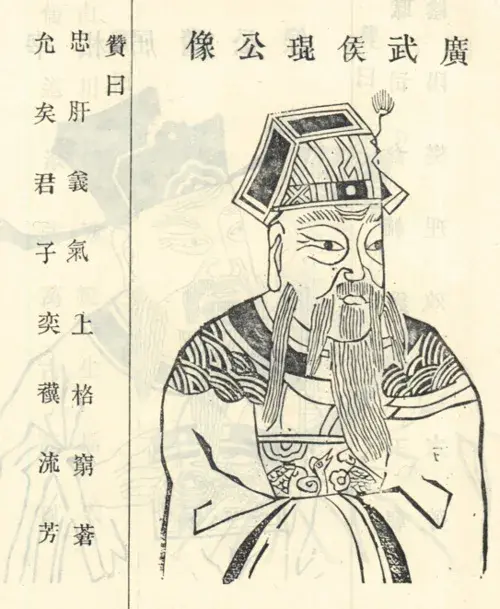
Life and Career
Early Brilliance and Dancing at Cockcrow
Liu Kun was born in 271 in Weichang County, Zhongshan Commandery. The Liu lineage traced its noble descent to Prince Jing of Zhongshan Liu Sheng of the Western Han imperial house. His grandfather Liu Mai had served as a senior advisor in the chancellor's administration, and his father Liu Fan attained the rank of Grand Master of Splendid Happiness. Blessed with a privileged upbringing, Liu Kun showed precocious academic brilliance, mastering classical history and literature while demonstrating notable talent in poetry, musical composition, archery, and horsemanship.
During the Yuankang era under Emperor Hui, the twenty-something Liu Kun was appointed as an administrative officer in Sizhou alongside Zu Ti of Fanyang. The two young men discovered an identical patriotic zeal, becoming intimate companions who shared quarters. Troubled by the moral decay of the ruling elite and the growing barbarian threats along the borders, they frequently stayed awake discussing state affairs. Whenever a rooster crowed in the dead of night, they would wake one another, draw their swords, and dance under the open sky to steel their bodies and determination, pledging to restore dynastic peace when the time arrived. This daily discipline originated the celebrated proverb "Rising at Cockcrow to Dance with Swords" (Wenji Qiwu).
During the ascendancy of Empress Jia Nanfeng, her nephew Jia Mi established an influential salon in Luoyang. Liu Kun and his elder brother Liu Yu gained widespread acclaim, joining Pan Yue, Shi Chong, Lu Ji, and Zuo Si as members of the renowned "Twenty-Four Friends of Jingu". Liu Kun's vibrant verse and quick wit during poetry banquets at the Golden Valley Garden earned him high prestige among the metropolitan gentry.
Imperial Strife and Hardening on the Battlefield
In 300, Prince of Zhao Sima Lun executed Empress Jia, triggering the devastating sixteen-year conflict known as the War of the Eight Princes. Over the ensuing decade, Liu Kun was recruited into the personal administrations of Sima Lun, Prince of Qi Sima Jiong, Prince of Fanyang Sima Xiao, and Prince of Donghai Sima Yue, successively holding positions including record keeper, Assistant Director of the Left in the Department of State Affairs, and senior administrator.
In 304, Liu Kun accompanied Sima Xiao in campaigns around Xuchang. Facing assaults from Prince of Chengdu Sima Ying and Prince of Hejian Sima Yong, Liu Kun displayed remarkable operational daring. He rode personally to Ji Province to plead for reinforcements, successfully persuading Inspector of You Province Wang Jun to dispatch elite Wuhuan cavalry southward. Joining these units, Liu Kun routed Sima Ying's general Shi Chao at Huangqiao, rescuing Sima Xiao from mortal peril. Through these harsh conflicts, Liu Kun evolved from a refined Luoyang poet into an experienced military commander.
In 306, Sima Yue prevailed over rival princes and escorted Emperor Hui back to Luoyang. However, the civil war had exhausted the Western Jin empire. Taking advantage of the vacuum, Xiongnu aristocrat Liu Yuan rebelled at Lishi, founding the Han Zhao dynasty and overrunning most of Bing Province. To prevent Xiongnu armies from marching directly on Luoyang, Sima Yue appointed Liu Kun as Inspector of Bing Province, General of Inspiring Might, and Leader of the Xiongnu Cavalry, dispatching him to stabilize the northern borderlands.
Rebuilding Jinyang from Desolation
In the autumn of 306, Liu Kun departed for his post. By that time, Bing Province was engulfed in chaos, with primary trade routes severed and roving cavalry bands plundering settlements. The imperial court provided neither an army nor supplies; Liu Kun had to rely solely on his personal charisma to assemble a volunteer force of roughly one thousand men. Escorting civilian families, his column battled bandit gangs and traversed the rugged Taihang Mountains, finally arriving at Jinyang (modern Taiyuan, Shanxi) in the spring of 307.
The sight confronting him at Jinyang was devastating. The battlements lay ruined, government granaries stood empty, weeds choked the roads, and human remains littered the streets. Fewer than thirty starving households remained in the entire city. Undeterred by the catastrophe, Liu Kun set aside his official robes, picked up tools, and led his soldiers in clearing brush, interring unburied remains, constructing defensive walls, and restoring government quarters.
He instituted agricultural recovery policies, enforced military discipline, and welcomed returning displaced families. Furthermore, he established fortified settlements (wubao) across the countryside to unite local gentry clans. Within months, Jinyang transformed into a functioning frontier fortress. Thousands of peasants and mountain inhabitants emerged from hiding to place themselves under his administration. In the midst of hostile nomadic territory, Liu Kun created a formidable bastion for the Western Jin.
Whistling and the Nomad Flute
In the early Yongjia period, Han Zhao armies repeatedly deployed tens of thousands of cavalry to besiege Jinyang, determined to eliminate this solitary loyalist base. On one autumn night, a massive Xiongnu force surrounded the city walls. Inside Jinyang, food reserves were dwindling, ammunition was scarce, and no relief was in sight; the defenders felt despair creeping through their ranks.
In this supreme emergency, Liu Kun employed an extraordinary psychological and musical maneuver. Wearing his war robe and carrying his saber, he ascended the watchtowers at midnight under a bright full moon. Standing against the cold wind, Liu Kun produced a long, piercing whistle. His whistling was resonant and crystal-clear, echoing through the mountain valleys and into the enemy's encampments. Startled by the haunting sound, the Xiongnu horsemen stepped out of their tents in amazement, listening in silence.
Later in the night, Liu Kun brought out a nomad flute (hujia). Deeply knowledgeable in the folk tunes of the northern steppes, he played a melancholy, mournful melody of the frontier. The lamenting tune drifted through the night air, stirring deep sorrow and homesickness among the Xiongnu warriors who had campaigned far from their homes for years. Many soldiers embraced one another and wept openly, losing all will to fight. Before dawn, Liu Kun played the flute once more; unable to bear the emotional strain, the Xiongnu forces broke camp and withdrew in the dark. This legendary feat of dispersing enemy armies through artistic genius became celebrated throughout Chinese military lore.
Alliance with Tuoba and Resistance against Han Zhao
Liu Kun recognized that Bing Province could not withstand the relentless pressure of Liu Yuan, Liu Cong, and Shi Le through isolated strength alone. At that time, Tuoba Yilu led the formidable Xianbei Tuoba tribe in the northern reaches of Dai, commanding hundreds of thousands of cavalry. Demonstrating grand diplomatic vision, Liu Kun dispatched emissaries to forge a coalition and met Tuoba Yilu in person in Dai Commandery. The two men swore an oath of brotherhood, and Liu Kun successfully petitioned the court to invest Tuoba Yilu as Grand Shanyu and Duke of Dai (later Prince of Dai).
With Tuoba cavalry support, Liu Kun's defensive posture was vastly reinforced. Between 310 and 314, Han Zhao commanders Liu Can, Liu Yao, and Jie warlord Shi Le launched successive massive invasions into Bing Province. In coordinated operations with Tuoba Yilu, Liu Kun repeatedly routed the invaders east of the Fen River, capturing tens of thousands of horses and camels and safeguarding the province.
In 316, Shi Le used deceptive diversionary tactics to capture Leping and march on Jinyang. Simultaneously, internal tragedy struck the Tuoba clan: Tuoba Yilu was murdered by his rebellious son Tuoba Liuxiu, preventing Xianbei reinforcements from mobilizing. Left without external aid, Liu Kun led his forces outside the walls, falling into an ambush prepared by Shi Le at Shouyang Mountain. The Bing Province army was shattered, and Jinyang fell. Liu Kun's parents were killed in the fighting. Gathering several hundred survivors, Liu Kun wept bitterly over the lost city and marched northeast toward Youzhou to seek a new base of resistance.
Tragedy in Youzhou and Enduring Legacy
Reaching Youzhou, Liu Kun allied with Duan Pidi, the Xianbei chieftain and Inspector of Youzhou. Finding mutual respect, Liu Kun and Duan Pidi swore brotherhood, pledging to combine their forces, defeat Shi Le, and recover the lost imperial capitals at Luoyang and Chang'an. In late 316, Chang'an fell, and Emperor Min was captured, marking the demise of the Western Jin.
In 317, Liu Kun joined Duan Pidi and over one hundred civil and military leaders across You and Ji Provinces in submitting a formal petition (Quanjin Biao) to Prince of Langya Sima Rui in Jiankang, urging him to assume the imperial mantle. Sima Rui acceded to the throne as Emperor Yuan of Eastern Jin, appointing Liu Kun Palace Attendant and Grand Defender with imperial authority.
However, factional fissures undermined the Duan tribe. In 318, during a joint expedition against Shi Le, Duan Pidi's cousin Duan Mopei accepted substantial bribes from Shi Le and refused to advance, causing the offensive to collapse. Fearing the growing prestige of Han generals, Duan Mopei circulated slanderous rumors accusing Liu Kun of conspiring to seize Youzhou. The suspicious Duan Pidi placed Liu Kun under house arrest.
Concurrently, the powerful chancellor Wang Dun in Jiankang, eager to eliminate potential military rivals in the north, sent secret directives to Duan Pidi instructing him to execute Liu Kun. On June 22, 318 (22nd day of the 5th month), Duan Pidi executed Liu Kun by strangulation on fabricated charges of treason, along with four of his sons, including his eldest son Liu Zun, when Liu Kun was forty-eight years old. Facing death, Liu Kun remained calm, composing his final poem with the poignant line: "Who would have thought that steel refined a hundred times could be turned into something soft enough to wrap around a finger." His subordinate Lu Chen escaped south to present his case, and Emperor Yuan subsequently cleared his name, posthumously conferring the title Marquis Min.
Major Achievements
Inspiring Resolve by Dancing at Cockcrow
During his early career in the Yuankang era, Liu Kun served with Zu Ti as an officer in Sizhou. Distressed by court decadence and frontier vulnerability, the two young men shared a passionate dedication to the restoration of dynastic peace. Every night they discussed grand strategy, and upon hearing midnight cockcrow, they immediately leaped from bed to practice fencing in the courtyard. This unyielding discipline gave rise to the idiom "Rising at Cockcrow to Dance with Swords", inspiring countless generations of Chinese youth to embrace rigorous self-cultivation and patriotic devotion.
Rebuilding Jinyang from Ruin
In 306, appointed Inspector of Bing Province amidst catastrophic devastation, Liu Kun led one thousand followers into the abandoned ruins of Jinyang. Confronting weed-choked streets, skeletal remains, and only thirty surviving families, he personally cleared brush, interred the dead, rebuilt fortifications, and instituted tax relief to attract returning refugees. Through persistent civil administration and agricultural restoration, he established Jinyang as an impregnable frontline stronghold against nomadic invasions, showcasing consummate administrative resilience.
Night Dispersal of Foes by Nomad Flute
When tens of thousands of Xiongnu cavalry besieged Jinyang and pushed the garrison to the brink of despair, Liu Kun employed psychological warfare rooted in musical mastery. Ascending the walls on an autumn night, he whistled into the wind before playing mournful northern melodies on the nomad flute (hujia). The melancholy airs evoked unbearable homesickness among the nomadic warriors, who wept and abandoned their siege lines before dawn. This legendary episode stands as an extraordinary example of resolving a tactical crisis through psychological insight and cultural empathy.
Forging the Xianbei Alliance
Recognizing that Bing Province could not endure in isolation, Liu Kun implemented a forward-looking coalition strategy. He met Tuoba Yilu in Dai Commandery, established an oath of brotherhood, and secured imperial investitures for the Tuoba leadership. Leveraging elite Xianbei horsemen, he repeatedly turned back major offensives by Liu Yuan and Shi Le in the Fen River valley, preserving the northern frontier and safeguarding the remaining Han populations.
Ten-Year Defense of the Northern Frontier
As the central capitals of Luoyang and Chang'an fell and royal princes fled or surrendered, Liu Kun maintained an unyielding resistance in Bing Province for a decade. Despite losing both parents to the violence of war and facing overwhelming odds, he refused all overtures of surrender, fighting on through countless engagements. His lone struggle anchored the northern frontier and exemplified the highest standards of ministerial loyalty and personal sacrifice.
Petitioning the Restoration of the Jin Court
Following the fall of Western Jin in 316, Liu Kun took the lead in uniting northern commanders and tribal allies. Alongside Duan Pidi, he gathered over a hundred regional officials to submit a historic petition to Sima Rui in Jiankang, urging him to assume the imperial dignity. This crucial legal and political action consolidated the legitimacy of the Eastern Jin dynasty, ensuring the continuity of Chinese dynastic heritage in the south.
Multi-Ethnic Collaboration for Restoration
After the loss of Jinyang, Liu Kun maintained his dedication to dynastic restoration by allying with the Xianbei Duan tribe in Youzhou. He formed an integrated Han-Xianbei military coalition, seeking to strike Shi Le from the northeast. His inclusive diplomatic approach fostered cooperation across ethnic lines, and though internal tribal betrayal ultimately cut short his endeavors, his vision of multi-ethnic solidarity in defense of the realm influenced subsequent generations of statesmen.
Pioneering Heroic Verse in Late Jin
Liu Kun was not only a frontline commander but also a preeminent poet in the late Western Jin. Amidst military turmoil and exile, he penned deeply moving poems, including Song of Fufeng, Reply to Lu Chen, and Second Poem to Lu Chen. His poetry inherited the vigorous spirit of the Jian'an era, characterized by grand pathos, martial energy, and poignant historical reflection, earning him acclaim as a vital forerunner of patriotic poetic literature.
Musical Mastery Bridging Steppe and Central Plains
Liu Kun possessed extraordinary musical talent, mastering classical zither performance alongside the traditional melodies of the nomad flute. His comprehensive understanding of steppe folk culture allowed him to touch the emotional core of Xiongnu warriors during the midnight siege of Jinyang. His life stands as a testament to the capacity of art to transcend cultural barriers and dissolve armed conflict.
Unyielding Martyrdom and Enduring Inspiration
During his imprisonment in Youzhou, facing inevitable death due to political slander and southern intrigue, Liu Kun remained serene and dignified, composing his famous final poetic testament: "Who would have thought that steel refined a hundred times could be turned into something soft enough to wrap around a finger." Facing execution, he refused to abandon his identity as a loyal minister of Jin. His martyrdom established a lasting moral benchmark for patriotic devotion in Chinese history.