Biography
Early Scholarship and Grassroots Administration
Gui E was born on October 19, 1478 (the twenty-fourth day of the ninth lunar month in the fourteenth year of the Chenghua era) into a farming household of modest means in Jinjiang Town, Anren County, Raozhou Prefecture. While his family worked the soil for generations, they maintained a strict tradition of Confucian schooling. Endowed with a robust physique and an analytical mind, Gui E was introduced at age ten to Zhang Zheng, a respected disciple of the prominent Confucian thinker Hu Juren. In 1494, at age seventeen, Gui E accompanied his elder brother Gui Hua to study in the secluded Zhongfeng Monastery, where the two brothers engaged in rigorous debates on classical statecraft. Unlike scholars immersed in abstract metaphysics, Gui E concentrated on functional disciplines—jurisprudence, fiscal administration, water conservancy, and military logistics.
In 1507, Gui E passed the Jiangxi provincial examination, and in 1511, he secured the metropolitan jinshi degree. Independent and unwilling to flatter palace eunuchs or powerful courtiers, he cited chronic respiratory illness to return home to Jiangxi, spending three years examining statutory collections and dynastic precedents.
In the spring of 1514, Gui E was appointed Magistrate of Dantu County in Zhenjiang Prefecture, Nanzhili. Situated at the bustling junction of the Grand Canal and the Yangtze River, Dantu groaned under heavy corvée duties and extortionate grain transit tolls. Influential lineages routinely colluded with clerk syndicates to conceal fertile fields and shift taxes onto impoverished tenants. Gui E audited land registries, eliminated dozens of unauthorized surcharges, and prosecuted predatory clerks. When inspecting censors and surveillance commissioners demanded unlawful requisitions, Gui E rebuffed them face-to-face. In the autumn of 1515, targeted by hostile censorial reports, the court ordered him transferred to the remote mountainous county of Qingtian in Zhejiang. Recognizing the move as bureaucratic vengeance, Gui E adamantly refused to take up the post.
In 1518, through the recommendation of senior patrons, Gui E was recalled to govern Wukang County in Huzhou Prefecture, Zhejiang. Known for litigious and defiant local gentry, Wukang saw Gui E overhaul judicial proceedings, overturn dozens of wrongful convictions, punish exploitative local bullies, and abolish extra-statutory community watch levies, winning heartfelt gratitude from ordinary farmers. However, his unbending enforcement of statutory codes alienated Huzhou prefectural supervisors, and upon the death of his parents shortly thereafter, he resigned to observe the prescribed mourning rites.
Governance in Cheng'an and the Succession Dilemma
In the spring of 1522, having completed his mourning, Gui E was appointed Magistrate of Cheng'an County in Guangping Prefecture, Beizhili. Situated in the arid southern Hebei plain, Cheng'an suffered from chronic drought, sandstorms, soil exhaustion, and widespread tenant flight. Gui E went personally into villages to survey households and acreage, abolishing private impositions and distributing labor burdens equitably. When the Zhang River burst its banks, Gui E directed laborers through torrential rain to build thirty li of flood dykes, transforming floodwaters into irrigation canals. He discovered substantial unrecorded arable acreage, resettled hundreds of refugee families, and distributed grain seed with a three-year tax exemption. This three-year tenure gave Gui E an indispensable understanding of the structural flaws in northern military colonies, village lands, and poll-tax labor duties.
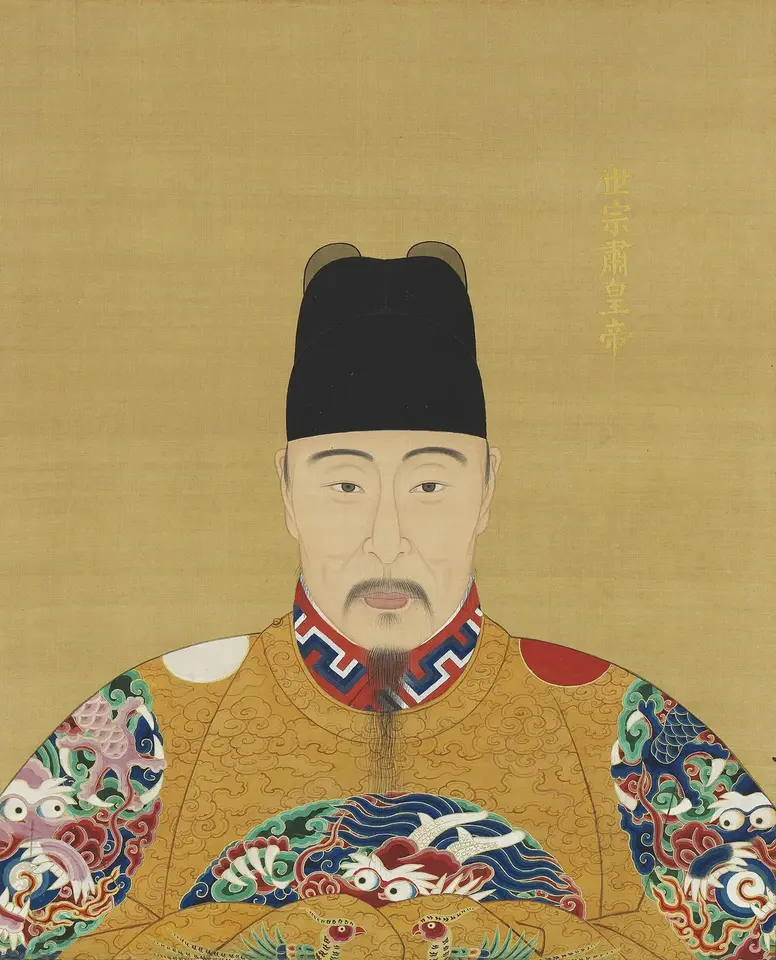
In 1523, on the strength of his stellar administrative record in Cheng'an, Gui E was promoted to Secretary in the Nanjing Ministry of Justice. At that moment, the central government in Beijing was paralyzed by an unprecedented constitutional confrontation. Emperor Wuzong (Zhu Houzhao) had died without issue in 1521. Zhu Houcong, the teenage son of Wuzong's uncle the Prince of Xing, was summoned from Hubei to ascend the throne as the Jiajing Emperor. Senior Grand Secretary Yang Tinghe and Minister of Rites Mao Cheng, relying on Han and Song precedents, insisted that the new monarch must be posthumously adopted as the son of Emperor Xiaozong (Wuzong's father), addressing Xiaozong as Imperial Father while demoting his biological father, the Prince of Xing, to Imperial Uncle. The Jiajing Emperor resisted vehemently, maintaining that he had ascended the throne under the dynastic mandate of collateral succession (xiongzhong diji) rather than through personal adoption. For three years, court business remained deadlocked.
Serving in Nanjing, Gui E analyzed dynastic statutes, imperial ancestry codes, and classical canonical treatises, concluding that Yang Tinghe's faction had conflated dynastic succession with private lineage adoption.
The Great Rites Memorial and Rise to Central Power
On February 24, 1524 (the twenty-first day of the first lunar month in the third year of the Jiajing era), Gui E submitted his historic Memorial on the Great Rites. Drawing upon canonical authority, Gui E argued incisively: "When Chancellor Fan Chunren addressed Emperor Yingzong of Song, he noted that Yingzong had been personally brought into the palace by imperial decree of Renzong, receiving an explicit title as imperial son, which differed fundamentally from an outside prince succeeding to the throne. Today, Your Majesty succeeded to the throne in strict accordance with the dynastic ancestral instructions of Ming Taizu; you never received an adoption decree from Xiaozong. Your Majesty ascended the throne as the sovereign of the realm, not as an adopted son. How can the rightful bond between father and son be severed? To honor the Prince of Xing as Imperial Father and his consort as Imperial Mother is completely righteous!"
Gui E's memorial exploded across the capital like a thunderclap. Minister of Rites Wang Jun mobilized seventy-three senior courtiers to submit a joint protest, accusing Gui E of flattering the monarch and subverting ancestral rules. Gui E produced rebuttal after rebuttal. Delighted to find scholarly vindication, the Jiajing Emperor overruled the cabinet and issued an urgent summons ordering Gui E and Zhang Cong to rush to Beijing.
In May 1524, Gui E arrived at court and presented his ritual arguments in personal audiences, earning the emperor's complete admiration. In June, the emperor promoted Gui E to Hanlin Academician. Outraged by this meteoric rise of a sixth-rank departmental secretary, Grand Secretaries Jiang Mian and Mao Ji refused to countersign the appointment, and conservative officials hurled verbal abuse at Gui E in court corridors. The emperor stood firm, reprimanding the opposition.
In July 1524, the dispute culminated in the dramatic "Zuoshun Gate Incident," when more than two hundred civil and military officials prostrated themselves outside the palace gate, wailing in protest. The emperor dispatched the Embroidered Uniform Guard to arrest the leaders, administering severe court beatings (tingzhang) that broke Yang Tinghe's faction. The Jiajing Emperor formally promulgated the titles of his biological parents as Imperial Father and Imperial Mother. Gui E emerged as the emperor's foremost confidant.
Administrative Reforms in the Ministry of Personnel
In April 1525, Gui E was promoted to Chief Minister of the Court of Imperial Sacrifices and Academician Reader of the Hanlin Academy, tasked with compiling the Complete Collection of the Great Rites (Da Li Quan Shu). In October 1526, he was elevated to Right Vice Minister of Rites.
In February 1527, the emperor appointed Gui E Minister of Personnel. As head of the foremost executive ministry, Gui E initiated aggressive institutional overhauls. Confronting entrenched bureaucratic inertia, he championed the principle of "disregarding formal seniority to employ talent on merit," breaking through examination barriers to promote capable grassroots magistrates to central administrative posts.
To curb factional abuses within the censoriat, where supervising secretaries and investigating censors operated as partisan tools, Gui E submitted a memorial in 1528 establishing the "Mutual Surveillance System for Censors and Supervising Secretaries" (kedao hujiufa). This statutory mechanism empowered supervising secretaries to review provincial censors while permitting censors to audit the six sectional ministries, restoring institutional equilibrium.
Furthermore, tackling the prevalent elitism where bureaucrats avoided provincial hardship, Gui E enacted the Regulations on Rotation and Extended Tenure for Metropolitan and Outer Officials. Under this statute, metropolitan officials without demonstrable provincial governing experience were barred from high promotions, while prefects and magistrates who served six years with outstanding evaluations were prioritized for capital transfer. In conducting the 1528 Metropolitan Evaluation (Jingcha), Gui E dismissed dozens of corrupt metropolitan officials, purging bureaucratic rot while provoking bitter resentment among conservative factions.
Grand Secretariat and Censorial Backlash
In February 1529, the Jiajing Emperor appointed Gui E Junior Preceptor, Grand Tutor of the Crown Prince, and Grand Secretary of the Wuying Palace, placing him at the helm of the imperial cabinet alongside Senior Grand Secretary Zhang Cong. Operating in close partnership, Zhang and Gui drove the reform agenda forward, receiving special imperial seals and commendations from the emperor at the Western Park. To recruit capable talent, Gui E engaged Jiangxi scholar Yan Song to tutor his younger son and promoted diligent administrators like Xia Shangpu and Li Rugui.
However, Gui E's abrasive candor and uncompromising personality alienated numerous courtiers. In July 1529, Supervising Secretary Wang Zhun impeached Gui E, alleging that he had accepted bribes to secure an appointment for his personal physician, Li Menghe, in the Imperial Academy of Medicine. Although joint investigations failed to uncover bribery evidence, Supervising Secretary Lu Can launched a sweeping indictment accusing Zhang and Gui of factional tyranny and nepotism.
Beset by intense factional hostility, the Jiajing Emperor yielded temporarily to the storm, issuing an edict on September 17, 1529, dismissing Gui E to his home province with the title of Minister, while Zhang Cong also stepped aside.
Return to Office and the Blueprint for the Single Whip Law
Following Gui E's departure, fierce infighting erupted between Grand Secretary Yang Yiqing and Chamberlain of the Reverence Bureau Huo Tao, throwing the court into turmoil. The emperor soon realized that the charges against Gui E had been fabricated by political rivals. In December 1529, prompted by memorials from imperial scholar Cai Qi, the emperor reinstated Gui E as Grand Secretary of the Wuying Palace, dispatching couriers to summon him back to the capital.
On May 16, 1530, Gui E returned to Beijing, where the emperor restored all his titles as Junior Preceptor, Grand Tutor of the Crown Prince, Minister of Personnel, and Grand Secretary. Shortly after his return, Gui E presented his astronomical and calendrical treatise, Treatise on the Three Powers and the Daily Calendar (Sancai Rilishi), which the emperor studied with high praise and retained in the inner archives.
Confronted by depleted imperial coffers and escalating military expenditures along the northern frontier, Gui E submitted his most enduring policy masterpiece, Examination on Employing the People (Renmin Kao), in October 1530. In this exhaustive treatise, Gui E diagnosed the total collapse of the early Ming Yellow Registers and Fish Scale Registers, showing how gentry land engrossment and arbitrary labor requisitions had ruined the peasantry while starving the treasury.
Gui E proposed a revolutionary nationwide reform package:
First, abolish the traditional decennial rotation of labor service under the lijia system, combining countless fragmented corvée levies into a single assessment.
Second, integrate corvée assessments with cultivated land, standardizing northern acreage at 240 square paces per mu and rationalizing southern tax brackets.
Third, convert labor services into fixed silver payments assessed against landownership, with the government using the tax revenue to hire wage laborers (guanshou guanmai).
Adopted by the Ministry of Revenue and tested across several provinces, this proposal was christened the "Single Whip Law" (Yitiao Bianfa) by Censor Fu Hanchen and other officials. Gui E's blueprint initiated the historic transition from labor-based corvée to land-based silver taxation, serving as the direct institutional foundation for Zhang Juzheng's nationwide reforms half a century later.
Retirement and Posthumous Accolades
Years of non-stop political struggle and grueling administrative labor exhausted Gui E's health. By the winter of 1530, he suffered from severe pulmonary hemorrhaging and chronic leg ailments, leaving him bedridden. The emperor sent imperial physicians with delicacies and medicinal wines, repeatedly urging him to remain in office. Students from the Imperial Academy submitted petitions pleading for his retention.
On February 6, 1531, his condition worsening, Gui E submitted an emotional plea for retirement. Recognizing that his minister was mortally ill, the emperor granted his discharge, bestowing thirty ounces of silver, ceremonial silks, and three thousand strings of cash, while ordering relay stations to provide carriages for his journey home.
Returning to Anren, Gui E remained devoted to public affairs, composing a final memorial on frontier defense from his sickbed. On August 9, 1531 (the twenty-seventh day of the intercalary sixth lunar month in the tenth year of the Jiajing era), Gui E passed away at his Jinjiang residence at age fifty-four.
When his final memorial and obituary reached Beijing, the Jiajing Emperor wept openly, praising him as an incorruptible pillar of the state. The emperor conferred upon him the posthumous title of Grand Tutor and the posthumous name Wenxiang, funding nine official memorial sacrifices, constructing a state tomb on Mount Fenghuo south of Anren, and granting his eldest son Gui Yuxiao hereditary rank in the Embroidered Uniform Guard.
Major Achievements
Pioneer of the Single Whip Law
Gui E was the preeminent institutional architect who formulated the principles of the Single Whip Law. In his 1530 memorial Renmin Kao, Gui E identified the failure of the population-based labor service system and proposed shifting the tax burden to land acreage.
By standardizing land measurements, combining diverse labor duties into silver assessments, and instituting government-hired wage labor, Gui E broke the traditional poll-tax framework. His systemic reform protected smallholders, curtailed gentry evasion, and established the fiscal paradigm that guided Chinese public finance through the remainder of the Ming and Qing dynasties.
Reformer of the Bureaucracy and Censors
As Minister of Personnel, Gui E dismantled the entrenched culture of seniority and Hanlin elitism. He promoted talented grassroots magistrates to executive ministries, demonstrating that functional competence mattered more than examination standing.
His establishment of the "Mutual Surveillance System for Censors and Supervising Secretaries" created a vital institutional balance within the surveillance apparatus, preventing censorial factions from monopolizing power. His mandate requiring six years of successful local governance prior to capital appointment instilled professional accountability across provincial administration.
Educational Pragmatism and Statecraft
Gui E was a steadfast advocate of practical statecraft (jingshi zhiyong), scorning the abstract metaphysical speculations of late Song-Ming neo-Confucianism. He frequently cited Confucius's adage that practical action was superior to empty words.
He overhauled the Imperial Academy, introducing the "Four Halls Curriculum" to train scholars in jurisprudence, fiscal administration, mathematics, and military logistics alongside canonical texts. In ritual reform, he stripped Confucius of monarchical feudal titles, designating him "Ultimate Sage and First Teacher" (Zhisheng Xianshi) and replacing painted idols with simple wooden tablets, returning state Confucianism to ancient austerity.
Restraining Palace Extravagance
Having served as a county magistrate, Gui E remained deeply sensitive to peasant distress. Reaching the peak of power, he repeatedly risked imperial displeasure to curb court extravagance.
During the early Jiajing reign, when the emperor's Taoist construction projects strained state finances, Gui E submitted his "Four Measures to Economize and Pacify the People," demanding the reduction of palace staff, the suspension of imperial textile mills in Jiangnan, the recall of regional eunuch commissioners, and the outright rejection of fabricated "auspicious omens," saving millions of taels for the treasury.