Birth in the Western Regions
Born into a prominent Uyghur family in Beshbaliq; raised by his widowed mother and educated in multilingual statecraft.
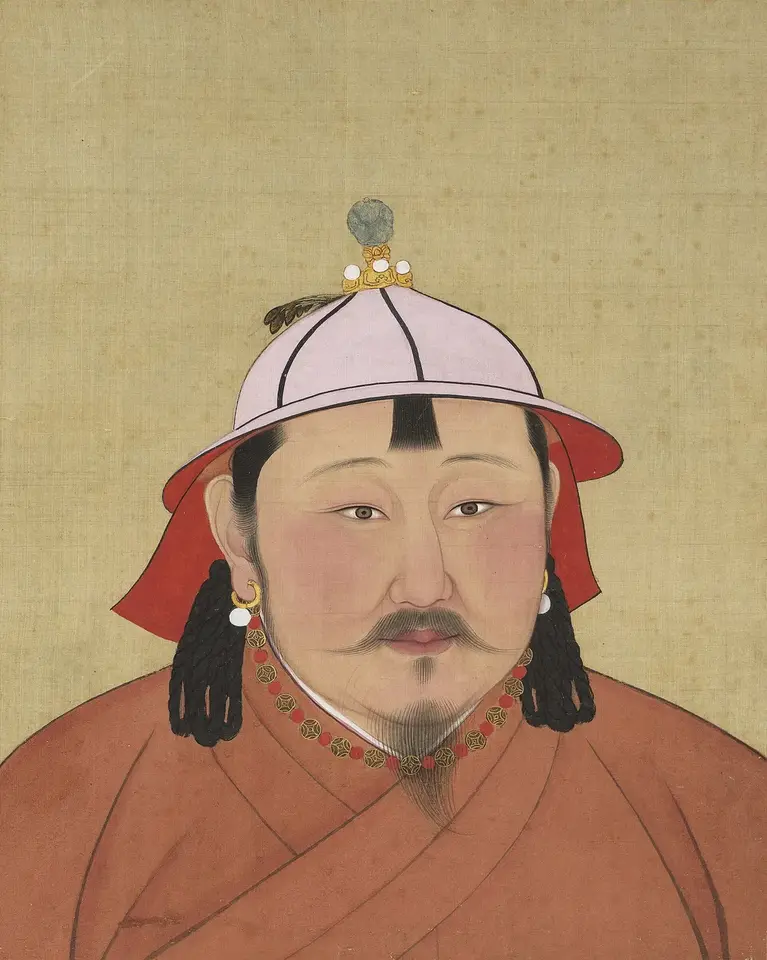
阿里海牙
Ariq Qaya (阿里海牙, 1227–1286), a Uyghur native of Beshbaliq north of the Tianshan Mountains (modern-day Jimsar County, Xinjiang), was an illustrious founding commander, military strategist, and statesman of the Yuan dynasty. He was one of the foremost theater commanders under Emperor Shizu (Kublai Khan) during the unification of China and the conquest of the Southern Song. Bereaved of his father in childhood, Ariq Qaya…
Ariq Qaya (阿里海牙, 1227–1286), a Uyghur native of Beshbaliq north of the Tianshan Mountains (modern-day Jimsar County, Xinjiang), was an illustrious founding commander, military strategist, and statesman of the Yuan dynasty. He was one of the foremost theater commanders under Emperor Shizu (Kublai Khan) during the unification of China and the conquest of the Southern Song. Bereaved of his father in childhood, Ariq Qaya displayed precocious intellect, mastering Uyghur, Mongolian, and classical Chinese scripts while excelling in mounted archery and strategy. Entering Kublai Khan's princely retinue as an imperial bodyguard, he earned the emperor's deep trust through discrete competence. In 1261, he was appointed Director of the Left and Right Departments in the Central Secretariat, later assisting Chancellor Zhao Bi in enforcing centralization across the Central Plains by eliminating the hereditary powers of Han warlords and installing bureaucratic regional magistrates. During the prolonged war against the Southern Song, Ariq Qaya performed monumental strategic exploits. Discerning the symbiotic interdependence of Xiangyang and Fancheng across the Han River, he formulated the decisive strategy to seize Fancheng first, traveling personally to the capital to recruit West Asian mechanical engineers who manufactured the formidable counterweight trebuchets known as the "Huihui cannons". Their deployment shattered the fortifications of Fancheng and Xiangyang, breaking a six-year stalemate. Resisting demands from fellow commander Liu Zheng to massacre the inhabitants, Ariq Qaya went to the foot of the city walls, snapped an arrow to swear an oath of safe conduct, and persuaded Song defender Lyu Wenhuan to surrender peacefully, preserving hundreds of thousands of civilian lives. In 1274, he spearheaded the amphibious crossing of the Yangtze River, storming the fortress of Yangluobao and shattering the primary Song defensive barrier. While supreme commander Bayan marched eastward toward Lin'an, Ariq Qaya remained behind to govern the Jinghu theater, capturing Jiangling, Changsha, and Hengzhou, before leading expeditionary armies across the Nanling Mountains to conquer Guangdong and Guangxi. In his final years, he served as Manager of Governmental Affairs for the Huguang Branch Secretariat and Left Grand Councilor of the Central Secretariat, dying of illness in 1286 at age sixty. He was posthumously created Prince of Chu with the posthumous title "Wuxiang".
Born into a prominent Uyghur family in Beshbaliq; raised by his widowed mother and educated in multilingual statecraft.
Joined Kublai Khan's princely retinue as an imperial bodyguard, managing confidential administrative affairs.
Appointed Director of the Left and Right Departments of the Central Secretariat; promoted to Participant in Determining Affairs.
Assisted Chancellor Zhao Bi in Henan, abolishing the hereditary privileges of Han warlords and restoring central administrative authority.
Dispatched to the Xiangyang front to oversee logistics, agricultural garrisons, and military coordination.
Formulated the strategy to capture Fancheng first; traveled to Dadu to enlist Western Muslim engineers and introduce counterweight trebuchets.
Snapped an arrow to swear safe conduct before Xiangyang, successfully persuading Lyu Wenhuan to surrender without bloodshed.
Appointed Right Vice Chancellor of Jinghu Branch Secretariat; commanded the bloody assault that captured the Yangluobao fortress.
Stationed at Ezhou with forty thousand elite troops; captured Jiangling and secured the submission of Song general Gao Da.
Marched south into Hunan, taking the provincial stronghold of Tanzhou (Changsha) and pacifying Hengzhou and Yongzhou.
Breached the formidable defenses of Jingjiang (Guilin) and pacified Guangnan West and East circuits, incorporating the far south.
Appointed Left Grand Councilor of the Central Secretariat; died of chronic illness in Dadu at age sixty; posthumously created Prince of Chu and titled "Wuxiang".
Ariq Qaya was born in the ancient Silk Road metropolis of Beshbaliq, situated on the northern flanks of the Tianshan Mountains. His family belonged to the prominent Uyghur aristocracy. His father died while Ariq Qaya was still a small child, and he was nurtured in adversity by his dedicated mother. Endowed with natural brilliance and a stately bearing, he displayed an extraordinary facility for languages, achieving fluency in Uyghur, Mongolian, and classical Chinese literature. He mastered archery and mounted combat while developing a keen understanding of historical statecraft and administrative law.
During the reign of Mongke Khan, Prince Kublai was commissioned to govern administrative and military affairs across the territories south of the Gobi Desert. Attracted by Kublai's reputation for valuing men of ability, Ariq Qaya traveled east to join the prince's entourage. Kublai conversed with him and was astonished by his strategic acumen and comprehensive grasp of geopolitical affairs, immediately enlisting him into his personal retinue as an imperial bodyguard and secretary entrusted with managing confidential state dispatches.
Following Kublai's accession to the throne as Great Khan and the proclamation of the Zhongtong reign title, the court promoted talented literati and multilingual Semu elites to construct a centralized civil administration. In 1261, Ariq Qaya was appointed Director of the Left and Right Departments in the Central Secretariat, supervising the bureaucratic operations of the six functional ministries. In 1264, he was promoted to Participant in Determining Affairs in the Central Secretariat, taking direct part in the formulation of high imperial policy.
In 1265, during the second year of the Zhiyuan era, the Yuan court embarked upon systemic reforms to centralize dynastic authority. Since the turbulent transition between the Jin and Yuan dynasties, expansive regions of Hebei, Shandong, and Henan had been dominated by hereditary Han warlords (shihou), who maintained private armies, collected regional revenues, and operated as semi-independent feudatories.
To eliminate these dangerous regional bastions, Kublai Khan dispatched Chancellor Zhao Bi to direct the Henan Branch Secretariat, appointing Ariq Qaya as Assistant Administrator to oversee military and civil reorganization across Nanjing, Henan, Daming, Shunde, Zhangde, and Huaimeng routes. Ariq Qaya implemented the imperial mandate with firm resolve and tactical diplomacy, rigorously stripping hereditary lords of their independent command privileges and enforcing the imperial policy of rotating civilian magistrates every three years.
He abolished private military recruitment, reclaimed local tax prerogatives for the imperial treasury, and transferred private armed retainers directly to the Bureau of Military Affairs. Through Ariq Qaya's meticulous administrative oversight, the powerful warlord families of the Yellow River plains were peacefully integrated into the centralized prefectural system without provoking armed rebellion, marking a vital turning point in the consolidation of imperial authority.
In 1268, Kublai Khan resolved to launch a decisive war of conquest against the Southern Song dynasty, identifying the heavily fortified twin citadel of Xiangyang and Fancheng—often hailed as the gateway to the Yangtze valley—as the primary operational target. The court established an expeditionary Branch Secretariat, appointing Ariq Qaya as Joint Administrator and subsequent Associate Administrator alongside Mongol commanders Aju, Shi Tianze, and Liu Zheng to besiege the fortress complex.
Xiangyang and Fancheng were situated on opposite banks of the Han River, linked by a fortified pontoon bridge and ringed by deep moats. Defended valiantly by Song general Lyu Wenhuan for five years, the twin cities successfully repulsed numerous assaults and received regular relief from Song naval flotillas. In the winter of 1272, during an emergency council of war, Ariq Qaya observed that the two citadels formed an interdependent defensive perimeter. He boldly proposed concentrating the entire assault force against Fancheng first, severing the pontoon bridge and isolating Xiangyang.
To batter down Fancheng's massive stone ramparts, Ariq Qaya rode to Dadu to petition the throne for specialized siege technology. Learning that West Asian engineers Ismail and Ala al-Din had arrived in the capital boasting expertise in constructing massive mechanical counterweight trebuchets, Ariq Qaya requested permission to bring them directly to the front line. In early 1273, the newly constructed "Huihui cannons" commenced bombardment outside Fancheng. Launching massive stone projectiles with thunderous roars that shattered stone battlements, the siege engines completely overwhelmed the defenders. Yuan forces breached the walls, severed the river bridge, and captured Fancheng.
With the fall of Fancheng, Xiangyang was transformed into a desperate island amid hostile waters. Although completely surrounded, Lyu Wenhuan continued to resist from behind the city walls. Earlier in the siege, Han army commander Liu Zheng had been wounded by crossbow fire while attempting to negotiate a surrender under the city walls; harboring intense personal hatred, Liu fiercely urged the council of war to bombard Xiangyang into rubble and slaughter all inhabitants to avenge his injury.
Possessing genuine strategic wisdom and moral compassion, Ariq Qaya adamantly opposed the massacre. He argued that Xiangyang was the premier fortress of the realm, and that slaughtering its population would stiffen the resolve of all remaining Song cities, plunging the empire into endless, bloody sieges. Conversely, if Lyu Wenhuan were persuaded to surrender with honor, cities throughout southern China would capitulate without fighting.
Disregarding his personal safety, Ariq Qaya rode alone with a few horsemen directly to the base of Xiangyang's ramparts, shouting upward to address the defenders: "General Lyu, you have defended an isolated fortress against our hosts for six years; all under heaven bear witness to your loyalty to your former lord! Now the Southern Song court has abandoned you. The Emperor of the Great Yuan deeply admires your fidelity. If you open the gates, His Majesty will bestow upon you high offices and rewards. Here before Heaven, I break my arrow as a solemn oath: your life and lineage shall never be harmed!" He snapped his arrow in two and cast the pieces onto the ground. Overcome by Ariq Qaya's sincere magnanimity, Lyu Wenhuan opened the gates and surrendered. Ariq Qaya personally escorted Lyu to Dadu, where Kublai Khan granted him high ministerial honors, sparing hundreds of thousands of lives in Xiangyang.
The fall of Xiangyang opened the upper reaches of the Han River and exposed the Yangtze river defenses of the Southern Song. In the first month of 1274, Ariq Qaya memorialized Kublai Khan: "The Jingxiang basin is an ancient theater of military conquest; with the upper reaches of the Han River firmly in our possession, a swift downstream campaign will inevitably subjugate the Song." The emperor named Grand Councilor Bayan supreme commander and appointed Ariq Qaya Right Vice Chancellor of the Jinghu Branch Secretariat, directing the army south.
Bypassing the heavily defended stronghold of Yingzhou, the combined Yuan naval and cavalry hosts captured Shayang and Xincheng before advancing to Hankou. To bar their advance, Song commander Xia Gui deployed ten thousand warships across the Yangtze, fortifying the strategic fortress of Yangluobao (Wujibao) on the northern shore. For three days, Yuan forces assaulted the position without success, creating a perilous stalemate.
Bayan and Ariq Qaya devised a coordinated operation. Ariq Qaya was assigned to lead units under Zhang Hongfan in a ferocious frontal diversion against Yangluobao, drawing the primary Song fleet into combat. Meanwhile, general Aju exploited the distraction to ferry his troops across the river at Shawukou under cover of darkness, capturing the southern heights of Qingshanji. When beacon fires flared on the southern bank and threw the Song defenders into panic, Ariq Qaya personally beat the war drums to lead an all-out assault, overrunning Yangluobao. The Song river defenses collapsed entirely, leading to the surrender of Ezhou and Hanyang.
After the river crossing, Bayan and Aju led the main imperial armies east down the Yangtze toward the Song capital at Lin'an. Kublai Khan entrusted Ariq Qaya with independent command over the entire upper Yangtze and central southern theater, stationing him at Ezhou with forty thousand seasoned troops to secure the army's rear and pacify the vast Jinghu region.
In the spring of 1275, substantial Song forces under regional commanders Gao Shijie, Gao Da, and Zhu Sisun prepared counteroffensives across Hubei and Hunan. Ariq Qaya launched preemptive strikes, shattering Gao Shijie's fleet at the mouth of Dongting Lake before marching upon the regional capital of Jiangling. Demonstrating diplomatic persuasion, he persuaded Imperial Commissioner Zhu Sisun and veteran commander Gao Da to yield the city, bringing the entirety of western Hubei into the Yuan fold.
Ariq Qaya then drove south into Hunan to besiege the provincial citadel of Tanzhou (modern Changsha). Despite desperate resistance led by Song prefect Li Fei, who died alongside his family when the city fell, Ariq Qaya strictly prohibited wanton looting, distributed emergency grain stores, and consolidated control over Hengzhou, Yongzhou, and Baoqing. In 1277, he crossed the rugged Nanling mountain passes, breached the formidable cliff fortifications of Jingjiang (Guilin), and swept through Guangnan West and East circuits, accepting the submission of hundreds of indigenous tribal chieftains and bringing the entire southern frontier into the Yuan empire.
Following the pacification of the south, Ariq Qaya served as Manager of Governmental Affairs for the Huguang Branch Secretariat for nine years. He implemented extensive agricultural garrisons, constructed water conservancy works, instituted equitable taxation, and established a network of relay stations across the southwestern highlands. In 1286, he was recalled to Dadu and elevated to Left Grand Councilor of the Central Secretariat, the highest executive post in the imperial administration. Worn down by decades of military campaigning, he succumbed to illness in Dadu at age sixty.
Throughout the crucial six-year siege of Xiangyang and Fancheng, Ariq Qaya displayed profound strategic insight and extraordinary sensitivity to military engineering.
Confronting the Song strategy of relying upon mutually supportive river defenses, Ariq Qaya was the first to recognize that the twin citadels had to be decoupled. His insistence on severing the river pontoon bridge and concentrating imperial forces against Fancheng eliminated the tactical coordination of the defenders, preparing the ground for ultimate victory.
Crucially, Ariq Qaya served as the historical catalyst for the deployment of counterweight trebuchets ("Huihui cannons") on the East Asian battlefield. Recognizing the revolutionary destructive potential of mechanical artillery designed by West Asian engineers Ismail and Ala al-Din, he personally secured imperial sanction to bring these specialists to the front lines. The thunderous impact of these siege engines shattered the brick and stone battlements of Fancheng and Xiangyang, breaking the prolonged stalemate and equipping Yuan armies with an irresistible siege weapon that rapidly unseated downstream fortifications.
Amid the ferocious bloodshed that characterized the Mongol-Song wars, Ariq Qaya demonstrated exceptional humanitarian restraint and diplomatic mastery.
When Fancheng fell, bitter losses prompted Yuan commanders to demand the annihilation of the surrendered garrison, with Han commander Liu Zheng fiercely advocating the total destruction of Xiangyang. Resisting intense peer pressure, Ariq Qaya persuaded Kublai Khan that a policy of magnanimous reconciliation would yield vastly superior strategic results.
By stepping before the ramparts and breaking his arrow to swear an oath of safe conduct, Ariq Qaya achieved the peaceful capitulation of Xiangyang. This compassionate action spared hundreds of thousands of urban inhabitants from massacre. Furthermore, it generated a profound psychological collapse throughout the Southern Song defense network. When Lyu Wenhuan subsequently served as an advance herald counseling surrender, dozens of Yangtze cities capitulated without armed resistance, drastically shortening the war and averting catastrophic regional destruction.
While supreme commander Bayan advanced along the Yangtze River toward Lin'an, Ariq Qaya operated as an independent theater commander entrusted with pacifying the inland core of southern China.
Commanding forty thousand troops from his base at Ezhou, Ariq Qaya confronted substantial Song forces attempting to sever imperial supply lines. Demonstrating operational agility, he decisively neutralized Song naval units at Dongting Lake and captured the administrative capital of Jiangling, firmly locking down the vital agricultural resources of the Jianghan plain.
His subsequent southern offensive into Hunan destroyed the stubborn resistance mounted at Tanzhou (Changsha), pacifying the entire Middle Yangtze river basin. By eliminating hostile forces across Hubei and Hunan, Ariq Qaya protected Bayan's southern flank from counterattack, providing an impenetrable defensive shield that guaranteed the fall of the Southern Song court.
Following the formal surrender of the Song court at Lin'an, loyalist forces fled south across the Nanling Mountains to mount protracted guerrilla resistance from the dense jungles and steep gorges of Guangdong and Guangxi. Ariq Qaya led imperial armies into this rugged sub-tropical frontier.
Operating under harsh conditions exacerbated by endemic tropical diseases, Ariq Qaya breached the mountainous stronghold of Jingjiang and pacified both Guangnan West and East circuits. Confronting complex indigenous chiefdoms throughout the southwestern highlands, he blended decisive military intimidation with diplomatic accommodation, enlisting hundreds of local tribal leaders into the imperial framework.
He integrated the distant southern frontier into the newly formed Huguang Branch Secretariat, establishing relay stations and civil garrisons that linked the far south directly with the imperial capital. This administrative integration permanently unified the southern borderlands with the central Chinese empire, representing an enduring contribution to the territorial integrity of China.
FIGURES ASSOCIATED WITH THIS DYNASTY