Birth in Changshu
Born on May 19 into an illustrious scholar-official clan in Changshu, beginning classical study at age four.
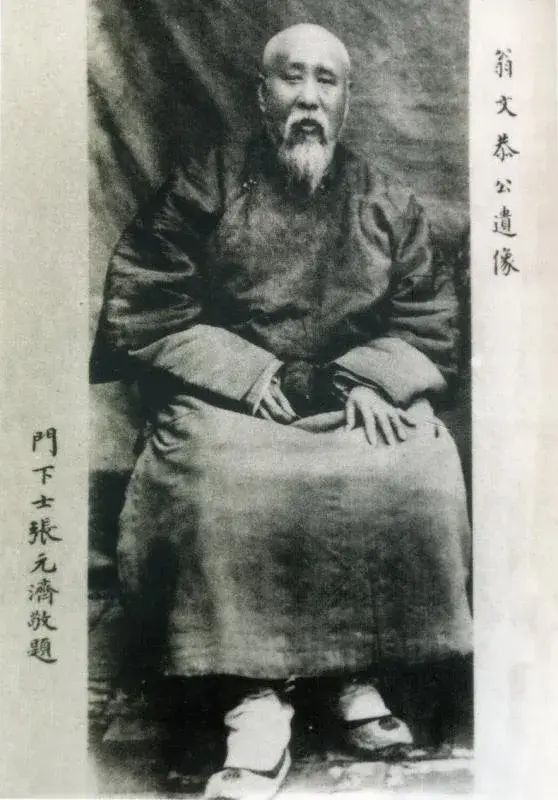
翁同龢
Weng Tonghe (翁同龢, 1830–1904), courtesy name Shuping (叔平), art name Songchan (松禅) and Master of Pinglu (瓶庐居士), posthumous title Wengong (文恭), was an illustrious statesman, master calligrapher, and high-ranking minister who served across four imperial reigns—Daoguang, Xianfeng, Tongzhi, and Guangxu. He was celebrated as Imperial Tutor to Two Emperors and the central civilian leader of the Emperor's Faction during the late Qing…
Weng Tonghe (翁同龢, 1830–1904), courtesy name Shuping (叔平), art name Songchan (松禅) and Master of Pinglu (瓶庐居士), posthumous title Wengong (文恭), was an illustrious statesman, master calligrapher, and high-ranking minister who served across four imperial reigns—Daoguang, Xianfeng, Tongzhi, and Guangxu. He was celebrated as Imperial Tutor to Two Emperors and the central civilian leader of the Emperor's Faction during the late Qing Dynasty. Born into an eminent bureaucratic lineage in Changshu, his father Weng Xincun served as Grand Secretary of the Tiiren Pavilion, his eldest brother Weng Tongshu as Governor of Anhui, and his elder brother Weng Tongjue as Governor-General of Huguang. In 1856, Weng Tonghe achieved the supreme academic distinction of first-rank metropolitan graduate (Zhuangyuan), entering the imperial court as Senior Compiler in the Hanlin Academy. In 1865, Weng Tonghe was appointed Attendant in the Hall of Hongde to instruct the young Emperor Tongzhi, and in 1875, by decree of the Empress Dowager Cixi, he was assigned to the Yuqing Palace as chief tutor to Emperor Guangxu. Over more than two decades in the imperial lecture halls, he became Guangxu's most trusted mentor and fatherly confidant. Concurrently, while acting as Senior Vice Minister of Justice, he displayed fearless judicial integrity by reinvestigating and thoroughly exonerating the victims of the infamous Yang Naiwu and Little Cabbage miscarriage of justice, overturning fabricated confessions and holding over thirty corrupt provincial officials accountable. During the Sino-French War and the First Sino-Japanese War of 1894, Weng Tonghe served as Minister of Revenue and Grand Councilor, steadfastly championing national resistance against foreign encroachment and opposing humiliating concessions. Shaken by China's catastrophic defeat in 1894, he decisively abandoned rigid ancestral precedents and embraced comprehensive political reform. He patronized reformist scholars, recommended Kang Youwei and Liang Qichao to the throne, and drafted the landmark Imperial Edict on Setting the National Policy that launched the Hundred Days' Reform in 1898. However, his efforts to empower Emperor Guangxu alienated Empress Dowager Cixi and the conservative faction. At the onset of the reforms, Cixi forced his dismissal; following the coup, he was stripped of all offices and placed under lifetime surveillance in his hometown. He retired to the Pinglu retreat in Changshu, devoting his final years to calligraphy and scholarship. Rehabilitated in 1909 with the posthumous title Wengong, his powerful calligraphic works and lifelong diaries remain invaluable treasures of modern Chinese history.
Born on May 19 into an illustrious scholar-official clan in Changshu, beginning classical study at age four.
Placed first in the imperial palace examination (Zhuangyuan) and appointed Senior Compiler in the Hanlin Academy.
Appointed Provincial Education Commissioner of Shaanxi, reforming local examination discipline and encouraging honest scholarship.
Appointed Attendant in the Hall of Hongde to instruct the young Emperor Tongzhi in classical Confucian statecraft.
Assigned to the Yuqing Palace to tutor Emperor Guangxu; concurrently reviewed and overturned the Yang Naiwu case.
Promoted to Minister of Works and entered the Grand Council, actively directing military resistance in the Sino-French War.
Appointed Minister of Revenue, enforcing fiscal austerity, managing imperial budgets, and rectifying financial abuses.
Resolutely opposed capitulation during the First Sino-Japanese War, urging decisive military defense to protect sovereignty.
Concurrently appointed Minister of the Zongli Yamen, turning toward radical reform and meeting with reformist leaders.
Drafted the reform edict initiating the Hundred Days' Reform; dismissed by Cixi and later stripped of all ranks for life.
Passed away at his Pinglu retreat at the age of seventy-five, and in 1909 was posthumously restored to his original titles with the rank of Grand Guardian of the Heir Apparent and the posthumous title Wengong.
Weng Tonghe was born on May 19, 1830, in Changshu County, Suzhou Prefecture. The Changshu Weng clan had been renowned for examination success since the Wanli era of the Ming Dynasty. His father Weng Xincun attained the jinshi degree and served as Grand Secretary of the Tiiren Pavilion, instructing the young Daoguang Emperor; his eldest brother Weng Tongshu attained the governorship of Anhui, while his brother Weng Tongjue served as Governor-General of Huguang. The family stood as one of the most distinguished bureaucratic households in nineteenth-century China.
Weng Tonghe was reared in an atmosphere of rigorous classical scholarship. Guided by his mother and elder sister, he began reading the Analects and Mencius at age four, entered formal private academies at six, and composed sophisticated prose essays by eight. During the First Opium War in 1840, when British gunboats entered the Yangtze River estuary, the Weng family fled to the rural outskirts of Weijiabang, an ordeal that imparted to the young scholar a vivid awareness of foreign naval intimidation.
In 1845, fifteen-year-old Weng Tonghe attained first place in the prefectural and licensing examinations in Suzhou, subsequently entering the prestigious Ziyang Academy. In 1852, he passed the Shuntian provincial examination. In the spring of 1856, during the metropolitan and palace examinations of the Bingchen year, Weng Tonghe's balanced policy treatise and elegant calligraphic script captivated Emperor Xianfeng and the chief examiners, winning him the supreme honor of Zhuangyuan (Rank 1, Class 1), whereupon he was commissioned Senior Compiler in the Hanlin Academy.
In 1858, Weng Tonghe was appointed Associate Chief Examiner for the Shaanxi provincial examination alongside Pan Zuoyin, traveling to Xi'an to supervise the triennial contests. Soon after, the court elevated him to Provincial Education Commissioner of Shaanxi. Over his tenure in the northwest, Weng Tonghe enforced uncompromising standards of examination integrity, suppressed aristocratic favoritism, and promoted impoverished scholars of proven talent.
In 1861, Emperor Xianfeng died at the Chengde Mountain Resort, and Emperor Tongzhi ascended the throne in infancy under the co-regency of Empress Dowager Ci'an and Empress Dowager Cixi. In 1862, Weng Tonghe's eldest brother, Weng Tongshu, then Governor of Anhui, was severely impeached by Imperial Commissioner Zeng Guofan for failing to hold Dingyuan and mishandling the rebel general Miao Peilin, with Zeng demanding capital punishment.
Distraught by this existential threat to his clan, Weng Tonghe labored tirelessly in the capital to plead for his brother's life. His father Weng Xincun succumbed to grief and illness in the winter of 1862. Observing strict mourning in Changshu, Weng Tonghe mobilized support from Prince Gong and other senior dignitaries, eventually securing an imperial commutation that spared Weng Tongshu's life and sent him into frontier exile in Xinjiang. This harrowing political crisis deepened Weng Tonghe's understanding of factional court politics.
In 1865, upon concluding his mourning period, Weng Tonghe returned to Beijing and was appointed Right Expositor in the Household Administration. In November, recognized for his impeccable scholarship and ethical stature, he was commanded by imperial decree to attend the Hall of Hongde to instruct the ten-year-old Emperor Tongzhi in the Confucian classics. For nearly a decade, he served as the young sovereign's primary tutor, delivering daily lectures on moral governance until Tongzhi assumed personal rule.
Following the death of Emperor Tongzhi in 1875 and the enthronement of four-year-old Emperor Guangxu, Empress Dowager Cixi issued an edict commanding Weng Tonghe and Xia Tongshan to enter the Yuqing Palace to oversee Guangxu's education. Though he submitted humble memorials requesting to decline the grave responsibility, the throne insisted, and Weng Tonghe commenced twenty-three continuous years of daily tutoring.
Simultaneously, Weng Tonghe made an extraordinary contribution to the imperial judiciary. In the autumn of 1875, while acting as Senior Vice Minister of Justice, he was assigned to review the notorious murder and adultery trial of Yang Naiwu and Little Cabbage. The case had become deeply compromised by torture and pervasive collusion among the local magistrates of Yuhang, the prefects of Hangzhou, and Zhejiang Governor Yang Changjun.
Convinced that systemic corruption had framed innocent subjects, Weng Tonghe meticulously examined the coroner's registries and purchase receipts, identifying glaring factual fabrications. Defying fierce resistance from conservative provincial cliques, he drafted urgent memorials insisting that the prisoners and physical remains be transferred to the capital for an open post-mortem examination. The subsequent disinterment at the Haihui Temple proved conclusively that the victim had died of natural illness rather than poisoning. Yang Naiwu and Little Cabbage were completely exonerated, and over thirty magistrates, prefects, and judicial scribes were cashiered, securing Weng Tonghe nationwide acclaim for judicial integrity.
Between 1875 and 1898, Weng Tonghe served as the emotional anchor and intellectual guide of Emperor Guangxu in the Yuqing Palace. Reared under the intimidating shadow of Empress Dowager Cixi, Guangxu was nervous, insecure, and isolated. Weng Tonghe arrived before dawn every morning through freezing winter gales, comforting the young boy during thunderstorms, guiding his calligraphy, and expounding classical texts.
Rather than confining lessons to dry philology, Weng Tonghe utilized dynastic chronicles to instill in Guangxu a sense of moral mission, highlighting the virtues of frugal administration, compassion for the agrarian populace, and courage in defending imperial territory against external aggression. The young emperor held Weng Tonghe in profound veneration, calling him Teacher and relying upon his counsel in all matters. Around this intimate pedagogical relationship, a coalition of younger Hanlin scholars, censors, and officials gathered, coalescing into the Emperor's Faction with Weng Tonghe as its recognized leader.
In the winter of 1882, Weng Tonghe was promoted to Minister of Works and entered the Grand Council, participating in central military deliberations. When French forces invaded northern Vietnam in late 1883, triggering the Sino-French War, Li Hongzhang and conservative modernizers favored appeasement. Weng Tonghe aligned with the vocal Qingliu (Pure Stream) faction, fiercely advocating national defense and supporting veteran general Feng Zicai's deployment to the Guangxi border, which culminated in the historic victory at Zhennanguan.
In 1886, Weng Tonghe was transferred to head the Ministry of Revenue, presiding over the empire's central treasury. Faced with chronic budgetary deficits, mounting foreign debt payments, and systemic provincial corruption, Weng Tonghe enforced stringent financial oversight, curbing unauthorized expenditures across provincial garrisons. His rigorous auditing policies prioritized fiscal discipline, seeking to restrain unauthorized expenditures and eliminate fabricated provincial accounts.
Faced with mounting border crises, he submitted frequent memorials urging the recovery of agricultural tax arrears, the rectification of maritime customs receipts, and the targeted funding of northeastern frontier defenses. His unbending personal honesty and relentless auditing won him deep respect from the imperial court.
In 1894, Japan exploited domestic rebellions in Korea to dispatch modern expeditionary forces across the peninsula, precipitating the First Sino-Japanese War. While Li Hongzhang sought to avoid open confrontation and preserve his Beiyang Army and Navy through Western diplomatic arbitration, Weng Tonghe recognized that Japanese aggression could only be checked through resolute military defense.
Drafting imperial edicts on behalf of Emperor Guangxu, Weng Tonghe reprimanded Li Hongzhang for relying on foreign mediation and demanded aggressive naval deployments into the Yellow Sea to protect troop transports. He believed that China's vast geographical depth and limitless human resources would enable it to prevail in a prolonged defensive war against an economically fragile adversary.
However, operational paralysis, command failures, and naval destruction at Weihaiwei doomed the war effort. The resulting Treaty of Shimonoseki inflicted staggering territorial losses and indemnity burdens upon the Qing Empire. Weng Tonghe wept bitterly before Emperor Guangxu, passionately protesting the cession of Taiwan and Liaodong, but imperial capitulation was ultimately decreed by Empress Dowager Cixi.
The national catastrophe of 1894 transformed Weng Tonghe's political ideology. He realized that incremental modernization focused purely on armaments was fundamentally bankrupt, and that systemic institutional reform of the state was imperative for national survival. In 1895, he was appointed Minister of the Zongli Yamen, directly managing diplomatic relations.
When provincial examination candidates organized mass petitions against the Shimonoseki Treaty, Weng Tonghe sheltered their leaders. He actively met with radical intellectuals Kang Youwei and Liang Qichao, reading their reform proposals with intense admiration and declaring to Emperor Guangxu that Kang's transformative genius far surpassed his own. Through Weng Tonghe's decisive patronage, the reformist memorials reached the emperor's desk.
In the fourth month of 1898, as imperialist powers accelerated the scramble for concessions, Weng Tonghe directly assisted Emperor Guangxu in formulating and issuing the landmark Imperial Edict on Setting the National Policy on June 11, formally launching the Hundred Days' Reform. Weng Tonghe drafted foundational decrees promoting Western schools, establishing Peking Imperial University, abolishing the eight-legged examination essay, and eliminating sinecure posts.
Alarmed by Guangxu's bid for political autonomy and the rapid ascendance of the Emperor's Faction, Empress Dowager Cixi struck decisively. On June 15, 1898—only four days after the first reform edict—she compelled Guangxu to issue an imperial decree stripping Weng Tonghe of all duties on charges of factional arrogance and banishing him to his ancestral home. The emperor wept uncontrollably as his beloved tutor surrendered his ministerial seals.
Following the bloody coup of September 1898, which saw Guangxu imprisoned at Yingtai and the execution of the Six Gentlemen of the Reform, Cixi issued a harsh edict formally revoking all of Weng Tonghe's past ranks and placing him under indefinite local surveillance as a dangerous conspirator. Returning to Changshu, Weng Tonghe lived in secluded retreat at the Pinglu cottage beneath Mount Yu, enduring constant surveillance with serene dignity.
In retirement, he immersed himself in calligraphy, classical literature, and private diaries. On July 4, 1904, Weng Tonghe passed away at his Pinglu residence at the age of seventy-five. Although Guangxu was forbidden from publicly mourning his master, the accession of Emperor Xuantong in 1909 brought full political rehabilitation. The Qing court restored his rank of Associate Grand Secretary, conferred the title of Grand Guardian of the Heir Apparent, and granted him the posthumous title Wengong.
Weng Tonghe occupied an unparalleled position in the history of Qing imperial education. Serving as preceptor to two successive emperors, Tongzhi and Guangxu, across more than two decades, he dedicated his life to shaping the minds of the monarchs. He abandoned pedantic classical rote memorization, emphasizing practical Confucian statecraft, administrative accountability, and patriotic responsibility.
He created structured curricula that combined dynastic historical texts with international geography and political developments, cultivating in young Guangxu an intense desire for national renewal. The emperor's unwavering commitment to sovereign independence and institutional reform during his adult reign was the direct intellectual product of Weng Tonghe's lifelong instruction.
The exoneration of Yang Naiwu and Little Cabbage in 1875 remains one of the crowning triumphs of judicial integrity in the late Qing Dynasty. Confronted with a fabricated murder confession protected by the entire provincial bureaucracy of Zhejiang, Weng Tonghe demonstrated extraordinary legal acumen and moral fortitude.
He broke through the code of silence dominating bureaucratic circles, conducted rigorous forensic audits of trial transcripts, and compelled the central ministry to perform a transparent public post-mortem examination in Beijing. By saving two innocent lives from execution and cashiering dozens of abusive officials, Weng Tonghe struck a historic blow against arbitrary torture and procedural corruption.
During the geopolitical crisis of 1894, Weng Tonghe stood as the moral conscience of the imperial court. He rejected the defeatist calculations of conservative officials who urged territorial concessions to preserve regional fleets, recognizing that appeasement would invite total imperialist subjugation.
His unyielding advocacy of prolonged territorial resistance and strategic military mobilization embodied the highest ideals of patriotic Confucian statecraft. Though the war was lost due to operational negligence on the battlefield, Weng Tonghe's courageous defense of national dignity cemented his reputation as an uncompromising defender of Chinese sovereignty.
Weng Tonghe's decisive political transformation after 1894 made the Hundred Days' Reform possible. As the premier statesman holding concurrent appointments in the Grand Council, the Ministry of Revenue, and the imperial lecture halls, he served as the indispensable bridge between radical outsider reformers and the imperial throne.
By bringing Kang Youwei and Liang Qichao into direct communication with Emperor Guangxu and personally drafting the foundational reform edicts, Weng Tonghe translated intellectual modernization theories into actual imperial state policy. His readiness to sacrifice his exalted ministerial standing in pursuit of national institutional salvation marks him as one of the great pioneering sponsors of modern Chinese statehood.
In Chinese cultural history, Weng Tonghe was acclaimed as the preeminent calligraphic titan of the late nineteenth century. Rooted in the Tang mastery of Ouyang Xun and Yan Zhenqing, his calligraphy integrated Northern Wei stele inscriptions with Song calligraphic fluidity, creating an imposing style celebrated as the pinnacle of the post-Qianlong era.
Furthermore, his continuous daily diary, kept over forty-six years from 1858 until his death in 1904 and published as The Diary of Lord Weng Wengong, represents an invaluable historical chronicle of the late Qing. Recording imperial audiences, administrative deliberations, military reports, and confidential palace maneuvers, it ranks alongside the diaries of Li Ciming and Wang Kaishi as one of the four greatest primary documentary archives for modern Chinese historical research.
FIGURES ASSOCIATED WITH THIS DYNASTY