Birth in Qiao
Born in Qiao County, Pei Commandery, the second son of Cao Cao and Lady Bian, displaying extraordinary physical power in youth.
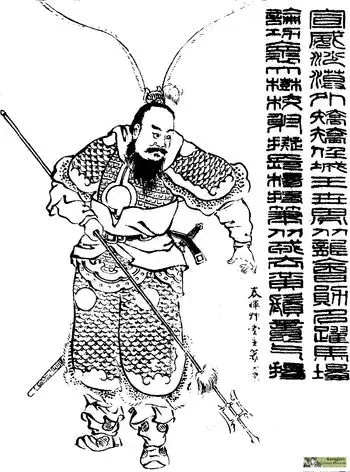
曹彰
Cao Zhang (曹彰, 189 AD – August 1, 223 AD), courtesy name Ziwen, was a native of Qiao County in Pei Commandery (present-day Qiaocheng District, Bozhou, Anhui). He was a distinguished imperial general and strategist of the Cao Wei dynasty during the Three Kingdoms Period, the second son of Cao Cao (Emperor Wu of Wei), uterine younger brother of Cao Pi (Emperor Wen of Wei), and uterine elder brother of Cao Zhi (Prince of…
Cao Zhang (曹彰, 189 AD – August 1, 223 AD), courtesy name Ziwen, was a native of Qiao County in Pei Commandery (present-day Qiaocheng District, Bozhou, Anhui). He was a distinguished imperial general and strategist of the Cao Wei dynasty during the Three Kingdoms Period, the second son of Cao Cao (Emperor Wu of Wei), uterine younger brother of Cao Pi (Emperor Wen of Wei), and uterine elder brother of Cao Zhi (Prince of Chensi), born to Empress Dowager Bian. Endowed with a distinctive yellowish beard, astonishing physical strength, and peerless martial valor, he was affectionately hailed by his father as the "Yellow-Bearded Son" (Huangxuer). From early youth, Cao Zhang displayed fearless martial zeal, excelling in archery, horsemanship, and bare-handed combat against predatory beasts, aspiring to emulate the desert exploits of Han dynastic champions Wei Qing and Huo Qubing. In 218 AD, when the Wuhuan chieftain Wuchen Di staged a massive rebellion in northern Dai, Cao Cao appointed Cao Zhang as Commander of the North and Acting General of Agile Cavalry to lead an expedition into the frontier. Adopting the tactical defenses devised by Tian Yu, Cao Zhang used a thousand infantrymen to withstand several thousand charging nomadic cavalry, subsequently spearheading an aggressive pursuit across more than two hundred leagues to the Sanggan River. Slaying and capturing thousands of insurgents, his crushing triumph compelled the formidable Xianbei grand chieftain Kebineng to submit without fighting, bringing lasting peace to the northern frontier. Cao Cao stroked his son's beard in delight, declaring that "the Yellow-Bearded Son is truly marvelous." During the climactic Hanzhong campaign against Liu Bei, Cao Cao summoned Cao Zhang across the western mountains, subsequently commissioning him as Acting General of the Elite Cavalry to garrison the strategic capital of Chang'an. Following Cao Pi's imperial ascension, Cao Zhang was advanced to Duke of Yanling and formally invested as Prince of Rencheng in 222 AD. In the summer of 223 AD, while visiting Luoyang for imperial audiences, Cao Zhang was suddenly stricken with an acute illness and passed away at age thirty-five, receiving the posthumous title Prince Wei and imperial funeral rites. Cao Zhang's battlefield courage and military command made him the most formidable tactical warrior among the imperial princes of Cao Wei.
Born in Qiao County, Pei Commandery, the second son of Cao Cao and Lady Bian, displaying extraordinary physical power in youth.
Appointed Commander of the North and Acting General of Agile Cavalry, routing the Wuhuan at the Sanggan River and inducing Kebineng to surrender.
Marched with urgent speed to reinforce Cao Cao in Hanzhong; subsequently commissioned as Acting General of the Elite Cavalry in Chang'an.
Following Cao Cao's death and Cao Pi's accession, received an additional five thousand households, expanding his appanage to ten thousand.
Promoted to Duke of Yanling as part of the formal reorganization of the imperial clan aristocracy.
Officially created Prince of Rencheng under the imperial statutory reform of princely feudal territories.
Attended the capital court in Luoyang; passed away suddenly of severe acute illness on August 1 at age thirty-five, honored as Prince Wei.
From early childhood, Cao Zhang exhibited an innate martial passion that set him apart from his literary brothers. Possessing tremendous natural arm strength, he attained consummate skill in mounted archery and chariot control, demonstrating the rare audacity to engage ferocious wild beasts in unarmed combat without the slightest sign of hesitation. Throughout his youth, he frequently accompanied his father Cao Cao on military expeditions against rival regional warlords across northern China, displaying an eager, exhilarated demeanor whenever witnessing the shock of battlefield clashes.
Aware of Cao Zhang's martial ferocity, Cao Cao sought to steer him toward statecraft and classical literature, admonishing him on one occasion: "You refuse to cultivate the books of ancient sages, indulging only in riding and swordplay. These martial pursuits suffice only to counter a single adversary; what true worth do they hold for a prince?" Cao Cao ordered senior attendants to instruct him in the Classic of Poetry and the Classic of Documents. Unmoved, Cao Zhang confided to his companions: "A real man born into times of turmoil should emulate great commanders like Wei Qing and Huo Qubing, leading one hundred thousand armored horsemen across the vast northern wastes to drive out barbarian hordes and carve his name upon the frontier rocks! How could one be content with the narrow existence of an Imperial Academy pedant?"
On another occasion, Cao Cao convened his sons to examine their personal aspirations, instructing each to articulate their core desires. When it was Cao Zhang's turn, he replied without hesitation: "Your son desires only to be a general!" Cao Cao asked: "And what does it mean to be a general?" Cao Zhang replied with solemn conviction: "To don heavy armor, wield razor-sharp steel, disregard personal safety in the face of mortal peril, and lead from the front of the ranks; rewarding battlefield merit without hesitation, and punishing infractions strictly according to the martial code!" Cao Cao broke into hearty laughter, deeply impressed by his son's martial clarity.
In 216 AD, upon Cao Cao's elevation as King of Wei, Cao Zhang was formally enfeoffed as Marquis of Yanling. In the fourth month of 218 AD, the northern Wuhuan tribes under Wuchen Di (Nengchen Di) rose in widespread armed revolt across the Dai region, uniting with local insurgent clans to raid commanderies along the northern marches of Youzhou and Jizhou. With the northern frontier in acute danger, Cao Cao commissioned Cao Zhang as Commander of the North and conferred upon him the powers of Acting General of Agile Cavalry, charging him with the supreme operational command of the northern counteroffensive. Before his departure, Cao Cao sternly admonished him: "Within our household, we are father and son; but once military commands are issued, we are sovereign and subject. Every maneuver and decision must strictly adhere to the royal statutes and military laws. Take this as your solemn guide!"
Marching north with relentless speed, Cao Zhang advanced into Zhuo Commandery. At that juncture, the main imperial expeditionary army had not yet completed its mobilization; Cao Zhang possessed merely one thousand foot soldiers and several hundred cavalrymen, while several thousand elite Wuhuan shock horsemen swept toward his vanguard. Confronting severe numerical disparity, Cao Zhang embraced the defensive recommendations of his staff officer Tian Yu, arranging his infantry into a compact, interlocking circular perimeter to hold the terrain bottlenecks with long pikes and heavy repeating crossbows. The charging Wuhuan cavalry were repeatedly shattered against the shield wall, their momentum breaking into headlong retreat.
Seizing the tactical initiative, Cao Zhang mounted his charger and led his small cavalry detachment in a ferocious counterattack, plunging directly into the retreating enemy formations. Drawing his composite bow with blinding speed, Cao Zhang felled enemy horsemen with lethal accuracy, leaving a trail of fallen warriors behind his charge. Throughout half a day of desperate close-quarters fighting, Cao Zhang sustained several arrow strikes directly upon his iron cuirass, yet his martial fury only intensified. The imperial detachment pursued the fleeing enemy across more than two hundred leagues, driving them back to the banks of the Sanggan River.
Observing that the troops were exhausted from non-stop combat, the army adjutant and senior captains urged a halt, citing Cao Cao's strict standing orders prohibiting operations beyond the borders of Dai Commandery. Cao Zhang drew his sword and roared: "An expeditionary army marches solely to achieve total victory! Why should we be paralyzed by rigid parchment orders? The barbarian host is broken and fleeing; pressing the pursuit ensures their total annihilation. To release the enemy out of slavish adherence to obsolete orders is the mark of an incompetent commander!" He mounted his stallion, issuing a thunderous command to the ranks: "Any soldier who lags behind shall be summarily executed!" Driving his troops without pause day and night, Cao Zhang caught the main Wuhuan host in the open northern wastes, launching an irresistible shock charge that slaughtered and captured several thousand enemy fighters, breaking the back of the rebellion. Cao Zhang distributed the vast captured herds and spoils lavishly among his men, elevating morale to supreme heights.
Stationed near the frontier, Kebineng, the supreme grand chieftain of the Xianbei confederacy, watched the conflict with tens of thousands of horsemen, intending to exploit the victor's exhaustion. Observing Cao Zhang charging with reckless courage and smashing the enemy formations like a whirlwind, Kebineng was overwhelmed by terror and reverence. He immediately dispatched royal emissaries to Cao Zhang's field pavilion, offering hostages and formal tribute. With this diplomatic triumph, the northern marches of the empire were entirely pacified.
Following the conclusion of the northern expedition, Cao Cao was encamped at Chang'an directing western operations, dispatching express riders to summon Cao Zhang to his field headquarters. Journeying south from Dai, Cao Zhang passed through Ye, where Crown Prince Cao Pi offered crucial counsel: "You have just accomplished miraculous military triumphs. When you present yourself to our royal father in the west, take care never to indulge in boastful arrogance; let all your replies reflect sincere humility." Arriving in Chang'an, Cao Zhang strictly adhered to his brother's advice, attributing the entire triumph to the strategic planning of his father and the selfless valor of his subordinate officers. Cao Cao was delighted beyond measure, affectionately reaching out to caress Cao Zhang's yellowish beard and exclaiming with fatherly pride: "The Yellow-Bearded Son is truly marvelous!"
In the ninth month of that year, Cao Cao was locked in a brutal war of attrition with Liu Bei in the rugged mountains of Hanzhong. Entrenched atop commanding peaks, Liu Bei repeatedly dispatched his adopted son Liu Feng down the slopes to issue mocking challenges. Infuriated, Cao Cao shouted across the gorge: "You shoemaker's apprentice, you dare send your adopted boy to challenge me! Just wait until I summon my own Yellow-Bearded Son, and we shall see who the true champion is!" Cao Cao immediately dispatched urgent orders summoning Cao Zhang to the front. Cao Zhang drove his cavalry night and day to reinforce the army, but by the time he reached Chang'an, Cao Cao had already executed a strategic withdrawal from Hanzhong. Upon returning east to Luoyang, Cao Cao appointed Cao Zhang as Acting General of the Elite Cavalry, entrusting him with the supreme garrison defense of Chang'an to secure the western frontier.
In early 220 AD, Cao Cao fell terminally ill in Luoyang and dispatched swift couriers to summon Cao Zhang from Chang'an. Before Cao Zhang could reach the capital, however, Cao Cao had passed away. Crown Prince Cao Pi succeeded to the royal throne in Ye and subsequently received the abdication of Emperor Xian, founding the Cao Wei dynasty. To prevent dynastic instability, Cao Pi implemented strict containment policies regarding imperial princes, dispatching them to their respective domains. However, honoring his brother's singular northern achievements, Cao Pi issued an imperial edict adding five thousand households to his appanage, elevating his total estate to ten thousand households.
In 221 AD, under the revised aristocratic titles of the Wei court, Cao Zhang was elevated from Marquis to Duke of Yanling. In 222 AD, the court enacted sweeping institutional reforms regarding imperial princely titles, and Cao Zhang was formally invested as Prince of Rencheng. In his princely realm, Cao Zhang lived in disciplined restraint, scrupulously observing all imperial edicts.
In the fifth month of 223 AD, the imperial princes assembled in Luoyang to pay formal homage to Emperor Wen. During his stay in the capital, Cao Zhang was stricken with a violent, acute illness. On August 1 (the seventeenth day of the sixth month), he passed away suddenly in his capital estate at the age of thirty-five. Overcome with grief, Emperor Wen conferred upon him the posthumous title Prince Wei and granted exceptional funerary honors, including imperial dragon banners and an escort of one hundred elite tiger-tally warriors, mirroring the revered rites accorded to Prince Cang of Dongping in the Eastern Han. His son Cao Kai inherited his noble title.
Cao Zhang represented the pinnacle of frontline martial ferocity among the commanders of the Three Kingdoms era. Combining natural physical power with consummate mounted archery, he led shock assaults from the very front of his lines.
His performance in the Battle of Northern Dai demonstrated the highest ideals of classical generalship. Despite suffering multiple arrow wounds to his cuirass, his relentless aggression broke enemy formations and electrified his troops, proving that tactical boldness and absolute personal courage could decisively overcome overwhelming numerical odds.
Cao Zhang's northern campaign in 218 AD constitutes a masterclass in strategic pursuit and deep penetration warfare. Confronted with rigid standing orders that forbade advancing past Dai Commandery, Cao Zhang displayed the supreme audacity of a true military genius, recognizing that allowing the defeated insurgents to scatter into the northern wastes would perpetuate endless border raiding.
By driving his troops across more than two hundred leagues to the Sanggan River in a relentless day-and-night pursuit, he annihilated the Wuhuan insurgent host and broke the martial will of the northern tribes. His overwhelming victory permanently eliminated northern border threats for the Cao Wei dynasty, compelling the supreme Xianbei chieftain Kebineng to submit without striking a blow.
As Cao Cao's most militarily capable son, Cao Zhang served as an indispensable pillar of the emerging Cao Wei state. Stationed in Chang'an, his military presence stabilized the vulnerable western marches and discouraged incursions from Shu and Wu.
Crucially, despite his towering martial repute and vast military following, Cao Zhang conducted himself with scrupulous filial deference and political prudence. By deflecting personal accolades onto his officers and adhering to royal authority, he embodied the noble archetype of an unpretentious imperial warrior-prince whose loyalty was dedicated entirely to the preservation of his house.
FIGURES ASSOCIATED WITH THIS DYNASTY